
Zebra shark
Striped like a zebra when it hatches and spotted like a leopard when it grows up — the calm, half-tail reef shark that half the world calls by the wrong animal.
Vital statistics
Egg-laying. The cases are large — about 17 x 8 x 5 cm — dark brown to purplish black with lengthwise striations, and are anchored to the reef by tufts of fine fibres. Females lay in batches across a season lasting months: 18-54 eggs a year in aquaria (Toledo et al. 2022) or up to 40-80 (Florida Museum). Pups hatch at 20-26 cm (FishBase) to 36 cm (Florida Museum), already striped and already ridged.
The short version
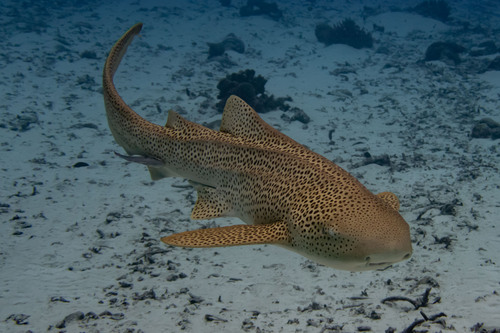
The zebra shark is a slow, spotted, bottom-living carpet shark of the tropical Indo-Pacific and the only living member of its family. The largest reliably measured animals are about 2.46 m long, and roughly half of that is tail — the caudal fin alone makes up 50 to 54% of total length. It lives from the Red Sea and East Africa east to New Caledonia and Fiji, north to southern Japan and south to New South Wales, on sand and rubble beside coral reefs, usually in 5 to 30 m of water.
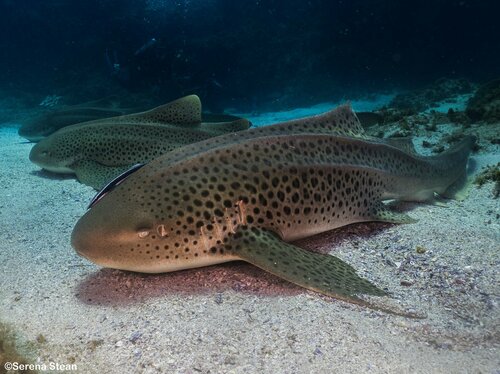
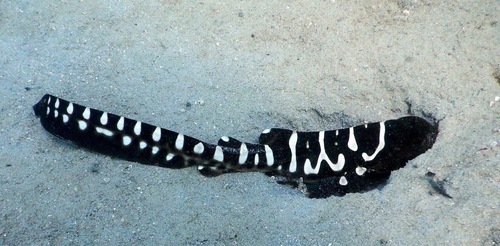
Its name is a puzzle the shark solves as it grows. A newly hatched zebra shark is dark brown with pale bands — striped like a zebra. Somewhere between about 56 cm and 1.4 m long those bands break apart into a scatter of dark dots on a pale background, and the adult looks like a leopard. Most of the world names the species after the babies and calls it the zebra shark; Australia, the aquarium world and the conservation projects working on it name it after the adults and call it the leopard shark — which collides with the Californian leopard shark, Triakis semifasciata, an unrelated houndshark that has its own page here. The scientific name moved too: since a 2019 review it is Stegostoma tigrinum, not Stegostoma fasciatum.
It is harmless to people — one unprovoked incident on file, no injury — and Endangered, assessed again in 2023, because it is shallow, slow and easy to catch. In Raja Ampat, Indonesia, only about 20 are thought to remain. Since 2022 the StAR Project has been hatching eggs laid by aquarium sharks in a nursery there and releasing the pups onto the reef: the first time sharks bred in aquaria have been moved between countries to rebuild a wild population, and more than 60 young sharks in so far.
Where it lives
The zebra shark belongs to the warm Indo-West Pacific and nowhere else. FishBase draws the outline as the Red Sea and East Africa east to New Caledonia and Fiji, north to southern Japan and south to New South Wales, with records from the Persian Gulf and, recently, Tonga — roughly 41°N to 30°S. There is no Atlantic population and never has been. Inside that band it is a shark of the shallow coastal margin rather than the open ocean: sand flats, rubble and the edges of coral reefs, the places where a flat-bottomed animal can lie down.
Depth is where the references disagree politely. FishBase gives 0-90 m; Compagno’s older 0-62 m is the figure most other profiles still carry. Both agree on the part that matters to anyone in the water: almost every zebra shark ever seen was between 5 and 30 m down. They turn up in brackish water as well as fully marine, and a freshwater record from the Philippines has been repeated for decades without ever being confirmed.
A range that wide is not one population. Genetic work published in 2009 divided the species into two groups — an Indian and Southeast Asian one, and an eastern Indonesian and Oceanian one — a split that matches the way these sharks behave, returning to the same reefs year after year rather than crossing deep water. It also explains the most alarming thing in the species’ file. A local population can be fished out and simply not refill from next door. In Raja Ampat, Indonesia, roughly 20 adults are thought to remain across about six million hectares of reef — too few to replace themselves, which is what biologists mean when they call a species functionally extinct in a place where it still technically exists.


- Point Lookout, North Stradbroke Island, Australia — A cluster of rocky outcrops called The Group, about 500 m off the headland, collects zebra sharks every austral summer. It is the best-counted aggregation of this species anywhere: 327 individuals recognised from their spots between 2003 and 2006, and a population estimate of 458 sharks.
- Raja Ampat, West Papua, Indonesia — Southeast Asia’s first shark and ray sanctuary, nine marine protected areas — and almost no zebra sharks left, after the fishing of the 1990s and 2000s. Since 2022 it has been the site of the StAR Project, where eggs from aquarium sharks hatch in a nursery on Kri Island and the pups are released into the reef.
- Phi Phi Islands & the Similans, Andaman Sea, Thailand — Thailand’s dive fleet has been photographing the same sharks since 2004, and those photographs became a monitoring programme: 278 individual sharks identified from more than 1,300 pictures. In September 2025 Thailand released its first three hatchery-raised sharks off Maiton, near Phuket.
- The Red Sea, the Persian Gulf and East Africa — The western end of the range, and the half of the species that the Endangered listing is really about. This is the Indian and Southeast Asian subpopulation, living along coasts where inshore gillnets and trawls work the exact depths a zebra shark rests in.
Where it goes
Zebra sharks are not long-distance travellers, and the honest headline is that nobody has tracked one across an ocean. What they do instead is gather, on a timetable. Off Point Lookout on North Stradbroke Island in southeast Queensland, a set of rocky outcrops about 500 m from the beach fills with zebra sharks every austral summer. Photo-identification there between 2003 and 2006 recognised 327 individuals from 570 photographs and put the aggregation at 458 sharks, with a confidence range of 298 to 618. Every animal in it was a large adult over 1.8 m, and females outnumbered males 3.8 to one. A typical dive found eight sharks; the best day produced 34.
The spots make all of that possible, because they are fingerprints. Numbered dart tags on 15 sharks confirmed that an individual’s pattern stays recognisable for at least 810 days, and 27% of the sharks photographed turned up again in a later summer. What the gathering is for is still being worked out; the current idea is that it is a mating site and that females then move north along the Queensland coast to lay their eggs. Researchers who need a blood sample or an acoustic tag use tonic immobility — the trance a shark falls into when it is turned upside down — which for this species has been written up as a capture method in its own right.
Share of verified zebra shark records by month (GBIF, all years). Darker rose means a larger share of sightings fall in that month. This reflects when people record them, which mixes real seasonality with when divers and boats are out.
Southeast Queensland, Australia: The Point Lookout aggregation is an austral summer event, thinning through autumn as the warm East Australian Current weakens and gone over winter. This is the seasonal edge of the range, not the tropical core — on a reef in Raja Ampat or the Maldives the species is present all year.
What it eats
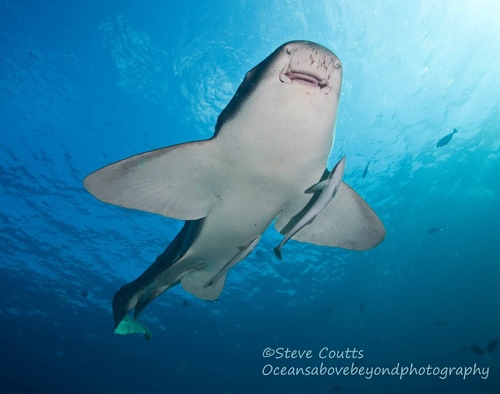
At midday a zebra shark is doing nothing whatsoever: propped on the sand facing the current, pumping water over its gills through the two large spiracles behind its eyes, motionless for hours. That is the animal almost every photograph shows, and it is only half the story. The hunting happens after dark. The mouth is small and set well forward under the snout with two short barbels in front of it, and behind the mouth sits a heavily muscled throat that works like a bellows: the shark puts its face against a hole and pulls, and whatever is inside comes out with the water. Shelled molluscs are the staple, alongside crabs, shrimps, small bony fishes and the occasional sea snake.
The body is built for that job and very little else. Five ridges run the length of a stiff, cylindrical body, the pectoral fins are broad enough to prop it up on the bottom, and the tail — nearly half the whole shark — is low and flexible enough to steer the front end into a gap in the reef and keep pushing. FishBase puts the species at trophic level 3.1, roughly the same as a large reef fish. That is a useful corrective: a two-metre shark that eats snails is not a predator anything on the reef has to worry about.
Is it dangerous?
Zebra sharks are not dangerous to people, and the record is about as clean as a record gets. The Florida Museum’s species profile cites a single unprovoked incident in the International Shark Attack File, and it caused no injury; the file’s species table, which attributes 949 confirmed unprovoked cases from 1580 to the present to particular sharks, does not list the zebra shark at all. What does happen is provoked bites, for the usual reason — divers grab the tail or sit on a resting shark for a photograph, and a shark that has had enough turns around. The rule is the same one that works everywhere: look, don’t touch, and let it be the animal asleep on the sand that you swim past.
Turn the question around and the numbers stop being reassuring. FishBase scores the species at 77 out of 100 for fishing vulnerability — very high — because everything about it is convenient to a fishery: shallow, slow, predictable, and inclined to lie still. It is taken for meat, for fins and for liver oil, mostly by inshore gillnets and trawls across the Indian Ocean and Southeast Asia, and the populations there have fallen far enough for a second Endangered listing in 2023. Raja Ampat shows what the end of that looks like: a reef system the size of a small country with about 20 adult zebra sharks left in it. The thing worth knowing is that this is also the species where somebody decided to do something about it, and it appears to be working.
Zebra shark facts
- The colour change is the whole naming problem. Juveniles up to about 56 cm are dark with pale bands, transitional sharks between roughly 56 cm and 1.4 m wear a breaking-up mixture of bands and spots, and adults are pale with dark dots. Early naturalists described the life stages as different species. — Dahl et al. 2019, Copeia / Florida Museum species profile
- The tail is nearly half the shark. The caudal fin measures 49.9-54.2% of total length, and its relative length shrinks as the animal grows — so a hatchling is proportionally even more tail than an adult. — FishBase morphology / Dahl et al. 2019, Copeia
- The scientific name changed recently. A 2019 review concluded that Forster’s 1781 name Stegostoma tigrinum has priority, making the familiar Stegostoma fasciatum (Hermann, 1783) a junior synonym. The same study described a previously unknown "sandy" colour morph and confirmed with mitochondrial DNA that it is all still one species. — Dahl et al. 2019, Copeia / WoRMS
- Zebra sharks can reproduce without a male. A female at the Burj Al Arab aquarium produced 15 pups over four consecutive years with no male present, and a female at Reef HQ in Townsville switched from sexual reproduction to parthenogenesis after years apart from males — the first such switch demonstrated in any shark. — Robinson et al. 2011, J. Fish Biology / Dudgeon et al. 2017, Scientific Reports
- It is not a free lunch. Following 10 parthenogenetic pups and 2 sexually produced ones at the same aquarium, the parthenotes hatched smaller, grew more slowly, swam oddly and had a median lifespan of 1.05 years; none reached sexual maturity, while a sexually produced sibling did. — Adams et al. 2023, Endangered Species Research
- The summer aggregation off North Stradbroke Island, Australia was counted by photographing spot patterns: 327 individuals from 570 photographs across 2003-2006, an estimated 458 sharks, a female bias of 3.8 to 1, and dart tags proving a pattern stays recognisable for at least 810 days. — Dudgeon, Noad & Lanyon 2008, Marine Ecology Progress Series
- The StAR Project — Stegostoma tigrinum Augmentation and Recovery — is the first attempt to rebuild a wild shark population from aquarium-laid eggs. Eggs from aquariums in Australia and the United States hatch at a nursery on Kri Island, Raja Ampat; the first three hatched in September 2022 and were released in early 2023, and more than 60 juveniles have now gone into the reef. — Conservation International, December 2022 / ReShark StAR Project
- The egg cases are big, dark and hairy: roughly 17 x 8 x 5 cm, purplish black with lengthwise striations, anchored to the reef by tufts of fine fibres. In aquaria a female lays 18-54 of them a year across a season lasting months, and the pups hatch at 20-26 cm already wearing their stripes. — FishBase / Toledo et al. 2022, J. Zoo & Aquarium Research
Photos
Seen lately
PierMonkey’s live map carries community shark sightings from iNaturalist, refreshed every three hours. Open the map to see where zebra sharks have turned up recently.
How big is that, really?
Maximum reliably recorded length. Rose marks the large or potentially dangerous species the map flags as notable.
Help protect it
- ReShark — the StAR ProjectThe consortium running the zebra shark rewilding in Indonesia and Thailand, with twelve approved breeding aquariums behind it. The page tracks releases as they happen and takes donations — and if you are booking a Raja Ampat or Phuket dive trip, it tells you which operators and resorts are part of the programme.
- Spot the Leopard Shark — ThailandA shark’s spots never change, so a holiday photograph is data. Upload yours from anywhere in Thai waters and it goes into a database that has already identified 278 individual sharks from more than 1,300 pictures since 2004. This is the single most useful thing an ordinary diver can do for this species.
- Raja Ampat Research & Conservation Centre — StAR nurseryThe people who actually run the egg tanks, pup tanks and sea pen on Kri Island. Worth reading before you form an opinion on aquariums: this is where the case for keeping breeding populations in them is being tested, one hatchling at a time, and the centre takes both donations and volunteers.
Report what you see
Photograph a shark, upload it, and once the community confirms the ID it becomes a research-grade record — which is where every sighting on our map comes from. Yours would appear here within three hours.
How to submit an observation →Organisations working on sharks like this one
- The Shark Trustgood for kidsReport eggcases and sightings, join campaigns, download free ID guides.
- Great Eggcase Huntgood for kidsWalk a beach, find a mermaid’s purse, log it. Over 630,000 eggcases recorded since 2003 — the easiest real science a family can do.
- Sharks4Kidsgood for kidsFree classroom lessons, virtual field trips and activity packs for teachers and parents.
- Save Our Seas FoundationFunds shark research and education worldwide; publishes what each project found.
- Shark StewardsCampaigns to end the shark fin trade and establish shark sanctuaries.
- OceanaPolicy campaigning on fisheries management and bycatch — the thing that actually kills sharks.
- IUCN Shark Specialist GroupThe scientists behind the Red List assessments. For older readers who want the primary source.
Conservation status: Endangered (IUCN Red List, assessed 2023). Endangered under criterion A2bcd, assessment dated 22 June 2023 and carried in Red List version 2025-2. It was already Endangered in the previous assessment, published in 2019, so this is a status that has now stood through two rounds. The listing is driven by the Indian and Southeast Asian end of the range, where inshore gillnet and trawl fisheries work exactly the depths the species lives in. Australia is the exception and says so formally: its national shark report card rates the Australian stock sustainable, and the Florida Museum notes the species is treated as Least Concern there. One shark, two very different futures depending on which reef it hatched on. Read the assessment →
Common questions
Why is the zebra shark also called the leopard shark?▾
Why did the zebra shark’s scientific name change to Stegostoma tigrinum?▾
Is it safe to dive with a zebra shark lying on the sand?▾
Why is the zebra shark’s tail so long?▾
What is the StAR Project, and is it actually working?▾
If aquariums breed zebra sharks so easily, why is the species Endangered?▾
Keep exploring
- Snapper Rocks, Gold Coast — live surf conditions
- Noosa, Queensland — live surf conditions
- Uluwatu, Bali — live surf conditions
- Pasta Point, Maldives — live surf conditions
- All 40 species →
Sightings © iNaturalist contributors (research-grade observations). Occurrence maps © GBIF.org contributors (CC BY). Community science, not a beach-safety service. Last updated 2026-09-20.
See where sharks are turning up — on the live map
The map and live conditions are open to everyone. A free account unlocks full 16-day forecasts and custom swell alerts.