
Spotted wobbegong
A flat, mottled, fringe-mouthed Australian shark that spends its whole life pretending to be the reef — and occasionally gets trodden on for it.
Vital statistics
Live-bearing without a placenta; the pups run on yolk. Females breed once every three years — follicles take two years to ripen, ovulation is in November, gestation lasts 10–11 months and the litter of about 21 (up to 37) is born in September–October at around 23 cm.
The short version
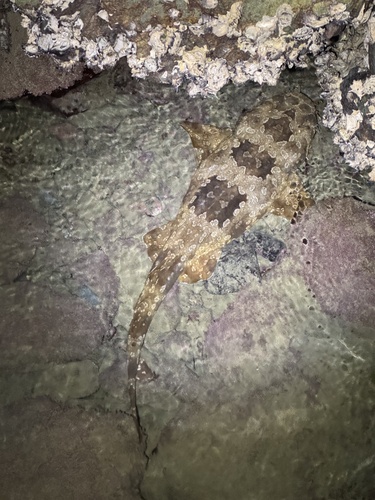
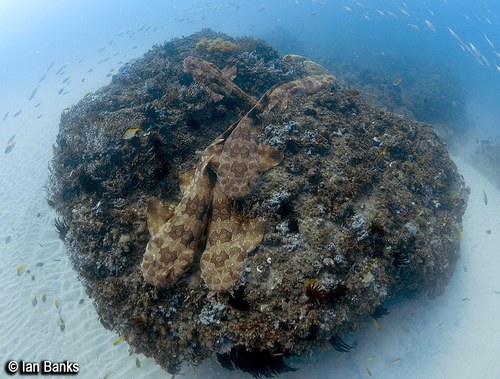
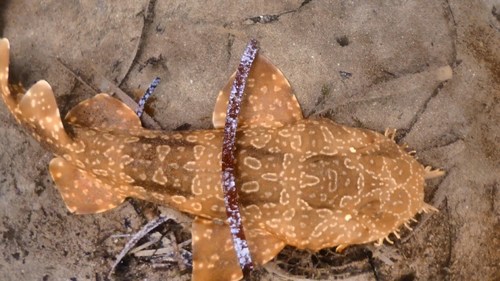
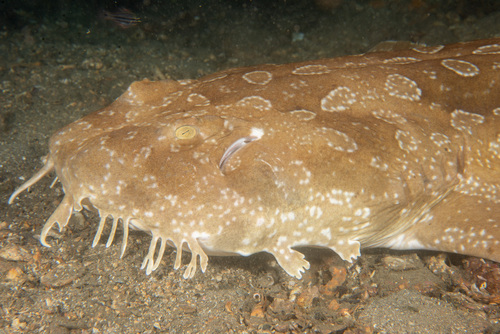
The spotted wobbegong is a flattened, bottom-living carpet shark found only around Australia, from North West Cape in Western Australia round the south of the continent and up to southern Queensland. It is built to disappear: a sandy-gold to greenish-brown body carrying dark saddles and dozens of small white O-shaped rings, plus a fringe of eight to ten fleshy flaps — dermal lobes — around its mouth and the sides of its head. Most adults are 1.5–1.8 m long; the maximum in the reference books is 3.2 m.
It hunts at night by ambush and spends the day lying still on reef or sand. Bony fish make up roughly 95% of its diet, with octopus, crabs, lobsters and the occasional small shark behind them. It does not chase: it waits, throws its jaws forward and inhales, holding the prey on long fang-like teeth. It matures at about 1.2 m, lives an estimated 22 years, and breeds only once every three years, giving birth to about 21 pups in September and October after a 10–11 month pregnancy.
It is not endangered — the IUCN assessed it as Least Concern in 2015 — and it is not dangerous to swim near, but it is one of the few sharks that will bite a person who stands on it or grabs it. Of 1,204 Australian shark incidents recorded since 1791, 200 involve wobbegongs, none were fatal, half were provoked, and a foot is the commonest injury. The rule is simple: look where you put your feet, and do not touch it.
Where it lives
The spotted wobbegong is an Australian animal and almost nothing else. Australia’s national shark report card puts its range from North West Cape in Western Australia, south and east through South Australia, Victoria and New South Wales, and up the east coast to about the Swain Reefs in Queensland. Tasmanian sightings are treated as unreliable. Old records from Japan and the South China Sea, which for decades made this look like a western Pacific species, are now read as misidentifications of other wobbegongs. If you are looking at one in the wild, you are in Australia.
Within that range it is a shelf animal that stays shallow. Records run from the intertidal zone down to 218 m, but the great majority of what anyone actually sees is in the top few metres of rocky reef, coral reef, seagrass, bay and estuary, and under piers and jetties. Juveniles turn up in estuaries and seagrass beds. It will lie in water barely deep enough to cover it, and the FAO’s shark catalogue records one hauling itself across the ridge between two tide pools with its back out in the air.
Read any wobbegong distribution map with one eye open, because the genus was quietly rearranged underneath it. Three more Western Australian wobbegongs were described between 2006 and 2008, and the dwarf spotted wobbegong in particular had been sitting inside this species’ records for years — the long-quoted figure that spotted wobbegongs mature at 60 cm turned out to be that other shark. The real figure is about 120 cm. The sighting data has its own quirk, too: nearly nine in ten of the species’ occurrence records worldwide are not sightings at all but acoustic detections logged by receivers in one small Sydney bay between 2009 and 2011, from a few dozen tagged sharks. Photographed, verified records of this shark number only in the low thousands.


- Cabbage Tree Bay Aquatic Reserve, Manly (Sydney) — The best-studied wobbegong site anywhere: a no-take reserve where 27 spotted wobbegongs were followed by acoustic receivers, and where snorkellers meet them in a few metres of water. Around 580 verified photo records sit within 10 km.
- Julian Rocks, Byron Bay, New South Wales — Northern New South Wales is the breeding end of the range — pregnant females are caught here and essentially never south of Sydney. The ledges at Julian Rocks put wobbegongs within a fin-kick of divers.
- Jervis Bay & the New South Wales south coast — Cool, clear rocky reef with deep gutters, and a steady trickle of verified records. South of Sydney you meet adults, but not pregnant ones.
- Port Phillip Heads, Victoria — The southern edge of where the species is regularly recorded, on the sponge gardens and reef inside the heads.
- Moreton Bay & the southern Queensland reefs — The warm northern end of the range, running out somewhere around the Swain Reefs. Wobbegongs here share the ledges with far more tropical company.
Where it goes
This is not a shark that goes anywhere much, and that is the single most important thing to know about protecting it. Spotted wobbegongs are site-attached: they use the same reefs, often the same ledges, and a fishery that finds a good patch can empty it without ever moving the boat. Genetics backs up the lack of long-range drama — a study of the east coast found no population split between New South Wales and Queensland, so the animals are all one stock even though individuals stay home.
The detail comes from Cabbage Tree Bay in Sydney, where receivers tracked 27 wobbegongs over several years. Attendance had a clear seasonal shape, peaking in summer, and some individuals came back in later summers — but the median residency index was only 0.13, meaning a tagged shark was detected in the bay on roughly one day in eight. They are frequent visitors rather than permanent residents.
The same study doubled as an experiment nobody had run before: 15 aquarium-bred wobbegongs were released into the bay to see whether captive breeding could restock a depleted reef. The adults settled and stayed up to three years. Every released juvenile was gone within a year, and three were picked up 12 km away. Age at release turned out to decide the outcome — a useful, slightly deflating result for anyone who assumes you can simply put bred sharks back.
Share of verified spotted wobbegong records by month (GBIF, all years). Darker rose means a larger share of sightings fall in that month. This reflects when people record them, which mixes real seasonality with when divers and boats are out.
Cabbage Tree Bay & the Sydney coast: Acoustic receivers at Cabbage Tree Bay logged the highest probability of a tagged wobbegong being present in the summer months. This curve follows that pattern rather than a count of sightings — wobbegongs are on Sydney reefs all year, they are simply detected far less in winter.
What it eats
For a shark that looks like a doormat, it eats near the top of the food chain. The one quantitative study of what New South Wales wobbegongs have been eating found bony fish made up about 95% of the diet of spotted wobbegongs by index of relative importance — snapper, slimy mackerel, pike eel and others — with octopus at roughly 3.5% and small sharks and rays under 1%. Crabs and lobsters go down too, which is why wobbegongs are an old enemy of lobster fishers: they climb into the pot after the bait and then cannot get out. That study also shows how hard this animal is to study. Of 155 wobbegongs examined, only 39 had anything in the stomach at all, because a hooked wobbegong throws up its last meal.
The hunting is all ambush, mostly at night. The shark lies flat and does not move; the saddles and white rings dissolve its body into the reef; the fringe of dermal lobes around its mouth and cheeks erases the hard line of the head, which is the shape a small fish is actually watching for. Prey have been seen nibbling at those lobes moments before being eaten. When something is close enough the jaws are thrown forward and the mouth expands, and the prey is inhaled rather than bitten — a suction strike that is over in a fraction of a second. Long, slender, fang-like teeth, in two rows up top and three below, exist to hold on rather than to cut. It can also stalk: divers have watched wobbegongs creep slowly across open sand towards a target.
Is it dangerous?
The spotted wobbegong is one of the few sharks that genuinely does bite people, and the reason is not appetite. Australia’s national incident database holds 1,204 records going back to 1791; 200 of them are attributed to wobbegongs, which puts the group third behind white and tiger sharks. Not one has ever been fatal. Half — 99 of the 200 — are classed as provoked, meaning somebody stood on the shark, grabbed its tail, speared it or tried to move it. The injuries are overwhelmingly minor: 100 records of minor lacerations, 57 of nothing worse than teeth marks, seven of major lacerations. The single most commonly injured body part is a foot, in 65 of the 200 cases, and 15 of the people involved were simply standing in the water. The International Shark Attack File, counting unprovoked bites only and going back to 1580, lists 31 for wobbegongs and no deaths.
So the honest lesson is a practical one rather than a frightening one. A wobbegong bite is a hold, not a strike: those recurved teeth catch in skin and the shark is famously reluctant to let go, which is what turns a defensive nip into stitches. Shuffle your feet on shallow reef and sand instead of stamping, look before you put a hand or a knee down, and never, ever grab the tail — it is the one trick that reliably gets people bitten. Left alone, a wobbegong does nothing at all, which is why thousands of divers swim over them every year without noticing. The traffic runs the other way in any case: this shark was targeted by a commercial fishery in New South Wales for decades, is discarded from trawls and lobster pots with poor survival, and stays put on the same reef while it happens.
Spotted wobbegong facts
- The fringe of eight to ten fleshy dermal lobes around its mouth and cheeks does two jobs at once: it erases the outline of the head, and it draws prey in. Small fish have been watched nibbling at the lobes moments before being eaten. — Florida Museum
- The strike is suction, not a bite. The jaws are thrown forward and the mouth expands to inhale prey, which is then held on long, slender fang-like teeth — two rows in the upper jaw, three in the lower. — Florida Museum / Compagno 2001
- Stomach contents from 155 New South Wales spotted wobbegongs were about 95% bony fish by index of relative importance, with octopus near 3.5% and small sharks and rays under 1%. Only 39 of those stomachs held anything: hooked wobbegongs regurgitate. — Huveneers et al. 2007, ICES Journal of Marine Science
- Females breed once every three years. Follicles take two years to ripen, ovulation is in November, pregnancy lasts 10–11 months, and the pups — 21 on average, up to 37 recorded — are born in September and October at about 23 cm. — Huveneers et al. 2007, Marine & Freshwater Research
- Acoustic tracking of 27 spotted wobbegongs at Cabbage Tree Bay in Sydney found a clear summer peak in attendance and individuals returning in later years, but a median residency index of just 0.13 — they are regulars at a reef rather than residents of it. — Lee et al. 2015, Frontiers in Marine Science
- Fifteen aquarium-bred wobbegongs were released into the same bay to test whether captive breeding could restock a reef. The adults stayed up to three years; every released juvenile had gone within one, and three were detected 12 km away. — Lee et al. 2015, Frontiers in Marine Science
- Of 1,204 Australian shark incidents recorded since 1791, 200 are attributed to wobbegongs — third behind white and tiger sharks — and none was fatal. A foot is the most commonly injured body part, in 65 of those 200 cases. — Australian Shark-Incident Database (Taronga & Flinders University)
- New South Wales wobbegong catch fell by more than half between 1997–98 and 2007–08. Total landings dropped from about 120 tonnes a year in 1990–91 to roughly 20 tonnes today, after a six-shark daily limit for commercial fishers came in during May 2008. — FRDC / SAFS Report Card 2023
Photos
Seen lately
PierMonkey’s live map carries community shark sightings from iNaturalist, refreshed every three hours. Open the map to see where spotted wobbegongs have turned up recently.
How big is that, really?
Maximum reliably recorded length. Rose marks the large or potentially dangerous species the map flags as notable.
Help protect it
- Australasian Fishes (iNaturalist)Run with the Australian Museum, this is where a dive photo becomes data: upload it, ichthyologists confirm the identification, and the record joins the verified set that range maps — including ours — are built from. There are only a couple of thousand confirmed photo records of this species in the world, so one good shot genuinely moves the number.
- Reef Life SurveyAustralian-run programme that trains recreational divers to swim standardised transects and count what they see. The depth and water temperature range quoted on this page comes from those surveys, which is a fair summary of the deal: volunteer divers are how Australia knows what lives on its temperate reefs.
- Australian Shark-Incident DatabaseTaronga’s public record of every documented shark incident in Australia since 1791, free to search and download. Look up your own state before you believe a headline, and report an encounter if you have one — this database is the reason anyone can say with confidence that no wobbegong bite has ever killed a person.
Report what you see
Photograph a shark, upload it, and once the community confirms the ID it becomes a research-grade record — which is where every sighting on our map comes from. Yours would appear here within three hours.
How to submit an observation →Organisations working on sharks like this one
- The Shark Trustgood for kidsReport eggcases and sightings, join campaigns, download free ID guides.
- Great Eggcase Huntgood for kidsWalk a beach, find a mermaid’s purse, log it. Over 630,000 eggcases recorded since 2003 — the easiest real science a family can do.
- Sharks4Kidsgood for kidsFree classroom lessons, virtual field trips and activity packs for teachers and parents.
- Save Our Seas FoundationFunds shark research and education worldwide; publishes what each project found.
- Shark StewardsCampaigns to end the shark fin trade and establish shark sanctuaries.
- OceanaPolicy campaigning on fisheries management and bycatch — the thing that actually kills sharks.
- IUCN Shark Specialist GroupThe scientists behind the Red List assessments. For older readers who want the primary source.
Conservation status: Least Concern (IUCN Red List, assessed 2015). Assessed as Least Concern in 2015 (Huveneers, Pollard, Gordon, Flaherty & Pogonoski), and Least Concern again in the Australian assessment behind the national fisheries report card. The qualifier matters: commercial catch in New South Wales fell by more than half between 1997–98 and 2007–08, and the species was judged not to have declined across the rest of its range, where it is barely fished. Read the assessment →
Common questions
Why can a wobbegong be right in front of you and still be invisible?▾
Where does the word "wobbegong" come from?▾
Do spotted wobbegongs bite people?▾
How big does a spotted wobbegong actually get?▾
How do you tell a spotted wobbegong from the other wobbegongs?▾
Is the spotted wobbegong endangered?▾
Keep exploring
- Manly Beach, New South Wales — live surf conditions
- North Narrabeen, New South Wales — live surf conditions
- The Pass, Byron Bay — live surf conditions
- Snapper Rocks, Gold Coast — live surf conditions
- All 40 species →
Sightings © iNaturalist contributors (research-grade observations). Occurrence maps © GBIF.org contributors (CC BY). Community science, not a beach-safety service. Last updated 2026-09-20.
See where sharks are turning up — on the live map
The map and live conditions are open to everyone. A free account unlocks full 16-day forecasts and custom swell alerts.