
Spiny dogfish
Probably the shark most people have eaten — a metre-long, schooling, spine-carrying dogfish that stays pregnant for two years and was fished to collapse before anyone worked out what that costs.
Vital statistics
Live birth without a placenta — the pup lives off its yolk sac for the whole pregnancy. Mating is in winter, gestation runs 18–24 months, and litters of about 2–15 pups (six is typical) of 20–33 cm are delivered on the offshore wintering grounds with their spines sheathed so they cannot injure the mother. Females breed every second year and start the next litter while still carrying this one.
The short version
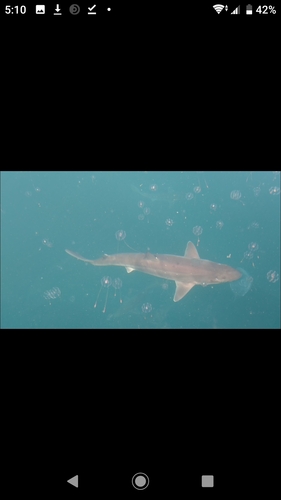
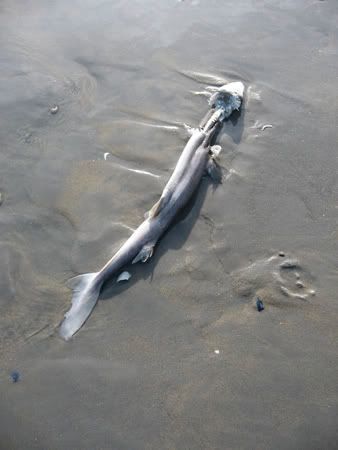
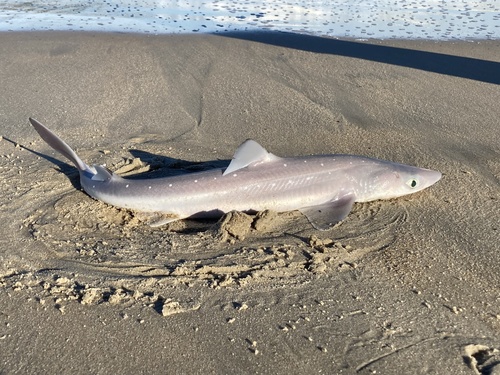
The spiny dogfish is a small, slim, grey shark of cold continental shelves worldwide, and it is almost certainly the shark most people have eaten. Adults are mostly 0.7–1.0 m long, with a pointed snout, big eyes, a scatter of white spots that fade with age, no anal fin, and a stiff spine standing in front of each of its two dorsal fins. Those spines carry a mild venom and are the only way this shark can hurt you. It appears nowhere in the International Shark Attack File’s list of species implicated in unprovoked bites.
Two numbers explain both its fame and its trouble. It is pregnant for 18 to 24 months — as long as an African elephant’s pregnancy and the longest known in any shark — and it lives 35 to 40 years, with females not breeding until about twelve. A shark like that can be fished down far faster than it can grow back. It was: northeast Atlantic landings ran above 40,000 tonnes a year in the early 1980s and had fallen to 886 tonnes by 2010, and US landings peaked near 60 million pounds in 1996 before collapsing to under five million by 2001.
Both of those stocks are now managed and both have come back — the US stock is not overfished and its spawning biomass sits at 101% of target, and ICES advised catches of up to 22,309 tonnes in the northeast Atlantic for 2025 after a decade in which its advice was no targeted fishery at all. The IUCN still lists the species as Vulnerable, assessed in 2019, because the Mediterranean and Black Sea populations have not recovered and much of the rest of the range is not counted at all. In Britain it is sold as rock salmon, flake or huss; in Germany the smoked belly flaps are Schillerlocken.
Where it lives
This is one of the most widely distributed sharks there is. FishBase calls it circumglobal in boreal and temperate water, and the 2019 IUCN assessment says the same, with two exclusions: the North Pacific and the Southern Ocean. In the west Atlantic that runs from Labrador to Florida and on to Argentina; in the east from Iceland and the Murman coast of Russia to South Africa, taking in the Mediterranean and the Black Sea. There are populations off southern Australia, New Zealand and Chile. What links all of it is temperature rather than geography: this is a shark of the cold end of the continental shelf, and it simply skips the warm middle of the planet.
The North Pacific gap is not an accident of the map. Until 2010 the dogfish off British Columbia, Alaska and Japan were counted as the same species; that year Ebert and colleagues resurrected the name Squalus suckleyi for them in the journal Zootaxa, and every North Pacific record now belongs to that shark instead. It matters more than a name change usually does, because a good deal of what people "know" about spiny dogfish — the extreme ages especially — was measured on the Pacific fish.
Within that huge range it is a bottom-oriented shark of the shelf and upper slope, though it will work midwater and the surface too. Adults spend most of their time between about 10 and 200 m; the deepest records reach far beyond that, but most are shallower than 600 m. It handles brackish water and turns up in enclosed bays and estuaries, and unlike the bull shark it cannot manage fresh water for more than a few hours.


- The North Sea and west of Scotland — The old heartland of the fishery and the clearest record of what happened. ICES landings for the northeast Atlantic open at 40,968 tonnes in 1980, mostly Scottish, French, Norwegian and English, and reach 886 tonnes by 2010. Tagging showed these fish wintering off Norway and summering off Scotland.
- Gulf of Maine to Cape Hatteras — The best-counted spiny dogfish on earth. The US stock is surveyed every spring by NOAA on a time series now 51 years long, assessed on a schedule, and capped by a quota split between the states — and as of the 2023 assessment its spawning stock biomass sits at 101% of target.
- Norwegian fjords — Where the modern tracking work is being done. Nineteen pregnant females carried archival satellite tags here for up to a full year, which is how we now know what their seasons and their daily up-and-down movements actually look like rather than inferring it from nets.
- The Black Sea — Once fished hard by Turkey, Russia and Ukraine, now depleted: in 2017 fishing mortality here was estimated at nearly ten times the reference point. Most of those fisheries have closed and Bulgaria is the only country left with a targeted one.
- Chatham Rise and the South Island shelf, New Zealand — The southern-hemisphere counterweight. New Zealand has managed spiny dogfish under its quota system for decades, took nearly 25,000 tonnes across five fishing years to 2012–13, and its trawl surveys have been stable or rising since the early 1990s.
Where it goes
Spiny dogfish follow water temperature the way migrating birds follow daylight, and in the northwest Atlantic the pattern is documented year by year. They spend winter and spring concentrated in mid-Atlantic waters and along the shelf break south of Georges Bank; in summer they are far to the north, inshore in Canadian bays and estuaries and through the Gulf of Maine; by autumn they are thick off southern New England and on Georges Bank, and as the water cools they run south again. The northbound leg reaches Georges Bank in March and April, and nothing shows off Maine or the Canadian coast until late June or July. In the northeast Atlantic the same machinery runs on a different axis — tagged fish from the northern North Sea and northwest Scotland wintered off Norway and summered back off Scotland.
The schools travel sorted. Juveniles group by size; once mature they sort by size and sex together, so a net comes up full of one kind of dogfish — a thousand half-grown fish, or a school of big pregnant females. That last habit is the reason this shark was so easy to overfish, and it is also why the fishery took the breeding females first. Individuals can go a very long way indeed: a dogfish tagged on St Pierre Bank off Newfoundland was caught again in the Shetland Isles–northern North Sea area eleven years later, the first recorded west-to-east crossing of the Atlantic by this species. The scientist who reported it concluded such crossings are not common but probably not unusual either.
Share of verified spiny dogfish records by month (GBIF, all years). Darker rose means a larger share of sightings fall in that month. This reflects when people record them, which mixes real seasonality with when divers and boats are out.
Virginia and North Carolina — inshore in winter and early spring: The opposite of almost every other shark on this site. Spiny dogfish are a cold-season fish in the mid-Atlantic: NOAA and the ASMFC both put the winter and spring concentration here, the Florida Museum has them reaching North Carolina in winter, and the ASMFC restricts overnight gillnet soaks off Maryland and Virginia from November through March — the months that fishery is on the water. By June they are off New England and Canada, which is why the summer months read zero — for this coast, not for the shark.
What it eats
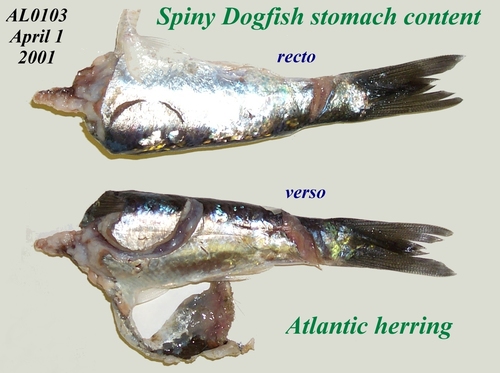
It eats whatever is in front of it, and the menu shifts with size: small dogfish work through crustaceans, big ones switch to schooling fish, squid and jellyfish. Herring, mackerel, capelin, sand lance and menhaden make up the bulk of it, with wolffish, flatfish, octopus, shrimp, crabs, comb jellies and even sea cucumbers filling in. They appear to eat little through the winter in deep water — fish caught inshore in early spring are noticeably thin. Dogfish are themselves eaten by cod, red hake, goosefish, seals, orcas, larger sharks and, routinely, other spiny dogfish.
The teeth are the giveaway that this is a cutter, not a crusher. About 28 in the upper jaw and 22 to 24 in the lower, all small, all angled towards the corners of the mouth, and set so they form a nearly continuous blade from one side to the other — nothing like the paving-stone plates of the smooth dogfish it is so often confused with. Fishermen have disliked them for a century for exactly this reason: a school will drive mackerel and herring off a ground, eat the catch out of a net and chew through the net doing it. The name itself is said to come from the way they run down prey in packs, like dogs.
Is it dangerous?
The only hazard here is the two spines, and you have to be holding the shark to meet them. One stands in front of each dorsal fin, each with a gland at its base that makes a mild venom, and the shark uses them deliberately: grabbed or cornered, it curls into a bow and whips sideways to drive a spine into whatever has hold of it. The wound is a deep puncture that hurts far out of proportion to its size, swells, and is slow to settle — a fisherman spined by a South American relative of this shark described exactly that in a 2005 clinical case report. Treat it like a weever sting: clean it, soak the limb in water as hot as you can comfortably stand, and see a doctor if it worsens. The teeth need no precautions at all. The International Shark Attack File lists no Squalus at all among the species implicated in unprovoked bites.
The traffic runs overwhelmingly the other way. This is a small schooling shark that gathers into shoals of big pregnant females and replaces itself more slowly than almost any fish in the sea — six pups every second year after a two-year pregnancy, with females not breeding at all until they are about twelve. Fisheries took it in enormous quantity anyway, for British chip shops, German smokehouses, liver oil, fishmeal and fertiliser, and the North Atlantic and Black Sea stocks fell away. What makes this page worth writing is what happened next: the United States declared its stock overfished in 1998 and capped it, and the European Union cut the northeast Atlantic quota by 90% in 2010, set it to zero in 2011 and made the fish a prohibited species for most of the decade that followed. Both stocks came back. It took about a quarter of a century — roughly one dogfish lifetime, which is the pace at which this shark does anything.
Spiny dogfish facts
- It is pregnant for 18 to 24 months — the longest gestation of any shark, and as long as an African elephant carries a calf. The pups are born head-first on the mother’s offshore wintering grounds, each with a soft sheath over its spines so they cannot cut her on the way out, and she starts developing the next litter while still carrying this one. — NOAA Fisheries; Florida Museum, Discover Fishes; FishBase (Compagno)
- You age one by reading its spine, not its backbone. Most sharks are aged from growth bands in the vertebrae, but the dogfish’s dorsal spine lays down countable annual rings on the outside, and the method was formally validated in 1985 — which is why the fishery has believable ages at all. — Beamish & McFarlane 1985, Can. J. Fish. Aquat. Sci. 42(11)
- In 2010 the North Pacific population was split off as a separate species, Squalus suckleyi. Anything you read about spiny dogfish living 75, 80 or 100 years came from those Pacific fish. For the Atlantic species NOAA gives 35 to 40 years, and the IUCN’s own generation-length maths used a maximum age of 24. — Ebert et al. 2010, Zootaxa 2612; NOAA Fisheries; IUCN assessment 2019
- Northeast Atlantic landings ran at 40,968 tonnes in 1980 and 886 tonnes in 2010. The EU cut the quota 90% in 2010, set it to zero in 2011 and made spurdog a prohibited species from 2017 to 2022. With the stock back above every one of its reference points, ICES has advised catches of up to 22,309 tonnes for 2025 — the first real targeted fishery here in a generation. — ICES advice dgs.27.nea, October 2024; IUCN European regional assessment
- About 98% of the US commercial catch is female. Bigger fish fetch more and females grow bigger, and because mature schools sort themselves by sex, a fleet can target them. That is precisely the part of the population a slow-breeding shark can least afford to lose, and it is why the 1990s crash still shows in the numbers. — Atlantic States Marine Fisheries Commission, spiny dogfish species page
- Medicine owes this fish a debt. Its rectal gland is a standard model for how human kidneys handle salt, and in 1993 researchers isolated a broad-spectrum steroid antibiotic from its tissues and named it squalamine. Squalamine and its relatives are still being investigated, now for viral and neurodegenerative disease. — Moore et al. 1993, PNAS 90(4); ASMFC species page
- One tagged dogfish crossed the Atlantic. Released on St Pierre Bank off Newfoundland, it was recaptured in the Shetland Isles–northern North Sea area eleven years later — the first documented west-to-east transatlantic migration for the species. — Templeman 1976, J. Fish. Res. Board Can. 33(11)
- It is the fish in a lot of fish and chips. In Britain it is sold as rock salmon, flake or huss; in Germany its smoked belly flaps are Schillerlocken, sold as a beer-garden snack. The US fishery that supplies much of that market has been certified sustainable by the Marine Stewardship Council since 30 August 2012. — NOAA Fisheries; SWI swissinfo.ch, December 2025; MSC fishery certificate
Photos
Seen lately
PierMonkey’s live map carries community shark sightings from iNaturalist, refreshed every three hours. Open the map to see where spiny dogfishs have turned up recently.
How big is that, really?
Maximum reliably recorded length. Rose marks the large or potentially dangerous species the map flags as notable.
Help protect it
- Shark Trust — Shark Log sightings databaseIf you dive, fish or work on the water in Europe, log the spurdog you see. Recording has run since 2008 and it is open to anyone, anywhere; for a shark whose European recovery is being tracked almost entirely through commercial nets and trawl surveys, independent sightings are genuinely useful.
- ASMFC spiny dogfish managementThe US coastwide quota, the state shares and the trip limits are set here in public, board meeting by board meeting. Agendas, stock assessments and public-comment windows are all posted on this page. If you think the country that rebuilt this stock should keep being careful with it, this is where to say so.
- MSC certificate — US Atlantic spiny dogfishBefore you buy rock salmon, huss or Schillerlocken, find out where it came from: the same species is a rebuilt, certified fishery in one ocean basin and an unmanaged, depleted one in another. This page shows what the certified fishery covers and when the certificate runs out, so you can ask the counter a specific question.
Report what you see
Photograph a shark, upload it, and once the community confirms the ID it becomes a research-grade record — which is where every sighting on our map comes from. Yours would appear here within three hours.
How to submit an observation →Organisations working on sharks like this one
- The Shark Trustgood for kidsReport eggcases and sightings, join campaigns, download free ID guides.
- Great Eggcase Huntgood for kidsWalk a beach, find a mermaid’s purse, log it. Over 630,000 eggcases recorded since 2003 — the easiest real science a family can do.
- Sharks4Kidsgood for kidsFree classroom lessons, virtual field trips and activity packs for teachers and parents.
- Save Our Seas FoundationFunds shark research and education worldwide; publishes what each project found.
- Shark StewardsCampaigns to end the shark fin trade and establish shark sanctuaries.
- OceanaPolicy campaigning on fisheries management and bycatch — the thing that actually kills sharks.
- IUCN Shark Specialist GroupThe scientists behind the Red List assessments. For older readers who want the primary source.
Conservation status: Vulnerable (IUCN Red List, assessed 2019). Assessed Vulnerable under criterion A2bd on 21 November 2019 by Finucci and ten co-assessors (e.T91209505A124551959) and published in the 2020 Red List update, which is why some sources date it 2020. The global figure — a 30–49% reduction over three generations, 51 years — hides four different stories. The assessors’ own regional analysis put the northeast Atlantic down about 64% and the Mediterranean down more than 99% over the same span, while the northwest Atlantic was up and New Zealand was stable to rising. Europe’s separate regional assessment, made in 2014, rates it Endangered on declines of 77% to over 80%. Read the assessment →
Common questions
What happens if a spiny dogfish spines you?▾
How long is a spiny dogfish pregnant?▾
Is spiny dogfish the shark in British fish and chips?▾
Why did the Pacific spiny dogfish become a separate species?▾
If US stocks are healthy, why is the spiny dogfish still Vulnerable?▾
Why are spiny dogfish here in winter when other sharks have gone?▾
Keep exploring
- Mullaghmore Head, Ireland — live surf conditions
- Bundoran, Ireland — live surf conditions
- Ditch Plains, New York — live surf conditions
- Rockaway Beach, New York — live surf conditions
- Virginia Beach, Virginia — live surf conditions
- Cape Hatteras, North Carolina — live surf conditions
- Shipstern Bluff, Tasmania — live surf conditions
- All 40 species →
Sightings © iNaturalist contributors (research-grade observations). Occurrence maps © GBIF.org contributors (CC BY). Community science, not a beach-safety service. Last updated 2026-09-20.
See where sharks are turning up — on the live map
The map and live conditions are open to everyone. A free account unlocks full 16-day forecasts and custom swell alerts.