
School shark
A mild, metre-and-a-half houndshark that crosses oceans and lives half a century — fished down worldwide for the vitamin A in its liver, and now Critically Endangered under a name almost nobody knows.
Vital statistics
Live birth without a placenta — the pups are fed by a yolk sac for a gestation of about 12 months. Litters run 6 to 52 pups, averaging around 35 in California and rising with the size of the mother; newborns are 30–37 cm. Females mature at 10–15 years and then breed only every third year, which is the arithmetic behind everything else on this page.
The short version
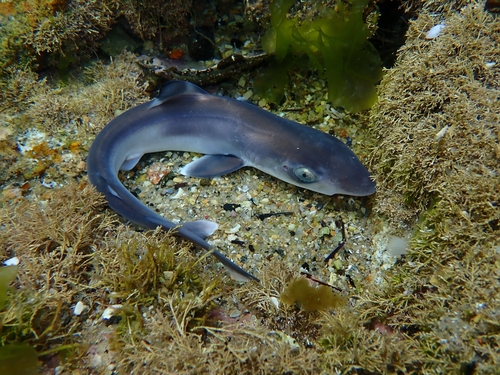
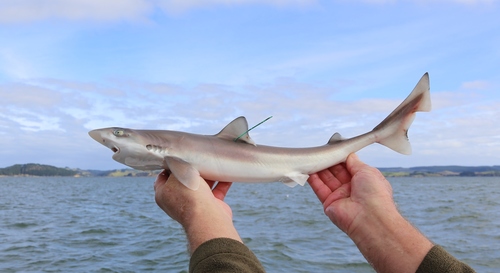
The school shark is a slim, harmless houndshark of cool temperate seas, and it carries a different name in nearly every one of them: tope in Britain and Ireland, soupfin shark in California, vitamin shark in Spanish. Adults are usually 1.2–1.6 m long; the biggest on record are about 1.95 m and 44.7 kg. Look for a long pointed snout, large almond-shaped eyes, a first dorsal fin much bigger than the second, and a large tab at the very tip of the tail about half as long as the fin’s upper edge.
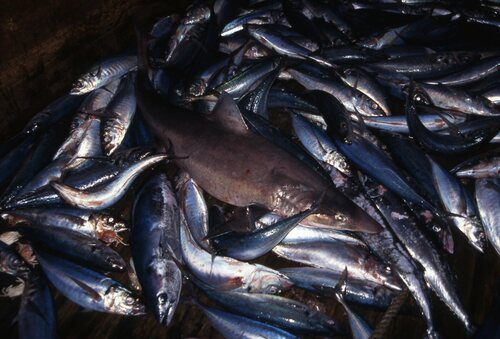
It is also one of the most heavily fished sharks in history, and the reason is its liver. Before chemists learned to make vitamin A, shark liver oil was one of the richest sources of it, and this species had the most potent liver of any shark on the Californian coast. When the Second World War cut off Europe’s cod-liver oil, the Pacific coast went after it: more than 24 million pounds of soupfin were landed in California between 1936 and 1944, and the fishery collapsed by the middle of that decade. Australia fished it for liver oil too, then for meat — this is the shark that built the Australian shark-and-chips trade — peaking at 3,158 tonnes in 1969.
The IUCN assessed it Critically Endangered in 2020, estimating that the global population had fallen by about 88% over three generations, a span it puts at 79 years. That one figure hides very different regional stories: southern Australia’s stock is still below a fifth of its original size, while Britain and Ireland are a relative stronghold where anglers catch and release tope every summer. And it migrates far enough to make the decline everyone’s problem — one tagged shark was recaught 4,940 km away. The International Shark Attack File records one bite by this species in its entire history.
Where it lives
Draw this shark’s range and you get temperate bands rather than one continuous belt. In the eastern Atlantic it runs from Iceland and Norway past the British Isles to Senegal, through the Mediterranean, and again from Gabon south to South Africa and Mozambique; in the western Atlantic it holds only southern Brazil to Argentina. In the Pacific it takes British Columbia down to Baja California, Peru and Chile on the far side of the equator, and southern Australia and New Zealand. It is absent from eastern North America and eastern Asia altogether. The gaps are the tropics: this is a temperate animal, recorded between about 11 °C and 21 °C.
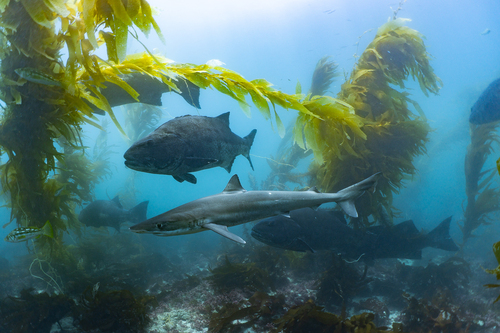
Inside those bands it is a shelf shark, working near the bottom over continental and island shelves, into shallow bays and the surf line, and down to about 800 m on the slope. It does not stay on the bottom, though, and that is unusual for a houndshark: tope rise into midwater and have been found more than 1,500 km offshore. Look for a slim grey-to-bluish shark with a white belly, a long pointed snout, big almond-shaped eyes, a first dorsal fin much larger than the second, and the feature that settles it — a large tab at the very tip of the tail, about half as long as the fin’s upper edge. Sharks under about 60 cm have black-tipped dorsal and tail fins.
The most important thing on that map is the white space between the bands. Genetic work splits the species into roughly six sub-populations — Australasia, the north-east Pacific, the south-east Pacific, southern Africa, the south-west Atlantic and the north-east Atlantic — that do not interbreed. Sharks travel enormous distances inside one and effectively never between them, so a stock fished down in one region is not refilled from the next. That is why a collapse that happened off California in the 1940s is still visible off California today.


- Bass Strait — Victoria and Tasmania — The water that built Australian shark and chips. Catches peaked at 3,158 tonnes in 1969; today targeting the species is banned, every pupping ground confirmed by research is closed to fishing, Victorian coastal waters are shut to shark gillnets and Tasmanian nursery areas are closed outright.
- The Irish Sea, North Channel and northern Celtic Sea — Identified in 2025, from decades of angler tagging, as the likeliest mating area for the north-east Atlantic population — and, with young-of-the-year turning up there, probably a nursery as well. Tralee Bay in Kerry is where most Irish tope have been tagged.
- Southern California, south of Point Conception — The nursery end of the eastern Pacific population: adult females and newborn pups in numbers. Further north, the San Francisco Bay and Tomales Bay nurseries emptied by the 1930s and 1940s liver fishery have, by California’s own account, never fully recovered.
- Bahía San Blas, northern Patagonia, Argentina — A pupping and nursery ground with a seasonal fishing restriction while pregnant females are present — one of the very few protections anywhere in the south-west Atlantic, the region where the declines have been steepest.
- The Western Cape, South Africa — One of South Africa’s most commercially valuable sharks, sold as frozen fillet, dried for local markets and exported, with the fins going to Asia. Biomass there was estimated at about 43% of the pre-exploitation level, and there are no conservation measures specific to the species.
Where it goes
Almost every population of this shark migrates, and the distances are a large part of why it is in trouble. Between 1985 and 1997, 3,950 school sharks were tagged in New Zealand; of those recaptured, most stayed within 500 km, but a tenth had moved more than 1,700 km, the longest journey measured 4,940 km, and the longest any tagged shark stayed at liberty was 9.6 years. Seven were caught in South Australia or Tasmania and one tagged off Tasmania was recaught in Foveaux Strait — straight crossings of the Tasman Sea. Sharks tagged by anglers around Britain and Ireland have been recaptured off Iceland, Norway, the Azores, the Canary Islands and in the Mediterranean, more than 2,000 km away, while others turned up near the same mark after ten years. And a female tagged south of Ventura, California in July 1943 was recovered at Nootka Sound, Vancouver Island, 26 months later.
They also separate by sex and size, in every ocean anyone has looked at. A 2025 analysis of the Irish angler-tagging archive found females living consistently further south than males, and their movements tracking water temperature more closely. Californian catches show the same split the other way up: almost entirely male off northern California, overwhelmingly female in the south. Juveniles largely stay put while the adults travel. Put those two paragraphs together and you have the management problem: a fleet in one country’s waters can be catching the pregnant females of a stock that pups in another’s, and no single government can look after an animal that treats a national boundary as scenery. That is why tope was added to Appendix II of the Convention on Migratory Species in 2020 — an agreement to cooperate rather than a ban, and one Australia entered a reservation against.
Share of verified school shark records by month (GBIF, all years). Darker rose means a larger share of sightings fall in that month. This reflects when people record them, which mixes real seasonality with when divers and boats are out.
The Irish Sea and Cardigan Bay — inshore tope: A season shaped like a British summer. The first fish show in Cardigan Bay in April, the main run arrives through May and June, and June to August is the peak for the charter boats that fish for them; numbers thin through September and October. The winter zeroes mean inshore only — the sharks are alive and well, further south and further out, and Irish tagging shows some of them a very long way away indeed. This pattern comes from Welsh and Irish angling seasons read against the recapture record, not from a survey, so treat it as the shape of the year rather than a timetable.
What it eats
Tope are fish eaters, and they sit unusually high up the food chain for their size: FishBase puts them at trophic level 4.3 and a standard review of shark diets at 4.2, both above the average for sharks. Stomach contents from California list sardine, herring, mackerel, rockfish, midshipman, smelt, flatfish, squid and ratfish — some of those live on the seabed and some in open water, which tells you this is a predator taking whatever the season has made abundant. Larger tope take other sharks and rays; young ones eat more crabs, shrimp, worms and shellfish, and shift towards fish as they grow.
The teeth are blades, not plates, and that is the quickest way to place the animal among its relatives: angled cutting cusps with small extra points behind them, much the same in both jaws, where the smooth-hounds in the same family carry flat pavement for crushing crabs. Being a metre-and-a-half predator does not put a tope at the top of anything, either — juveniles are eaten by white sharks and sevengill sharks, and probably by marine mammals.
Is it dangerous?
There is effectively nothing here to be afraid of. In the International Shark Attack File’s global table of species implicated in unprovoked bites, which runs from 1580 to the present, Galeorhinus galeus appears with a single non-fatal incident — one, in more than four centuries of records — and FishBase classifies the species as harmless. This is a slim shark that tops out around 45 kg, eats fish and spends most of its life near the bottom. The realistic way to get hurt by one is to handle it: a tope fights hard and twists when held, and shark skin is rough enough to take the top off your knuckles.
What we do to them does not compare. Tope have been targeted for liver oil, meat and fins across almost their whole range, and the coastal life that makes them easy to meet makes them easy to catch. Some of that has been dialled back: Britain’s Tope (Prohibition of Fishing) Order 2008 ended any directed commercial fishery, allowing capture by rod and line only — and those fish may not be landed — with bycatch retention capped at 45 kg a day; Australia bans targeting, caps incidental catch at 225 tonnes and has required live release since 2014-15. Set that against the arithmetic of a female who does not breed until she is ten to fifteen, carries her pups for a year, and then breeds only every third year. A stock built like that can be emptied in a decade and takes most of a human lifetime to come back: Australia’s rebuilding plan gives itself 66 years, three shark generations, to climb back to a fifth of the original biomass.
School shark facts
- Every common name it has is a description of what people made out of it. "Soupfin" is the fins, once prized above every other Californian shark for soup; "liver-oil shark" and the Spanish "tiburón vitamínico", vitamin shark, are the wartime trade in its liver; "school shark" is the way it travels. Only "tope", the British and Irish name, is just a name. — CMS COP13 listing proposal (EU, 2019); California Department of Fish and Game, Status Report 2001
- It was fished for a vitamin. Shark liver oil was a major source of vitamin A before synthesis, and this species had the highest potency of any shark on the US Pacific coast. With European cod-liver oil cut off by the Second World War, over 24 million pounds were landed in California between 1936 and 1944 — the fishery collapsed by the mid-1940s, and synthetic vitamin A finished off what was left of the market. — California Department of Fish and Game, Status Report 2001; Nakatsu 1957, Commercial Fisheries Review 19(12)
- Nursery grounds do not necessarily come back. California’s own status report says the San Francisco Bay and Tomales Bay nurseries that the liver boom emptied have never fully recovered — eighty years on, and with no stock assessment done there in over half a century. — California Department of Fish and Game, Status Report 2001; CMS COP13 listing proposal (EU, 2019)
- One tagged school shark was recaught 4,940 km from where it was released. In the New Zealand tagging study behind that figure, most recaptured sharks had moved less than 500 km, but a tenth had travelled over 1,700 km, and the longest any of them stayed out before being caught again was 9.6 years. — Hurst et al. 1999, NZ Journal of Marine and Freshwater Research 33; CMS COP13 listing proposal (EU, 2019)
- Sharks tagged by sea anglers around Britain and Ireland have been recaptured off Iceland, Norway, the Azores, the Canary Islands and in the Mediterranean — over 2,000 km away — while others were caught near the same mark more than a decade later. Irish anglers tagged 6,406 tope between 1970 and 2009, most of them in Tralee Bay. — Inland Fisheries Ireland, Marine Sportfish Tagging Programme; Holden & Horrod 1979, ICES Journal of Marine Science 38(3)
- About six sub-populations — Australasia, the north-east Pacific, the south-east Pacific, southern Africa, the south-west Atlantic and the north-east Atlantic — do not mix. However far individual sharks travel inside one of them, a depleted region cannot be restocked by immigrants from the next one along. — Australian Shark Report Card 2023 (FRDC), after Chabot & Allen 2009 and Hernández et al. 2015
- Australian mercury rules, not conservation, first cut the catch: the 1972 ban on selling large school sharks because of their mercury content dropped landings, which then climbed again when the rules were relaxed, reaching 3,060 tonnes in 1986 before management restrictions brought the shark fishery’s total down to 170 tonnes by 2001. — Australian Shark Report Card 2023 (FRDC); Status of Australian Fish Stocks, School Shark 2023
- Counting the growth bands in a tope’s vertebrae does not work reliably, so its age has been estimated from tagged sharks instead: 46–59 years for females and 43–55 for males. FishBase’s maximum reported age is 55 and Australia’s report card says potentially 60. Females do not breed at all until they are 10 to 15. — Dureuil & Worm 2015, Journal of Fish Biology 87; FishBase; Australian Shark Report Card 2023 (FRDC)
Photos
Seen lately
PierMonkey’s live map carries community shark sightings from iNaturalist, refreshed every three hours. Open the map to see where school sharks have turned up recently.
How big is that, really?
Maximum reliably recorded length. Rose marks the large or potentially dangerous species the map flags as notable.
Help protect it
- The Shark Trust — Shark Log sightings databaseCaught or seen a tope? Log it. The Shark Log takes records from anyone — anglers, divers, snorkellers — anywhere in the world, the conservation team verifies each one, and the database has collected over 18,000 records since 2008. For a shark with almost no dedicated monitoring across most of its range, ordinary sightings are a real part of the evidence.
- Inland Fisheries Ireland — Marine Sportfish Tagging ProgrammeIrish charter skippers and sea anglers can request tags, tag the tope they catch and report recaptures. This is not a token exercise: 6,406 tope tagged since 1970 are the reason anyone knows where north-east Atlantic tope go, and the same dataset produced the 2025 paper that identified the Irish Sea as a likely mating and nursery area. Handle the fish in the water, unhook it quickly, and it swims off carrying a data point.
- GoodFish — Australia’s Sustainable Seafood Guide, shark and flakeIf you buy flake in Australia, ask the shop which shark it is. The Australian Fish Names Standard reserves the word "flake" for gummy shark and New Zealand rig, but it is not legally binding and other sharks are sold under it anyway. GoodFish rates shark red — "Say No" — and names alternatives worth ordering instead.
Report what you see
Photograph a shark, upload it, and once the community confirms the ID it becomes a research-grade record — which is where every sighting on our map comes from. Yours would appear here within three hours.
How to submit an observation →Organisations working on sharks like this one
- The Shark Trustgood for kidsReport eggcases and sightings, join campaigns, download free ID guides.
- Great Eggcase Huntgood for kidsWalk a beach, find a mermaid’s purse, log it. Over 630,000 eggcases recorded since 2003 — the easiest real science a family can do.
- Sharks4Kidsgood for kidsFree classroom lessons, virtual field trips and activity packs for teachers and parents.
- Save Our Seas FoundationFunds shark research and education worldwide; publishes what each project found.
- Shark StewardsCampaigns to end the shark fin trade and establish shark sanctuaries.
- OceanaPolicy campaigning on fisheries management and bycatch — the thing that actually kills sharks.
- IUCN Shark Specialist GroupThe scientists behind the Red List assessments. For older readers who want the primary source.
Conservation status: Critically Endangered (IUCN Red List, assessed 2020). Assessed Critically Endangered in 2020 (Walker, Rigby, Pacoureau, Ellis, Kulka, Chiaramonte and Herman, e.T39352A2907336), under criterion A2bd: the assessment estimates a global population reduction of about 88% over three generations, a period it puts at 79 years. Regional verdicts differ sharply from that global one and it is worth knowing both — the same assessors rate the Australian population Endangered, Australia’s own Status of Australian Fish Stocks report calls the southern stock Depleted, and a 2025 study of north-east Atlantic tagging data describes Britain, Ireland and their neighbouring seas as a relative stronghold. Critically Endangered is the average of a long, uneven century. Read the assessment →
Common questions
Is a tope the same thing as a school shark or a soupfin shark?▾
What is flake in Australia, and is it made from this shark?▾
Why were sharks killed for vitamin A?▾
Has a tope ever bitten anyone?▾
I have hooked a tope from the shore or a boat — what should I do?▾
If tope are Critically Endangered, why do British and Irish anglers still catch them every summer?▾
Keep exploring
- Fistral Beach, Cornwall — live surf conditions
- Lahinch, County Clare — live surf conditions
- Steamer Lane, California — live surf conditions
- Rincon, California — live surf conditions
- Bells Beach, Victoria — live surf conditions
- Shipstern Bluff, Tasmania — live surf conditions
- Dungeons, Cape Town — live surf conditions
- All 40 species →
Sightings © iNaturalist contributors (research-grade observations). Occurrence maps © GBIF.org contributors (CC BY). Community science, not a beach-safety service. Last updated 2026-09-20.
See where sharks are turning up — on the live map
The map and live conditions are open to everyone. A free account unlocks full 16-day forecasts and custom swell alerts.