
Pacific spiny dogfish
A slow, cold, spine-armed shark of the North Pacific that can reach about ninety years old — and does not breed until it is thirty-five.
Vital statistics
Live-bearing, with the pups fed by a yolk sac rather than a placenta, and one of the longest pregnancies known in any fish. COSEWIC gives 18–24 months, NOAA Fisheries 18–22, Fisheries and Oceans Canada 22 and Washington’s wildlife department 24 — which it calls the longest gestation of any known cartilaginous fish. COSEWIC records an average of six pups, 22–25 cm long at birth; NOAA puts the maximum at 22 for a large female. Females then rest for a year or more before starting again, so a breeding female produces a litter roughly every three years.
The short version
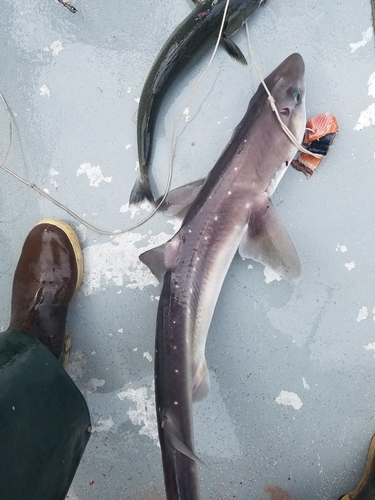
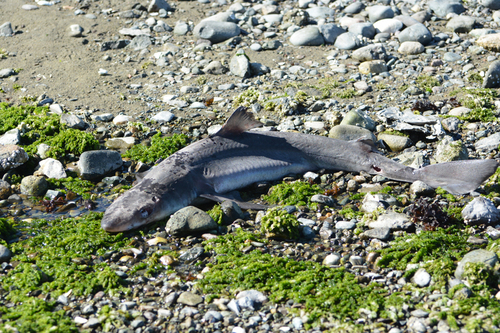
The Pacific spiny dogfish is a small, slate-grey shark of cold North Pacific water, found from Japan and the Sea of Okhotsk round through the Bering Sea and the Gulf of Alaska and down the American coast to Baja California. Most adults are 75 cm to a little over a metre long; the largest published length is 1.4 m and the heaviest about 10 kg. Two features identify it: a scatter of small white spots on a grey back, and a hard, sharp spine standing in front of each of its two dorsal fins.
Until 2010 it was not officially a species at all. Every North Pacific spiny dogfish was filed under Squalus acanthias, and it took a study combining body measurements, vertebral counts and DNA to bring the old name Squalus suckleyi back for the Pacific animal. The number that makes it remarkable is its age. Canada’s national status report estimates that the biggest ones, around 130 cm, are roughly 90 years old, and NOAA Fisheries says they live "sometimes more than 80 years". Females do not breed until about 35, carry their pups for around two years, and rest a year before doing it again — a generation time of 51 years, longer than most fisheries have existed.
It is harmless in the water; the only sharp end is the pair of mildly venomous dorsal spines, which are a hazard to hands rather than to swimmers. The IUCN assessed it as Least Concern in 2016 and the US Pacific coast stock was found not overfished in its 2021 assessment, but Canada listed it as Special Concern in 2011, and the slow arithmetic behind that listing has not changed. It is the most abundant shark in Puget Sound and the Salish Sea, where it arrives in spring, schools by the thousand and leaves for the open Pacific around November.
Where it lives
This shark belongs to the cold rim of one ocean. FishBase traces it from Korea and Japan north to Kamchatka and the Sea of Okhotsk, across the Bering Sea and the Aleutian chain, then east and south through the Gulf of Alaska and British Columbia to southern Baja California — roughly 67°N to 29°N. NOAA Fisheries describes the same arc as Bering Sea to Baja, and adds the detail that matters: it is far more common off the US West Coast and British Columbia than in Alaskan waters. The range is really a temperature band — FishBase has the species preferring 7–15 °C and moving to stay inside it.
Vertically it covers an enormous span for such a small shark. Records run from 15 m down to 1,244 m, but most animals are far shallower — NOAA puts the bulk of them above about 350 m. Newborns and juveniles live up in the water column, mostly in the top 25 m, and settle onto the bottom as they mature, generally between 50 and 200 m. Adult males tend to sit shallower than adult females, with one exception: heavily pregnant females move into shallow bays to give birth. It is also one of the few sharks at home in a sheltered inland sea — San Francisco Bay and Puget Sound both hold it.
It travels in company, which is the thing most people get wrong about it. Pacific spiny dogfish gather in schools of hundreds and sometimes thousands, sorted by size and by sex. A school that size strips a patch of herring and moves on, and it is why one net set can land tonnes of a single age class. In the Salish Sea the numbers are large enough to make this the most abundant shark in the system: Canadian surveys put a minimum of about 100,000 mature individuals in the Strait of Georgia alone.


- Strait of Georgia, British Columbia — The best-studied dogfish water anywhere. Canada has run longline research surveys here since 1986, and the Strait supplied the samples behind the age and maturity figures the rest of the world now quotes.
- Puget Sound, Washington — The most abundant shark in the Sound, and the subject of the acoustic-tagging work that showed the population leaving for the open Pacific each winter and filtering back in spring.
- Queen Charlotte Sound & the northern BC shelf — The release area for much of Canada’s 1978–1988 tagging programme, and the starting point of the longest dogfish journey ever recorded — 7,000 km to the coast of northeast Japan.
- Gulf of Alaska & the eastern Bering Sea — The northern end of the range, where dogfish are taken almost entirely as incidental catch in halibut and groundfish gear. Both Alaskan stocks are assessed inside shark complexes, and neither has enough data to say how large it is.
- Sea of Japan & Sea of Okhotsk — The western half of the range, and the reason the 2010 split mattered to more than North Americans: Korean researchers formally changed the scientific name used for their dogfish in 2016 on the strength of the same morphological and molecular evidence.
Where it goes
The evidence here is unusually good, because this species was the subject of the largest shark-tagging programme ever run. Between 1978 and 1988 Canadian scientists tagged roughly 71,000 spiny dogfish off the west coast of Canada. The result was mixed, and honest: most recaptured fish turned up close to where they were released, so the average dogfish is a stay-at-home — but a minority made journeys of up to 7,000 km. One tagged in Queen Charlotte Sound in June 1980 was caught off northeast Japan in November 1982, and about 7% of the recaptures from northern British Columbia releases came from somewhere else entirely, mostly Japan and Alaska.
On a smaller scale the movement is seasonal, and the Salish Sea shows it clearly. NOAA researchers Kelly Andrews and Chris Harvey put acoustic tags in 17 Puget Sound dogfish, of which 14 survived to be tracked; every one of those 14 left the Sound through the Strait of Juan de Fuca for the open Pacific, mostly in November and December. Nine came back the following year and seven reached the main basin again; one large female never returned and settled off California instead. The emptying matters ecologically — with the dogfish gone, the modelled pressure they put on other Puget Sound fish fell by about 70% in winter. There is a daily rhythm too, and it runs backwards from what most people expect: dogfish move shallower by day and deeper at night.
Share of verified pacific spiny dogfish records by month (GBIF, all years). Darker rose means a larger share of sightings fall in that month. This reflects when people record them, which mixes real seasonality with when divers and boats are out.
Puget Sound & the Salish Sea: Dogfish move into the Salish Sea in spring and stay through to autumn. The acoustic-tagging study found the tagged fish leaving for the open Pacific mainly in November and December, and returning through the following spring and summer. The Sound is never quite empty — NOAA notes that some animals winter in cold water rather than moving — but midsummer is when there are most of them.
What it eats
Pacific spiny dogfish are opportunists with no single target. FishBase lists fish as the main prey of larger individuals, alongside squid and octopus, jellyfish and comb jellies, shrimp, krill and amphipods, and bristle worms off the bottom; NOAA gives the same picture from the other end, with small schooling fish such as herring at the centre. A school eats what a stretch of water is offering that month, which is why two diet studies from different bays can read like two different animals — and why fishermen know them for grabbing any baited hook that goes down.
They are prey as much as predator, and that shapes the schooling. NOAA lists larger sharks — including larger spiny dogfish, which will eat smaller ones — along with cod, hake, seals and killer whales among the things that eat them, and puts the schooling down partly to safety in numbers. Sitting in the middle of the food web is what makes them so interesting in an enclosed sea: researchers working on Puget Sound describe dogfish as close to a keystone species there — abundant enough that what they eat, and when they are there to eat it, moves the whole system.
Is it dangerous?
FishBase lists this shark flatly as harmless, and that is the right word for anyone in the water. It is a metre-long fish with a small mouth, it lives in cold water mostly well below the surf zone, and it has no history of biting swimmers or surfers. Where it can actually hurt you is in your hands. Each of the two dorsal fins is preceded by a hard, sharp spine, and Washington’s wildlife department describes those spines as mildly venomous; a dogfish that feels itself held arches its back and drives one into whatever is holding it. A case report in the journal Toxicon on a fisherman spined by a dogfish of this genus records swelling, redness and severe pain for about six hours. Control the head and the tail, keep your hand clear of both fin bases, and if it is awkward, cut the line instead.
The risk running the other way is much larger, and it is arithmetic. A female does not breed until roughly 35, carries her pups for about two years, has around six and then rests a year; COSEWIC calculates a generation time of 51 years. Population models for the Gulf of Alaska put the rebound rate of an unfished population at 0.02–0.03 per year, and found a fishing mortality of just 0.03–0.04 enough to stop it growing. There is almost no headroom, and history shows what happens when that is ignored: catches during the 1940s liver-oil boom peaked above 12,000 tonnes a year on the inside British Columbia stock and above 25,000 tonnes on the outside stock, and recovery took decades. Today the US Pacific coast stock is assessed as not overfished, and dogfish are mostly caught by accident. One last note follows straight from the age: a fish feeding for most of a century accumulates mercury, and FishBase’s standing advice is to eat only individuals under 60 cm.
Pacific spiny dogfish facts
- It has only been a separate species since 2010. A study using body measurements, fin proportions, vertebral counts and DNA resurrected the name Squalus suckleyi for the North Pacific population. The external differences from the Atlantic spiny dogfish are subtle — a shorter, blunter snout, a first dorsal fin set further back, a pelvic fin closer to the second dorsal than the first, and an average of 99 vertebrae — but the genetics are not: divergence between the two species was 0.765%, five to six times the variation found within either one. — Ebert, White, Goldman, Compagno, Daly-Engel & Ward 2010, Zootaxa 2612:22–40
- The largest recorded animals, about 130 cm long, are estimated at 90 years old, and NOAA Fisheries puts the species at "sometimes more than 80 years". That makes it the longest-lived shark anyone has aged carefully in the North Pacific — though nowhere near the Greenland shark, which holds the record for any vertebrate. — COSEWIC 2011 status report (Canada); NOAA Fisheries species directory
- The two spines are defensive weapons, not decoration. Each sits immediately in front of a dorsal fin with glandular tissue at its base, and Washington’s wildlife department describes them as mildly venomous. The point of them is a mouthful: a predator that takes a dogfish sideways gets stabbed, which is one reason a shark this small can afford to live in open water in enormous schools. — Washington Dept of Fish & Wildlife; Haddad et al. 2005, Toxicon (Squalus envenoming)
- Nobody quite agrees how long the pregnancy is. COSEWIC says 18–24 months, NOAA Fisheries 18–22, Fisheries and Oceans Canada 22 and Washington’s wildlife department 24 — the last calling it the longest gestation of any known cartilaginous fish. What the sources do agree on is what follows it: the female rests for a year or more before starting again, so a litter of about six arrives roughly every three years. — COSEWIC 2011; NOAA Fisheries; Fisheries and Oceans Canada; WDFW; FishBase
- Ageing this shark is genuinely contested, because the structure used to do it wears out. Ages come from counting band pairs on a dorsal fin spine — a method validated by bomb-radiocarbon dating and by injecting wild sharks with a dye that leaves a dated mark — but spines stick out of the fish and erode, so the missing bands have to be estimated. A 2017 study tried vertebrae instead and found they read consistently younger than spines past age 10, and concluded vertebrae are not yet a usable substitute. — Tribuzio, Matta, Gburski, Blood, Bubley & Kruse 2017, Marine and Freshwater Research 69:37–47
- One dogfish tagged in Queen Charlotte Sound, British Columbia in June 1980 was recaught off the northeast coast of Japan in November 1982 — about 7,000 km away, and the longest movement recorded for the species. It came out of a programme that tagged roughly 71,000 dogfish off western Canada between 1978 and 1988, the most extensive tagging study ever run on any shark. — McFarlane & King 2003, Fishery Bulletin (NOAA); Fisheries and Oceans Canada
- Acoustic tags on 14 Puget Sound dogfish showed every one of them leaving the Sound through the Strait of Juan de Fuca for the open ocean, mostly in November and December. Nine returned the following year and seven reached the main basin again; one large female never came back and settled off California instead. — Andrews & Harvey (NOAA Northwest Fisheries Science Center), via Encyclopedia of Puget Sound
- Dogfish were once fished for their livers rather than their flesh. Catches during the vitamin-A liver boom of the early 1940s peaked above 12,000 tonnes a year on the inside British Columbia stock and above 25,000 tonnes on the outside stock. Earlier still, dogfish liver oil was burned in the lamps of the coal mines around Nanaimo. — COSEWIC 2011 status report; FishBase
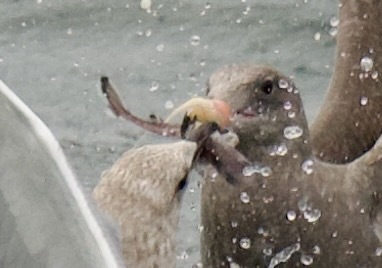
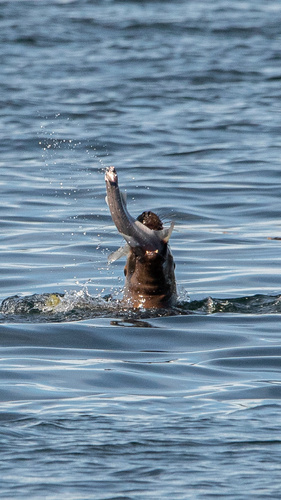
Photos
Seen lately
PierMonkey’s live map carries community shark sightings from iNaturalist, refreshed every three hours. Open the map to see where pacific spiny dogfishs have turned up recently.
How big is that, really?
Maximum reliably recorded length. Rose marks the large or potentially dangerous species the map flags as notable.
Help protect it
- iNaturalist — Squalus suckleyiThis is the rare case where one photograph measurably moves the dataset. For a shark that numbers in the millions, iNaturalist held only a few hundred verified observations of Squalus suckleyi when this page was written. If you catch one off a Washington jetty or a BC pier, photograph it before you release it — the whole fish, and the front of the first dorsal fin so the spine shows — and upload it with the location.
- WDFW — fishing rules and how to handle a dogfishRead this before you fish Washington’s coast or Puget Sound. Dogfish take almost any bait, so you will catch them whether you mean to or not, and how you unhook one decides whether it swims away. Check the current bottomfish limits on the same site, keep your hands clear of both dorsal spines, and cut the line rather than fight an awkward fish out of the water.
- Fisheries and Oceans Canada — Pacific spiny dogfish researchWhere the tagging and survey work that produced almost every number on this page is described, including the 1978–1988 programme and the Strait of Georgia longline surveys. If you ever land a shark carrying a tag, photograph the tag and its number and report it to the agency named on it — recoveries decades after release are exactly what made the longevity estimates possible.
Report what you see
Photograph a shark, upload it, and once the community confirms the ID it becomes a research-grade record — which is where every sighting on our map comes from. Yours would appear here within three hours.
How to submit an observation →Organisations working on sharks like this one
- The Shark Trustgood for kidsReport eggcases and sightings, join campaigns, download free ID guides.
- Great Eggcase Huntgood for kidsWalk a beach, find a mermaid’s purse, log it. Over 630,000 eggcases recorded since 2003 — the easiest real science a family can do.
- Sharks4Kidsgood for kidsFree classroom lessons, virtual field trips and activity packs for teachers and parents.
- Save Our Seas FoundationFunds shark research and education worldwide; publishes what each project found.
- Shark StewardsCampaigns to end the shark fin trade and establish shark sanctuaries.
- OceanaPolicy campaigning on fisheries management and bycatch — the thing that actually kills sharks.
- IUCN Shark Specialist GroupThe scientists behind the Red List assessments. For older readers who want the primary source.
Conservation status: Least Concern (IUCN Red List, assessed 2016). Assessed as Least Concern in March 2016 (Bigman, Ebert & Goldman), the first global assessment made after the North Pacific animal was separated from the Atlantic spiny dogfish. Least Concern here means abundant and lightly fished, not safe: Canada takes a dimmer view, and COSEWIC listed the species as Special Concern in 2011 on the strength of a 51-year generation time and a long history of boom fisheries. Read the assessment →
Common questions
How do you tell a Pacific spiny dogfish from an Atlantic one?▾
How long do Pacific spiny dogfish live, and how does anyone know?▾
How big do Pacific spiny dogfish get?▾
Are Pacific spiny dogfish dangerous to surfers or swimmers?▾
When are dogfish in Puget Sound and the Salish Sea?▾
If they are so common, why do they need careful management?▾
Keep exploring
- Cox Bay, Tofino, British Columbia — live surf conditions
- Mavericks, California — live surf conditions
- Ocean Beach, San Francisco — live surf conditions
- Steamer Lane, California — live surf conditions
- All 40 species →
Sightings © iNaturalist contributors (research-grade observations). Occurrence maps © GBIF.org contributors (CC BY). Community science, not a beach-safety service. Last updated 2026-09-20.
See where sharks are turning up — on the live map
The map and live conditions are open to everyone. A free account unlocks full 16-day forecasts and custom swell alerts.