
Epaulette shark
A metre-long reef shark that walks on its fins between tide pools and can switch off parts of its own brain to get through the night on almost no oxygen.
Vital statistics
Egg-laying, two at a time. A female produces a pair of cases roughly every 14 days from August to January — about 20 eggs a year (Shark Trust), and up to 50 in the most productive animals (Save Our Seas Foundation). The cases are small and smooth, about 10 x 4 cm (Australian Museum) or 9 x 3.5 cm (Florida Museum), and are wedged into the reef. Incubation is about 120-130 days on the reef, and 140 ± 5 days in an aquarium held at 24-25 °C (Payne 2012). Pups hatch at 14-16 cm and about 20 g, and walk from the first day.
The short version
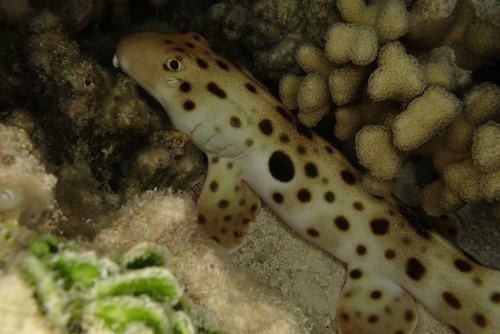
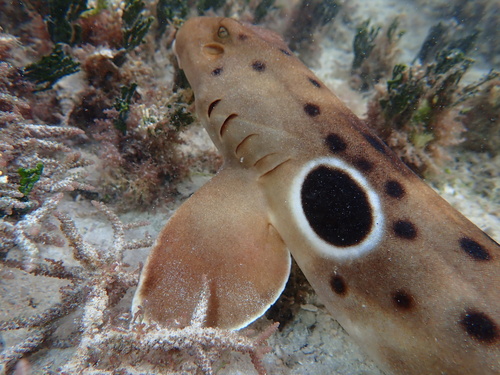
The epaulette shark is a small, slender, bottom-living carpet shark of the Great Barrier Reef, up to 107 cm long and usually 60-90 cm, and it is completely harmless to people. It is named for the two black white-ringed spots behind its head, which sit where a soldier’s shoulder badges — epaulettes — would be. It lives on shallow reef flats, lagoons and tide pools, hunts worms and crabs at night, and is listed as Least Concern.
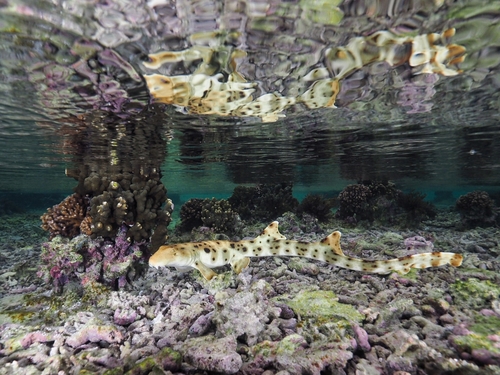
It also walks. Using its paired fins as limbs, an epaulette shark moves across the reef in a sprawling, diagonal-sequence gait — front fin on one side with back fin on the other, the same pattern a salamander uses — with the pelvic fins doing most of the pushing. Measured in a tank, young sharks walk at about 3 cm a second, or nearly 7 cm a second when hurrying, against about 12 cm a second swimming. And it does this out of the water as well as in it, clambering over exposed reef from one tide pool to the next.
Its second trick is stranger. On nocturnal low tides the pools it lives in can lose 80% of their oxygen to the breathing of the coral around it, so the shark has evolved to switch parts of itself off. It survives three and a half hours of severe oxygen shortage, and in water with no oxygen at all it goes limp after about 46 minutes and then comes straight back when the oxygen returns. It holds blood flow to its brain steady while its blood pressure halves, and floods the brain with adenosine to shut non-essential nerve cells down. That combination is why a reef shark ends up in the literature on human stroke and brain injury.
Where it lives
The epaulette shark is a Great Barrier Reef animal, and the Australian authorities on it are blunt about that: the Australian Museum and Fishes of Australia both treat the species as endemic to the reef, from about the northern tip of Cape York Peninsula south to the Capricorn Group off Gladstone, with the northernmost record at Sunday Island, 11°56’S. The global databases draw it wider. FishBase adds New Guinea and lists Malaysia, Sumatra and the Solomon Islands as possible, and the Florida Museum extends it south to Sydney. Both versions are in print, though everything anyone actually knows about this shark was learned on Australian reef flats.
There is a good reason to be careful with the foreign records. The epaulette shark belongs to a genus of nine walking sharks, all of them small, benthic and restricted to the Indo-Australian Archipelago, and several were only described in the last twenty years from New Guinea and Raja Ampat. A dated molecular phylogeny published in 2020 found the group radiated recently and disperses very little at any life stage — which is how you end up with nine lookalike species in neighbouring bays, and how an old "epaulette shark" record from New Guinea might turn out to be a cousin.
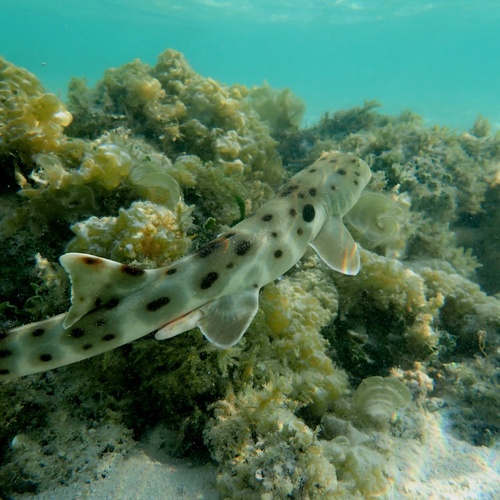
Inside that range it lives in about a metre of water. Reef flats, lagoons, rubble and tide pools are the habitat; FishBase gives a depth range of 0-50 m and the Florida Museum 40 m, but those are the outer edges of a life spent in the shallows. By day it wedges itself under a coral head or a ledge; it comes out at dusk, at night and on daytime spring low tides, which is when snorkellers meet it — a slender, blotchy brown shark with two black spots behind its head, propped on its fins in water barely deep enough to cover it.


- Heron Island reef flat, Capricorn–Bunker Group, Australia — Nearly every number on this page was measured here. The research station sits on a lagoon that drains at spring low tide, which is why the world’s best-studied low-oxygen vertebrate happens to be a small Queensland shark. Reef-flat temperatures there ran from 15 to 34 °C across 2017.
- The Capricorn Group, southern Great Barrier Reef — The southern end of the range, and the last reef the species is reliably recorded from. Anything reported further south — and the Florida Museum takes the range to Sydney — sits outside what Australian sources will sign off on.
- Cape York Peninsula & Sunday Island, far north Queensland — The northern end, with the northernmost verified record at Sunday Island (11°56’S, 143°12’E). Beyond here the reef flats belong to Torres Strait and New Guinea, where the walking sharks start turning into other species.
- New Guinea — On the range map in most global databases, and quietly missing from the Australian ones. Worth treating as unsettled: this is the heartland of the rest of the genus, and several of those species were unknown to science until recently.
Where it goes
Epaulette sharks do not migrate, and the scale of their world is the most surprising thing about them after the walking. They are site-attached: the 2020 phylogeny of the genus found limited dispersal in both juveniles and adults, and the researchers who use the species as a laboratory model describe it plainly as site-attached and benthic. No home range has ever been published in square metres, so we are not going to invent one — but the animal that gets tagged on a Heron Island reef flat is the animal you find on that reef flat again.
What moves instead is the water. The tide runs the day: the shark follows the flood in over the flat to feed, and as the ebb drains the lagoon it either walks back towards the reef crest or settles into a pool and waits the low out. That daily rhythm is the whole explanation for both of its famous tricks. A shark that lets itself be cut off by the tide needs a way to cross dry reef, and a way to breathe in a pool where the oxygen is running out.
Share of verified epaulette shark records by month (GBIF, all years). Darker rose means a larger share of sightings fall in that month. This reflects when people record them, which mixes real seasonality with when divers and boats are out.
What it eats
The epaulette shark eats what lives under the rubble. A study of stomach contents from Heron Island ranked the prey by importance and got worms first at 51.3%, crabs second at 40.1%, then shrimps at 7.7%, small fishes at 0.7% and amphipods at 0.3% — a diet with almost no swimming animals in it at all. Juveniles lean harder on worms; adults take more crabs. Feeding peaks at dusk and dawn, though a hungry shark will hunt at any hour.
Nothing about the hunt is fast. The mouth is small and set well under the snout, with a short barbel either side, and the shark works by nosing into sand and rubble and sucking. It finds prey by smell and by electroreception — the jelly-filled pores across its snout pick up the tiny electrical fields of a buried worm, and the epaulette shark’s electrosensory anatomy has been mapped in detail for exactly that reason. Walking is part of the hunting method rather than a party trick: fins that can push let it shove its head into a crevice and keep going, and get into pools where the prey is trapped and the competition cannot follow.
Is it dangerous?
There is no risk here. FishBase lists the species as harmless and the Florida Museum — which runs the International Shark Attack File — says the same, with the sensible caveat that a shark picked up by hand may bite. That caveat is the whole safety briefing. An epaulette shark is under a metre long, it eats worms, and it cannot outrun you; if you find one in a tide pool it will sit there and let you look at it. Look, photograph, and leave it exactly where it is.
The pressures run the other way, and they are unusual ones. Almost nobody fishes for this shark, but plenty of people keep it: it is small, calm and hardy, which makes it one of the most popular sharks in public and private aquariums, and collection for that trade is the threat the Save Our Seas Foundation names first. The bigger one is heat. Adults are extraordinarily tough — few sharks match their tolerance of low oxygen and high carbon dioxide — but embryos reared at 31 °C hatched earlier, smaller and with worse metabolic performance than those at 27 °C, and 31 °C is well inside the warming projected for these reefs this century. A species can be resilient in almost every way and still lose on the one that counts.
Epaulette shark facts
- Its gait is a tetrapod’s. Filmed against 13 anatomical landmarks, epaulette sharks use a sprawling, diagonal-sequence walk with the pelvic fins doing the work — those rotate 22-37° forward through a step, while the pectorals manage only 5-11°. Neonates and juveniles walk identically despite very different body shapes. — Porter et al. 2022, Integrative and Comparative Biology
- Three gaits, all slow. Young sharks average 3.02 cm per second at a slow-to-medium walk, 6.68 cm per second walking fast and 11.68 cm per second swimming — so a hurrying epaulette shark covers about four metres in a minute. — Porter et al. 2022, Integrative and Comparative Biology
- It survives 3.5 hours at 5% air saturation — 0.36 mg of oxygen per litre — at 25 °C, a level that would kill almost any other shark. Through two hours of that, blood flow to its brain does not drop, even as blood pressure falls by 50%, because the vessels feeding the brain dilate to compensate. — Wise, Mulvey & Renshaw 1998, J. Experimental Zoology / Söderström, Renshaw & Nilsson 1999, J. Experimental Biology
- In water with no oxygen at all (<0.02 mg per litre) an epaulette shark loses its righting reflex after 46.3 ± 2.8 minutes and then regains full alertness the moment oxygen returns. Brain adenosine — a natural nerve-cell sedative — rises 3.5-fold, and blocking its receptors keeps the shark responsive for longer but drains its brain of ATP. Going quiet is the survival strategy, not the injury. — Renshaw, Kerrisk & Nilsson 2002, Comparative Biochemistry and Physiology B
- The reef trains it. During nocturnal low tides the oxygen in an isolated reef-flat pool can fall by 80% as the coral and everything living in it breathes, and because tides get lower over successive nights, each episode is longer than the last. That is hypoxic preconditioning — the shark arrives at the worst night already primed, with a lowered metabolic rate. — Nilsson & Renshaw 2004, Journal of Experimental Biology
- Its diet is 90% worms and crabs. Stomach contents from Heron Island ranked prey at 51.3% worms, 40.1% crabs, 7.7% shrimps, 0.7% small fishes and 0.3% amphipods, found by smell and by the electrical sense in the pores across its snout. — Heupel & Bennett 1999, Marine and Freshwater Research
- Warming hits the eggs, not the adults. Embryos reared at 31 °C — a temperature within end-of-century projections for these reefs — hatched earlier and lighter than those at today’s 27 °C summer average, with reduced metabolic performance. Adults, by contrast, shrugged off 60 days at carbon dioxide levels projected for 2100. — Wheeler et al. 2021, Scientific Reports / Heinrich et al. 2014, Conservation Physiology
- Its genome mutates about as slowly as any vertebrate measured. Sequencing a pair of epaulette sharks and nine of their pups gave a rate of 7 x 10⁻¹⁰ mutations per base pair per generation — evidence that sharks really are a slow-evolving lineage, and a warning that they may recover genetic diversity slowly after a population crash. — Sendell-Price et al. 2023, Nature Communications
Photos
Seen lately
PierMonkey’s live map carries community shark sightings from iNaturalist, refreshed every three hours. Open the map to see where epaulette sharks have turned up recently.
How big is that, really?
Maximum reliably recorded length. Rose marks the large or potentially dangerous species the map flags as notable.
Help protect it
- Australasian Fishes on iNaturalistA photograph of a shark in a tide pool is a data point, and this is where an Australian one belongs: the project is curated by Australian Museum ichthyologists, who confirm or correct your identification. Records that clear that review are the same iNaturalist observations the PierMonkey shark map draws, so uploading one literally puts your shark on our map.
- Redmap AustraliaRedmap collects sightings of marine species turning up outside their usual range, which is how Australia is tracking species moving with warming water. If you see an epaulette shark well south of the Capricorn Group — the edge of the accepted range — that is exactly the report they want, and it takes a photo, a date and a location.
- New England Aquarium epaulette shark programmeCollection for aquariums is the main direct pressure on this species, so the useful question to ask any aquarium or shop is where its sharks came from. This one has an answer: it has bred epaulette sharks since 2009, hatched its 100th in January 2024, and sends pups to other institutions instead of taking them off a reef.
Report what you see
Photograph a shark, upload it, and once the community confirms the ID it becomes a research-grade record — which is where every sighting on our map comes from. Yours would appear here within three hours.
How to submit an observation →Organisations working on sharks like this one
- The Shark Trustgood for kidsReport eggcases and sightings, join campaigns, download free ID guides.
- Great Eggcase Huntgood for kidsWalk a beach, find a mermaid’s purse, log it. Over 630,000 eggcases recorded since 2003 — the easiest real science a family can do.
- Sharks4Kidsgood for kidsFree classroom lessons, virtual field trips and activity packs for teachers and parents.
- Save Our Seas FoundationFunds shark research and education worldwide; publishes what each project found.
- Shark StewardsCampaigns to end the shark fin trade and establish shark sanctuaries.
- OceanaPolicy campaigning on fisheries management and bycatch — the thing that actually kills sharks.
- IUCN Shark Specialist GroupThe scientists behind the Red List assessments. For older readers who want the primary source.
Conservation status: Least Concern (IUCN Red List, assessed 2015). Least Concern, assessed on 18 February 2015 by Bennett, Kyne and Heupel and published in Red List version 2015-4; FishBase still carries it as Least Concern in version 2025-2, so nothing has changed in a decade. The reasoning is unusually simple for a shark. Commercial fisheries have no interest in it — FishBase records its fishery value as none — most of its range sits inside the Great Barrier Reef Marine Park, and the population is considered stable. The two pressures worth watching are collection for the aquarium trade and, further ahead, water temperature: the experiments described below show the adults are tough and the eggs are not. Read the assessment →
Common questions
Can an epaulette shark really walk — and can it walk on land?▾
How can it survive with almost no oxygen?▾
Why do human brain researchers study this shark?▾
What are the two black spots behind an epaulette shark’s head for?▾
I found one in a rock pool at low tide — is it stranded, and should I move it?▾
Why are epaulette sharks in so many aquariums?▾
Keep exploring
- Noosa, Queensland — live surf conditions
- Snapper Rocks, Gold Coast — live surf conditions
- Kirra, Gold Coast — live surf conditions
- All 40 species →
Sightings © iNaturalist contributors (research-grade observations). Occurrence maps © GBIF.org contributors (CC BY). Community science, not a beach-safety service. Last updated 2026-09-20.
See where sharks are turning up — on the live map
The map and live conditions are open to everyone. A free account unlocks full 16-day forecasts and custom swell alerts.