
Whitetip reef shark
The reef shark that can breathe lying down — so it spends the day parked in a cave, hunts crevices after dark, and may pass its entire life on a few hundred metres of one reef.
Vital statistics
Live birth with a placenta, as in other requiem sharks: 1 to 5 pups, usually 2 or 3, born at 52–60 cm. Gestation is genuinely disputed — FishBase says more than five months, the Florida Museum gives 11–12 months for Great Barrier Reef sharks, and two aquarium births recorded in 2022 came 278 and 339 days after mating. Males mature at about seven years and 112–116 cm, females at about eight years and 114–122 cm.
The short version
The whitetip reef shark is a small, slender shark of Indo-Pacific coral reefs, named for the bright white tips on its first dorsal fin and the top of its tail. FishBase and the Florida Museum both give a maximum length of 213 cm, just under seven feet, but adults rarely reach even six, and the heaviest individual FishBase carries is 18.3 kg — a shark a person could lift. It lives from the Red Sea and East Africa across the Indian and Pacific Oceans to Hawaii and Pitcairn, and again in the eastern Pacific at Cocos Island, the Galápagos and the coast from Panama to Costa Rica, usually in 8 to 40 m of water.
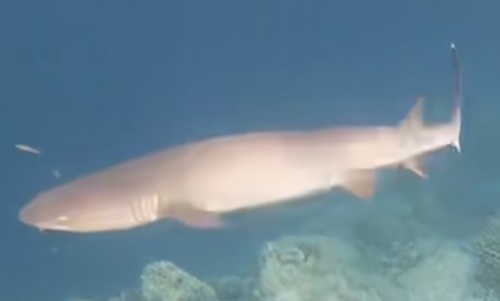
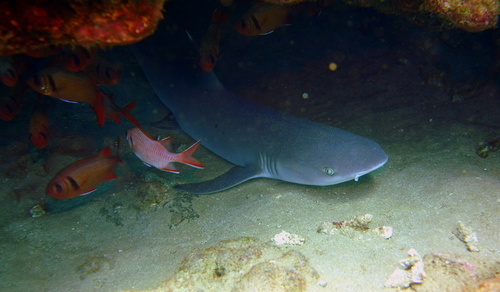
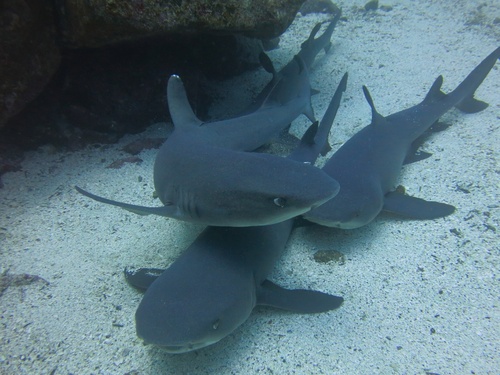
Most requiem sharks — the family that also holds the tiger, bull and blue sharks — have to keep swimming to push water over their gills. This one does not. It can pump water through its own mouth while lying still, so it spends the day motionless in caves and under ledges, often several sharks together, and hunts at night instead. Its blunt head and narrow body are built to force into crevices after fish that are asleep, and it barely travels: FishBase records lifetime movements of about 0.3 to 3 km, and tagged sharks at Isla del Coco returned a residency index of 0.97 over a year.
It is rarely a risk to people. The International Shark Attack File records five unprovoked whitetip reef shark bites and no fatalities since 1580, and the incidents that do happen cluster around spearfishing and hand-feeding. The IUCN listed the species as Vulnerable in 2020: it remains one of the commonest sharks on healthy reefs, but it is fished out reef by reef, and because each shark stays put for life, an emptied reef stays empty.
Where it lives
Where there is warm, clear coral reef in the Indian or Pacific Ocean, there is usually a whitetip reef shark under a ledge somewhere on it. FishBase draws the outline: the Red Sea and East Africa east through Indonesia and the Arafura Sea, north to the Ryukyu and Ogasawara islands of Japan, south to New South Wales and New Caledonia, and out across Micronesia and Polynesia to Hawaii and Pitcairn — roughly 29°N to 30°S. Then, separately, a block in the eastern Pacific: Cocos Island, the Galápagos, and the coast from Panama to Costa Rica. Australia’s national report card traces it from Point Quobba in Western Australia round the top to Gladstone in Queensland.
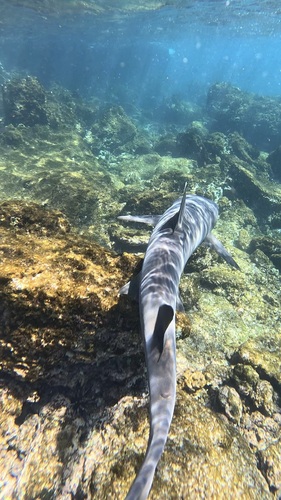
Inside that outline it stays shallow. FishBase gives a depth range of 0–330 m but puts it usually in 8–40 m; Australia’s report card says 1–330 m and commonly 10–40 m. It wants lagoons, seaward reef faces, coral ledges, caves, sand patches and current-swept channels, and it wants clear water, because this is a shark that hunts by pushing its head into holes. That shallowness is why this page exists: the whitetip reef shark is the third most-reported shark in PierMonkey’s own live sightings feed — 85 records in a recent 45-day window — not because it is unusual, but because it lies motionless in fifteen metres of clear water while a diver swims up and photographs it.
Common, though, is not the same as safe, and this species is the clearest case in the library of the difference. Across the Pacific islands, the lowest abundances are found around the islands with the highest human populations (Nadon and colleagues, 2012). On the Great Barrier Reef, underwater surveys estimated up to 80% fewer whitetips in fished zones than in no-take and no-entry zones, and a later study found abundance about 50% higher inside no-take zones. A shark that never leaves its reef cannot repopulate a reef that has been emptied, so the species can look abundant to a diver in a marine park and be gone entirely from the reef twenty kilometres away.


- Isla del Coco, Costa Rica — The night-hunting spectacle, and the place the residency numbers come from. Eight sharks tagged in Chatham and Wafer bays were picked up 278,706 times over a year, with an average residency index of 0.97 — about as close to "always here" as telemetry gets. Detections fall away after 6pm, which is the sharks leaving the bay to hunt the reef.
- Osprey Reef, Coral Sea, Australia — An isolated seamount and the cleanest test of site fidelity anyone has run on the species: 11 of 18 tagged adults were detected on more than 90% of days after tagging, and they stayed within about five kilometres of where they were caught for the whole study.
- Great Barrier Reef Marine Park, Australia — The natural experiment. Because the park is zoned into fished, no-take and no-entry areas, you can count the same shark species either side of a line on a chart — which is how the 80% difference between fished and protected zones was measured. Australia now assesses its own population as Near Threatened rather than Vulnerable, and its stock as sustainable, on the view that zoning and fishing rules let it recover.
- Main Hawaiian Islands — Where divers’ holiday photographs became science. Researchers identified 178 individual sharks from community-contributed photographs, matching them on natural markings, and found animals turning up at the same site again and again over seven years.
- Academy Bay, Santa Cruz, Galápagos — A saltwater creek south of the bay where tagged sharks used the inner channel by day and the water outside it at night — the daily commute of a resident shark, recorded receiver by receiver.
Where it goes
Almost every shark in this library is defined by where it goes. This one is defined by where it stays. FishBase sums up a lifetime of movement in a single line — distances of about 0.3 to 3 km over periods of up to a year — and Animal Diversity Web puts the average home range at around 2 km², which is a few reef bommies and the sand between them. Acoustic tagging says the same thing wherever it is tried: 0.97 residency at Isla del Coco, 11 of 18 sharks present on more than 90% of days at Osprey Reef. The long-distance record is modest by shark standards — 26.4 km, at up to 3.27 km a day, by one of 178 Hawaiian sharks identified from divers’ photographs, most of which simply kept reappearing at the reef where they were first photographed.
What it does instead of migrating is commute. Daylight is spent resting in caves, under coral ledges or on a sand patch, and the same caves get used again and again; at dusk the sharks move out over the reef to hunt, which is why the Cocos receivers go quiet after 6pm. That habit has a hard edge to it. A shark that lives its whole life on one reef is completely protected by a small marine reserve — the animals inside the line are the same animals year after year — and completely defenceless without one, because when a reef is fished out there is no travelling population to refill it. FishBase rates the species’ resilience "very low", with a minimum population doubling time of more than fourteen years.
Share of verified whitetip reef shark records by month (GBIF, all years). Darker rose means a larger share of sightings fall in that month. This reflects when people record them, which mixes real seasonality with when divers and boats are out.
What it eats
The whitetip reef shark eats the reef’s night shift and, more precisely, the animals other sharks cannot reach: bony fishes wedged in holes, octopus, spiny lobsters and crabs. FishBase puts it at trophic level 4.2, squarely predatory. Everything about the animal is shaped for getting into a coral head rather than for chasing anything down. The head is short, broad and blunt; the body is slender enough to follow it; the teeth each carry a central cusp flanked by two small cusplets, which is what gives the genus its name, Triaenodon, trident-tooth. Having found a fish by smell, sound and the electrical fields all animals leak, the shark shoves its head into the crevice and twists its whole body to force itself deeper, sometimes emerging from a hole on the other side of the coral head, sometimes snapping off lumps of coral and tearing its own skin and fins in the process.
It is also the shark most often described as hunting in packs, and that needs care. What observers at Isla del Coco and elsewhere describe is real: groups of whitetips moving over the reef face together after dark, poking into every crack in turn, and several sharks converging on one coral head so that every exit a fish might use is covered. But nobody has shown they divide up roles or share a plan, and each shark swallows what it catches. The honest description is a loosely organised crowd rather than a wolf pack: dozens of individuals working the same reef on the same schedule, each one drawn to the commotion the others make. That instinct to investigate commotion is also why they turn up fast around a speared fish.
Is it dangerous?
This is one of the least dangerous sharks a swimmer can meet, and the record says so plainly. The International Shark Attack File, which runs from 1580 to the present, lists five unprovoked whitetip reef shark bites and no deaths at all. The Florida Museum describes the species as rarely aggressive, placid enough to be hand-fed — which is the part that causes what little trouble there is. Two habits make a whitetip pushy: spearfishing, because a struggling speared fish is exactly the signal the shark evolved to run towards, and feeding, because sharks at heavily visited sites learn to come up to the sound of a boat engine expecting food. Neither is the shark misbehaving. Keep speared fish out of the water, do not feed them, and leave a resting shark alone in its cave — poking one out of a ledge for a photograph wakes an animal that needs that ledge tomorrow as well.
Turn the question round and the traffic is one-sided, as usual. Whitetip reef sharks are caught by commercial, recreational and artisanal fisheries all over the coral-reef tropics, usually on inshore longlines and in gillnets, and the meat and liver are eaten — though the Florida Museum warns the liver carries a risk of ciguatera poisoning. They are easy to catch and slow to replace: FishBase scores the species at 83 out of 100 for fishing vulnerability, with a very low resilience and a population doubling time over fourteen years, because a shark that matures at seven or eight and has two or three pups at a time cannot absorb much. Since 25 November 2023 international trade in every requiem shark, this one included, requires a CITES Appendix II permit.
Whitetip reef shark facts
- Unusually for a requiem shark, it can breathe without swimming. By pumping water through its mouth and over its gills — buccal pumping — it can lie motionless on the bottom for hours, which is why divers find whitetips stacked in caves by day while their relatives are still swimming laps. — Animal Diversity Web / Save Our Seas Foundation
- It may be the least travelled shark in this library. FishBase sums up its movements as distances of about 0.3 to 3 km over periods of up to a year, and Animal Diversity Web gives an average home range of roughly 2 km² — a patch of reef you could snorkel across in an afternoon. — FishBase / Animal Diversity Web
- Eight whitetips tagged in Chatham and Wafer bays at Isla del Coco, Costa Rica, were detected 278,706 times between November 2014 and December 2015, giving an average residency index of 0.97 out of 1. Detections dropped away after 6pm each evening, when the sharks left to hunt. — Revista de Biología Tropical, 2020 (Isla del Coco residency study)
- Divers’ holiday photographs identified 178 individual whitetips around the main Hawaiian Islands, matched on natural markings. The longest movement recorded was 26.4 km, at up to 3.27 km a day, while other sharks were re-sighted at the same spot up to 13 times across seven years. — Whitney et al. 2012, Environmental Biology of Fishes
- Its hunting style damages both the reef and the shark. A whitetip that finds a fish in a hole twists violently to force itself in, sometimes squeezing into one side of a coral head and out of the other, breaking off coral and tearing its own skin and fins as it goes. — R. Aidan Martin, ReefQuest Centre for Shark Research
- On the Great Barrier Reef, surveys estimated up to 80% fewer whitetip reef sharks in fished zones than in no-take and no-entry zones, and a later study found about 50% higher abundance inside no-take zones. Across the Pacific islands, the fewest sharks are found around the islands with the most people. — Robbins 2006 and Espinoza et al. 2014, via Australia’s SAFS report card
- The name is all teeth and belly. Triaenodon comes from the Greek for trident, because each tooth carries a central cusp with two small cusplets beside it; obesus is Latin for stout, for the blunt head that makes the shark look plump. It is the only species in its genus. — ETYFish via FishBase
- A slow shark in a fast fishery: FishBase scores it 83 out of 100 for fishing vulnerability and rates its resilience "very low", with a minimum population doubling time of more than 14 years. Since 25 November 2023 it has been listed on CITES Appendix II with the rest of the requiem sharks. — FishBase / CITES
Photos
Seen lately
PierMonkey’s live map carries community shark sightings from iNaturalist, refreshed every three hours. Open the map to see where whitetip reef sharks have turned up recently.
How big is that, really?
Maximum reliably recorded length. Rose marks the large or potentially dangerous species the map flags as notable.
Help protect it
- Friends of Cocos Island (FAICO)The Costa Rican foundation that funds the management and protection of Isla del Coco National Park — the reef where the night hunt has been filmed and the residency work was done. Donating here pays for the protection of a place whose sharks cannot move somewhere safer.
- CITES Sharks and Rays — requiem sharksWhat the November 2023 Appendix II listing actually means in practice, species by species. Read it before you buy shark meat, a jaw or a souvenir on a reef holiday: international trade in this shark now needs a permit, and this page tells you what a legal one looks like.
- Global FinPrintThe worldwide reef shark and ray survey, with an interactive map of every reef they filmed, what they saw there and what protection is in place. Look up the reef you dive or surf before you go, then use it to argue for no-take zoning where the map is empty.
Report what you see
Photograph a shark, upload it, and once the community confirms the ID it becomes a research-grade record — which is where every sighting on our map comes from. Yours would appear here within three hours.
How to submit an observation →Organisations working on sharks like this one
- The Shark Trustgood for kidsReport eggcases and sightings, join campaigns, download free ID guides.
- Great Eggcase Huntgood for kidsWalk a beach, find a mermaid’s purse, log it. Over 630,000 eggcases recorded since 2003 — the easiest real science a family can do.
- Sharks4Kidsgood for kidsFree classroom lessons, virtual field trips and activity packs for teachers and parents.
- Save Our Seas FoundationFunds shark research and education worldwide; publishes what each project found.
- Shark StewardsCampaigns to end the shark fin trade and establish shark sanctuaries.
- OceanaPolicy campaigning on fisheries management and bycatch — the thing that actually kills sharks.
- IUCN Shark Specialist GroupThe scientists behind the Red List assessments. For older readers who want the primary source.
Conservation status: Vulnerable (IUCN Red List, assessed 2020). Assessed globally as Vulnerable in 2020 (Simpfendorfer and colleagues), population trend decreasing. The argument is not that the shark is rare — it is still one of the commonest sharks on Indo-Pacific reefs — but that it is being thinned out reef by reef: underwater surveys show local depletion in several regions, and abundance is lowest around the islands with the most people on them. Australia assesses its own population separately as Near Threatened (Kyne et al. 2021, the Action Plan for Australian Sharks and Rays), on the grounds that marine reserves and fishing rules have probably let it recover there. The uplisting is recent enough that good reference pages still carry the old one: the Florida Museum’s species profile, for instance, still says Near Threatened. Since 25 November 2023 every requiem shark, this one included, has needed a CITES Appendix II permit to cross an international border. Read the assessment →
Common questions
Why can a whitetip reef shark rest on the bottom when most requiem sharks cannot?▾
Are whitetip reef sharks dangerous to divers and snorkellers?▾
Do whitetip reef sharks really hunt in packs?▾
Will the same whitetip reef shark still be there next year?▾
What is the difference between a whitetip reef shark and an oceanic whitetip?▾
If divers see so many, why is the whitetip reef shark Vulnerable?▾
Keep exploring
- Pasta Point, Maldives — live surf conditions
- Cloudbreak, Fiji — live surf conditions
- Teahupo’o, Tahiti — live surf conditions
- Witch’s Rock, Costa Rica — live surf conditions
- All 40 species →
Sightings © iNaturalist contributors (research-grade observations). Occurrence maps © GBIF.org contributors (CC BY). Community science, not a beach-safety service. Last updated 2026-09-20.
See where sharks are turning up — on the live map
The map and live conditions are open to everyone. A free account unlocks full 16-day forecasts and custom swell alerts.