
Whale shark
The biggest fish in the ocean, and it lives on some of the smallest food in it.
Vital statistics
Live birth from egg cases carried inside the mother. The one pregnant female ever examined in detail held about 300 pups at every stage at once; newborns are 40–64 cm long.
The short version
The whale shark is the largest fish alive. The biggest individual ever carefully measured was 18.8 metres, and the heaviest ever actually put on a scale was 12.65 metres and about 21.5 tonnes. Most whale sharks people meet are much smaller than that: coastal gathering sites are dominated by juvenile males of roughly 6 to 10 metres. It lives in tropical and warm-temperate seas across the Atlantic, Pacific and Indian Oceans — every warm sea except the Mediterranean.
For all its size it is a filter feeder and completely harmless to people. It swims with its mouth open and strains plankton, fish eggs, krill, small schooling fish and squid through twenty filter pads inside its throat. It carries more than three thousand teeth, each about six millimetres long, and uses none of them to eat. Swimming with whale sharks is a licensed, regulated industry in a dozen countries.
The IUCN lists the whale shark as Endangered, reassessed in 2025, with a decreasing population. Numbers are inferred to have fallen by between 50% and 79% over the last three generations — 120 years — mainly through capture in fishing nets and collisions with ships. Recovery is slow because the animal is slow: males take around 25 years to mature, females longer still.
Where it lives
Whale sharks live right around the world in a broad band of warm water, roughly between 30° north and 35° south. That takes in all the tropical and warm-temperate seas of the Atlantic, Indian and Pacific Oceans, with one conspicuous gap: they are absent from the Mediterranean. FishBase puts their temperature range at 18–30 °C and the Florida Museum narrows the preferred band to 21–30 °C, which is why a map of whale shark sightings looks so much like a map of warm surface water.
Most of their life happens in open ocean rather than near a coast. Satellite tags have followed whale sharks down to 1,928 metres, but the same tagging work found they spend about 96% of their time in the sunlit top layer of the sea. The gatherings snorkellers visit are the visible fraction of a mostly offshore animal, and that is a large part of why basic questions — where they breed, where the adults spend their time — are still open. Genetics splits the world population in two, an Atlantic group and a much larger Indo-Pacific one, with surprisingly little traffic between them given how far individuals can travel.
The coastal gatherings are predictable because they are feeding events: a coral spawning, a fish spawning, a seasonal bloom. They are also strangely lopsided. Almost every well-studied coastal site is made up of young males under about ten metres. Big adult females are hardly ever seen, apart from a few places such as Darwin Island in the Galápagos and the waters off Saint Helena, and that missing half of the population is one of the largest gaps in whale shark science.


- Ningaloo Reef, Western Australia — Sharks arrive after the reef’s mass coral spawning. The licensed swim season runs 1 March to 31 July and peaks in April and May. Western Australia wrote the first rulebook for swim-with tours and most other countries copied it.
- Isla Mujeres & the Afuera, Mexico — The largest gathering ever counted: 420 whale sharks in a single aerial survey over about 18 km² of open water, feeding on the eggs of little tunny. Present from May to mid-September.
- South Ari Atoll, Maldives — One of the few sites where whale sharks are seen all year rather than in one season — which is also why boat-strike injuries have been studied here more closely than anywhere else.
- Oslob, Cebu, Philippines — The controversial one. Sharks are hand-fed shrimp from paddleboats every morning and an encounter is close to guaranteed. Studies show the sharks learn the routine and stay longer than they otherwise would; whether that actually harms them is still argued over in the literature. Worth reading about before you book.
- Darwin Island, Galápagos, Ecuador — Almost the opposite of everywhere else: the sharks here are huge adult females, most with the swollen bellies that suggest pregnancy — though ultrasound work has yet to confirm it. A rare look at the part of the population nobody normally sees.
Where it goes
All of it is done slowly. The swimming speeds anyone has actually measured sit at around one metre per second — roughly 4 to 5 km/h, the pace of a brisk walk — whether the shark is feeding or just going somewhere, and no reliable burst speed has ever been recorded for the species. Whale sharks turn up at the same feeding sites at roughly the same time each year, then travel a very long way in between. The record belongs to a female tagged off Coiba, in Panama, in 2011 and named Anne. Her tag reported for 841 days and traced 20,142 kilometres across the Pacific — past the Galápagos, south of Hawaii, ending near the Mariana Trench. It is the longest whale shark migration on record, and a reminder that a shark protected in one country can be caught in the next one along. What makes that record possible at all is the other half of their behaviour: individuals come back. Many whale sharks show real fidelity to a feeding site and are re-photographed there season after season, which is how a database of named, known animals exists for a fish that spends most of its life out of sight.
They migrate vertically as well as horizontally. Tagged sharks dive in repeated up-and-down patterns day and night, and one male in the Gulf of Mexico went to 1,928 metres — deep enough that the tag’s pressure failsafe let go. Sharks feeding on fish eggs off the Yucatán run the reverse of the usual daily pattern, cruising the surface from sunrise and then switching to steady deep oscillations in the afternoon. The leading explanation is that this is simply how a filter feeder searches a three-dimensional ocean for patchy food.
Share of verified whale shark records by month (GBIF, all years). Darker rose means a larger share of sightings fall in that month. This reflects when people record them, which mixes real seasonality with when divers and boats are out.
Ningaloo Reef, Western Australia: The licensed interaction season runs 1 March to 31 July. Sightings cluster from early April to early June, and in some years a few sharks linger into August or later.
What it eats
The mouth is up to a metre and a half wide, and behind it sit twenty filter pads — sieves that evolved from gill rakers. The shark uses cross-flow filtration: water slides across the face of the pads rather than being pushed straight through them, so particles smaller than the holes still get caught and the mesh does not clog. It works well enough that a six-metre shark strains roughly 600 cubic metres of water an hour, and sharks off Mexico were recorded feeding at the surface for about seven and a half hours a day. Surface feeding is just the part we can watch, though; much of the rest of the diving they do looks like feeding too.
“Plankton” undersells the menu. Whale sharks eat sergestid shrimp, copepods, arrow worms, krill and fish larvae, and they eat a great deal of fish spawn — the Mexican Caribbean gathering exists because little tunny spawn there. They also take small schooling fish and squid, sometimes by hanging almost vertically in the water and sucking a whole bait ball in. Their three thousand-odd teeth, each about the size of a grain of rice, play no part in any of it.
Is it dangerous?
A whale shark is not dangerous to people. It has no interest in anything it cannot filter, the Florida Museum files it under “generally considered harmless”, and there is no record of one deliberately injuring anybody. The only real hazard is physical: a tail that size shifts a lot of water, so stay out of its arc and let the shark choose the distance. Do not touch one. The skin carries a mucus layer that protects it from infection, and grabbing on or riding — still done, still filmed — is banned everywhere the activity is properly managed.
The danger runs the other way, and it is not close. The 2025 Red List assessment names incidental capture in net fisheries and injury from vessel strikes as the two big threats, with meat eaten locally and fins entering international trade whenever a shark is landed. Tourism helps when it is regulated and hurts when it is not: at Ningaloo the rules are three metres from the body, four from the tail, ten swimmers in the water at a time, no flash and no touching, and that is a reasonable standard to hold any operator to anywhere in the world. An animal that takes 25 or 30 years to breed cannot absorb much of any of this. The IUCN’s separate recovery scoring calls the species “largely depleted”, at 29% of what a healthy global population would look like — but it also concludes that a full recovery is possible within a century if bycatch in gillnet and purse-seine fisheries is brought down and kept down.
Whale shark facts
- It is the largest fish in the ocean. The biggest specimen anyone has measured reliably was 18.8 m, caught in the Arabian Sea; claims of 20 m and more exist but nobody recorded how they were measured. — McClain et al. 2015, PeerJ
- The heaviest one ever weighed was 12.65 m long and about 21.5 tonnes, landed off Baba Island near Karachi, Pakistan. That is the record for the heaviest fish species of any kind. — Guinness World Records
- The pattern of white spots behind the gills is unique to each shark, like a fingerprint. The software that matches them was adapted from a Hubble Space Telescope algorithm written to line up star fields. — Arzoumanian, Holmberg & Norman 2005, J. Applied Ecology
- A female named Anne, tagged off Panama, was tracked 20,142 km across the Pacific over 841 days, ending near the Mariana Trench — the longest whale shark migration ever recorded. — Guzman et al. 2018 / Smithsonian STRI
- One tagged male dived to 1,928 m in the Gulf of Mexico, the deepest dive known for the species. The tag’s pressure failsafe released it on the way down. — Tyminski et al. 2015, PLOS ONE
- Only one pregnant whale shark has ever been examined properly — a 10.6 m female landed in Taiwan in 1995, carrying about 300 pups at every stage from egg case to newborn. Genetic testing later showed they all had the same father. — Joung et al. 1996 / Schmidt et al. 2010
- Their eyeballs are covered in roughly 2,900 tiny tooth-like scales, and they can pull the eye halfway back into the socket. No other vertebrate is known to armour its eyes this way. — Tomita et al. 2020, PLOS ONE
- Nobody knows how long they live. The oldest individual ever aged was 50 years, confirmed by bomb-radiocarbon dating of its vertebrae; growth models stretch the estimate to somewhere between 80 and 130. — Ong, Campana & Meekan 2020, Frontiers in Marine Science
Photos
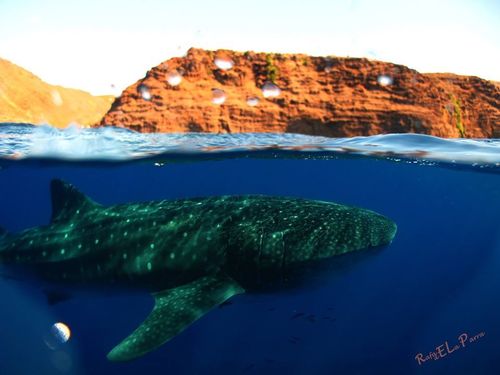

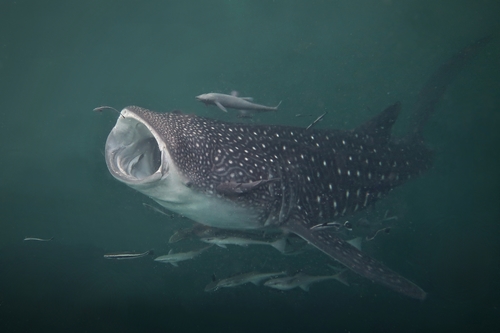
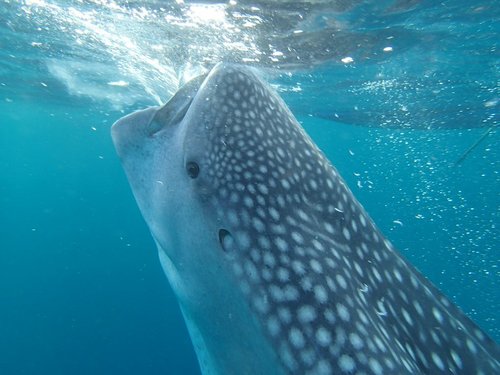
Seen lately
PierMonkey’s live map carries community shark sightings from iNaturalist, refreshed every three hours. Open the map to see where whale sharks have turned up recently.
How big is that, really?
Maximum reliably recorded length. Rose marks the large or potentially dangerous species the map flags as notable.
Help protect it
- Sharkbook (Wildbook for Whale Sharks)If you have ever swum with a whale shark, upload the photo of its left side behind the gills. The spot-matching software will tell you which individual it was, and your holiday snap becomes a data point in a global population study.
- Marine Megafauna FoundationRuns long-term whale shark research in Mozambique and beyond, and publishes a plain-English guide to the species. Read their anatomy and reproduction pages before you book any swim-with trip.
- LAMAVE (Large Marine Vertebrates Research Institute Philippines)The team that actually studied the fed sharks at Oslob and Donsol. Their published work is the place to go if you want to decide for yourself about provisioned tourism; they also take volunteers and interns.
Report what you see
Photograph a shark, upload it, and once the community confirms the ID it becomes a research-grade record — which is where every sighting on our map comes from. Yours would appear here within three hours.
How to submit an observation →Organisations working on sharks like this one
- The Shark Trustgood for kidsReport eggcases and sightings, join campaigns, download free ID guides.
- Great Eggcase Huntgood for kidsWalk a beach, find a mermaid’s purse, log it. Over 630,000 eggcases recorded since 2003 — the easiest real science a family can do.
- Sharks4Kidsgood for kidsFree classroom lessons, virtual field trips and activity packs for teachers and parents.
- Save Our Seas FoundationFunds shark research and education worldwide; publishes what each project found.
- Shark StewardsCampaigns to end the shark fin trade and establish shark sanctuaries.
- OceanaPolicy campaigning on fisheries management and bycatch — the thing that actually kills sharks.
- IUCN Shark Specialist GroupThe scientists behind the Red List assessments. For older readers who want the primary source.
Conservation status: Endangered (IUCN Red List, assessed 2025). Endangered under criterion A2bd, last assessed 31 March 2025, population trend decreasing. A reduction of 50–79% is inferred over the last three generations — 120 years. The Indo-Pacific subpopulation, which holds about three quarters of the world’s whale sharks, is down more than 65% and rates Endangered on its own; the Atlantic subpopulation is down at least 30% and rates Vulnerable. Read the assessment →
Common questions
How big is a whale shark?▾
Are whale sharks dangerous to swim with?▾
What do whale sharks eat?▾
Where can you see whale sharks?▾
How long do whale sharks live?▾
Why are whale sharks endangered?▾
Keep exploring
- Pasta Point, Maldives — live surf conditions
- Cloud 9, Siargao — live surf conditions
- Pavones, Costa Rica — live surf conditions
- All 40 species →
Sightings © iNaturalist contributors (research-grade observations). Occurrence maps © GBIF.org contributors (CC BY). Community science, not a beach-safety service. Last updated 2026-09-20.
See where sharks are turning up — on the live map
The map and live conditions are open to everyone. A free account unlocks full 16-day forecasts and custom swell alerts.