
Tiger shark
A warm-water wanderer with the widest menu of any shark, named for stripes it loses as it grows up.
Vital statistics
Live birth after 13–16 months; 10–82 pups at 51–76 cm — and, alone among the requiem sharks, with no placenta.
The short version
The tiger shark is the largest of the requiem sharks, the only living member of its genus — recent taxonomy splits it into a family of its own, Galeocerdonidae — and one of the most widely distributed big predators in the ocean. The largest individual actually measured in the scientific literature was 5.5 m, off Australia; most adults run between about 3.25 and 4.25 m, and the heaviest ever landed on rod and line weighed 807 kg. It lives in tropical and warm-temperate water worldwide — essentially every warm sea except the Mediterranean — and it takes its name from the dark vertical bars a young one wears and an adult gradually loses.
It is famous for eating almost anything, and the reputation is earned: fish, squid, rays, other sharks, sea snakes, seabirds, sea turtles, dolphins and dugongs all turn up in stomach surveys, along with carrion and, near towns, human rubbish. The teeth explain the turtles. Each one is a broad, deeply notched cockscomb with serrations on its serrations, the same shape in the upper and lower jaw, and it cuts rather than punctures. Tiger sharks also travel: individuals make repeated annual round trips of more than 7,500 km, and one covered 8,000 km in 99 days.
The IUCN lists the tiger shark as Near Threatened, with a suspected decline of about 30% over three generations. It is one of the three species most often identified in serious bites on people — and that record amounts to 142 unprovoked cases in a global file that begins in 1580.
Where it lives
Tiger sharks are a warm-water species on a very long leash. FishBase puts the range between 62° N and 44° S, which looks enormous until you notice how much of it is seasonal: they push into temperate water while it is warm and pull back when it cools. They use continental and island shelves, estuaries, harbours, coral atolls and lagoons, and the Florida Museum notes one conspicuous hole in an otherwise global range — the Mediterranean.
Temperature, not geography, is what actually draws the boundary. Satellite tags in the western Atlantic recorded sharks in 22–30 °C water for the great majority of their time, with a modelled preference nearer 26–28 °C and about 22 °C as the cool-end limit. Tags off Western Australia found animals spending most of their time at 23–26 °C while experiencing anything from 6 °C to 33 °C, and in Shark Bay catch rates climb sharply once the water passes 19 °C.
Depth is the other half of the picture. Day to day they work the top hundred metres or so, which is why the tiger is the big shark most often seen from a boat in the tropics. They are not tied to it, though: FishBase compiles records to 800 m, and a 3.7 m female tracked across the Coral Sea went to 1,136 m. The sharks people see inshore are simply the part of the population that happens to be shallow that day.


- Main Hawaiian Islands — Resident around every main island year-round, with an autumn influx of large females from the northwest. Tiger sharks account for 47% of Hawaii’s recorded bite incidents since 1995.
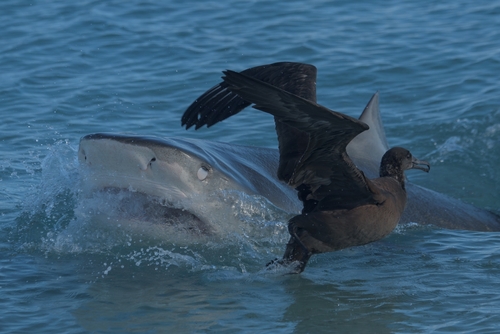
- Lalo (French Frigate Shoals), Papahānaumokuākea — Tiger sharks converge on the atoll’s islets each summer to take fledgling albatrosses. While they are there, grey reef and Galapagos sharks get out of the way.
- Tiger Beach, Grand Bahama — A female-dominated aggregation in shallow, warm water: of 65 sharks sampled across four seasons, 59 were female and 23 of those were pregnant. Now one of the best-known shark dives in the world.
- Shark Bay, Western Australia — Seagrass, dugongs, sea snakes and green turtles. Catch rates rise with water temperature, and 25 years of work here produced the best evidence anywhere that fear of a shark can reshape an entire ecosystem.
- Northwest Atlantic & Gulf of Mexico — Caribbean reef waters in winter, open ocean at higher latitudes in summer. The northern edge of that range has moved more than 400 km since the 1980s.
Where it goes
Tiger sharks are among the best-travelled fish in the sea, and satellite tags have turned that reputation into numbers. Adult males tagged in the Bahamas were followed for up to three years making the same round trip annually — over 7,500 km between Caribbean reefs in winter and open ocean at high latitude in summer, returning to the same overwintering island each time. A female tagged in Shark Bay covered at least 8,000 km to the coast of southeast Africa in 99 days. Not every shark does it: smaller, immature animals tend to stay put, a split biologists call partial migration.
The Hawaiian pattern is the best-documented seasonal one, and it has a practical edge. Acoustic tracking showed that about a quarter of mature females leave the remote northwestern atolls and move down to the main islands in late summer and autumn to give birth, and detections spike in October. Further north, warming is moving the whole picture: NOAA reports the northwest Atlantic range extending about 4° of latitude — more than 400 km — since the 1980s, with sharks arriving roughly 14 days earlier for every 1 °C of sea-surface warming, which is pushing them out of the areas closed to longlining.
Share of verified tiger shark records by month (GBIF, all years). Darker rose means a larger share of sightings fall in that month. This reflects when people record them, which mixes real seasonality with when divers and boats are out.
Main Hawaiian Islands: Tiger sharks are around the main islands all year — this is relative nearshore abundance, not presence and absence. The late-summer and autumn rise is the arrival of mature females from the northwestern atolls, peaking with the September–November pupping season.
What it eats
No large shark eats a wider menu. Stomach studies from Hawaii, Western Australia and South Africa produce a list running from fish, squid and crabs through rays and smaller sharks to sea snakes, seabirds, sea turtles, dolphins and dugongs, plus whatever carrion drifts past. The mix changes as the shark grows: small tiger sharks live mostly on fish and cephalopods, and turtles, birds and large prey only become important once the shark is big enough to handle them. That is a jaw story as much as an appetite one. Each tooth is a broad cockscomb with a deep notch and serrations carrying their own smaller serrations — a saw rather than a spike — which is how a tiger shark opens the bony carapace of an adult sea turtle, something almost nothing else in the sea can do.
The rubbish reputation is the famous part, and the half-true part. Tiger sharks genuinely do swallow indigestible human litter — tins, packaging, leather, butcher’s bones — often enough to have earned the nickname. But it shows up overwhelmingly in sharks caught near towns and harbours and is close to absent far from people, so it describes what we leave in the water rather than what the shark hunts. Their appetite also does work nobody sees: in Shark Bay, dugongs and green turtles shift which parts of a seagrass bank they graze depending on whether tiger sharks are about, so the sharks shape the meadow without eating a blade of it.
Is it dangerous?
Tiger sharks are one of three species — with the white and the bull — behind most serious bites on people, and that is worth saying plainly rather than dancing around. The scale is the part usually left out. The International Shark Attack File runs from 1580 to the present and holds 142 unprovoked tiger shark cases in that entire span. Worldwide, all species together average about 61 unprovoked bites a year and around eight deaths. Where a seasonal pattern is known it is genuinely useful: in Hawaii, October is the month to take a little more care, because that is when pregnant females come inshore to pup. The rest of the advice is dull, which is a good sign — go in with other people, stay out of murky water near river mouths and outflows, keep away from bait and fishing lines, and take local warnings at face value.
The comparison that matters runs the other way. Around 80 million sharks were killed by fishing in 2019, and the tiger shark is assessed as Near Threatened on a suspected 30% decline over three generations. It is legally protected across very little of its range, and it is taken as longline bycatch, for fins, meat and skin, and in beach-netting programmes. You are very unlikely ever to be bitten by one. A tiger shark is very likely to meet a hook.
Tiger shark facts
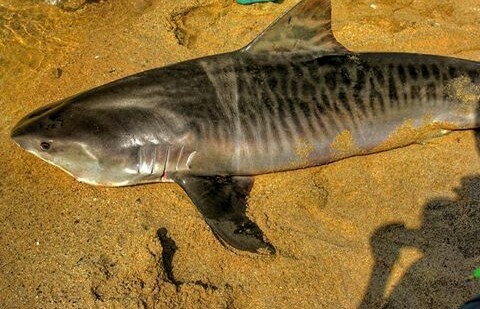
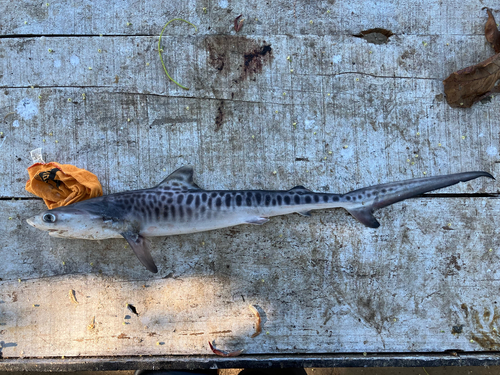
- Juveniles are strongly barred and blotched down the flank; the markings fade as the shark grows and are usually faint on anything over about 3 m. The name fits the young far better than the adults. — Florida Museum ISAF
- Every tooth is a broad cockscomb with a deep notch and serrations that carry their own smaller serrations — and the same shape sits in both jaws. It works as a saw, which is how a tiger shark opens a sea turtle. — Türtscher et al. 2022
- Alone among the requiem sharks, tiger sharks grow no placenta. Pups develop on yolk inside the mother for 13–16 months and are born at 51–76 cm, in litters of 10 to 82. — Holmes et al. 2018
- Bomb-radiocarbon dating validated their growth bands as annual to age 20. The oldest sharks directly aged were 20 and 22 years, with models predicting 27–29 and other studies reaching 33 — while FishBase still carries an unvalidated 50. — Kneebone et al. 2008
- A female tagged in Shark Bay, Western Australia covered at least 8,000 km to the coast of southeast Africa in 99 days — the longest tiger shark movement on record. — Heithaus et al. 2007
- Across 1995–2024, 20% of Hawaii’s shark bite incidents happened in October — two to four times any other month — and tiger sharks accounted for at least 63% of them. It lines up with their September–November pupping season. — Meyer 2026, Frontiers in Marine Science
- Their northwest Atlantic range has extended about 4° of latitude, over 400 km further north, since the 1980s, and they arrive roughly 14 days earlier for each 1 °C of sea-surface warming. — NOAA Fisheries
- In Shark Bay, dugongs and green turtles change which parts of a seagrass bank they graze depending on whether tiger sharks are around. The sharks reshape the meadow without eating any of it. — Burkholder et al. 2013
Photos
Seen lately
PierMonkey’s live map carries community shark sightings from iNaturalist, refreshed every three hours. Open the map to see where tiger sharks have turned up recently.
How big is that, really?
Maximum reliably recorded length. Rose marks the large or potentially dangerous species the map flags as notable.
Help protect it
- Shark Trust — Tiger Shark ID GuideA free one-page download that shows you how to tell a tiger from the other grey sharks — the notched teeth, the blunt snout, the bars. Learn it and your sighting report is worth something.
- International Shark Attack FileThe Florida Museum keeps the only investigated global record of shark bites. Look up the real numbers for your own coast — and report an incident if you witness one, because their data depends on it.
- Shark Bay Ecosystem Research ProjectTwenty-five years of tiger shark work in Western Australia, published openly. Read how they proved that a predator changes a seagrass meadow by being frightening rather than by eating.
Report what you see
Photograph a shark, upload it, and once the community confirms the ID it becomes a research-grade record — which is where every sighting on our map comes from. Yours would appear here within three hours.
How to submit an observation →Organisations working on sharks like this one
- The Shark Trustgood for kidsReport eggcases and sightings, join campaigns, download free ID guides.
- Great Eggcase Huntgood for kidsWalk a beach, find a mermaid’s purse, log it. Over 630,000 eggcases recorded since 2003 — the easiest real science a family can do.
- Sharks4Kidsgood for kidsFree classroom lessons, virtual field trips and activity packs for teachers and parents.
- Save Our Seas FoundationFunds shark research and education worldwide; publishes what each project found.
- Shark StewardsCampaigns to end the shark fin trade and establish shark sanctuaries.
- OceanaPolicy campaigning on fisheries management and bycatch — the thing that actually kills sharks.
- IUCN Shark Specialist GroupThe scientists behind the Red List assessments. For older readers who want the primary source.
Conservation status: Near Threatened (IUCN Red List, assessed 2019). Assessed as Near Threatened on a suspected decline of roughly 30% over three generations. Fished for fins, meat, skin and liver oil, taken as longline bycatch and killed in beach-netting programmes; protected across very little of its range. Read the assessment →
Common questions
How big do tiger sharks get?▾
Why is it called a tiger shark?▾
Are tiger sharks dangerous to swimmers and surfers?▾
What do tiger sharks eat?▾
Do tiger sharks really eat rubbish?▾
Are tiger sharks endangered?▾
Keep exploring
Sightings © iNaturalist contributors (research-grade observations). Occurrence maps © GBIF.org contributors (CC BY). Community science, not a beach-safety service. Last updated 2026-09-20.
See where sharks are turning up — on the live map
The map and live conditions are open to everyone. A free account unlocks full 16-day forecasts and custom swell alerts.