
Tawny nurse shark
The Indo-Pacific’s own nurse shark — a rust-brown reef sleeper that piles up in caves by day, feeds by suction after dark, and spits water at anyone who lifts it out.
Vital statistics
Live birth without a placenta, and unique among carpet sharks: the embryos run out of yolk and then eat unfertilised eggs the mother keeps producing (oophagy). Pups are born 40–60 cm long. Litter size is genuinely disputed — Compagno reports as few as one or two, the Florida Museum up to eight, and compilations of the Australian records give 26–32.
The short version
The tawny nurse shark is the Indo-Pacific half of a story most people only know the Atlantic end of. It is a big, blunt, rust-brown bottom shark of tropical reefs, found from the Red Sea and East Africa east to the Tuamotu Islands, north to southern Japan and south to northern Australia. The largest reliably reported was 3.2 m long, adults are usually 2.25–2.5 m, and no authority publishes a maximum weight for it at all. It is not the Atlantic nurse shark, Ginglymostoma cirratum: different genus, different ocean, ranges that never meet.
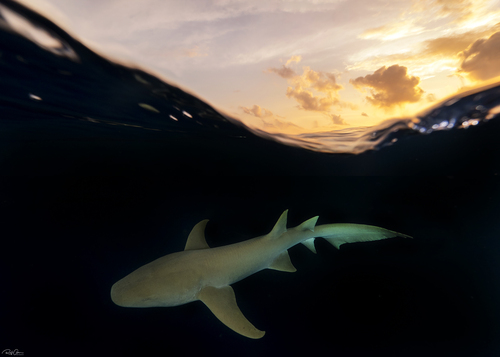
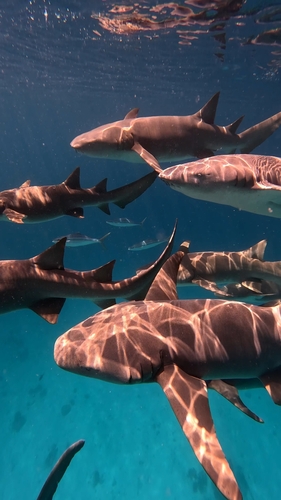
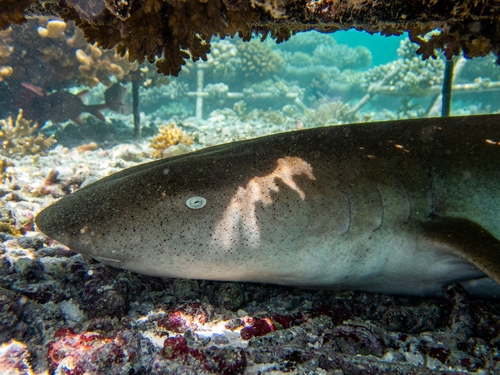
Day to day it lives much as its Atlantic relative does — nocturnal, resting through the daylight in caves and under ledges in groups of two dozen or more sharks piled on one another, feeding by suction rather than pursuit. The differences are in the detail. The tawny is the slimmer and more mobile of the two, described by Compagno as the more active swimmer; it can slowly change colour to match the bottom; and hauled up on a line it fires jets of water at whoever is holding it, grunting between them — hence spitting shark.
Its reproduction is stranger still, and unique among carpet sharks: the embryos develop inside the mother without a placenta, and once their own yolk runs out they eat unfertilised eggs she keeps producing — oophagy. The IUCN assessed the species as Vulnerable with a decreasing population in 2021, because it lives in shallow inshore water that is heavily fished almost everywhere it occurs, with local extinctions reported off India and in the Gulf of Thailand. In Australian waters the same shark is Least Concern.
Where it lives
This is a tropical Indo-Pacific shark and nothing else. FishBase draws the outline as the Red Sea, the Persian Gulf and East Africa east to the Tuamotu Islands, north to southern Japan and south to Australia, roughly between 36° north and 27° south. The Florida Museum’s country list fills it in: Mozambique, Madagascar, the Seychelles, the Maldives, India, Thailand, Indonesia, the Philippines, Papua New Guinea, Palau, the Marshall Islands and Tahiti. In Australia it runs from Ningaloo in the west, around the top of the continent, to about Rockhampton in Queensland.
Inside that outline it is a shallow-water animal, and that is the whole of its problem. FishBase and Australia’s stock report agree on the numbers — intertidal down to about 70 m, usually between 5 and 30 — and on the habitat: lagoons, the outer edges of coral and rocky reef, and the sand beside them. By day it is in a crevice or a sandy hollow, often with other tawnies lying across it. A shark that spends its life in the first thirty metres of water, in daylight, in a predictable hole, is a shark an inshore fishery can find.
Density inside that range is wildly uneven, and that is the most useful thing to know about this shark. Australia’s 2023 Shark and Ray report card calls it widely distributed and abundant there; the same document records local extinctions reported off India and in the Gulf of Thailand. Of the breaks we cover, the Maldives, Bali, Siargao and Tahiti sit inside the range — the Australian ones, from the Gold Coast south, sit below it.


- Great Barrier Reef & the Queensland coast — The one large piece of the range where this shark is unambiguously doing well: Australia’s 2023 assessment records it as abundant, and taken only as small numbers of bycatch in reef-line fisheries, gillnets and beach meshing.
- Ningaloo Reef, Western Australia — The western anchor of the Australian range: fringing reef that comes almost to the beach, so the 5–30 m band this shark prefers starts a short swim out.
- Gulf of Thailand & the Andaman coast — Where the decline is clearest: historically more abundant, hit by heavy inshore fishing and by reef blasting and poisoning, now reported locally extinct in parts of the Gulf — and still a headline animal for dive boats a few hundred kilometres away.
- Yaeyama Islands, Okinawa, Japan — Near the northern limit, and where the species’ biology was worked out: sharks from the Yaeyamas were the ones in which Teshima and colleagues found egg-eating embryos in 1995.
- French Polynesia & the Tuamotus — The eastern edge, some 200 degrees of longitude from the Red Sea end of the range. Tahitian name: ma’o rohoi.
Where it goes
It does not migrate, and unlike most sharks in this library there is no tracking study to argue about. What the fisheries literature and the dive operators agree on is small-scale fidelity: it holds a limited home range and returns to the same area — often the same cave or ledge — every day after a night of foraging. Australia’s report card lists exactly that habit, alongside small litters, as the reason the species is easy to empty out of one reef at a time. A shark that sleeps at a known address is a shark that can be collected.
The contrast with the Atlantic nurse shark is worth drawing carefully. That species is famous for returning to one Florida mating ground across decades, but it is also the more sluggish of the two: Compagno describes the tawny as the more streamlined animal and the more active swimmer, less strictly tied to the bottom, and the Florida Museum says the same. So the tawny is the more mobile nurse shark that still behaves like a resident. Nobody has published tracking that would say how far one actually ranges, which is a real gap — it is hard to size a protected area when you cannot say how much reef one shark needs.
Share of verified tawny nurse shark records by month (GBIF, all years). Darker rose means a larger share of sightings fall in that month. This reflects when people record them, which mixes real seasonality with when divers and boats are out.
What it eats
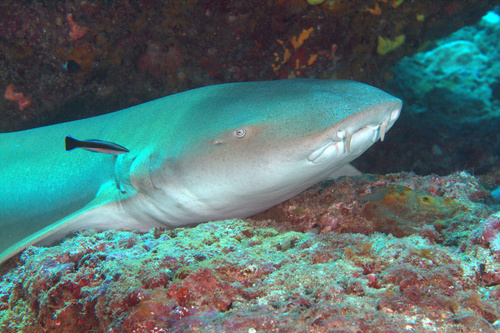
A tawny nurse shark hunts by pulling, not chasing. It noses along the bottom after dark, and when it finds something it expands its large muscular throat fast enough that the pressure inside its mouth collapses and the prey is pushed in by the water behind it. The mouth is small and set well forward under a squared-off snout, and the teeth are rows of small overlapping combs, each with a central point and three or more cusplets: a gripping set, not a slicing one. One caution — the spectacular suction pressures often quoted for nurse sharks were measured in the Atlantic species. Nobody has put a sensor in the mouth of a tawny, so the mechanism is shared and the number is not ours to claim.
The menu is a reef-floor menu. The Florida Museum lists cephalopods — octopus above all — crustaceans and sea urchins, plus small fishes including surgeonfish, queenfish and rabbitfish, and the occasional sea snake. Much of that is prey a fast shark could not catch and a slow one can: an octopus jammed in a hole comes out whole if you can generate enough suction, and a reef fish asleep in a crack at two in the morning is not going anywhere. The colour change helps too — this shark can slowly shift its shade of brown towards whatever it is lying on, which is worth a lot to an animal that sleeps in the open.
Is it dangerous?
The honest answer on danger is that this shark barely appears in the record at all. The Florida Museum’s International Shark Attack File, which runs from 1580 to the present, does not list the tawny nurse shark among the species implicated in unprovoked bites; the Atlantic nurse shark, for comparison, has nine. What does exist is a handful of non-fatal incidents in the older literature, and they share a pattern — somebody had hold of the shark. Compagno calls it docile and willing to be touched and still notes those bites, because the jaws are strong and a cornered animal clamps. The rule is easy: do not grab a resting shark, do not block its cave, do not hand it food. Divers have watched them on those terms off Thailand and the Solomon Islands for years.
Turn it round and the traffic is not close. Across Indonesia, Thailand, the Philippines, Pakistan and India it is caught in demersal trawls, gillnets and on baited hooks, and used for meat, fins, liver oil, fishmeal and a hide that makes good leather. It is shallow, slow, predictable and produces very few pups — the recipe for local depletion, and that is what has happened. The IUCN listed it as Vulnerable in 2021 with a decreasing population, citing those reported local extinctions off India and in the Gulf of Thailand. Australia is the exception rather than the rule: no target fishery, minimal catch, Least Concern by the same criteria and Sustainable in its own stock assessment.
Tawny nurse shark facts
- It is the only carpet shark known to practise oophagy. When the embryos exhaust their own yolk they eat unfertilised eggs the mother goes on producing — the first uterine cannibalism ever found in the order Orectolobiformes. Whether the embryos also eat each other has never been established. — Teshima et al. 1995, Bull. Seikai Natl. Fish. Res. Inst., via Florida Museum
- Nobody agrees how many pups it has. Compagno reports litters as small as one or two, the Florida Museum says up to eight, and compilations of the Australian records give 26–32 against 1–4 for Japan. Newborns are 40–60 cm long. The disagreement is real: almost every detailed observation comes from one small study area. — Compagno 2001 / Florida Museum / Save Our Seas Foundation
- Hauled out of the water it spits. The shark fires a powerful jet of water at whoever is holding it and grunts between jets, making it one of very few sharks recorded producing a sound. "Spitting shark" is a standard English common name for it. — Compagno 2001, FAO Catalogue, via Florida Museum common-name list
- The same species is Vulnerable globally and Least Concern in Australia. Australia’s 2023 Shark and Ray report card prints both assessments side by side and rates the Australian stock Sustainable, because there is no target fishery and the catch is tiny. — fish.gov.au Shark and Ray Report Card 2023 / Kyne et al. 2021
- The International Shark Attack File, covering 1580 to the present, does not list the tawny nurse shark among the species implicated in unprovoked bites at all. The Atlantic nurse shark, on the same table, has nine and no fatalities. — Florida Museum, International Shark Attack File
- It changes colour. The shark can slowly shift its shade of brown towards the background it is resting on, which is a useful trick for an animal that sleeps in the open in daylight. Juveniles can be told from adults by small dark spots. — Florida Museum / Compagno 2001
- How long it lives is unknown, and unusually clearly so: Australia’s 2023 report card prints "Longevity: unknown" and the Save Our Seas Foundation profile says the same. No one has aged the species, which means nobody can calculate a generation length for it either. — fish.gov.au Shark and Ray Report Card 2023 / Save Our Seas Foundation
- It has been an aquarium shark for decades — tough, hardy and easy to keep, displayed in Europe, the United States, Okinawa and Singapore. Captive females laid loose egg cases that never developed, which is why the species was filed as an egg-layer for years before the egg-eating embryos were found. — Compagno 2001 / Florida Museum
Photos
Seen lately
PierMonkey’s live map carries community shark sightings from iNaturalist, refreshed every three hours. Open the map to see where tawny nurse sharks have turned up recently.
How big is that, really?
Maximum reliably recorded length. Rose marks the large or potentially dangerous species the map flags as notable.
Help protect it
- Reef Life Survey — Nebrius ferrugineusEvery reef where trained volunteer divers have actually logged this shark on a standardised survey, with the counts. If you dive, RLS trains and equips volunteers to run those surveys — this is the dataset you would be adding to.
- Great Fiji Shark Count — tawny nurse sharkA diver-run count that asks dive shops and visiting divers to record every shark they see during set survey months. If you are diving Fiji, you can log your sightings straight into it — including this species.
- Tawny Shark report card, Australia’s Shark and Ray ReportTwo free pages from Australia’s national fisheries assessment, naming the assessors and the evidence. Read it if you want to see how a "Vulnerable globally, Least Concern here" split is actually argued — it is the clearest short example of that reasoning we know of.
Report what you see
Photograph a shark, upload it, and once the community confirms the ID it becomes a research-grade record — which is where every sighting on our map comes from. Yours would appear here within three hours.
How to submit an observation →Organisations working on sharks like this one
- The Shark Trustgood for kidsReport eggcases and sightings, join campaigns, download free ID guides.
- Great Eggcase Huntgood for kidsWalk a beach, find a mermaid’s purse, log it. Over 630,000 eggcases recorded since 2003 — the easiest real science a family can do.
- Sharks4Kidsgood for kidsFree classroom lessons, virtual field trips and activity packs for teachers and parents.
- Save Our Seas FoundationFunds shark research and education worldwide; publishes what each project found.
- Shark StewardsCampaigns to end the shark fin trade and establish shark sanctuaries.
- OceanaPolicy campaigning on fisheries management and bycatch — the thing that actually kills sharks.
- IUCN Shark Specialist GroupThe scientists behind the Red List assessments. For older readers who want the primary source.
Conservation status: Vulnerable (IUCN Red List, assessed 2021). Assessed as Vulnerable with a decreasing population in the 2021 global assessment (Simpfendorfer, Derrick, Bin Ali, Fahmi and colleagues). The case is not a measured decline — there is very little population data anywhere in its range — but an inference: a shark restricted to shallow inshore water that is heavily fished everywhere except Australia, with a narrow habitat band, limited dispersal and very low fecundity, and with reported local extinctions off India and in the Gulf of Thailand. The Australian assessment, by the same Red List criteria, is Least Concern (Kyne et al. 2021), and Australia’s own fisheries scientists rate the stock Sustainable. Read the assessment →
Common questions
What is the difference between a tawny nurse shark and a nurse shark?▾
Why is the tawny nurse shark called the spitting shark?▾
Do baby tawny nurse sharks really eat eggs before they are born?▾
Are tawny nurse sharks dangerous to divers?▾
Why is it Vulnerable worldwide but Least Concern in Australia?▾
How big do tawny nurse sharks get, and how long do they live?▾
Keep exploring
- Pasta Point, Maldives — live surf conditions
- Keramas, Bali — live surf conditions
- Cloud 9, Siargao — live surf conditions
- Teahupo’o, Tahiti — live surf conditions
- All 40 species →
Sightings © iNaturalist contributors (research-grade observations). Occurrence maps © GBIF.org contributors (CC BY). Community science, not a beach-safety service. Last updated 2026-09-20.
See where sharks are turning up — on the live map
The map and live conditions are open to everyone. A free account unlocks full 16-day forecasts and custom swell alerts.