
Smooth hammerhead shark
The cold-water hammerhead — no notch in the head, young sharks in schools of hundreds, and the only one of the big three that follows summer into temperate seas.
Vital statistics
Live birth with a placenta after 10–11 months; 20–50 pups, 49–63 cm long at birth, usually in summer.
The short version
The smooth hammerhead is the hammerhead of cool water. Its two big relatives, the great and the scalloped, are tropical and subtropical sharks; this one lives worldwide in temperate seas, roughly between 59° N and 55° S, which is why hammerhead sightings off California, southern Australia, New Zealand, South Africa, the Azores and the coasts of Europe are usually this species. It reaches 370–400 cm, with adults mature from about 250 cm, and it is named for the field mark that identifies it: the front edge of the head is a smooth curve with no notch in the middle, where the other two are notched.
Young sharks live close in, in bays, harbours and estuaries, and they are sociable — juveniles gather in schools reported to be hundreds strong, and stay in the same nursery for years before moving offshore at around two or three years old. The diet is built on squid and schooling fish rather than on the rays that the great hammerhead specialises in, with other sharks added once a shark passes about two metres.
The IUCN lists it as Vulnerable, on an inferred decline of 30–49% over three generations — a milder verdict than the Critically Endangered status of the great and scalloped hammerheads, partly because it breeds faster than they do and partly because its cool-water range keeps it away from some of the fisheries that hit them hardest. It is still caught heavily as bycatch, usually dies on the line, and its fins are the fourth most common in the Hong Kong market. It is also, by the admission of nearly every paper written about it, the least studied of the three.
Where it lives
There are three big hammerheads, and this is the one that goes where the water is cold. The great and the scalloped hammerhead are tropical and subtropical animals; the IUCN describes the smooth hammerhead as living worldwide in temperate seas, and only in some regions in tropical ones. FishBase draws its band from about 59° N to 55° S and files it as subtropical, against 46° N to 39° S for the scalloped and 40° N to 37° S for the great, both filed as tropical. The Red List’s own country list for it runs from Ireland, the United Kingdom and Norway down past South Africa, New Zealand and Chile. That tolerance is the identity of the species. If you meet a hammerhead in water cool enough to want a wetsuit — off California, the Cape, northern New Zealand, southern Australia or the Azores — this is almost certainly the one.
It is also, oddly, the most oceanic of the three. Young sharks are coastal, in bays, harbours and estuaries, but the IUCN notes they commonly leave those habitats at two or three years old for the open shelf and the water beyond it. FishBase puts the depth range at 0–200 m and the usual depth at 0–20 m; the assessment allows at least 200 m and possibly 500 m. The deepest record from any tag is 144 m, by a juvenile in New Zealand that spent its first ten weeks above 10 m and then switched, almost overnight, to riding between the surface and 60 m.
Where it is missing tells you as much as where it is. The Mediterranean is a temperate sea that ought to suit this shark, and hammerheads were once ordinary there. Ferretti and colleagues rebuilt nine long abundance series for the north-west Mediterranean and found hammerheads had declined faster than any other large shark — gone from coastal waters after 1963, gone from pelagic waters by the early 1980s, an estimated 99.99% down since the early nineteenth century. In the eastern Pacific the usual northern limit is about 37° N, the latitude of San Francisco, though during the 2013–2015 north-east Pacific warm-water anomaly smooth hammerheads were among the species reported far north of that.


- New York Bight to Cape Hatteras — Six juveniles carrying satellite tags spent every summer in shallow water off Long Island and every winter off Cape Hatteras. Their winter ground sits inside the Mid-Atlantic Shark Area, a seven-month longline closure — but they arrive in November and are sitting there through December, before the closure starts on 1 January.
- Faial and Pico, Azores — A true nursery in the middle of the North Atlantic. Acoustically tagged juveniles were detected on the island shelf for up to 1,555 days — more than four years — returning summer after summer to the north shore of Faial.
- Northern New Zealand — Bay of Islands, Hauraki Gulf, the Firth of Thames and Ninety Mile Beach: shallow, sheltered nursery water for sharks up to about two years old and 150 cm. Loose schools of bigger juveniles are seen from the air off the west coast.
- La Libertad and northern Peru — The other kind of hotspot. This is Peru’s third most caught shark, landed by small-scale gillnetters; in a 2022 survey of four ports, 92% of the sharks coming ashore were juveniles or younger.
- Eastern Cape and KwaZulu-Natal, South Africa — Juveniles inshore, adults out over deep reefs at the shelf edge — the pattern first described here in 1991. Catch rates in the KwaZulu-Natal beach nets have varied a great deal since 1978 but trend slightly upward — one of the few parts of the world where that is true.
Where it goes
The textbook line is that smooth hammerheads move towards the poles in summer and back in winter, and satellite tags have now put detail on it. Six juveniles tagged off the US mid-Atlantic all ran the same circuit: a summer spent in the New York Bight above 40° N, a directed run south through the autumn, a winter parked off Cape Hatteras, and a return north in late April or early May. One was followed for 441 days, through two summers in the Bight and the winter between them. Adults can go a great deal further than that. A shark tagged near Cuvier Island in New Zealand was caught again 884 days later near Vava’u in Tonga, about 2,225 km away, by then roughly 285 cm long and mature.
Not every shark travels. In the Azores, juveniles tagged off Faial and Pico used the same few square kilometres of island shelf year after year, one of them detected across 1,555 days, and the array around the neighbouring seamounts never picked them up at all. What nobody can yet describe is the adults. The first electronic tags ever put on this species anywhere in the world went on in New Zealand and were reported in 2016 — the first on any hammerhead in the southern hemisphere — and the author’s summary of where the grown sharks spend most of the year was that it is unknown. For an animal caught in three oceans, that is a remarkable blank.
Share of verified smooth hammerhead shark records by month (GBIF, all years). Darker rose means a larger share of sightings fall in that month. This reflects when people record them, which mixes real seasonality with when divers and boats are out.
New York Bight, US mid-Atlantic: Built from the seasonal core areas in Logan et al. 2020: summer in the New York Bight, autumn transit south, winter off Cape Hatteras, north again in late April or early May. It describes six tagged juveniles, not the whole population, and adults are not represented at all.
What it eats
Squid first. Off northern Peru, 485 stomachs from sharks between 53 and 294 cm were dominated by two species — Patagonian squid at 37% of the diet by index of relative importance and jumbo flying squid at 27% — with cephalopods in 89% of the stomachs that held anything and fish in 11%. The same picture turns up in South Africa, where the squid eaten by small sharks are coastal species and the squid eaten by large ones are oceanic, and in New South Wales, where stomachs held squid and schooling fish and almost nothing that lives on the bottom. Off the Eastern Cape the staples are pilchard and squid, and sharks over two metres start adding other sharks and rays.
This is a hunter of moving shoals rather than of buried prey, which is what separates it at the dinner table from its famous relative: the great hammerhead pins stingrays to the seabed, while the smooth hammerhead chases schools through open water. Its diet shifts as it grows, from coastal prey to oceanic prey, and its trophic position climbs with it. The appetite can be considerable — one 230 cm shark off Peru had the beaks of 74 squid in its stomach. At the top end of the size range they take large prey indeed: off Brazil, adult smooth hammerheads have been recorded feeding on dolphins.
Is it dangerous?
Nobody can point to a confirmed attack by this species. The International Shark Attack File, running from 1580, lists 18 unprovoked bites for hammerheads of any kind and no fatalities, and that total is not broken down by species; older summaries from the Florida Museum put the same genus-wide figure at 15. The species is listed as potentially dangerous in the reference books purely because it is four metres long, and the standard caveat, going back to the FAO catalogue, is that few incidents can even tentatively be assigned to it because it lives in cool water where fewer people swim. Treat one the way you would treat any large shark: give it room, do not crowd or corner it, and keep speared fish out of the water.
The traffic runs the other way, and mostly through gear this shark never sees coming. About 71% are already dead at the boat on Atlantic longlines in Portuguese observer data. In the New South Wales beach-netting programme — where the hammerhead catch is predominantly this species and nearly all of it juvenile — mortality in the nets ran at about 95% before 2010. Peru’s gillnet fishery landed sharks that were 92% juveniles or younger in a recent port survey, and a fin-trimming survey of the Hong Kong retail market found smooth hammerhead made up 1.7% of the fins, the fourth most abundant species there. The animal that is dangerous in this relationship is not the one with the hammer.
Smooth hammerhead shark facts
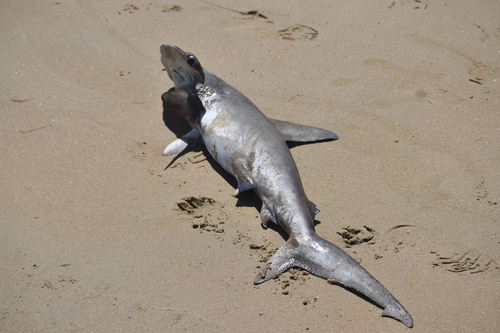
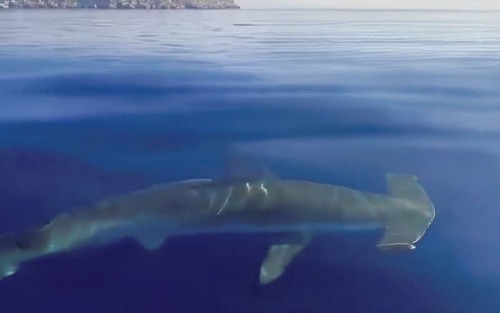
- The name is the field mark. The front edge of the head is a smooth, broad arch with no notch at the centre — the great and scalloped hammerheads both have one — though there are still clear indentations further out towards the sides. — Florida Museum ISAF; FishBase, after Compagno
- It ranges further into cool water than any other large hammerhead. FishBase bounds it at about 59° N to 55° S, and the IUCN describes it as occurring worldwide in temperate seas and only regionally in tropical ones. — FishBase; IUCN Red List assessment (Rigby et al. 2019)
- Young smooth hammerheads are famously gregarious: FishBase records aggregations of hundreds of juveniles, South African work describes large inshore gatherings of sharks 100–150 cm long, and loose schools are seen from the air off New Zealand. — FishBase (Compagno); Bass et al. 1975; Francis 2016
- In 485 stomachs sampled off northern Peru, Patagonian squid and jumbo flying squid together made up more than 60% of the diet, and one 230 cm shark held the beaks of 74 squid. — Gonzalez-Pestana et al. 2017, Fishery Bulletin 115
- A shark tagged near Cuvier Island, New Zealand, was recaptured 884 days later near Vava’u in Tonga — about 2,225 km away. It measured roughly 285 cm and weighed 85 kg. — Francis 2016, NZ Journal of Marine and Freshwater Research
- Juveniles tagged in the Azores used the shelf off Faial and Pico for up to 1,555 days — more than four years — with the strongest presence each summer, confirming the islands as a genuine nursery. — Afonso et al. 2022, Frontiers in Marine Science
- It was the last of the big hammerheads to be tracked at all: the first electronic tags ever deployed on this species anywhere in the world were reported in 2016, and where adults spend most of the year is still unknown. — Francis 2016; Rosa et al. 2017
- Genetic sampling of 4,800 fin trimmings from Hong Kong retail markets in 2014–2015 found smooth hammerhead at 1.7% of the trade — the fourth most abundant species in the world’s largest fin market. — Fields et al. 2018, Conservation Biology
Photos
Seen lately
PierMonkey’s live map carries community shark sightings from iNaturalist, refreshed every three hours. Open the map to see where smooth hammerhead sharks have turned up recently.
How big is that, really?
Maximum reliably recorded length. Rose marks the large or potentially dangerous species the map flags as notable.
Help protect it
- Shark Trust — Big Shark PledgeSign it. The pledge is aimed squarely at the bodies that set high-seas catch limits, which is the gear this shark actually dies in — pelagic longlines, in oceans where no country is in charge on its own.
- CITES Trade DatabaseSearch "Sphyrna zygaena" and see, country by country and year by year, what fins and meat have been declared since the 2014 listing. It is the public record of a trade most people only ever read about.
- Sharkipedia — Sphyrna zygaenaLook up every published measurement for this shark with the paper it came from. It takes about a minute to read, which is the point: this is how little anyone has measured.
Report what you see
Photograph a shark, upload it, and once the community confirms the ID it becomes a research-grade record — which is where every sighting on our map comes from. Yours would appear here within three hours.
How to submit an observation →Organisations working on sharks like this one
- The Shark Trustgood for kidsReport eggcases and sightings, join campaigns, download free ID guides.
- Great Eggcase Huntgood for kidsWalk a beach, find a mermaid’s purse, log it. Over 630,000 eggcases recorded since 2003 — the easiest real science a family can do.
- Sharks4Kidsgood for kidsFree classroom lessons, virtual field trips and activity packs for teachers and parents.
- Save Our Seas FoundationFunds shark research and education worldwide; publishes what each project found.
- Shark StewardsCampaigns to end the shark fin trade and establish shark sanctuaries.
- OceanaPolicy campaigning on fisheries management and bycatch — the thing that actually kills sharks.
- IUCN Shark Specialist GroupThe scientists behind the Red List assessments. For older readers who want the primary source.
Conservation status: Vulnerable (IUCN Red List, assessed 2019). Assessed on 8 November 2018 and published in 2019 (Rigby et al.) as Vulnerable under criterion A2bd. The assessors could not land on one global number: their own trend analysis spanned a median reduction of 21.8–64.8% over three generations — 72.3 years — with steep historic declines in the Atlantic, smaller ones in the South Pacific and increases in the Indian Ocean, so the published figure of 30–49% came from expert judgement rather than from a single data set. Added to CITES Appendix II in 2013 and in force from 14 September 2014, and only because its fins are hard to tell from a scalloped hammerhead’s. Unlike the other two large hammerheads it is on no Convention on Migratory Species appendix at all; it was added to Annex 1 of the CMS Sharks Memorandum of Understanding in 2018. Read the assessment →
Common questions
How do you tell a smooth hammerhead from the other hammerheads?▾
Are there hammerhead sharks in cold water — California, the UK, New Zealand?▾
How big do smooth hammerheads get, and how long do they live?▾
Why are nearly all the smooth hammerheads people catch young ones?▾
Has a smooth hammerhead ever attacked a person?▾
Why is the smooth hammerhead only Vulnerable when the other two are Critically Endangered?▾
Keep exploring
- Rockaway Beach, New York — live surf conditions
- Chicama, Peru — live surf conditions
- Jeffreys Bay, South Africa — live surf conditions
- Piha, New Zealand — live surf conditions
- All 40 species →
Sightings © iNaturalist contributors (research-grade observations). Occurrence maps © GBIF.org contributors (CC BY). Community science, not a beach-safety service. Last updated 2026-09-20.
See where sharks are turning up — on the live map
The map and live conditions are open to everyone. A free account unlocks full 16-day forecasts and custom swell alerts.