
Small-spotted catshark
Britain and Ireland’s commonest shark — small enough to hold in two hands, and the one whose mermaid’s purses turn up on the strandline in their thousands.
Vital statistics
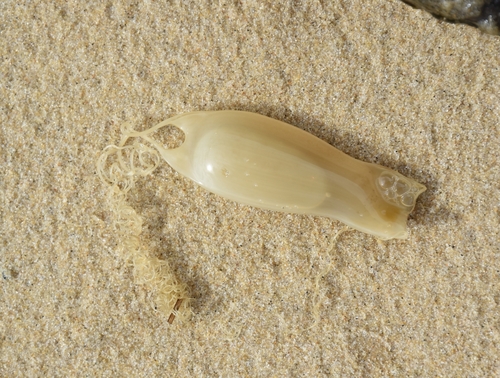
Egg-laying. A female lays her eggs in pairs, one per oviduct, across a long season — roughly 30–60 a year — each sealed in a 5–7 cm capsule tethered to weed by curly tendrils. One pup hatches after 5–11 months at about 9–10 cm.
The short version
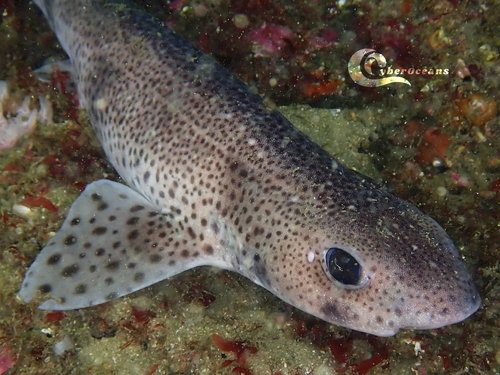
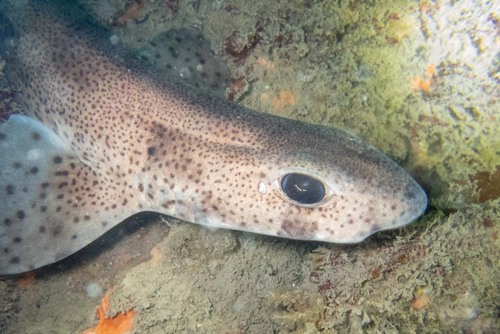
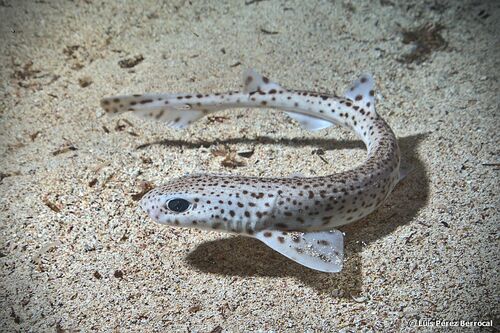
The small-spotted catshark is a slim, sandy-brown shark of European shelf seas, scattered with dozens of small dark spots. It reaches about 1 m at the very most, and adults are usually 50–75 cm, which makes it one of the smallest sharks anyone is likely to meet. It lives on the bottom — sand, gravel, mud and the clean ground beside reefs — from water you could stand up in down to around 400 m, hunts at night and rests by day, often piled against other catsharks. In Britain and Ireland it is simply the commonest shark there is; most British anglers know it as the lesser-spotted dogfish.
It lays eggs rather than giving birth to live young. Each one is sealed in a tough amber capsule 5–7 cm long — a mermaid’s purse — with a fine curly tendril at each corner that the female winds around seaweed so the tide cannot roll it away. A single pup hatches five to eleven months later, depending on how cold the water is, at about 9–10 cm long. Empty cases wash up on every coast of the British Isles in enormous numbers, which is why this is the species most often recorded by the Shark Trust’s Great Eggcase Hunt.
It is harmless — no shark attack file anywhere lists it — and the IUCN assessed it as Least Concern in 2021. Unusually for a shark, the surveys keep finding more of them: ICES reported increasing biomass in the North Sea between 2004 and 2022 and in the Celtic Seas between 2008 and 2018. It is also the shark behind several chip-shop names, because UK labelling rules let any Scyliorhinus be sold as dogfish, flake, huss, rigg, rock eel or rock salmon, and it is the shark most European laboratories work on, because it is small, abundant and lays eggs you can watch develop.
Where it lives
The small-spotted catshark belongs to the northeast Atlantic and the Mediterranean. Its stronghold runs from Norway, Shetland and the Skagerrak — Norway’s Institute of Marine Research calls it the commonest catshark in Norwegian waters — south through the North Sea, the Irish and Celtic Seas, the Bay of Biscay and Iberia to West Africa, and right across the Mediterranean; the IUCN assessment lists the Black Sea as well. The southern end is the vague end. Senegal is the boundary usually given, FishBase maps the species down to 3° N, and records further along the African coast are tangled up with close relatives that are hard to tell apart. Genetic work has shown the Atlantic and Mediterranean animals to be strongly structured — not one pool of sharks but several.
Within that range it is a bottom fish. Sand, gravel, muddy shell and the clean patches beside a reef are where it lives, usually between 10 and 100 m down. Norway’s IMR and most European accounts cap the normal range at about 400 m, and FishBase carries a single extreme record of 780 m. The shallow end matters more to anyone reading this: catsharks tracked in Lough Hyne in County Cork spent their days wedged in caves in half a metre to a metre and a half of water. Divers and snorkellers meet them lying on sand in a few metres, and shore anglers catch them off beaches and piers after dark, all round the coast.
Sheer abundance is the story of this species. It is among the most abundant sharks anywhere in the northeast Atlantic and the Mediterranean, GBIF holds more than 540,000 occurrence records of it, and ICES manages it as four separate stock units around northwest Europe. It is also worth almost nothing: 101 tonnes were landed into Cornish ports in 2024 for about £23,000, which says more about how lightly the fish is valued than about how many there are.


- Lough Hyne, County Cork — Ireland’s first marine nature reserve, and the sea lough where acoustic tracking first showed male and female catsharks keeping completely different daily timetables.
- Morecambe Bay & the Cumbrian coast — The strandline to beat. One Shark Trust hunt here in April 2022 drew 280 people who logged 3,313 eggcases in a single event, almost all of them this species.
- Celtic Sea & Bristol Channel — One of the four ICES stock units, and the water the classic British work on its breeding season came from. Also where catch records most often confuse it with the larger nursehound.
- The western Mediterranean shelf — Abundant on trawl grounds from Spain to Italy, and heavily studied there — though the IUCN assessment notes that numbers off Malta have fallen.
- Skagerrak & the northern North Sea — The northern edge of the range, and where it is most often met in Scandinavian waters. ICES survey biomass in the North Sea has been rising since the mid-2000s.
Where it goes
This is not a shark that goes anywhere much, and it would be dishonest to dress it up as one. There is no ocean crossing to report: tagged animals stay on the same stretch of coast, and marked individuals turn up in the same sea lough years apart. What a catshark divides up is not the map but the day — and the two sexes divide it differently. Continuous acoustic tracking at Lough Hyne found females spending daylight hours jammed into shallow caves and coming out to feed in deeper water only two or three nights in six, while males stayed active in deeper water almost every night. The explanation offered was not shyness but arithmetic: males will keep trying to mate, mating costs a female energy, and hiding saves it at exactly the time of year she is producing eggs. Later work on the same species reframed the whole pattern as avoiding year-round harassment.
The one journey it does make is inshore, to lay. Females move into shallow water to wind their eggcases onto weed, and the season is long rather than sharp: Norway’s IMR gives January to June, while UK accounts put the peak in June and July, so somewhere in the range eggs are going down in most months of the year. Archival tags have since been used to pick the moment of egg-laying itself out of a swimming record — which is how a behaviour almost nobody has watched in the wild gets measured at all.
Share of verified small-spotted catshark records by month (GBIF, all years). Darker rose means a larger share of sightings fall in that month. This reflects when people record them, which mixes real seasonality with when divers and boats are out.
What it eats
It eats whatever the seabed is offering. Decapod crustaceans — shrimps, prawns, swimming crabs and especially hermit crabs — come top almost everywhere its stomach contents have been studied, followed by molluscs including squid and cuttlefish, polychaete worms, and small fish such as sandeels, gobies and young whiting. Brittlestars, sea squirts and peanut worms turn up too, and it will happily scavenge. The mix shifts as the shark grows: small catsharks take small crustaceans, bigger ones move on to hermit crabs, shellfish and fish. Hunting is done largely by smell and by electricity — the jelly-filled pores across its snout, the ampullae of Lorenzini, pick up the faint electrical fields of animals buried out of sight in the sand.
Its best trick is what it does with a mouthful that is too big to swallow. A catshark has no great shearing bite, so a juvenile curls its tail forward until the food snags on the backward-facing denticles of its own skin, then flicks its head back hard and tears a piece off — using its own hide as a work surface. Hatchlings only a few days old already do it, so it looks built in rather than learned. Those same denticles are why a catshark feels like wet sandpaper in one direction and smooth in the other, and why anglers who handle a lot of them go home with grazed forearms.
Is it dangerous?
There is no danger here at all. The animal is about the size of a cat, its teeth are a few millimetres long, and its mouth is a small crescent tucked underneath the snout. The Florida Museum, which keeps the international file on shark incidents, has nothing for this species, and there is no reason it ever should: people swim, dive and snorkel among them daily in Britain, Ireland, France, Spain and Portugal without noticing they are there.
The only way to come off worse is to pick one up. A held catshark curls round on itself and twists, and skin covered in backward-pointing denticles takes the top layer off a bare forearm; sea anglers call the result dogfish rash, and a cornered fish can nip as well. Wet your hands, support the body rather than dangling it, unhook it in the water where you can and put it straight back — survival after discarding runs at about 98% in this species, among the highest measured for any shark, so a released catshark really does swim away. The traffic runs the other way in any case. Trawls and gillnets catch them by the million, they are landed and sold under half a dozen names that hide what they are, and the most useful thing most people can do for them is find out which fish is actually in the batter.
Small-spotted catshark facts
- It is the species most often recorded by the Great Eggcase Hunt, which has logged over 630,000 eggcases since 2003. In the 2022 Easter hunt 3,254 of the 7,560 cases reported were this one shark — and 3,313 of them came from a single event in Morecambe Bay, where 280 people walked the strandline together. — The Shark Trust; DIVE Magazine, 2022
- Its eggcase is a 5–7 cm amber capsule with a fine curly tendril at each corner, wound around weed to hold it in place. The nursehound’s is the same shape but 8–10 cm long, much sturdier and with thick tendrils — which is how you tell two very similar sharks apart from their empties. — Shark Trust Great Eggcase Hunt ID key
- Juveniles use their own skin as a chopping board. They curl the tail forward until an oversized piece of food hooks on their backward-facing denticles, then snap the head back to tear off a bite. Hatchlings days old already do it. — Southall & Sims 2003, Proceedings of the Royal Society B
- At Lough Hyne in County Cork, tracked females spent their days in caves in 0.5–1.5 m of water and fed in deeper water only two or three nights in six, while males were active nearly every night — apparent sexual segregation inside one small sea lough. — Sims, Nash & Morritt 2001, Marine Biology
- Catsharks rest in piles, and they have social personalities: in ten groups of juveniles moved between habitats of different complexity, the well-connected individuals stayed well-connected, and each shark’s position in the social network was repeatable across time and settings. — Jacoby, Fear, Sims & Croft 2014, Behavioral Ecology and Sociobiology
- It is the standard laboratory shark of European science — small, abundant, not threatened, and producing eggs at any time of year that develop in a tank of seawater. It was the first cartilaginous fish sequenced by the Darwin Tree of Life project, at 4.2 billion bases, about a third larger than our own genome. — Darwin Tree of Life (Wellcome Sanger Institute); Mol. Biol. Evol. 2024
- UK fish-labelling rules allow six names — dogfish, flake, huss, rigg, rock eel and rock salmon — to be used for any Scyliorhinus, any Mustelus, any Galeorhinus, the blackmouth catshark and the spiny dogfish. One word on a menu can mean any of them. — UK commercial designations list (fish labelling)
- When researchers DNA-tested 117 shark samples from 90 English chip shops and fishmongers, 66% were spiny dogfish — Critically Endangered in the northeast Atlantic — 21% starry smooth-hound and 9% nursehound. Not one was a small-spotted catshark, despite the labels covering it. — Hobbs et al. 2019, Scientific Reports
Photos
Seen lately
PierMonkey’s live map carries community shark sightings from iNaturalist, refreshed every three hours. Open the map to see where small-spotted catsharks have turned up recently.
How big is that, really?
Maximum reliably recorded length. Rose marks the large or potentially dangerous species the map flags as notable.
Help protect it
- The Great Eggcase HuntThe single best thing to do with this species, and it costs nothing. Walk the strandline after a blow, pick up the leathery purses, soak them in water for an hour or two so they swell back to shape, then measure, photograph and log them. Over 630,000 have been recorded since 2003, and because a female lays her eggs where she lives, every record is a pin in the map of where sharks are actually breeding.
- SeasearchIf you dive or snorkel in Britain or Ireland, this is how what you saw becomes data. Seasearch trains ordinary recreational divers to record habitats and species on standard forms, and catsharks and their eggcases laid on live weed are exactly the sort of observation it collects. Courses run through local dive clubs and wildlife trusts.
- Cornwall Good Seafood Guide — lesser spotted dogfishBefore you buy rock salmon or huss, find out what it is. This entry shows how the fish is caught, how much is landed and how the fishery rates, and it is a reminder to ask the shop the one question that matters: which species is this? A fishmonger can answer it. If a takeaway cannot, that is worth knowing too.
Report what you see
Photograph a shark, upload it, and once the community confirms the ID it becomes a research-grade record — which is where every sighting on our map comes from. Yours would appear here within three hours.
How to submit an observation →Organisations working on sharks like this one
- The Shark Trustgood for kidsReport eggcases and sightings, join campaigns, download free ID guides.
- Great Eggcase Huntgood for kidsWalk a beach, find a mermaid’s purse, log it. Over 630,000 eggcases recorded since 2003 — the easiest real science a family can do.
- Sharks4Kidsgood for kidsFree classroom lessons, virtual field trips and activity packs for teachers and parents.
- Save Our Seas FoundationFunds shark research and education worldwide; publishes what each project found.
- Shark StewardsCampaigns to end the shark fin trade and establish shark sanctuaries.
- OceanaPolicy campaigning on fisheries management and bycatch — the thing that actually kills sharks.
- IUCN Shark Specialist GroupThe scientists behind the Red List assessments. For older readers who want the primary source.
Conservation status: Least Concern (IUCN Red List, assessed 2021). Assessed as Least Concern in 2021 (Finucci, Derrick, Neat, Pacoureau, Serena & VanderWright; assessment dated 31 August 2020). It is one of the most abundant sharks in the northeast Atlantic and the Mediterranean, most of what is caught is thrown back, and survival after being discarded is around 98%. The assessors flag local depletion — in the Wadden Sea, and off Malta — but surveys across most of the range show the population stable or increasing, which is a sentence that can be written about very few sharks. Read the assessment →
Common questions
What shark laid the mermaid’s purse I found on the beach?▾
Is rock salmon really shark?▾
Are small-spotted catsharks dangerous?▾
How do you tell a small-spotted catshark from a bull huss?▾
How big do small-spotted catsharks get?▾
Is the small-spotted catshark endangered?▾
Keep exploring
- Fistral Beach, Cornwall — live surf conditions
- Mullaghmore Head, Ireland — live surf conditions
- La Gravière, Hossegor — live surf conditions
- Supertubos, Peniche — live surf conditions
- All 40 species →
Sightings © iNaturalist contributors (research-grade observations). Occurrence maps © GBIF.org contributors (CC BY). Community science, not a beach-safety service. Last updated 2026-09-20.
See where sharks are turning up — on the live map
The map and live conditions are open to everyone. A free account unlocks full 16-day forecasts and custom swell alerts.