
Sicklefin lemon shark
The Indo-Pacific twin of the lemon shark: a big, slow, sickle-finned shark of lagoons and mangroves that spends its whole life on one reef — which is exactly why it is in trouble.
Vital statistics
Live birth with a placenta, like most requiem sharks. Litters of 1-14 pups (FishBase and the Florida Museum), typically 6-12 (Save Our Seas Foundation), after a gestation of 10-11 months; most females breed every second year rather than every year. Pups are born 45-80 cm long, straight into a mangrove creek or a lagoon shallow enough to keep bigger sharks out. When they are born depends entirely on where you are: October to January across the range as a whole, July to November at Moorea, and November to April at Ningaloo.
The short version
The sicklefin lemon shark is a large, heavy, yellow-brown requiem shark of Indo-Pacific reef flats, lagoons and mangroves. It reaches about 3.8 m at the outside, adults are usually 2.3-3.1 m, and it lives from the Red Sea and East Africa east to French Polynesia, north to Taiwan and south to Australia. It is nearly identical to the lemon shark (Negaprion brevirostris) of the Atlantic, the only other member of its genus, but the two never share water. If geography does not settle it, the fins do: the dorsal, pectoral and pelvic fins are strongly falcate, curved back like a sickle, which is where the name comes from.
Almost everything else about it follows from one habit: it stays put. It is a slow shark that cruises close to the bottom and rests on the sand, and tracking says it does that in the same small place for years. Of 38 adults followed along Australia’s Ningaloo coast for up to 6.1 years, about half were still within 10 km of their tagging site a year later, the average core home range was 1.7 km², and four never left one 28 km² bay for more than a few days. It is not a danger to swimmers: the International Shark Attack File does not list it among species confirmed in unprovoked bites. One non-fatal bite on a surfer at Makemo Atoll is published in the forensic literature, and the species will defend itself if speared or cornered.
The IUCN assessed it as Endangered in July 2020 — a category worse than its Atlantic twin, which is Vulnerable — and the reason is exactly the staying put. A shark that holds a home range of a couple of square kilometres and breeds every second year cannot refill a reef that has been fished out, because the survivors next door do not come. It has already vanished from waters off India, Thailand and Bali where it used to be caught. Where it is protected and left alone — French Polynesia, Ningaloo, Dongsha Atoll, the outer Seychelles — it is still there, in the same lagoons, year after year.
Where it lives
The sicklefin lemon shark is the Indo-Pacific half of a two-species genus. FishBase runs its range from the Red Sea and South Africa, taking in Madagascar, the Seychelles and Mauritius, east to the Philippines, north to Vietnam and Taiwan, south to Australia, and out across the Pacific to Palau, the Marshall Islands and Tahiti; nurseries have been studied as far north as Dongsha Atoll and the Yaeyama Islands of southern Japan. The other Negaprion — the lemon shark, N. brevirostris — lives in the Atlantic and eastern Pacific, and the two never meet: the single most useful identification fact on this page.
Inside that outline it is an animal of warm, shallow, cloudy water. The depth range on paper is 0-92 m, but this shark spends its life on coral reef flats, in sandy-bottomed lagoons, on seagrass and in mangrove creeks, and it is unusually slow about it: the Florida Museum describes a sluggish shark that swims slowly along the bottom, resting often on the substrate. Pups are dropped in water shallow enough to expose a dorsal fin, and adults follow the tide, moving into the shallowest water at high tide and at night and dropping back to the lagoon as it falls.
The awkward part of the range is what is missing from it. There is evidence of local extinction off India and Thailand, and the species is described in the recent genetics literature as extirpated in India, Thailand and Bali through overfishing, while remaining reasonably common in the western Indian Ocean and around northern Australia. The record databases match: GBIF, which pools museum and survey records worldwide, holds none at all from India or the Philippines and two from Thailand, against more than 47,000 from Australia. Patchy record-keeping explains part of it, but not that much of it.


- Mo’orea & the Society Islands, French Polynesia — The best-known population in the world, and a tiny one: 40 mature sharks photo-identified between 2005 and 2009, about 27 seen in any given year. Sharks have been protected by law across French Polynesia since 2006, so this is the species with no fishing at all — still small, still fragile.
- Ningaloo Reef, Western Australia — Where the movement data comes from: 41 sharks tracked by acoustic receivers between 2012 and 2018, some for more than six years, inside a marine park on a 300 km fringing reef. It is the clearest evidence anywhere that adults stay inside a few square kilometres for years.
- St Joseph Atoll, Seychelles — An uninhabited atoll holding one of the densest known nurseries: more than 300 young sicklefin lemon sharks tagged in one mark-recapture study, sharing the flats with young blacktip reef sharks. Captive trials there showed the lemon sharks win the arguments over food.
- Dongsha Atoll, South China Sea — A no-take national park holding a nursery that genetics says is effectively marooned: 188 juveniles genotyped, an effective population size of about 87 breeders, and no sign of mixing with anywhere else — a vivid illustration of what "site attached" means for a population’s future.
- Shark Reef Marine Reserve, Beqa Lagoon, Fiji — A fed dive site inside a no-take zone where every shark has been counted since 2004 — and where this species quietly faded out. Its abundance index fell from 0.31-0.44 in 2004-2006 to 0.01-0.03 by 2011-2012. Almost every individual recorded there was female.
Where it goes
This shark does not migrate in the way the word usually means, and the numbers are unusually good for once. Along the Ningaloo coast of Western Australia, 38 adults carrying acoustic tags were followed for up to 6.1 years. About half were still within 10 km of where they had been tagged more than a year later, the average core home range was 1.7 km², and four sharks never left one 28 km² bay for more than a few days across stretches of 625 to 2,164 days. In the Seychelles, 79% of tagged sicklefin lemon sharks moved only short distances and stayed in the same atoll, and young sharks marked at St Joseph Atoll were mostly recaptured close to where they were first caught, even after more than two and a half years.
What movement there is, is about breeding. Some Ningaloo adults made fast, highly directional southerly runs of up to 140 km — one covered that distance in two days — timed around mating and pupping, with males leaving one to two months before females and individuals repeating the same trip in seven consecutive years. At Mo’orea, heavily pregnant females disappeared for only a few days to give birth before returning, and genetic parentage work there showed most females going back to the same nursery litter after litter. That is the whole travel budget of the species: a short, repeated, reproductive loop, and then home again.
Share of verified sicklefin lemon shark records by month (GBIF, all years). Darker rose means a larger share of sightings fall in that month. This reflects when people record them, which mixes real seasonality with when divers and boats are out.
What it eats
The Florida Museum, FishBase and the Save Our Seas Foundation all give the same short list: smaller sharks, stingrays and bottom-living bony fishes. The few stomach analyses FishBase holds put adults at 85-100% nekton — free-swimming prey — while young sharks caught offshore in the Gulf of Carpentaria were living entirely on seafloor animals, and the species sits at trophic level 4.1, squarely in the predator tier. At St Joseph Atoll, stable isotopes showed young sicklefin lemon sharks feeding on more bottom-associated prey than the blacktip reef sharks beside them, and captive trials there found the lemon sharks simply took the food first.
The teeth explain how a shark this size is still only a fish-eater. Both jaws carry narrow, smooth-edged, slightly hooked teeth in 27-33 rows, built for gripping something slippery rather than shearing pieces off something large — the genus name Negaprion literally means "denies the saw", after the missing serrations. A tiger shark can cut a turtle in half; a sicklefin lemon shark holds a mullet. It hunts slowly, close to the bottom, and its habit of resting on the sand between efforts is the same energy economy read from the other end.
Is it dangerous?
Sicklefin lemon sharks are large sharks that are almost never a problem. They do not appear at all in the International Shark Attack File’s table of the 35-plus species confirmed in unprovoked bites, last updated in January 2022, while their Atlantic relative appears there with ten non-fatal bites and no deaths. Divers report the opposite of aggression: the Florida Museum calls the species shy and reluctant to come in even when bait is offered. But "shy" is not "safe". The same profile notes it responds quickly and hard to being speared, poked or cornered, and in January 2018 a surfer at Makemo Atoll in French Polynesia was bitten on the legs by one; DNA from a tooth fragment in the wounds identified the species. The bite was superficial, and the researchers read it as territorial rather than feeding: this is a fish predator, and a surfer is not food. Their advice was species-specific — because these sharks hold small home ranges and stay in them, do not go back to surf a spot where one has already bitten somebody.
The other direction of that ledger is the reason for this page. The species is caught across the Indo-Pacific for meat, fins and liver oil, in fisheries that mostly go uncounted, while its mangrove and reef habitat is cleared, dynamited and bleached. FishBase rates its resilience Very Low, with a minimum population doubling time of more than 14 years, and its fishing vulnerability at 78 out of 100 — very high. Put slow breeding next to a shark that never leaves a single reef and you get the pattern the Red List picked up in 2020: local populations do not decline, they disappear, and nothing swims in to replace them.
Sicklefin lemon shark facts
- Thirty-eight adults tracked along the Ningaloo coast of Western Australia for up to 6.1 years held an average core home range of 1.7 km², and about half stayed within 10 km of their tagging site for more than a year. Four never left one 28 km² bay for more than a few days across stretches of 625 to 2,164 days. — Pillans et al. 2021, Frontiers in Marine Science
- Five years of photo-identification around Mo’orea found a population of just 40 mature sharks, 2.4-3.1 m long. Genetics showed every one of them but a single individual was linked to the rest by at least one first-order relationship — parent, offspring or full sibling. — Mourier et al. 2013, PLoS ONE
- The nursery at Dongsha Atoll in the South China Sea looks healthy and is genetically marooned. Of 188 juveniles genotyped, the effective population size came out at about 87 — the number of animals actually passing on genes — with no structure between sites and no evident input from elsewhere. — Liu, Chen & Cheng 2023, Scientific Reports
- The species has been fished out of parts of its own range. There is evidence of local extinction off India and Thailand, and the recent literature lists India, Thailand and Bali as places where overexploitation removed it altogether, while northern Australia and the western Indian Ocean still hold it. — Florida Museum species profile / Liu et al. 2023, Scientific Reports
- Both halves of the name are about teeth and fins. Negaprion means "denies the saw", for teeth that lack the saw-like serrations most requiem sharks have, and acutidens means "sharp tooth"; the English name comes from the dorsal, pectoral and pelvic fins, which are strongly falcate — the one reliable way to separate it by eye from the Atlantic lemon shark. — ETYFish via FishBase / Florida Museum species profile
- At Fiji’s Shark Reef Marine Reserve, where every shark on every dive has been counted since 2004, this species faded out inside a protected area: its relative abundance index fell from 0.31-0.44 in 2004-2006 to 0.01-0.03 by 2011-2012. Nearly every individual recorded there was female. — Brunnschweiler, Abrantes & Barnett 2014, PLoS ONE
- Young sicklefin lemon sharks grow at wildly different speeds. At St Joseph Atoll in the Seychelles, individuals recaptured over more than two years had grown anywhere from 0.2 to 32.2 cm in a year, averaging 11.8 cm — the most variable growth rates ever recorded in wild juvenile sharks. The Florida Museum’s general figure is 12.5-15.5 cm a year. — Weideli, Papastamatiou & Planes 2019, Journal of Fish Biology / Florida Museum
- The International Shark Attack File does not list the sicklefin lemon shark among the 35-plus species confirmed in unprovoked bites. The one well-documented case — a surfer bitten on the legs at Makemo Atoll in January 2018 — was identified from DNA in a tooth fragment left in the wound, and was read as territorial rather than feeding. — Florida Museum ISAF species table / Clua & Haguenauer 2020, Journal of Forensic Sciences
Photos
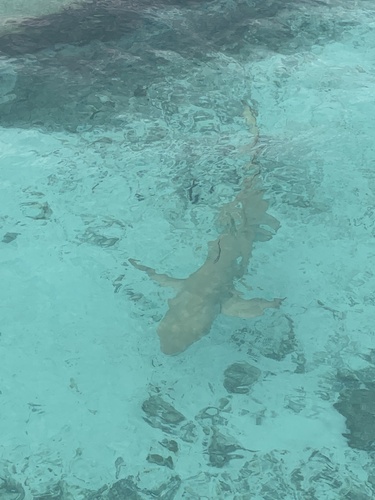
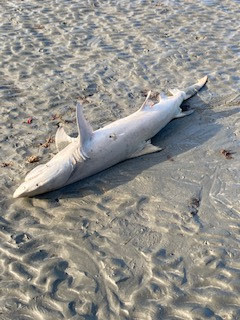
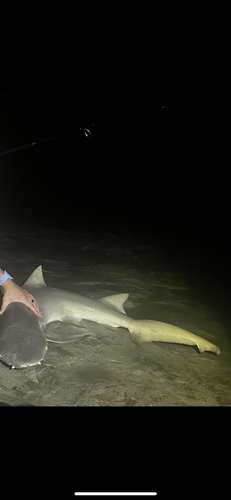
Seen lately
PierMonkey’s live map carries community shark sightings from iNaturalist, refreshed every three hours. Open the map to see where sicklefin lemon sharks have turned up recently.
How big is that, really?
Maximum reliably recorded length. Rose marks the large or potentially dangerous species the map flags as notable.
Help protect it
- The Great Fiji Shark CountIf you dive or snorkel in Fiji in April or November, log what you see. Thirty-nine dive operators have already contributed more than 146,000 shark observations from over 30,000 dives, and this species has its own ID page there — which matters, because the Fiji counts are how its slide at Shark Reef was noticed in the first place.
- Mangrove Action ProjectThis shark is born in mangroves and lagoons, so mangrove loss is nursery loss. MAP runs community-based restoration training in more than 30 countries — including Fiji, Thailand, the Philippines and Sri Lanka, all inside this shark’s range — and takes both volunteers on training courses and donations.
- Redmap AustraliaAustralia holds the biggest surviving population, and its southern edge is exactly where a warming coast will show up first. Redmap asks divers, anglers and beachgoers to photograph and log marine species turning up where they are uncommon; sightings are checked before they go on the map.
Report what you see
Photograph a shark, upload it, and once the community confirms the ID it becomes a research-grade record — which is where every sighting on our map comes from. Yours would appear here within three hours.
How to submit an observation →Organisations working on sharks like this one
- The Shark Trustgood for kidsReport eggcases and sightings, join campaigns, download free ID guides.
- Great Eggcase Huntgood for kidsWalk a beach, find a mermaid’s purse, log it. Over 630,000 eggcases recorded since 2003 — the easiest real science a family can do.
- Sharks4Kidsgood for kidsFree classroom lessons, virtual field trips and activity packs for teachers and parents.
- Save Our Seas FoundationFunds shark research and education worldwide; publishes what each project found.
- Shark StewardsCampaigns to end the shark fin trade and establish shark sanctuaries.
- OceanaPolicy campaigning on fisheries management and bycatch — the thing that actually kills sharks.
- IUCN Shark Specialist GroupThe scientists behind the Red List assessments. For older readers who want the primary source.
Conservation status: Endangered (IUCN Red List, assessed 2020). Assessed Endangered on 16 July 2020 under criterion A2bd — the criterion used when a population reduction of at least 50% over three generations is inferred from indices of abundance and from levels of exploitation, with the causes not necessarily stopped. The species was listed as Vulnerable globally before that, with the Southeast Asian subpopulation assessed separately as Endangered, and the change is recent enough that good reference pages still describe it as Vulnerable — the Florida Museum’s own species profile among them. The whole requiem shark family went onto CITES Appendix II in November 2023, which is the first trade control this shark has ever had. Read the assessment →
Common questions
Is a sicklefin lemon shark the same as a lemon shark?▾
Why is the sicklefin lemon shark Endangered when the Atlantic lemon shark is not?▾
Where has the sicklefin lemon shark already disappeared from?▾
Are sicklefin lemon sharks dangerous to divers or surfers?▾
Why does a sicklefin lemon shark lie on the bottom instead of swimming?▾
Where can I realistically see one?▾
Keep exploring
- Teahupo’o, Tahiti — live surf conditions
- Cloudbreak, Fiji — live surf conditions
- Pasta Point, Maldives — live surf conditions
- Uluwatu, Bali — live surf conditions
- Noosa, Queensland — live surf conditions
- All 40 species →
Sightings © iNaturalist contributors (research-grade observations). Occurrence maps © GBIF.org contributors (CC BY). Community science, not a beach-safety service. Last updated 2026-09-20.
See where sharks are turning up — on the live map
The map and live conditions are open to everyone. A free account unlocks full 16-day forecasts and custom swell alerts.