
Shortfin mako shark
The fastest shark in the sea — and the famous number attached to it has never once been measured.
Vital statistics
Live birth, with the embryos fed inside the mother on her own unfertilised eggs. Litters of 4–25 pups at 60–70 cm; published gestation estimates run anywhere from 9 to 25 months, and females breed about once every three years.
The short version
The shortfin mako is the fastest shark in the sea, and the most careful answer to "how fast?" is not the one you have read elsewhere. The quickest burst ever directly measured on a wild mako is 5.02 metres per second — about 18 km/h — recorded in 2022 by a speed-logging tag on a two-metre female in the Azores. The famous 68 km/h comes from a 1969 calculation of how fast hooked makos pulled away from a boat, and no instrument has ever confirmed it.
It is a mackerel shark, a close cousin of the great white, reaching about 4.45 metres and living to around 32 years. Like its relatives it is warm-bodied, holding its swimming muscles above sea temperature, and it has the highest aerobic metabolic rate measured in any shark. It lives in the open ocean of every warm and temperate sea, mostly in water between 17 and 22 °C, eating bluefish, mackerel, squid, tuna and smaller sharks, and individuals have been tracked more than 25,000 km.
The IUCN uplisted it to Endangered in 2019, with a global population reduction estimated near 50% over three generations and steeper declines in the North Atlantic and Mediterranean. Since 2022 ICCAT has banned retention of North Atlantic makos outright. It has been linked to about ten unprovoked bites in recorded history — this is a fishing story, not a danger story.
Where it lives
Shortfin makos live in every ocean that is warm enough, from about 65° N to 54° S, including the Mediterranean. That sounds like a shark you could meet anywhere, and in a sense it is — but the real boundary is drawn by temperature, not by coastline. Tagging studies from four ocean basins agree that makos spend most of their lives in water between 17 and 22 °C. They can handle far more than that when they need to, with tagged sharks recorded in everything from 10 °C to 31 °C, but the narrow band is where they choose to be.
Almost all of that life happens offshore. This is a true oceanic shark: it hunts in the open blue, well away from any beach, and comes close to land mainly where the continental shelf is narrow and deep water arrives near the coast. Day to day makos work the upper part of the water column, then punch downwards in repeated "yo-yo" dives that may be about feeding, about navigation, or about cooling off. The deepest dive on record is 979.5 metres. They also need oxygen-rich water — more than most sharks — and steer around the low-oxygen zones that other species tolerate.
A handful of places matter far more than the rest, because that is where the young ones are. The Southern California Bight, the offshore Gulf of Mexico, the temperate south-west Indian Ocean and, on the evidence of a 2025 study, a patch of open Pacific off Peru and Chile all hold concentrations of newborn and juvenile makos. Nobody has ever watched a mako give birth, so these nursery areas are inferred from where the small sharks and the pregnant females turn up — which is a polite way of saying that the most important places in this animal’s life are still being found.


- Southern California Bight — The best-studied mako nursery on earth. A NOAA survey fished the same blocks off the Channel Islands every summer from 1994 to 2013, and roughly 60% of the makos caught were pups or two- to four-year-olds.
- Georges Bank to Cape Hatteras — The stretch of American shelf edge where makos have been tagged since 1962 by NOAA’s Cooperative Shark Tagging Program — the longest-running shark tagging programme in the world, and mostly run by volunteer anglers.
- The Azores & the mid-North Atlantic — Where both of the studies that finally put a speed logger on a wild mako were done — in July 2020 and June 2022. Deep water close in, and makos passing through in numbers.
- Nazca Ridge, eastern South Pacific — A newly described open-ocean nursery off Peru and Chile. It sits directly under one of the busiest longline grounds on the planet: 76% of local fishing effort falls in the same squares as the juveniles.
- Mediterranean Sea — A cautionary tale rather than a hotspot. Combined records for makos and porbeagles suggest an almost total collapse — up to 99.99% — since the early nineteenth century.
Where it goes
Makos are among the most travelled animals in the sea, and because they are valuable to fisheries they are also among the most heavily tagged, so we know the routes unusually well. The longest journey published for the species belongs to a juvenile known as M8, which left the Great Australian Bight and covered roughly 25,550 km over eighteen months before its tag stopped reporting south-east of Madagascar. In the western North Atlantic, sharks tagged off the United States have wandered from Nova Scotia to Venezuela and out into the Sargasso Sea, passing through the waters of seventeen or more countries on a single track.
The surprise is that all this roaming is not aimless. Off the American west coast, 105 makos tagged between 2002 and 2014 covered something like 19,000 km a year each — and kept coming back to the same productive patches of ocean, summer after summer, which is a memory feat as much as a swimming one. That fidelity is also why management is so hard: a shark that reliably crosses a dozen national boundaries can only be protected if all of them agree.
Share of verified shortfin mako shark records by month (GBIF, all years). Darker rose means a larger share of sightings fall in that month. This reflects when people record them, which mixes real seasonality with when divers and boats are out.
Southern California Bight: Juvenile makos use the Bight all year — this is relative abundance, not presence and absence. Tagged sharks return in summer, when the water is most productive, and NOAA’s long-running juvenile survey fished the summer months for exactly that reason. In winter much of the population is far offshore or down off Baja California.
What it eats
A mako eats fast fish, and it eats a lot of them. The classic study of stomach contents in the north-west Atlantic found bluefish in 43.8% of the stomachs examined and making up 77.5% of the diet by volume — an unusually narrow menu for a big shark, and a reminder that makos hunt whatever is schooling in numbers where they happen to be. Elsewhere that means mackerel, tuna, squid, other sharks and, occasionally, swordfish, which is a genuinely difficult animal to catch. Marine mammals and turtles turn up in stomachs now and then, but they are incidental rather than the point.
The appetite is a consequence of the engine. Like the white shark and the porbeagle, a mako is regionally endothermic: a counter-current heat exchanger traps the warmth its swimming muscles generate instead of letting it escape through the gills, so the muscle runs warmer than the sea around it. Warm muscle is powerful muscle, but it has to be paid for. Makos have the highest aerobic metabolic rate ever measured in a shark, they need oxygen-rich water to sustain it, and one estimate puts their daily food requirement at 4.6% of their own body weight. A bluefish-shaped fuel bill, every day, for life.
Is it dangerous?
For an animal with this reputation, the record is remarkably thin. The Florida Museum’s International Shark Attack File attributes about ten unprovoked bites to shortfin makos in its entire history, one of them fatal. That is not because makos are gentle; it is because they live tens of kilometres offshore in deep blue water, and surfers and swimmers are not there. Most mako injuries on record involve a hooked shark being brought aboard a boat still very much alive, which the File counts as provoked, and which is a fair description of what happened.
The traffic runs overwhelmingly the other way, and the numbers are not close. When researchers satellite-tagged 40 makos in the western North Atlantic and simply waited, 30% of them were caught by fishing fleets within three years — a death rate about ten times higher than the figure the stock assessments had been using. North Atlantic landings and dead discards reported to ICCAT ran at 3,603 tonnes in 2013 and were still 1,709 tonnes in 2020. Makos are rarely the target; they are bycatch on longlines set for swordfish and tuna, kept because the meat and fins are worth money. If you want to help a mako, the lever is fishing policy, not fear.
Shortfin mako shark facts
- The fastest a wild mako has ever been clocked by an instrument is 5.02 m/s — roughly 18 km/h — from a speed-logging tag on a two-metre female off the Azores. She held a 14-second sprint at 2.38 m/s. Her ordinary cruising speed was about 0.9 m/s, slower than a person walks. — Waller et al. 2023, Journal of Fish Biology
- The 68 km/h everyone quotes traces back to Carey & Teal in 1969, who worked out that hooked makos breaching beside a boat were pulling away at over 9.8 m/s and put a theoretical ceiling near 20 m/s. That is an escaping shark, calculated, not a hunting shark, measured — and the tag researchers note the two are unlikely to be the same number. — Carey & Teal 1969, via Waller et al. 2023
- Makos have the highest aerobic metabolic rate ever measured in a shark. That is the real engineering achievement, and it comes with a bill: they avoid water with less than about 3 ml of dissolved oxygen per litre, and are estimated to eat 4.6% of their body weight a day. — Sepulveda et al. 2007; Wood et al. 2009
- They are warm-blooded in the parts that swim. Early measurements put mako muscle 7–10 °C above the surrounding water; modern tag data suggests a more typical 1.5–3.9 °C, and that deep-diving individuals can warm up before a dive and then hold the heat 14 to 47 times longer than they take to gain it. — Carey & Teal 1969; Tokunaga et al. 2025
- A juvenile tagged in the Great Australian Bight, known only as M8, covered about 25,550 km in eighteen months and ended up south-east of Madagascar — the longest mako migration ever published. — Rogers et al. 2015, Fisheries Oceanography
- Researchers satellite-tagged 40 makos in the western North Atlantic and watched what happened. Within three years fishing fleets had caught 30% of them, implying a fishing mortality rate about ten times what the official stock assessments assumed. — Byrne et al. 2017, Proceedings of the Royal Society B
- In the north-west Atlantic makos turned out to be near-specialists: bluefish made up 77.5% of their stomach contents by volume, and occurred in almost half the stomachs examined. — Stillwell & Kohler 1982
- A 2025 study found a probable open-ocean nursery off Peru and Chile — and 76% of the fishing effort in the area falls in exactly the squares where the juveniles are. — Mucientes et al. 2025, Scientific Reports
Photos
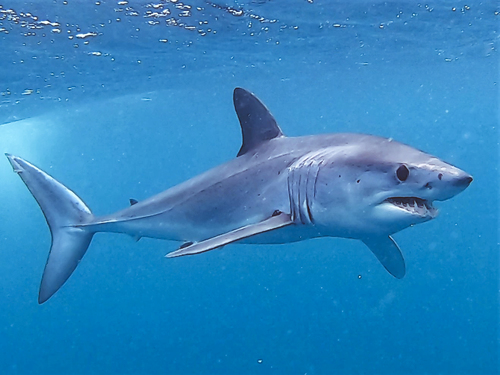
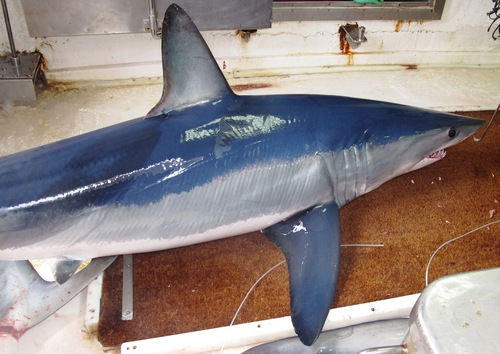
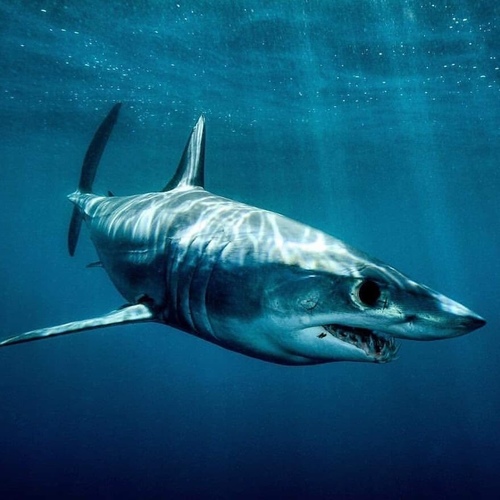
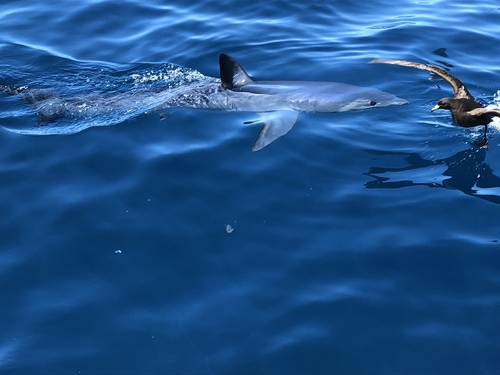
Seen lately
PierMonkey’s live map carries community shark sightings from iNaturalist, refreshed every three hours. Open the map to see where shortfin mako sharks have turned up recently.
How big is that, really?
Maximum reliably recorded length. Rose marks the large or potentially dangerous species the map flags as notable.
Help protect it
- NOAA Cooperative Shark Tagging ProgramIf you fish the US Atlantic, you can join, get free tags and tagging instructions, and report recaptures. Volunteers have tagged over 295,000 sharks since 1962 — much of what we know about mako movement came from anglers doing this.
- Guy Harvey Research Institute Shark TrackerFollow individually named, satellite-tagged makos on a live map, including several of the sharks from the tracking studies cited on this page. Free, and easy for kids to use.
- NOAA Fisheries — Atlantic shortfin mako retention limitThe current US rule, in plain language: the default retention limit is zero. If you fish for sharks in the Atlantic, check here before you go and release any mako you hook.
Report what you see
Photograph a shark, upload it, and once the community confirms the ID it becomes a research-grade record — which is where every sighting on our map comes from. Yours would appear here within three hours.
How to submit an observation →Organisations working on sharks like this one
- The Shark Trustgood for kidsReport eggcases and sightings, join campaigns, download free ID guides.
- Great Eggcase Huntgood for kidsWalk a beach, find a mermaid’s purse, log it. Over 630,000 eggcases recorded since 2003 — the easiest real science a family can do.
- Sharks4Kidsgood for kidsFree classroom lessons, virtual field trips and activity packs for teachers and parents.
- Save Our Seas FoundationFunds shark research and education worldwide; publishes what each project found.
- Shark StewardsCampaigns to end the shark fin trade and establish shark sanctuaries.
- OceanaPolicy campaigning on fisheries management and bycatch — the thing that actually kills sharks.
- IUCN Shark Specialist GroupThe scientists behind the Red List assessments. For older readers who want the primary source.
Conservation status: Endangered (IUCN Red List, assessed 2019). Uplisted from Vulnerable to Endangered in March 2019 under criterion A2bd, population trend decreasing. The assessment puts the median global reduction at 46.6% over three generations — 72–75 years — with the highest probability falling in the 50–79% band. The North Atlantic median is about 60%, and the Mediterranean at least 80%. The species went onto CITES Appendix II the same year. Read the assessment →
Common questions
How fast can a shortfin mako shark swim?▾
Is the shortfin mako really the fastest shark?▾
Are shortfin makos warm-blooded?▾
Have shortfin makos attacked swimmers or surfers?▾
Why is the shortfin mako Endangered?▾
Can you still catch and keep a mako shark?▾
Keep exploring
- Blacks Beach, California — live surf conditions
- Ditch Plains, Montauk — live surf conditions
- All 40 species →
Sightings © iNaturalist contributors (research-grade observations). Occurrence maps © GBIF.org contributors (CC BY). Community science, not a beach-safety service. Last updated 2026-09-20.
See where sharks are turning up — on the live map
The map and live conditions are open to everyone. A free account unlocks full 16-day forecasts and custom swell alerts.