
Scalloped hammerhead shark
The hammerhead that gathers in hundreds over a seamount by day and hunts alone by night — and the most heavily traded of the sharks CITES set out to protect.
Vital statistics
Live birth with a placenta after about 9–12 months; 12–41 pups at roughly 45–50 cm, born into a shallow coastal nursery.
The short version
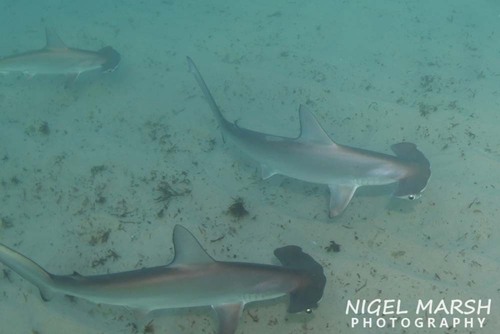
The scalloped hammerhead is the mid-sized hammerhead with the curved, notched head. The front edge of its cephalofoil is broadly arched, with a dip in the middle and a shallow scallop either side of it — the scallops it is named for. A great hammerhead’s front edge is nearly straight with one central notch; a smooth hammerhead has no notch at all. Most adults are 2.2 to 3.4 metres, the largest reliably reported is about 4.3 metres, and the heaviest published weight is 152 kg.
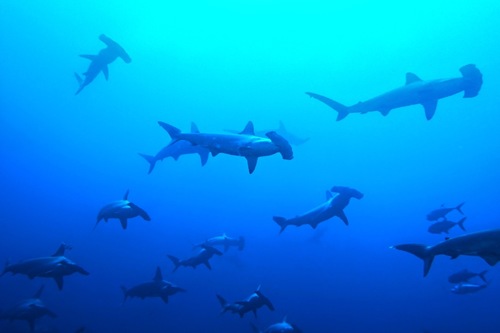
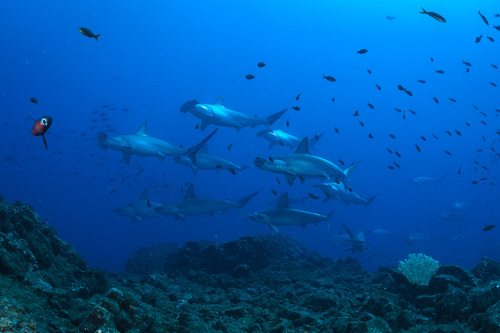
What sets it apart is behaviour rather than anatomy. At a handful of seamounts and remote islands — Cocos, Malpelo, the northern Galápagos, the Gulf of California — scalloped hammerheads mass in schools of tens to several hundred through the daylight hours, then scatter into open water at night to hunt alone. Almost no other large shark does this, and after forty years of work nobody can say for certain why. The schools are not family groups and do not look like protection; the three leading explanations — a meeting point at the centre of a night-time feeding range, a mating arena run by the largest females, and a magnetic landmark to navigate from — are still arguments.
The pups are not born out there. Pregnant females come into shallow, cloudy coastal bays, and the young spend their first months in water a person could stand up in; Kaneohe Bay on Oahu is the best-studied of those nurseries, with an estimated 7,700 born in it each year. That two-part life — hidden inshore as babies, massed and predictable as adults — is what makes the species so catchable. The IUCN lists it as Critically Endangered, the United States protects four separate populations under the Endangered Species Act, and its fins keep appearing in the Hong Kong market far more often than the legal trade can account for.
Where it lives
Scalloped hammerheads live in warm temperate and tropical seas all the way around the world. NOAA Fisheries traces them from New Jersey to Brazil in the western Atlantic, the Mediterranean to Namibia in the east, South Africa and the Red Sea across to Myanmar, Japan and China down through Indonesia to Australia, and southern California to Peru, taking in Hawaii and Tahiti. FishBase sums the same animal up in a phrase — a coastal-pelagic, semi-oceanic shark over continental and insular shelves that frequently enters bays and estuaries.
The more useful way to picture that range is by depth and by age, because this shark moves house as it grows: newborns inshore in cloudy bays a few metres deep, sub-adults out across the shelf, adults around islands, seamounts and the open water beyond. FishBase gives a usual depth of 0–25 m, which describes where they spend their time rather than where they can go.
Where they can go is startling. The deepest dive recorded is 1,044 m, off Oahu, into water of about 5 °C. A shark whose ordinary day is spent in warm surface water manages that by clamping its gill slits shut on the way down and holding its breath — around seventeen minutes under, only about four of them at the bottom — so its swimming muscles stay warm while it hunts. It is also why this page carries no water-temperature band: an honest one would span twenty degrees inside one dive.


- Cocos Island, Costa Rica — Eighty-four hammerheads tagged here between 2005 and 2013 showed up on the receivers about half of all days, overwhelmingly during daylight — and most of all at Alcyone, a seamount 3.6 km offshore rather than the island itself.
- Darwin & Wolf, Galápagos, Ecuador — The schools people travel to see — up to several hundred sharks, highest in January and lowest in May. Tracking at Wolf found them packed into the island’s south-eastern corner: a hotspot inside a hotspot.
- Malpelo Island, Colombia — The third corner of the eastern Pacific triangle. Nine sharks tagged at Malpelo and in the Galápagos were later detected at Cocos — which is how we know these are not three separate populations.
- El Bajo Espíritu Santo, Gulf of California, Mexico — Where the schooling was first worked out, by ultrasonic tracking in the early 1980s. Sharks patrolled the ridge by day, left at dusk and came back — some to the same rock over seven weeks.
- Kaneohe Bay, Oahu, Hawaii — Not a school but a nursery, and the most closely studied one anywhere: an estimated 7,700 hammerheads born in one shallow bay each year.
Where it goes
Scalloped hammerheads move on two very different scales. The nightly one is small and repeated: sharks tracked at El Bajo Espíritu Santo left the seamount at dusk, ranged 4 to 20 km out and were back by morning, often along closely parallel routes — running to particular feeding places rather than searching at random. The leading explanation, argued by Peter Klimley from those trackings, is that the seafloor is the map: lava is magnetised in stripes and ridges a shark can feel, and a seamount sits at the centre of a pattern you could navigate out from in the dark.
The second scale is long-haul. A juvenile female tagged in La Paz Bay, Mexico covered about 3,350 km up the Gulf of California and back in ten and a half months, ending 12 km from where she started. Genetics adds the twist: mitochondrial DNA, inherited only from the mother, is sharply divided between ocean basins in this species, while nuclear DNA is almost uniform worldwide. Females go back to coastal water — often the region they were born in — to give birth, while males make the ocean crossings. That is awkward for conservation: a population can look globally well connected and still be emptied out locally, because the females returning to one bay are the only ones that will restock it.
Share of verified scalloped hammerhead shark records by month (GBIF, all years). Darker rose means a larger share of sightings fall in that month. This reflects when people record them, which mixes real seasonality with when divers and boats are out.
Kaneohe Bay, Oahu: Built from the birth season rather than from counts. Duncan and Holland recorded pupping in Kaneohe Bay between May and September, about 7,700 newborns a year, with juveniles using the bay for up to twelve months afterwards — so a 1 here means young sharks are still around, not that the bay is empty.
What it eats
Scalloped hammerheads are opportunists that eat whatever the local water is full of. Stomach work in Mexico found chub mackerel the biggest item by weight in the Gulf of California and frigate tuna in the Gulf of Tehuantepec; sharks sampled at seamounts off north-eastern Brazil had been taking reef fish, deep-water crustaceans and the squid that rise toward the surface after dark. Isotope work puts the species above trophic level four, which is to say it eats predators as well as prey.
The hammer earns its keep here. Spreading a shark’s electrical sensors along a wide bar lets a hammerhead sweep a far broader strip of seabed for something buried in it, which is how a shark that mostly chases free-swimming fish still digs out stingrays; the Florida Museum notes that fifty or more stingray spines are often found embedded in a scalloped hammerhead’s mouth, apparently without lasting harm. Pups in a nursery bay eat something else entirely, small bottom fish and shrimp in a few metres of water, and many do badly at it: most juveniles recaptured in Kaneohe Bay had lost weight since release, and starvation rather than predators appears to be why so few last a year.
Is it dangerous?
Hundreds of large sharks in one place sounds alarming and is not. The Florida Museum’s species profile counts 17 unprovoked bites attributed to hammerheads of any species, the running International Shark Attack File now puts it at 18, and none was fatal — and a hammerhead is one of the easiest sharks to identify afterwards, so that figure is unlikely to be hiding much. Divers who travel to Cocos or Darwin report the opposite problem: the schools are wary and peel away from the bubbles of scuba gear, which is why photographers stay low and stop breathing as they pass. The ordinary rules cover the rest — do not chase or corner one, and keep speared fish out of the water.
The risk running the other way is severe and unusually well documented. Their fins are large and valuable, and their habit of gathering in predictable places in predictable numbers turns a whole school into one set of a net. The figures behind the listings come from NOAA’s own rule: Australian hammerhead abundance down 58 to 85 per cent; New South Wales beach nets catching more than 300 a year in 1973 and fewer than 30 by 2008; Queensland’s shark control programme down about 82 per cent between 1985 and 2012. And a decade after CITES listed the species, hammerhead fins still made up 8 to 12 per cent of the trimmings sampled each year in the Hong Kong market, against legally reported imports of under 1 per cent.
Scalloped hammerhead shark facts
- Schools of up to several hundred gather at Darwin and Wolf islands in the Galápagos, peaking in January and thinning out by May. Even inside that hotspot the sharks concentrate: tracking at Wolf found them using the south-eastern corner of the island almost to the exclusion of the rest of it. — Galápagos Conservation Trust; Hearn et al. 2010, Marine Biology
- The schools are mostly female and openly competitive. Larger females hold the middle and shoulder smaller sharks outward; males come in only briefly. Genetic sampling of Galápagos aggregations found the adults in them are not related to one another, so these are not family groups. — Klimley 1985, Zeitschrift für Tierpsychologie; Harned et al. 2022, Ecology and Evolution
- They hold their breath to dive. A shark tracked off Oahu reached 1,044 m, where the water is about 5 °C, by clamping its gill slits shut on the descent — roughly 17 minutes under, only about 4 of them at the bottom — so it could hunt deep without losing body heat. — Royer et al. 2023, Science (University of Hawaii Shark Research Group)
- An estimated 7,700 (± 2,240) scalloped hammerheads are born in Kaneohe Bay, Oahu every year, between May and September. Very few are still there a year later, and recaptured juveniles had usually lost weight — starvation, not predation, looks like the main cause. — Duncan & Holland 2006, Marine Ecology Progress Series
- They tan. Juvenile scalloped hammerheads in Hawaii darken with exposure to sunlight in shallow water, a finding published in Nature in 1996 under exactly that heading. — Lowe & Goodman-Lowe 1996, Nature 383:677
- Mothers and fathers leave different genetic traces. Maternal DNA is strongly divided between ocean basins while nuclear DNA is nearly uniform worldwide, meaning females return to coastal nurseries to give birth while males make the ocean crossings. — Daly-Engel et al. 2012, PLoS ONE
- Ten years after CITES listed it, hammerheads made up 8–12% of the fin trimmings sampled each year in the Hong Kong market, while legally reported hammerhead imports were under 1% of the total. 73 of the 90 fin-exporting nations (81%) had never reported any trade in the listed species, and the scalloped hammerhead was the most traded of them. — Cardeñosa et al. 2025, Science Advances
- Four distinct population segments have been listed under the US Endangered Species Act since 2 September 2014: the eastern Pacific and eastern Atlantic as endangered, the central and south-west Atlantic and the Indo-West Pacific as threatened. — NOAA Fisheries; Federal Register, 3 July 2014
Photos
Seen lately
PierMonkey’s live map carries community shark sightings from iNaturalist, refreshed every three hours. Open the map to see where scalloped hammerhead sharks have turned up recently.
How big is that, really?
Maximum reliably recorded length. Rose marks the large or potentially dangerous species the map flags as notable.
Help protect it
- MigraMarThe research network behind most of the eastern Pacific tagging, with 642 hammerheads tagged so far. Their expedition reports and papers are free to read, and donations pay for the next tag on the next shark.
- Galápagos Conservation TrustAdopt a hammerhead here and the money goes to the Endangered Sharks of Galápagos programme, which works on the coastal nurseries as well as the famous schools at Darwin and Wolf.
- CITES Trade DatabaseLook the trade up yourself: search Sphyrna lewini and any country and you get the fin exports that were actually reported — the same public record researchers hold against what turns up in the fin market.
Report what you see
Photograph a shark, upload it, and once the community confirms the ID it becomes a research-grade record — which is where every sighting on our map comes from. Yours would appear here within three hours.
How to submit an observation →Organisations working on sharks like this one
- The Shark Trustgood for kidsReport eggcases and sightings, join campaigns, download free ID guides.
- Great Eggcase Huntgood for kidsWalk a beach, find a mermaid’s purse, log it. Over 630,000 eggcases recorded since 2003 — the easiest real science a family can do.
- Sharks4Kidsgood for kidsFree classroom lessons, virtual field trips and activity packs for teachers and parents.
- Save Our Seas FoundationFunds shark research and education worldwide; publishes what each project found.
- Shark StewardsCampaigns to end the shark fin trade and establish shark sanctuaries.
- OceanaPolicy campaigning on fisheries management and bycatch — the thing that actually kills sharks.
- IUCN Shark Specialist GroupThe scientists behind the Red List assessments. For older readers who want the primary source.
Conservation status: Critically Endangered (IUCN Red List, assessed 2019). Assessed in 2018 and published in 2019 (Rigby et al.) as Critically Endangered. Listed on CITES Appendix II at CoP16 in 2013, in force from 14 September 2014, and on Appendix II of the Convention on Migratory Species in 2014. In the United States, four separate distinct population segments have been listed under the Endangered Species Act since 2 September 2014. Read the assessment →
Common questions
Why do scalloped hammerhead sharks swim in schools?▾
How do you tell a scalloped hammerhead from a great hammerhead?▾
How deep can a scalloped hammerhead dive?▾
Where do scalloped hammerhead sharks have their pups?▾
Are scalloped hammerhead sharks dangerous to divers?▾
Why is the scalloped hammerhead Critically Endangered?▾
Keep exploring
- Waikiki, Oahu — live surf conditions
- Witch’s Rock, Costa Rica — live surf conditions
- Montañita, Ecuador — live surf conditions
- All 40 species →
Sightings © iNaturalist contributors (research-grade observations). Occurrence maps © GBIF.org contributors (CC BY). Community science, not a beach-safety service. Last updated 2026-09-20.
See where sharks are turning up — on the live map
The map and live conditions are open to everyone. A free account unlocks full 16-day forecasts and custom swell alerts.