
Sandbar shark
The most abundant large shark on the US east coast and one almost no swimmer ever meets — it works deep sand, and the tall fin that identifies it is the reason it was fished down.
Vital statistics
Live birth through a true placenta after 8–12 months — about nine months in the western Atlantic, twelve off southeastern Africa. Litters run 1–14 pups, typically around eight, each 56–75 cm long at birth, dropped in shallow nursery bays from June to August. A female breeds at best every second year, with a resting year after each litter.
The short version
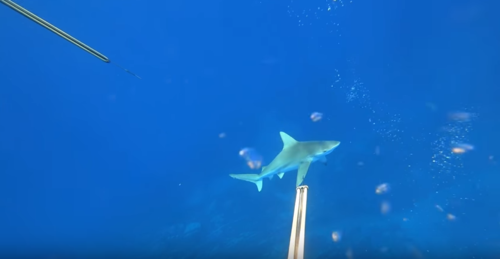
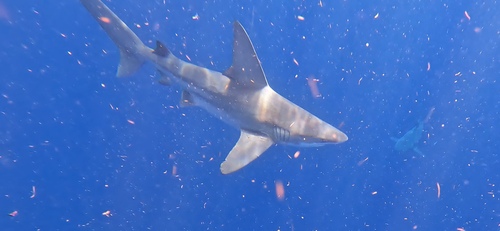
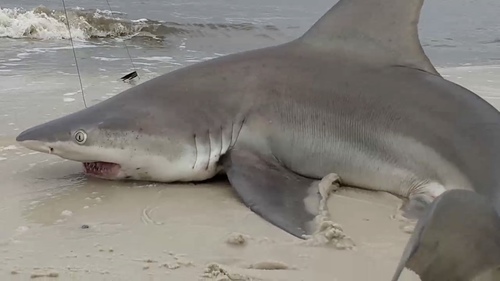
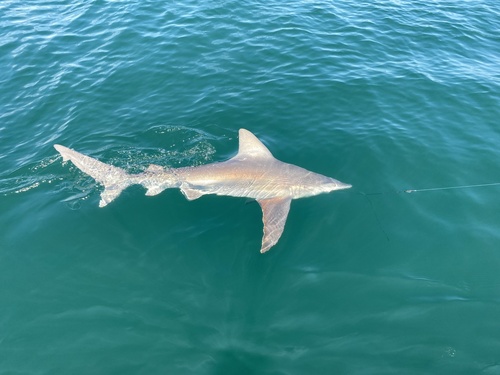
The sandbar shark is a stocky grey-brown requiem shark of warm coasts worldwide, and the most abundant large shark in the western Atlantic. It reaches about 2.5 m and 118 kg, with adults usually 1.8–2.2 m. The field mark is the first dorsal fin: unusually tall, broadly triangular, and set further forward than on any similar shark, starting over or just ahead of where the pectoral fins meet the body. A ridge of skin runs between the two dorsal fins, and the snout is blunt.
Despite being common along the whole US east coast, it almost never meets a swimmer. It is a bottom shark that spends most of its time between 20 and 65 m down on sand and mud, avoids coral reefs, avoids the surface and avoids the surf zone — so it and the people simply do not use the same water. The International Shark Attack File lists five unprovoked bites and no deaths. Its nurseries are the bays and estuaries from Delaware to North Carolina, above all Chesapeake Bay, where juveniles spend their summers eating blue crabs.
That same tall fin is why the species is in trouble. A high ratio of fin weight to carcass weight made the sandbar the primary target of the US Atlantic shark fishery, and the western Atlantic population is thought to have dropped by around two-thirds between the 1970s and the early 1990s. Since 2008 it has been illegal to keep one in US waters outside a small observed research fishery, and the rebuilding plan runs to 2070 — because a shark that matures at 13 or 14 and has eight pups every other year recovers on a timescale measured in careers. The IUCN assessed it as Endangered globally in 2021.
Where it lives
The sandbar shark lives almost everywhere warm except the one place you would expect. In the western Atlantic it runs from southern Massachusetts to Argentina, taking in the Gulf of Mexico, the Bahamas and the Caribbean. In the eastern Atlantic it reaches from Portugal to the Congo and through the Mediterranean, where the species was first described. Across the Indo-Pacific it is scattered from the Red Sea and the Persian Gulf down the east African coast and out to Hawaii. The eastern Pacific has it at two island groups, Revillagigedo and the Galápagos, and nowhere on the American mainland. The Florida Museum calls it the most abundant large shark in the western Atlantic.
Inside that outline it is a bottom shark with fixed opinions about what it is lying on. It wants smooth sand or mud — continental shelves, oceanic banks, harbours, estuaries, river mouths, turbid shallow water — and it avoids coral reefs and rough ground. It also avoids the two places people are: the surface, and the surf zone off a sandy beach. The Florida Museum and FishBase agree independently that it spends most of its life between 20 and 65 m down, and disagree wildly about its limit: NOAA says 810 ft (247 m), FishBase 500 m, shark-references 1,800 m. It tolerates brackish estuary water but is a marine animal, and unlike the bull shark it does not run up rivers.
The part of the range that matters most is a strip of the US east coast about the length of England. The bays and estuaries from Delaware to North Carolina are the prime nursery grounds for the whole western Atlantic population, and Chesapeake Bay is the largest of them. Females come inshore to give birth, the pups stay in water too shallow and too muddy for the big sharks that would eat them, and the juveniles work the bottom for blue crabs at two to three feet long. Which is why a paper on young sandbar sharks in this bay was already in print in 1960.


- Lower Chesapeake Bay, Virginia & Maryland — The best-known sandbar nursery on the coast, described by the Chesapeake Bay Program as one of the most important on the US east coast. Schools of juveniles two to three feet long arrive in summer and stay through autumn, eating mostly blue crabs, and leave as the water cools.
- Delaware Bay — The northern end of the nursery strip the Florida Museum picks out as prime pupping habitat — the bays and estuaries from Delaware to North Carolina. Pups are born here between June and August and the young of the year hold in the shallows until late autumn.
- Cape Hatteras & the Carolina shelf, North Carolina — The hinge of the whole migration. Everything that summers in the mid-Atlantic funnels past here in autumn on the way to warmer water, and back again in spring. Federal survey work in 2007 found most sandbar sharks caught in the mid-Atlantic closed area were still immature, which is why the closure exists.
- The Main Hawaiian Islands — The far eastern edge of the Indo-Pacific range, and a population that behaves differently: Hawaiian sandbar sharks are thought to be year-round residents rather than seasonal migrants. Litters here average about seven pups.
- KwaZulu-Natal & the Mozambique coast — The southeastern African population, and the one with the long pregnancy — twelve months rather than the western Atlantic’s nine, with pups born December to February. The size data the older literature still quotes came from sharks measured along this coast.
Where it goes
On the US east coast this is a twice-yearly commute run by a thermometer. Adults move north as far as Cape Cod through the warm months and turn south as the water cools, and the sexes do it separately. Males leave earlier and take a deeper route, in large schools; females go later and mostly alone. The young run a smaller version of the same circuit: pups born in the bays in June, July and August stay in the shallows until late autumn, then school up and move south and offshore for the winter, coming back the next summer — and repeating that for as much as five years before they join the long adult migration.
The sightings record shows the same shape from outside. Of the 498 mapped sandbar shark records GBIF holds between 36° and 41.5° N — roughly Virginia Beach to Cape Cod — almost none fall between February and April; the count climbs from May, peaks hard in August, September and October, and collapses in November. Not every population does this. Off Hawaii, sandbar sharks are thought to stay put all year, because the water never gives them a reason to leave. And the gaps between the world’s populations are wide enough that the Florida Museum treats the occasional ocean crossing as a shark catching a ride on a current rather than a journey it set out to make.
Share of verified sandbar shark records by month (GBIF, all years). Darker rose means a larger share of sightings fall in that month. This reflects when people record them, which mixes real seasonality with when divers and boats are out.
US mid-Atlantic — Chesapeake Bay to New York: A summer and autumn shark this far north. May is the leading edge, pups arrive with the June-to-August birthing season, and the peak runs August to October before the whole population heads south. Based on the Chesapeake Bay Program’s summer-and-autumn nursery season, the Florida Museum’s account of the adult migration, and the month-by-month shape of 498 mapped GBIF records between 36° and 41.5° N.
What it eats
It is an opportunistic bottom feeder, and the list is long and unglamorous: small bony fishes, eels, skates, rays, small dogfish and other little sharks, octopus, squid, bivalves, shrimp and crabs. In Chesapeake Bay the juveniles are near blue-crab specialists. It feeds through the day and steps that up at night. One aside from the Florida Museum is worth keeping: so many sandbar sharks are caught with food still in the stomach, and their livers are so large and oily, that the species is thought to feed more reliably than most of its relatives.
The teeth are ordinary requiem-shark teeth — broad serrated triangles above, narrower and more finely serrated below, erect at the front and angling back towards the corners of the jaw. They cut. What keeps this from mattering to anyone is where the mouth goes: down, onto sand, after things it can swallow, and nothing on the menu is bigger than a skate. The traffic runs the other way too — bull sharks prey heavily on juvenile sandbars, which is exactly why the nurseries sit in water shallow and murky enough to keep bull sharks out. Adults have few predators other than us.
Is it dangerous?
The headline is a strange one: this is probably the most abundant large shark on the busiest swimming coast in the United States, and the International Shark Attack File — whose records begin in 1580 — holds five unprovoked bites attributed to it and no deaths. The explanation is geography rather than temperament. A sandbar shark is a bottom animal living between 20 and 65 m down that avoids the surface, the reefs and the surf zone; swimmers and surfers are in the one strip of ocean it has no use for. The Florida Museum says it poses little threat to people, while noting fairly that a 2.5 m shark could do harm. One caveat: requiem sharks are hard to tell apart in the water, so species-level bite counts across this family are softer than they look — the Florida Museum says so itself.
Measured the other way it is not close. The sandbar was the backbone of the US Atlantic shark fishery because of the fin that identifies it: the Florida Museum lists its numbers, moderate size, palatable meat and high fin-to-carcass ratio as the reasons it became the primary targeted species on that coast, and it is taken for fins, flesh, skin and liver in the eastern North Atlantic and the South China Sea too. Between the 1970s and the early 1990s the western Atlantic population is thought to have fallen by about two-thirds. Then management actually happened. A 2005–2006 assessment led NOAA to declare the stock overfished with overfishing occurring; in 2008 the agency split sandbar sharks out of the large coastal shark group, banned keeping one outside a tiny observer-carrying research fishery, and set a rebuilding plan aimed at 2070. The stock is still listed as overfished, but no longer subject to overfishing — a slow, unfinished, working recovery.
Sandbar shark facts
- The first dorsal fin is the whole identification. It is much taller than on other requiem sharks of the same size and it starts further forward — over, or slightly ahead of, the point where the pectoral fins join the body. Add the ridge of skin running between the two dorsal fins and a blunt snout shorter than the width of the mouth, and there is very little else it can be. — Florida Museum, Discover Fishes; NOAA Fisheries species directory
- That fin is also why it was hunted. Its numbers, moderate size, palatable meat and unusually high ratio of fin weight to carcass weight made it the primary targeted species of the commercial shark fishery along the eastern United States — the anatomy that names the shark is the anatomy that priced it. — Florida Museum, Discover Fishes
- Since 2008 nobody in the US Atlantic may keep one outside a shark research fishery: a handful of permitted bottom-longline vessels fishing with a NOAA-approved observer aboard, against a base quota of 90.7 metric tons dressed weight that closes at 80% landed. There is no recreational fishery for the species at all. — NOAA Fisheries species directory; NMFS final rule, 73 FR (24 June 2008)
- The rebuilding target is the year 2070, and the arithmetic behind it is sobering. NMFS projected a 70% chance of rebuilding by then at a total allowable catch of 220 metric tons whole weight a year. Even with no fishing at all, rebuilding was calculated to take 38 years, and federal law then allows one mean generation time to be added on top — which for this shark NMFS put at 28 years. — NMFS final rule, Amendment 2 to the Consolidated HMS FMP, 73 FR (24 June 2008)
- It matures at around 13 to 14 years old, one of the slowest schedules of any coastal shark, at a length of roughly 1.66 m. A female then carries a litter for 8 to 12 months and rests for a year afterwards, so a single shark contributes about four pups a year once it finally starts. — NOAA Fisheries species directory; FishBase
- Chesapeake Bay research on this shark is older than most people realise: a paper on the measurements and occurrence of young sandbar sharks in the Maryland part of the Bay appeared in Chesapeake Science in 1960, under the name Carcharhinus milberti — a synonym used for decades because the Mediterranean population was wrongly thought to be a separate species. — Schwartz 1960, Chesapeake Science 1: 204; Florida Museum on the taxonomy
- The sexes migrate apart. Males set off earlier and follow a deeper route, travelling in large schools; females migrate later and largely alone. — Florida Museum, Discover Fishes
- Not every population migrates. Hawaiian sandbar sharks are thought to be year-round residents, while their Atlantic relatives run the length of a coastline twice a year — the same species, with and without a commute, decided by whether the water ever gets cold. — Florida Museum, Discover Fishes
Photos
Seen lately
PierMonkey’s live map carries community shark sightings from iNaturalist, refreshed every three hours. Open the map to see where sandbar sharks have turned up recently.
How big is that, really?
Maximum reliably recorded length. Rose marks the large or potentially dangerous species the map flags as notable.
Help protect it
- NOAA Cooperative Shark Tagging ProgramSandbar sharks are prohibited, so if you hook one it goes back in the water anyway — which makes a tag report free data. Look at the base of the first dorsal fin for a small plastic dart tag, note the number, length and place, and call (877) 826-2612 or email sharkrecap@noaa.gov. You get the shark’s history back, and so does whoever tagged it.
- NOAA Fisheries — sharks you must release, AtlanticBefore you fish anywhere between Maine and Texas, this is the page that tells you which sharks are prohibited and must be released without being taken out of the water. The sandbar is one of them, and it is easy to confuse with several sharks that are not — so read the list first, not after the fish is on the deck.
- Atlantic Shark InstituteA Rhode Island research non-profit working the northwest Atlantic. Its "Report a Shark" form takes sightings from ordinary boaters and anglers, and its tagging projects publish where the tagged animals went — a practical way to put a mid-Atlantic sighting somewhere it will be used.
Report what you see
Photograph a shark, upload it, and once the community confirms the ID it becomes a research-grade record — which is where every sighting on our map comes from. Yours would appear here within three hours.
How to submit an observation →Organisations working on sharks like this one
- The Shark Trustgood for kidsReport eggcases and sightings, join campaigns, download free ID guides.
- Great Eggcase Huntgood for kidsWalk a beach, find a mermaid’s purse, log it. Over 630,000 eggcases recorded since 2003 — the easiest real science a family can do.
- Sharks4Kidsgood for kidsFree classroom lessons, virtual field trips and activity packs for teachers and parents.
- Save Our Seas FoundationFunds shark research and education worldwide; publishes what each project found.
- Shark StewardsCampaigns to end the shark fin trade and establish shark sanctuaries.
- OceanaPolicy campaigning on fisheries management and bycatch — the thing that actually kills sharks.
- IUCN Shark Specialist GroupThe scientists behind the Red List assessments. For older readers who want the primary source.
Conservation status: Endangered (IUCN Red List, assessed 2021). Assessed Endangered by Rigby and co-assessors for the 2021 Red List (e.T3853A2874370); FishBase records the assessment date as 3 December 2020. The global listing and the American one point in different directions, and that tension is the most interesting thing about this shark. In US Atlantic waters it is counted, capped and slowly rebuilding under a federal plan that began in the 2000s. Across much of the rest of the range — the eastern Atlantic, the Mediterranean, the Indian Ocean, the South China Sea — it is landed by fisheries that keep no species-level record at all, and a global assessment has to average those two worlds. Reference pages written before 2021 still show the older Vulnerable listing. Read the assessment →
Common questions
How do you identify a sandbar shark?▾
Do sandbar sharks bite swimmers or surfers?▾
Why are there so many young sandbar sharks in Chesapeake Bay?▾
Can you catch and keep a sandbar shark?▾
Why will sandbar sharks take until 2070 to recover?▾
Is the sandbar shark the one in the shark fin trade?▾
Keep exploring
- Virginia Beach, Virginia — live surf conditions
- Cape Hatteras, North Carolina — live surf conditions
- Rockaway Beach, New York — live surf conditions
- New Smyrna Beach, Florida — live surf conditions
- Waikiki, Oahu — live surf conditions
- All 40 species →
Sightings © iNaturalist contributors (research-grade observations). Occurrence maps © GBIF.org contributors (CC BY). Community science, not a beach-safety service. Last updated 2026-09-20.
See where sharks are turning up — on the live map
The map and live conditions are open to everyone. A free account unlocks full 16-day forecasts and custom swell alerts.