
Sand tiger shark
It looks like the shark on the poster and behaves like the opposite of one — a slow, hovering, snaggle-toothed fish-eater that has never killed anybody.
Vital statistics
Live birth after about nine to twelve months. The largest embryo in each uterus eats its siblings and then the unfertilised eggs, so a litter is two pups — one per womb — each already about 1 m long. Females breed at best every second year.
The short version
The sand tiger shark is a large, slow coastal shark of warm and temperate seas — the same animal Australians call the grey nurse and South Africans the spotted ragged-tooth. It grows to about 3.2 m and 159 kg, and its narrow hooked teeth stick out even when its mouth is shut, which is why it is the shark photographers reach for when they want menace. The behaviour does not match the face. It eats fish, moves slowly, and the International Shark Attack File lists 29 unprovoked bites and no deaths for the species in a record that begins in 1580.
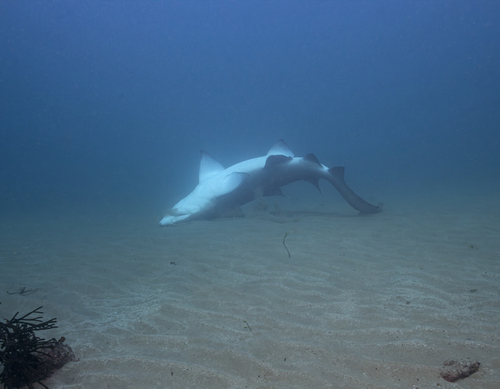
Two things about it are genuinely remarkable. It is the only shark known to swim to the surface, gulp air and hold it in its stomach — a home-made buoyancy tank that lets a fish with no swim bladder hover motionless over a reef or a wreck instead of swimming to stay up. And its young eat each other before birth: the biggest embryo in each of the two wombs consumes its smaller siblings, then lives on the unfertilised eggs that keep arriving, so however many embryos a litter starts with, exactly two pups are born, each already about a metre long.
That is also why it is in trouble. Two pups every second year is one of the lowest reproductive rates of any shark, so fishing removes adults faster than they can be replaced. The IUCN listed the species as Critically Endangered in 2021. New South Wales protected it in 1984, making the grey nurse one of the first sharks anywhere to be protected by law, and the US banned Atlantic landings in 1997 — and only now, four decades on, is the eastern Australian population measurably growing again.
Where it lives
Sand tigers live along warm-temperate and subtropical coasts almost everywhere, with one large hole in the map: there are none in the eastern Pacific at all. In the western Atlantic they run from the Gulf of Maine to Argentina. In the eastern Atlantic they reach from European waters and the Mediterranean down to South Africa, and in the Indo-Pacific from the Red Sea and India across to Japan and eastern Australia. Those groups barely mix: genetic work keeps finding populations that exchange almost no animals, which means a region emptied of sand tigers does not get refilled from next door.
Within that outline it is an inshore shark. FishBase gives a depth range of 1–191 m but puts it usually between 15 and 25 m; the Florida Museum reaches the same 191 m figure, and Australia’s report card says 200 m. The habitat list is the ordinary coast — surf zone, shallow bays, rocky and coral reefs, sandy gutters, the outer edge of the continental shelf and, more than almost any other shark, sunken ships. It is usually near the bottom, but turns up at any level of the water column — a clue to the trick described further down this page.
Temperature is what moves them. The only direct measurements come from archival tags on young sand tigers along the US east coast: across a whole year they experienced water from 9.8 to 26.9 °C but spent most of their time between 12 and 20 °C. That narrow comfort band is why the population walks up and down the coast twice a year instead of staying put.


- The Graveyard of the Atlantic wrecks, North Carolina — The best place on earth to meet one. Divers photographed 1,837 individual sand tigers on the wrecks off Morehead City and Cape Hatteras between 2005 and 2021, and 90% of those pictures came from just ten sites — the Caribsea, the Aeolus, the Spar, the W.E. Hutton and their neighbours, in 6 to 73 m of water.
- Delaware Bay, Delaware & New Jersey — The summer end of the US migration and an important nursery. Young sharks tagged here leave in autumn and come back the following June, year after year.
- Fish Rock and Wolf Rock, eastern Australia — The grey nurse sites. Fish Rock off South West Rocks in New South Wales is a through-cave divers queue for; Wolf Rock off Rainbow Beach in Queensland is the Australian site best known for gathering pregnant females, and has been studied as one since the 2000s.
- iSimangaliso Wetland Park & Aliwal Shoal, South Africa — Where the ragged-tooths spend their pregnancies, in water warmed by the Agulhas Current. South Africa is also the one national population where twenty years of catch and mark-recapture data show no detectable decline.
Where it goes
On the US east coast the sand tiger commutes. Acoustic and satellite tags on young sharks between Maine and Florida, tracked from 2007 to 2013, showed a clean seasonal shuttle: summer habitat from Maine to Delaware Bay from June to October, winter habitat from Cape Hatteras to central Florida from December to April, and the whole population on the move during April–June and October–December. They do it in shallow water the entire way — under 80 m, close in, right through the busiest fishing and boating coast in the country, which is exactly why bycatch matters so much for this species.
Halfway along that route are the wrecks. The Graveyard of the Atlantic off North Carolina holds hundreds of sunken ships, and sand tigers gather in them in numbers that have made the state a diving destination. Because every sand tiger carries a unique pattern of dark spots, divers’ photographs work as a tagging programme that costs nothing: a community science project matched 2,028 encounters to 1,837 individual sharks over seventeen years, re-found 101 of them on later dives — one shark fourteen separate times, another after a gap of 2,176 days — and found that pregnant females make up most of the sightings between June and December. That last detail turned the wrecks from a nice dive into probable breeding habitat. South Africa runs the same play with different scenery: adults move north into KwaZulu-Natal to mate in late October and November, females carry on north into warm water for the year of gestation, then swim back south to pup in the Eastern Cape between September and November.
Share of verified sand tiger shark records by month (GBIF, all years). Darker rose means a larger share of sightings fall in that month. This reflects when people record them, which mixes real seasonality with when divers and boats are out.
US mid-Atlantic & Northeast (Delaware Bay to Cape Cod): Northern presence is a summer thing: sharks arrive through late spring, peak June to September, and are gone south of Cape Hatteras by midwinter. Based on tag tracks of juveniles, 2007–2013.
What it eats
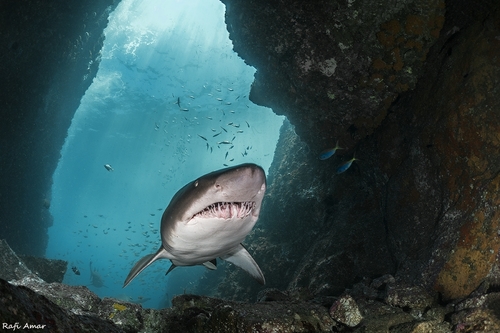
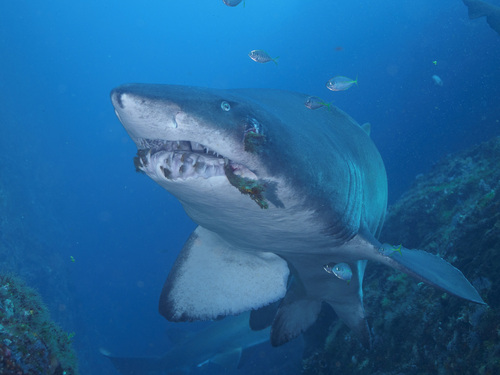
Start with the teeth, because they are the whole misunderstanding. A sand tiger’s teeth are long, narrow, slightly hooked spikes with a small cusplet either side, and they do not fold flat or fit inside the mouth, so the shark looks permanently caught mid-snarl. What they are not is sharp-edged. A great white’s teeth are serrated triangles, a saw for cutting through a seal; a sand tiger’s are smooth needles, a cage for holding something slippery that is trying to wriggle out. Everything on the menu fits that tool: herring, bluefish, mullet, flatfish, eels, snapper, hake and sea bass, plus squid, crabs, lobsters, rays and the occasional smaller shark. All of it is swallowed more or less whole.
The hunting matches the hardware. Sand tigers feed mostly at night, and they have been watched working in groups — a loose ring of sharks bunching a school of fish tighter and tighter before anyone feeds, which is rare behaviour in sharks and the kind of thing usually credited to dolphins. The rest of the time they hang almost motionless over a reef or a wreck, which is a genuine hunting advantage: a fish that cannot hear you coming has no reason to leave. Nothing in that repertoire has anything to do with people.
Is it dangerous?
The honest number is a small one. The International Shark Attack File, which reaches back to 1580, holds 29 records of an unprovoked sand tiger bite and not one death. Look at what those bites have in common and the shark comes out of it well: the Florida Museum singles out spearfishing, and notes that sand tigers will take a catch straight off a stringer or a spear. That is a shark going for a fish that happens to be attached to a person. Divers share the North Carolina wrecks and the New South Wales gutters with them all season without incident. The rules are boring: do not carry dead fish, and do not corner one in a cave or a gutter it cannot leave.
Measured the other way, the traffic is brutally one-sided. This is a Critically Endangered species, and the reason is arithmetic: two pups every other year cannot replace adults removed by fishing. Australia’s east coast subpopulation fell by 94–99% in under three generations, hunted deliberately, speared for trophies and caught in shark control nets, and it is still listed as Critically Endangered today. The good news is slow and real: New South Wales protected the species in 1984, Queensland in 1997 and Australia nationally in 1999, the United States banned Atlantic landings in 1997, and in 2025 CSIRO reported a genetic head-count of about 1,420 eastern Australian adults in 2023, up from 1,096 in 2017 — roughly 5% a year. Four decades of protection for a first flicker of recovery is the clearest picture anyone has of what slow reproduction really costs.
Sand tiger shark facts
- It is the only shark known to gulp air at the surface and hold it in its stomach. Sharks have no swim bladder and are denser than seawater, so most must keep swimming to stop sinking; a sand tiger swallows a mouthful of air instead and hangs in the water without moving. — Florida Museum / FishBase
- A litter is always two pups, one from each uterus, because the largest embryo in each womb eats its smaller siblings and then the unfertilised eggs. Embryos have working teeth by the time they are 17 cm long. — Florida Museum, after Pollard & Smith 2009 and Compagno et al. 2005
- Because of that, a litter can lose a father before it is born. DNA profiling of 15 litters found that 60% of mothers had mated with more than one male, but only 40% of litters ended up with more than one father — in three cases a male fertilised eggs and still produced no surviving pup. — Chapman et al. 2013, Biology Letters
- They live longer than the growth bands in their bones say. Bomb radiocarbon dating validated at least 40 years in females and 34 in males, and showed that band-counting had been underestimating large adults by 11 to 18 years. — Passerotti et al. 2014, Marine and Freshwater Research
- New South Wales protected the grey nurse in 1984, one of the first legal protections given to any shark species anywhere. Queensland followed in 1997 and Australia listed it nationally in 1999. — Florida Museum / fish.gov.au report card
- Every sand tiger has a unique pattern of dark spots, so a diver’s snapshot works like a tag. Photographs from the North Carolina wrecks matched 2,028 encounters to 1,837 individual sharks between 2005 and 2021, including one animal seen fourteen times and one re-found after 2,176 days. — Price et al. 2024, Frontiers in Marine Science
- Australia’s east coast population fell by 94–99% in under three generations. A CSIRO genetic head-count reported in 2025 put it at about 1,420 adults in 2023, up from 1,096 in 2017 — an increase of roughly 5% a year, four decades after protection began. — fish.gov.au report card / CSIRO 2025
- It is the shark you have probably already met. Sand tigers do well in tanks and are among the most displayed large sharks in the world, but the exhibits are not self-sustaining: an industry census counted 301 individuals on display worldwide in 2025, and aquariums still take replacements from the wild because breeding them in captivity almost never works. — Carlisle et al. 2026, Frontiers in Conservation Science
Photos
Seen lately
PierMonkey’s live map carries community shark sightings from iNaturalist, refreshed every three hours. Open the map to see where sand tiger sharks have turned up recently.
How big is that, really?
Maximum reliably recorded length. Rose marks the large or potentially dangerous species the map flags as notable.
Help protect it
- Spot A Shark USARun by the North Carolina Aquariums. If you dive the Atlantic wrecks, photograph the sharks’ flanks and upload the pictures — the spot patterns identify individuals, and the resulting database is what told researchers the wrecks are full of pregnant females.
- Spot A Shark (Australia)The same idea for grey nurse sharks on Australia’s east coast, running since 2006. Upload a dive photo from Fish Rock, Wolf Rock or Magic Point and the software compares it against thousands of others to find out whether that shark has been seen before.
- NOAA Fisheries — Atlantic shark species you must releaseThe sand tiger is a prohibited species in US Atlantic waters and has been since 1997. If you fish anywhere from Maine to Florida, this is the page that tells you which sharks must go back — released in the water, without lifting them out — and it is worth reading before the day you hook one.
Report what you see
Photograph a shark, upload it, and once the community confirms the ID it becomes a research-grade record — which is where every sighting on our map comes from. Yours would appear here within three hours.
How to submit an observation →Organisations working on sharks like this one
- The Shark Trustgood for kidsReport eggcases and sightings, join campaigns, download free ID guides.
- Great Eggcase Huntgood for kidsWalk a beach, find a mermaid’s purse, log it. Over 630,000 eggcases recorded since 2003 — the easiest real science a family can do.
- Sharks4Kidsgood for kidsFree classroom lessons, virtual field trips and activity packs for teachers and parents.
- Save Our Seas FoundationFunds shark research and education worldwide; publishes what each project found.
- Shark StewardsCampaigns to end the shark fin trade and establish shark sanctuaries.
- OceanaPolicy campaigning on fisheries management and bycatch — the thing that actually kills sharks.
- IUCN Shark Specialist GroupThe scientists behind the Red List assessments. For older readers who want the primary source.
Conservation status: Critically Endangered (IUCN Red List, assessed 2021). Assessed as Critically Endangered by Rigby and colleagues for the 2021 Red List (FishBase records the assessment date as 7 December 2020), population trend decreasing. The assessment’s own summary is blunt about the mechanism: annual rates of population increase are very low, so the species cannot absorb fishing pressure, and populations in several regions have been severely depleted by commercial fishing, spearfishing and protective beach meshing. The change is recent enough that good reference pages, the Florida Museum’s included, still show the older Vulnerable listing. Read the assessment →
Common questions
Are sand tiger sharks dangerous to people?▾
Why does a sand tiger shark look so frightening if it is harmless?▾
Is the grey nurse shark the same as the sand tiger shark?▾
Why do sand tiger sharks swallow air?▾
Do baby sand tiger sharks really eat each other?▾
Why are sand tiger sharks in almost every big aquarium?▾
Keep exploring
- Cape Hatteras, North Carolina — live surf conditions
- Virginia Beach, Virginia — live surf conditions
- New Smyrna Beach, Florida — live surf conditions
- The Pass, Byron Bay, NSW — live surf conditions
- All 40 species →
Sightings © iNaturalist contributors (research-grade observations). Occurrence maps © GBIF.org contributors (CC BY). Community science, not a beach-safety service. Last updated 2026-09-20.
See where sharks are turning up — on the live map
The map and live conditions are open to everyone. A free account unlocks full 16-day forecasts and custom swell alerts.