
Puffadder shyshark
A South African catshark that hides by curling into a ring and pulling its tail over its eyes — and that lives on one stretch of one country’s coast and nowhere else on Earth.
Vital statistics
Egg-laying, with no breeding season — females lay all year round. Eggs go down one or two at a time in tough brown capsules 3.5–5 cm long, banded, faintly furry to the touch and fitted with long sticky tendrils that the female winds around sea fans and other upright growth. One pup hatches at about 9–10 cm.
The short version
The puffadder shyshark is a small bottom-living catshark found only in South Africa, between Langebaan Lagoon in the Western Cape and Algoa Bay in the Eastern Cape. It reaches about 60 cm — most adults are 40–60 cm — and it is patterned with eight to ten orange-brown saddles with dark edges, sprinkled all over with small white spots. The saddles are why it is named after a snake: they look like the markings of the puff adder, a thickset African viper. It lives on sand, reef and kelp from the intertidal down to around 130 m, and it spends most of its time lying still.
Its name is literal. When a puffadder shyshark is frightened it curls into a tight ring and lays its tail across its own face, covering its eyes. South Africans call it the shy-eye shark, or skaamoog in Afrikaans, and divers call the shape a doughnut. It is not embarrassment: a curled shark protects its eyes and turns itself into an awkward, rigid circle that is much harder for a predator such as a Cape fur seal or a broadnose sevengill to swallow. It is harmless to people — the international shark incident file has nothing for it.
It is also Endangered, assessed by the IUCN in 2020 with a decreasing population, having been Near Threatened in 2009. That looks strange for a shark divers see on almost every Cape Town dive, and the explanation is range rather than rarity. The whole species lives on one busy stretch of one country’s coast, it barely moves, and it is caught constantly as bycatch — thrown back by trawlers, hooked from the beach by shore anglers who often kill it as a nuisance. A shark with nowhere else to live has no margin for error.
Where it lives
The puffadder shyshark lives in South Africa and absolutely nowhere else. Its range runs from Langebaan Lagoon on the cool Atlantic side of the Western Cape, round the Cape Peninsula and False Bay, along the south coast past Hermanus, Mossel Bay and Plettenberg Bay, and stops at the western shore of Algoa Bay in the Eastern Cape. That is the whole world map for this animal. Put a finger on Cape Town and another on Gqeberha and you have covered the entire species — a drive most South Africans have done in a day.
It used to be given a bigger range than that. Older books, and FishBase still, take it all the way up to KwaZulu-Natal, because a darker inshore "Natal form" was counted as the same shark. In 2006 Human and Compagno described that form as a species in its own right, the Natal shyshark Haploblepharus kistnasamyi, and the puffadder shyshark lost roughly the eastern third of its supposed range overnight. Nothing happened in the sea; the map simply became honest. It is worth knowing when reading any account written before 2006, including some still online.
Inside that strip it is a bottom shark of sand, rock, reef and kelp, from water shallow enough to wade in down to about 130 m. On the Cape Peninsula divers meet it in a few metres among the kelp stipes, usually lying motionless, often with two or three others tucked into the same gully; further east it tends to be found deeper on open sand. It is genuinely common where it occurs — of roughly 1,130 records of the species held by GBIF, 1,084 are South African, and more than 400 research-grade iNaturalist observations sit within 25 km of the Cape Peninsula alone. Common and small-ranged are not opposites, and this shark is the clearest illustration of that in the library.


- False Bay & the Cape Peninsula — The species’ headquarters and where most people meet it — Millers Point, Simon’s Town, the Kalk Bay side. The neotype that anchors the scientific name was collected at Millers Point.
- The Atlantic seaboard kelp forests — Oudekraal to Kommetjie: cold, clear and full of shysharks lying between the kelp holdfasts. It is the Cape kelp forest at its most reachable — snorkellable from the road, on a calm day.
- Langebaan Lagoon & Saldanha Bay — The western full stop. The range ends here, in a shallow warm lagoon inside a cold-water coast — beyond it, its relative the dark shyshark carries on into Namibia, but this species does not.
- Walker Bay & the Cape Whale Coast — Hermanus and Betty’s Bay, where South African researchers run baited video surveys of the endemic catsharks and where a lot of what is known about shyshark behaviour has been filmed.
- Algoa Bay, Eastern Cape — The eastern full stop, a short way up the coast from Jeffreys Bay. Sharks this end of the range grow larger than the west-coast animals and are more often taken as trawl bycatch.
Where it goes
There is no migration to describe, and that is the point of this entry. The puffadder shyshark is a sedentary animal in the plainest sense: it sits on the bottom, it feeds nearby, it lays its eggs on the same reefs, and no one has published a tracking study that puts a number on how far one of them wanders, because nothing about the species suggests the number would be large. There is no seasonal run to time a dive around and no ocean crossing to report. A shyshark you see in a gully at Millers Point is, as far as anyone can tell, a shyshark that belongs to that gully.
Normally that is a footnote. Here it is the whole conservation argument. A blue shark that finds its home water fished out can swim to another ocean; a sedentary shark on 1,000-odd kilometres of coastline cannot. Everything that happens to inshore South Africa — trawl effort, shore angling, ports, outfalls, warming water on the Agulhas side and acidifying upwelling on the Atlantic side — happens to the entire species at once, with no refuge population somewhere else to restock from. It is the same argument the Red List makes about small-range endemics generally, and South Africa has an unusual number of them: the Save Our Seas Foundation counts about 16 catshark species in the country, 14 of which live nowhere else.
Share of verified puffadder shyshark records by month (GBIF, all years). Darker rose means a larger share of sightings fall in that month. This reflects when people record them, which mixes real seasonality with when divers and boats are out.
What it eats
It is a generalist that eats whatever the seabed offers. Crustaceans come first almost everywhere its stomach contents have been examined — crabs, shrimps, hermit crabs, mantis shrimps, rock lobster — then polychaete worms, then small bony fish such as anchovy, gobies and young maasbanker, with squid and scavenged fish offal filling in. Prey is found largely by smell and by electroreception, the jelly-filled pores across the snout that pick up the faint electrical fields of animals buried in sand, which is how a slow shark makes a living without chasing anything down.
The odd part is that males and females are not eating the same meal. Work on Cape catsharks found males taking noticeably more polychaete worms and females more crustaceans, and their teeth match the split: a male’s are longer and three-pointed, a female’s shorter and five-pointed. Within one species, on one reef, the two sexes are equipped for different food. It is a neat reminder that "what does this shark eat" can have more than one correct answer, and it may also be what lets a lot of shysharks share a small patch of seabed without running each other out of dinner.
Is it dangerous?
None. This is a 60 cm fish with a small mouth and teeth a few millimetres long, and its entire response to being startled is to roll itself into a ring and hide its own eyes. The Florida Museum, which keeps the international file on shark incidents, has nothing for it and notes it poses little threat to people because of its size and its diet. Divers and snorkellers share the Cape kelp with them every weekend of the year without anything happening.
The danger runs entirely the other way, and mostly from a fishing rod. Shore anglers along the Cape coast hook them constantly, and because a shyshark takes bait meant for something else, many are treated as pests and killed or left on the sand rather than returned to the water; others are kept for lobster bait. Add the ones discarded by inshore trawlers between Mossel Bay and East London and by boats in False Bay, and you have an Endangered animal being killed almost entirely by accident and irritation. If you hook one, the fix costs nothing: unhook it in the water with wet hands, support its body instead of dangling it, and let it go. It will curl up in your hands, which is the nearest thing to a complaint it can make.
Puffadder shyshark facts
- The "shy" is literal and it is the best trick in the family. Threatened, a puffadder shyshark curls into a ring and folds its tail over its head so that the tail covers its eyes. The posture protects the eyes and makes the shark a stiff circle that is awkward to swallow whole, and it is the reason for both the name shyshark and the diver’s nickname doughnut. — Compagno et al., Sharks of the World; Save Our Seas Foundation
- The "puffadder" half of the name is about markings, not venom. The eight to ten dark-edged orange-brown saddles running down its back, thickly sprinkled with small white spots, look like the pattern of the puff adder — a broad, slow African viper — which is how a completely harmless fish ended up named after a snake. — Compagno et al., Sharks of the World; Two Oceans Aquarium
- Males and females eat differently and are built for it. Males take more polychaete worms and have longer, three-pointed teeth; females take more crustaceans and have shorter, five-pointed teeth. Crustaceans are the largest part of the diet overall, followed by worms and then small fish. — Dainty 2002, MSc thesis on Cape catshark biology; Florida Museum, Discover Fishes
- It is the shark that showed acidifying seawater can corrode shark skin. Puffadder shysharks held for nine weeks at pH 7.3 — a year-2300 projection — had 25.0 ± 6.7% of their dermal denticles damaged, against 9.2 ± 3.2% in control sharks, with 35% less calcium in the denticles. Their blood chemistry coped; their skin did not. — Dziergwa et al. 2019, Scientific Reports
- Its range shrank by about a third in 2006 without a single shark moving. The darker inshore "Natal form" had always been counted as the same species; Human and Compagno described it as the separate Natal shyshark, Haploblepharus kistnasamyi, and everything north-east of the Eastern Cape stopped being this animal. — Human & Compagno 2006, Zootaxa 1318; Human 2007, Zootaxa 1451
- Cape fur seals catch them and play with them, tossing them into the air and chewing on them, and black-backed kelp gulls have learned to wait and steal the shark from the seal. Broadnose sevengill sharks eat them outright. For a 60 cm fish on an open sand flat, curling up is a reasonable plan. — R.A. Martin, ReefQuest Centre for Shark Research; Ebert 1991 (sevengill diet, southern Africa); Florida Museum
- There is no breeding season — females lay all year. The capsules are 3.5–5 cm long, brown with pale bands, slightly furry to the touch and fitted with long sticky tendrils, and they are wound around sea fans and other upright growth one or two at a time. A single 9–10 cm pup hatches roughly three months later. — Dainty 2002; van der Elst, A Guide to the Common Sea Fishes of Southern Africa
- It really is a one-country shark. Of about 1,130 occurrence records held by GBIF, 1,084 are from South Africa — the handful filed under Ireland, Jersey or the Congo are the stray errors any aggregated database collects. South Africa has roughly 16 catshark species and 14 of them live nowhere else on Earth. — GBIF, September 2026; Save Our Seas Foundation
Photos
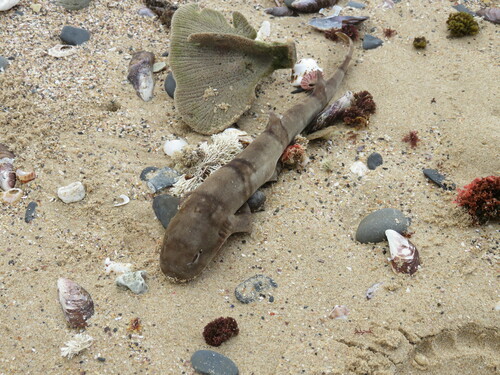
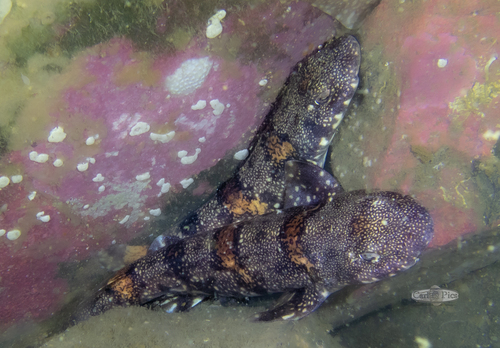
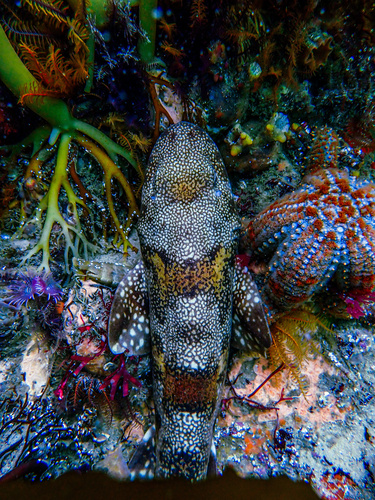
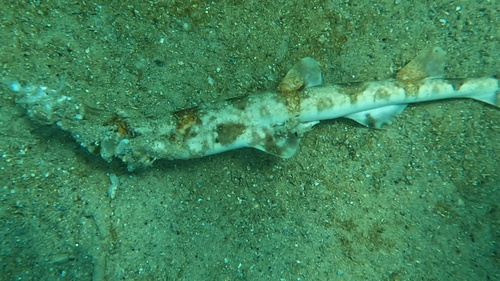
Seen lately
PierMonkey’s live map carries community shark sightings from iNaturalist, refreshed every three hours. Open the map to see where puffadder shysharks have turned up recently.
How big is that, really?
Maximum reliably recorded length. Rose marks the large or potentially dangerous species the map flags as notable.
Help protect it
- SOSF Shark Education Centre, Kalk BayThe most direct thing a visitor to Cape Town can do: book a guided tour of the centre in Kalk Bay, on the shore of False Bay, where this shark actually lives. The tours are free and the programmes are built around the rocky shore and kelp ecosystem outside the door, which is the habitat this entry is about. Booking is essential — it is a small building, not a museum queue.
- Cape RADD, Simon’s TownA research and diver-development outfit working in False Bay that takes members of the public out on citizen-science snorkel and dive surveys. Shysharks are one of the animals you are there to count: you learn the survey method, you record what you see, and the data goes into monitoring of exactly the endemic catsharks the Red List assessment says need better numbers. No biology degree required.
- Save Our Seas Foundation — World of SharksIf you want to check this page against someone else, start here. It is the profile kept by the foundation that funds much of the South African catshark work, it lists the threats in the same order the Red List does, and it is the place to read up before writing to a fishery or an angling club about how bycatch shysharks are handled on your local beach.
Report what you see
Photograph a shark, upload it, and once the community confirms the ID it becomes a research-grade record — which is where every sighting on our map comes from. Yours would appear here within three hours.
How to submit an observation →Organisations working on sharks like this one
- The Shark Trustgood for kidsReport eggcases and sightings, join campaigns, download free ID guides.
- Great Eggcase Huntgood for kidsWalk a beach, find a mermaid’s purse, log it. Over 630,000 eggcases recorded since 2003 — the easiest real science a family can do.
- Sharks4Kidsgood for kidsFree classroom lessons, virtual field trips and activity packs for teachers and parents.
- Save Our Seas FoundationFunds shark research and education worldwide; publishes what each project found.
- Shark StewardsCampaigns to end the shark fin trade and establish shark sanctuaries.
- OceanaPolicy campaigning on fisheries management and bycatch — the thing that actually kills sharks.
- IUCN Shark Specialist GroupThe scientists behind the Red List assessments. For older readers who want the primary source.
Conservation status: Endangered (IUCN Red List, assessed 2020). Endangered. The assessment is dated 1 August 2019 and was published in the IUCN Red List in 2020 (Pollom, Da Silva, Gledhill, Leslie, McCord & Winker), with the population trend given as decreasing. The previous assessment, by Human in 2009, had it as Near Threatened — the shark did not change, the evidence did. What drives the category is arithmetic rather than drama: the whole species lives inside one heavily fished stretch of South African coast, it is caught and thrown back by inshore trawlers and hooked from the beach by shore anglers, and it has nowhere else to be if that coast gets worse. Read the assessment →
Common questions
Why does the puffadder shyshark curl into a doughnut?▾
Where does the puffadder shyshark live, and how big is its range?▾
How big is a puffadder shyshark, and how old do they get?▾
How do I tell a puffadder shyshark from a dark shyshark on a Cape dive?▾
I hooked one off the beach — what should I do with it?▾
Why does living in a small area make a shark this common Endangered?▾
Keep exploring
- Dungeons, Cape Town — live surf conditions
- Jeffreys Bay, Eastern Cape — live surf conditions
- All 40 species →
Sightings © iNaturalist contributors (research-grade observations). Occurrence maps © GBIF.org contributors (CC BY). Community science, not a beach-safety service. Last updated 2026-09-20.
See where sharks are turning up — on the live map
The map and live conditions are open to everyone. A free account unlocks full 16-day forecasts and custom swell alerts.