
Port Jackson shark
A blunt-headed, shell-crushing Australian reef shark that lays the strangest egg in the ocean — a dark brown spiral, screwed into a crack in the rock.
Vital statistics
Egg-laying. A female produces 10–16 eggs a season, a pair at a time every 10–14 days, and one pup hatches from each spiral case after 10–12 months at about 23–25 cm.
The short version
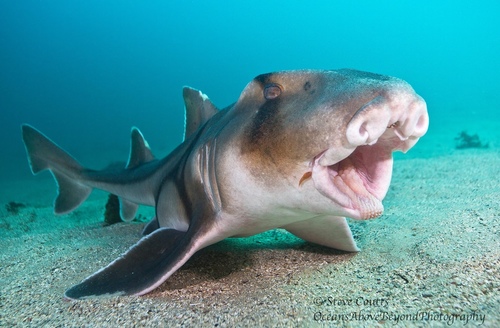
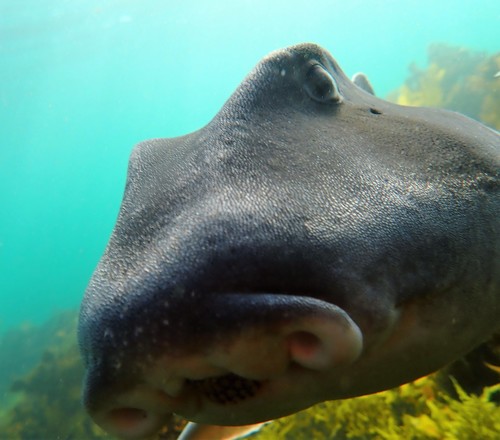
The Port Jackson shark is a small, blunt-headed bullhead shark found only in southern Australia, from Byron Bay round to the Houtman Abrolhos, including Tasmania. It reaches about 1.65 m at the very most; adults are usually 0.75–0.95 m, with females larger than males. You can identify it instantly by the dark harness-like straps that cross its eyes, run along its back and loop down its flanks, and by the spine in front of each of its two dorsal fins.
It eats hard-shelled food — sea urchins, snails, crabs, worms and small fish — using pointed front teeth to grip and flat molars at the back to crush, which is what the name Heterodontus, "different teeth", refers to. It is nocturnal, spending the day under ledges on rocky reef and feeding at night, and it lives to around 35 years. It lays eggs in a dark brown spiral case shaped like a drill bit, which the female wedges and screws into a crack in the reef; a single pup hatches ten to twelve months later.
It is harmless. There is no confirmed attack on a person on record, and the IUCN lists the species as Least Concern — it is abundant, and although fisheries catch a great many as bycatch, almost all are released alive. Eastern sharks migrate several hundred kilometres south each summer and return to the same breeding reefs year after year.
Where it lives
The Port Jackson shark lives in one country and nowhere else. Its range runs along the southern half of Australia, from Byron Bay in northern New South Wales down past Sydney, through Victoria and Tasmania, across South Australia and up the Western Australian coast as far as the Houtman Abrolhos. A single animal has ever been recorded from New Zealand, and occasional reports from Queensland are treated with suspicion. Genetic work splits it into two populations — an eastern one from southern Queensland to New South Wales, and a southern and western one from Victoria round to WA.
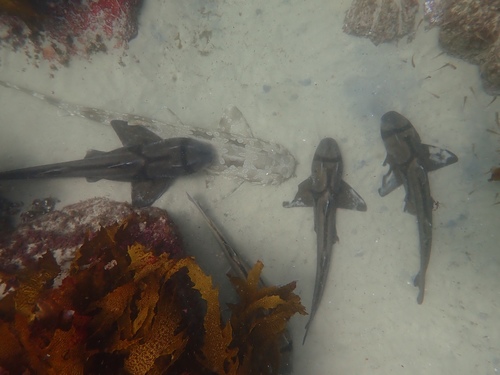
Within that range it is a reef animal. It shelters by day in caves, gutters and under ledges on rocky reef, and feeds at night over the adjacent sand, seagrass and kelp. Records run from the intertidal zone down to 275 m, but the great majority sit in the top 50 m, which is why this is a shark that snorkellers meet rather than one that scientists have to go looking for. Where there is reef there are usually several, tucked into the same gutter or stacked under the same ledge.
That shallowness is the whole reason this page exists. Port Jackson sharks are the most-reported shark in PierMonkey’s own live sightings feed — more records than any other species — not because they are rare or spectacular, but because they sit still in two metres of water off Sydney beaches while somebody photographs them.


- Jervis Bay, New South Wales — The best-studied breeding aggregation of the species, tracked with acoustic receivers since 2012, and one of only three known breeding sites on the NSW coast.
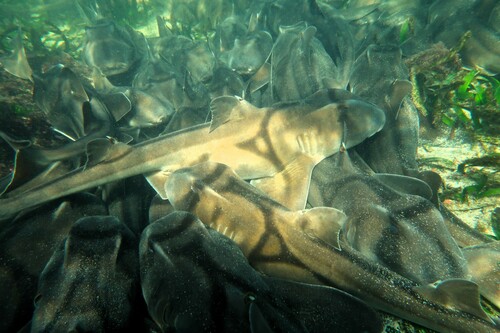
- Cabbage Tree Bay, Manly (Sydney) — A no-take aquatic reserve where divers have logged spring gatherings of 25–40 sharks, plus mating and egg cases, every year since 2010.
- Port Stephens, New South Wales — One of the three recognised breeding aggregation sites on the NSW coast, alongside Jervis Bay and Sydney Harbour.
- Bass Strait and eastern Tasmania — Not a breeding site but a feeding one — where much of the eastern population spends the summer and autumn.
- Gulf St Vincent & Spencer Gulf, South Australia — Abundant year-round on the gulf reefs; the growth records used to link this species to sea temperature came from here.
Where it goes
For a shark that spends its days lying under a ledge, the Port Jackson shark commutes remarkably far. The eastern population winters on the New South Wales coast to breed, then heads south for the summer to feed, and the Australian Museum puts the annual round trip at 600–800 km between the Bass Strait feeding grounds and the NSW breeding reefs.
The detail comes from more than a decade of acoustic tagging in Jervis Bay. Roughly half the tagged sharks were picked up heading south, with receivers logging them at Narooma, in Bass Strait and as far as Cape Barren Island off Tasmania; a later study using stable isotopes and telemetry together recorded individuals up to 645 km south of the bay. Not every shark goes. A minority stay in Jervis Bay all year, and the isotope work sorted the sharks into six separate feeding signatures — a useful corrective to the idea that a species migrates as a single block.
What makes this a genuinely good story is what happens next. The same animals come back. Year-to-year return rates to the same bay run around 77%, and individuals favour not just the bay but particular reefs within it, season after season. Both sexes show this homing — bisexual philopatry, which is rarer than it sounds — and the timing is sharply sex-specific: males arrive and leave about two weeks ahead of the females, and hold territory on a single reef while the females roam between reefs, apparently sizing up the males.
Share of verified port jackson shark records by month (GBIF, all years). Darker rose means a larger share of sightings fall in that month. This reflects when people record them, which mixes real seasonality with when divers and boats are out.
Jervis Bay & the New South Wales coast: The NSW breeding season peaks from July to November, with the heaviest presence in August and September; our own sighting records for the NSW coast follow the same curve, with about 70% falling in July–October. A few animals stay all year rather than migrating south.
What it eats
The genus name gives the game away. Heterodontus means "different teeth", and this shark has two sorts in the same mouth: small pointed teeth at the front for gripping, and broad flat molars at the back for crushing. That makes it a durophage — an eater of hard things. Sea urchins and large gastropod snails turn up in almost every study of its stomach contents, alongside crabs, prawns, bivalves, polychaete worms and small fish. The Australian Museum singles out black sea urchins as a particular favourite. Juveniles, whose back teeth have not broadened yet, take softer prey and work up to shellfish as they grow.
It hunts at night, nosing over sand and weed beside the reef, and it feeds by suction rather than by chasing anything down: a sharp inward pull draws a urchin into the mouth, and the molars do the rest. It can also pump water over its gills while it works, so it does not need to keep swimming to breathe — which is exactly why you so often find one parked motionless on the bottom, quietly eating.
Is it dangerous?
There is no confirmed record of a Port Jackson shark attacking a person. The Florida Museum, which keeps the international file on shark incidents, lists none. The mouth is small, the working teeth are grinding plates meant for shellfish, and the animal’s response to a diver is to sit still or shuffle further under its ledge. In Sydney every winter, snorkellers swim past them at arm’s length. This is a shark you can be in the water with, and that is the honest answer.
Two caveats, both about handling rather than swimming. Each dorsal fin has a stout spine in front of it — sharp in juveniles, blunter in adults — and some Australian sources describe those spines as venomous, though that is disputed; either way, picking one up or standing on one is a bad idea. And a cornered shark can deliver a hard, grinding nip. The traffic runs overwhelmingly the other way in any case: the species is caught in large numbers as fisheries bycatch, and its eggs sit in shallow crevices for ten to twelve months where a great many never hatch. If you meet one under a ledge, the right move is the boring one: hold your distance, take the photo, and leave both the shark and any wedged egg case exactly where you found them.
Port Jackson shark facts
- Its egg case is a dark brown spiral, roughly 7–8 cm across and 15 cm long, shaped like an auger bit. The female carries it in her mouth and turns her body to screw it into a crack in the reef, where it hardens in place so the surf cannot wash it away. — Australian Museum
- Heterodontus means "different teeth": small pointed ones at the front to grip, broad molars at the back to crush. Sea urchins and large sea snails appear in almost every study of what it has been eating. — Florida Museum
- It can pump water over its gills instead of swimming to breathe, so it can lie completely still on the bottom and eat at the same time. — Australian Museum
- Acoustic tagging in Jervis Bay found year-to-year return rates of about 77% to the same bay and often the same reef, with males arriving and departing roughly two weeks before the females. — Bass et al. 2016, 2021
- Sharks tagged at Jervis Bay have been picked up by receivers at Narooma, in Bass Strait and as far south as Cape Barren Island off Tasmania — the most detailed migration route yet published for the species. — Bass et al. 2016
- In a Macquarie University experiment, five of eight juveniles learned to associate a jazz track with food arriving in a particular corner of the tank — though they struggled to tell jazz from classical. — Vila-Pouca & Brown 2018, Animal Cognition
- Each dorsal fin has a stout spine in front of it. They are sharp in juveniles, when they matter most as defence, and wear blunt with age. Whether they are venomous is still argued over. — Australian Museum
- It is Least Concern for an unglamorous reason: gillnet and trawl fisheries catch huge numbers, but the flesh and fins are poor quality, so nearly all are released — and capture-stress trials show the species survives being caught unusually well. — FRDC / SAFS Report Card 2023
Photos
Seen lately
PierMonkey’s live map carries community shark sightings from iNaturalist, refreshed every three hours. Open the map to see where port jackson sharks have turned up recently.
How big is that, really?
Maximum reliably recorded length. Rose marks the large or potentially dangerous species the map flags as notable.
Help protect it
- The Great Eggcase Hunt AustraliaFound a spiral case on the beach or on a dive? Photograph it with something for scale and log it. The Shark Trust has run this with CSIRO in Australia since 2023, and your record joins a global database of where egg-laying sharks actually breed. The best five minutes of real science a family can do at the beach.
- Reef Life SurveyAustralian-run programme that trains recreational divers to swim standardised transects and count what they see. It is how Australia knows what is on its temperate reefs — Port Jackson sharks included — and it takes ordinary divers, not scientists.
- Atlas of Living AustraliaSearch, map and download every verified Australian record of the species, and add your own. The ALA is the national database that sits behind most Australian range maps, and it is free to use.
Report what you see
Photograph a shark, upload it, and once the community confirms the ID it becomes a research-grade record — which is where every sighting on our map comes from. Yours would appear here within three hours.
How to submit an observation →Organisations working on sharks like this one
- The Shark Trustgood for kidsReport eggcases and sightings, join campaigns, download free ID guides.
- Great Eggcase Huntgood for kidsWalk a beach, find a mermaid’s purse, log it. Over 630,000 eggcases recorded since 2003 — the easiest real science a family can do.
- Sharks4Kidsgood for kidsFree classroom lessons, virtual field trips and activity packs for teachers and parents.
- Save Our Seas FoundationFunds shark research and education worldwide; publishes what each project found.
- Shark StewardsCampaigns to end the shark fin trade and establish shark sanctuaries.
- OceanaPolicy campaigning on fisheries management and bycatch — the thing that actually kills sharks.
- IUCN Shark Specialist GroupThe scientists behind the Red List assessments. For older readers who want the primary source.
Conservation status: Least Concern (IUCN Red List, assessed 2015). Assessed as Least Concern. It is abundant right across southern Australia and is caught in large numbers as bycatch by gillnet and trawl fisheries, but its flesh and fins are of poor commercial value, so nearly every shark is released — and experiments show it survives capture unusually well. Read the assessment →
Common questions
Are Port Jackson sharks dangerous to humans?▾
What is the brown spiral thing I found on the beach?▾
How big do Port Jackson sharks get?▾
When can you see Port Jackson sharks around Sydney?▾
Why is it called a Port Jackson shark?▾
Are Port Jackson sharks endangered?▾
Keep exploring
- Manly Beach, New South Wales — live surf conditions
- North Narrabeen, New South Wales — live surf conditions
- All 40 species →
Sightings © iNaturalist contributors (research-grade observations). Occurrence maps © GBIF.org contributors (CC BY). Community science, not a beach-safety service. Last updated 2026-09-20.
See where sharks are turning up — on the live map
The map and live conditions are open to everyone. A free account unlocks full 16-day forecasts and custom swell alerts.