
Nursehound
Britain and Ireland’s other catshark — nearly twice the size of the common one, sold as bull huss, and the one of the pair the Red List calls Vulnerable.
Vital statistics
Egg-laying. A female lays her eggs a pair at a time through spring and summer — 9–41 a year in the one study that counted them — each sealed in a tough capsule about 10 cm long and wound onto weed or rock by thick tendrils. One pup hatches after roughly 7–12 months at about 16 cm.
The short version
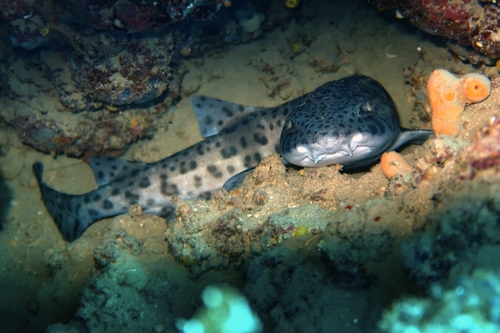
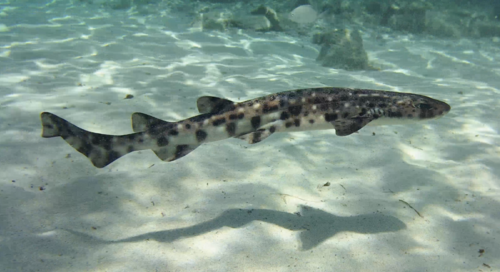
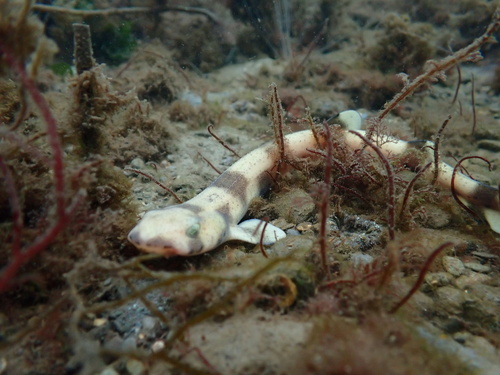
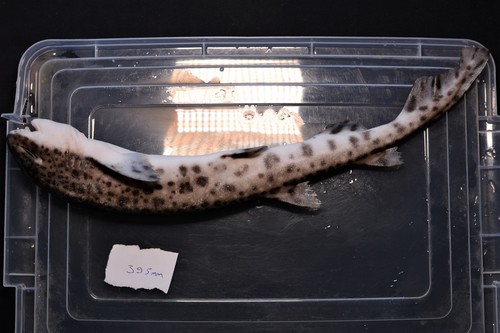
The nursehound is the bigger of the two catsharks in British and Irish waters, and the largest catshark in the region: about 1.6 m at the top end, against roughly 1 m for the small-spotted catshark. It is a creamy-brown bottom shark marked with large dark blotches — fewer and bigger than its cousin’s fine peppering — with a broad rounded head and both dorsal fins set well back. The certain way to tell the two apart is neither size nor spots, which overlap badly on young fish, but the nose: on a nursehound the flaps of skin beside the nostrils stop short, and on a small-spotted catshark they reach down to the mouth. Anglers and fishmongers call it bull huss.
It lives on rough, rocky and weedy ground, usually between about 20 and 60 m but often shallow enough for a snorkeller, and it is genuinely nocturnal: the day goes by wedged in a crack in the reef, and after dark it comes out for cuttlefish, octopus, bony fish and crabs. Like every catshark it lays eggs rather than bearing live young. Its capsules run about 10 cm long and up to 13 — roughly double the small-spotted catshark’s — anchored to weed by thick tendrils, and the pup that hatches out 7 to 12 months later is already about 16 cm long.
It is harmless to people, and the IUCN assessed it as Vulnerable in 2021 while its smaller relative is Least Concern and increasing. That contrast is the story of this shark, and it is arithmetic rather than bad luck: the nursehound matures at around 78 cm instead of 50, lays a few dozen large eggs a year that sit on the seabed for the best part of one, and replaces its generations so slowly that the Red List measures its decline in 48-year blocks. Most of that decline is Mediterranean — parts of the Tyrrhenian have lost more than 99% since the 1970s. In the northeast Atlantic the picture is better: the European regional assessment is Near Threatened, and catch rates in the Irish Sea and Bristol Channel are going up.
Where it lives
The nursehound lives in the same water as the small-spotted catshark and almost nowhere else: the northeast Atlantic from southern Scandinavia and Shetland down past the British Isles, Biscay and Iberia to Mauritania and Senegal, plus the whole Mediterranean. The difference between them is not where they are but how many. GBIF holds about 17,800 occurrence records of the nursehound against more than 540,000 of its smaller cousin — record counts measure how hard people looked as well as what is there, but a thirty-fold gap in the same seas, from the same surveys, means something. Nearly ten thousand of those nursehound records are British, with France, Ireland and Spain next and a cluster around the Isle of Man.
Within that range it is fussier about the ground than its cousin. This is a shark of rough, rocky and coralline bottoms and seaweed beds, inshore and out across the shelf, rather than open sand and mud. FishBase gives a depth range of 1–400 m and a usual band of 20–63 m; the IUCN assessment says intertidal to 400 m and commonest between 20 and 125 m. The shallow end is the interesting end: divers and snorkellers in Cornwall, Devon, Pembrokeshire and the southwest of Ireland meet them in a few metres of water, tucked under ledges with only a spotted tail showing.
The map is blurrier than it ought to be, and the reason is the animal’s double. For most of the twentieth century nursehounds and small-spotted catsharks were landed, counted and written down together, and ICES still warns that landings and catch figures for this species are unreliable. That has a real cost: a shark that is scarcer, slower to mature and more easily knocked back spent decades hidden inside the statistics of one that is none of those things. Eggcases have turned out to be a cleaner signal than catch records, and the verified nursehound cases reported to the Shark Trust come overwhelmingly from the southwest of England and the coast of Wales.


- Cornwall & the Fal — The densest concentration of modern sightings in the country — within 40 km of Fistral alone iNaturalist holds 84 research-grade records — and the place a breeding ground was first written up, in a note to Nature in 1926.
- The Welsh coast & the Irish Sea — Where most verified eggcases come from, and where catch rates have been going up rather than down. The British shore record, 19 lb 14 oz, came off Pwllheli Beach in Gwynedd in 1992.
- Celtic Sea, Bristol Channel & the western Channel — The ICES stock unit — subareas 6 and 7 — that in 2025 received the first quantitative catch advice ever issued for this species. Landings there have risen since 2009 and levelled off since 2017.
- The upper Tyrrhenian Sea — The cautionary one. Nursehound numbers in this corner of the Mediterranean have fallen by more than 99% since the 1970s, and that collapse is most of the reason the global listing reads Vulnerable.
Where it goes
Nothing about this shark travels. There is no seasonal run and no ocean crossing; what a nursehound has instead is an address. When a sub-adult male was followed by acoustic telemetry for 168 days in a tidal sea lough, it spent its days jammed into narrow-entrance holes in a labyrinth of rock, foraged at night, and came back, using at least five different refuges and returning to them rather than finding new ones. Divers found other nursehounds in the same holes, sometimes sharing one. The researchers called it philopatry: not a defended territory but a set of known, reusable hiding places at the centre of a small home range. A shark that comes back to the same rock is a shark you can find again, and a reef emptied of them does not refill from somewhere else in a hurry.
The one movement that happens is short, inshore, and made by females about to lay. Eggs go down through spring and summer — British records give March to October — wound by their thick tendrils onto weed, sea fans and rock in shallow water, sometimes in enough numbers to mark a patch of ground as a nursery. A note in Nature described one such ground in the Fal Estuary in 1926; surveys in the Adriatic were still mapping them in 2025. Then the eggs wait: about 7 months in the warm southern Mediterranean, 10 to 12 in the cold North Sea and Atlantic, before a 16 cm pup files itself out of the case. Almost a year tethered to one piece of seabed is a long time to be a shark that cannot swim away.
Share of verified nursehound records by month (GBIF, all years). Darker rose means a larger share of sightings fall in that month. This reflects when people record them, which mixes real seasonality with when divers and boats are out.
What it eats
The size difference between the two British catsharks shows up on the menu. Where the small-spotted catshark works through shrimps, hermit crabs and worms, a nursehound has the jaws for proper mouthfuls: cephalopods above all, then bony fish including mackerel, dragonets and flatfish, crabs and lobsters, and — awkwardly — smaller sharks, its own cousin among them. Nursehounds from the Gulf of Naples held 52 prey items across 13 kinds of animal, and cephalopods were both the most abundant group and the most varied — nine species of squid, cuttlefish and octopus between them. Hunting is done in the dark, by smell and by the electrical sense in the jelly-filled pores of its snout, which is how you find a cuttlefish buried in sand at midnight.
The same study turned up a sneakier record of what this shark eats. Those nursehounds carried a thin parasite community — one gill fluke and three tapeworms — and almost 80% of every parasite counted was a single tapeworm that arrives inside cephalopod prey. A shark’s worms are a diary of its dinners: they can only get in one way, so a gut full of one tapeworm says squid and cuttlefish, night after night, more reliably than a stomach that happens to be empty when the fish is caught.
Is it dangerous?
There is no danger here. FishBase files the nursehound as harmless, the Florida Museum’s international incident file has nothing under its name, and people snorkel, dive and swim over rocky ground full of them all summer in Cornwall, Wales and Ireland without ever knowing. It is a metre-and-a-bit bottom shark with a small crescent mouth set under a blunt snout and teeth built for cracking crab and gripping cuttlefish. Its own instinct around anything large is to stay in the hole.
What it will do — first written up in 2026, off Cornwall — is tell a snorkeller to back off. Researchers described a nursehound performing a threat display at an approaching swimmer, the kind of stiff, exaggerated warning usually reported from sharks people already fear. Their reading: an anti-predator response, not aggression — a cornered animal making itself expensive to bother. The lesson is polite: look, do not reach, never pull one out of its crevice for a photograph, and if a shark the length of your leg postures at you, it is frightened, so give it room. The real traffic runs the other way anyway: nets, trawls and pots catch them, and the fish ends up on a slab labelled huss.
Nursehound facts
- The reliable field mark is on the nose, not the body. A nursehound’s nasal flaps are small and stop well short of the mouth; on a small-spotted catshark they extend all the way down to it. Spots and size both mislead — a young nursehound is catshark-sized, and both species carry large and small dark marks — but the nose does not. — MarLIN species profile; Compagno, FAO Species Catalogue
- It is the largest catshark in UK waters. MarLIN and Compagno both give a maximum of about 1.6 m, FishBase carries a 170 cm record, and most adults are under 1.3 m. The British rod records give a sense of the weight: 22 lb 4 oz (10.1 kg) from a boat off Minehead in 1986, and 19 lb 14 oz (9.0 kg) from the shore at Pwllheli in 1992. — MarLIN; FishBase; British Record (Rod Caught) Fish Committee listings
- Its eggcase is about 10 cm long and 3–4 cm wide, with a recorded range of 9–13 cm — the same shape as a small-spotted catshark’s but around double the size, and held on by thick tendrils rather than fine curly ones. The pup inside hatches at roughly 16 cm, nearly twice the length of a newly hatched small-spotted catshark. — Shark Trust Great Eggcase Hunt; FishBase
- A sub-adult male tracked by acoustic telemetry for 168 days in a tidal sea lough sheltered in at least five different narrow-entrance holes between nocturnal foraging trips, returning to them repeatedly. Other nursehounds were seen using the same refuges, sometimes two at once. — Sims, Southall, Wearmouth, Hutchinson, Budd & Morritt 2005, J. Mar. Biol. Assoc. UK
- The Vulnerable listing rests on a suspected global decline of 30–49% over three generations, or 48 years. The nursehound’s own maximum age and age at maturity have never been measured, so that 16-year generation length was inferred from the small-spotted catshark — the assessors say so in the assessment. — IUCN Red List assessment, published 2021 (assessed 31 August 2020)
- The decline is regional, not uniform. In the upper Tyrrhenian Sea the species has fallen by more than 99% since the 1970s, while in the northeast Atlantic catch rates in the Irish Sea and Bristol Channel have been rising — which is why the European regional assessment is the gentler Near Threatened. — Ferretti et al. 2005, cited in the IUCN assessment; European regional Red List
- In 2025 ICES issued the first quantitative catch advice ever given for this stock, recommending landings of no more than 758 tonnes in each of 2026 and 2027 in subareas 6 and 7. The same advice warns that landings data for the species remain unreliable, because it has spent decades being recorded as something else. — ICES advice, greater-spotted dogfish in subareas 6 and 7 (2025)
- Almost none of it is landed on purpose. Cornish ports took 69 kg of bull huss in 2024 — against 101 tonnes of small-spotted catshark — and when 117 shark samples from English chip shops and fishmongers were DNA-tested, 9% turned out to be nursehound, sold under labels that name no species at all. — Cornwall Good Seafood Guide; Hobbs et al. 2019, Scientific Reports
Photos
Seen lately
PierMonkey’s live map carries community shark sightings from iNaturalist, refreshed every three hours. Open the map to see where nursehounds have turned up recently.
How big is that, really?
Maximum reliably recorded length. Rose marks the large or potentially dangerous species the map flags as notable.
Help protect it
- Shark Trust — nursehound eggcase IDLearn the big case, then go and find one. This page gives the nursehound capsule’s measurements and shape so you can separate it from the far commoner small-spotted catshark case on the strandline. Verified nursehound records are still concentrated in southwest England and Wales, which means a logged case from Scotland, Ireland or the east coast genuinely adds something — soak it, measure it, photograph it and submit it.
- Shark Log — the Shark Trust sightings databaseIf you dive, snorkel or fish and you see one, record it. Shark Log has taken public sightings of sharks, skates and rays since 2008, and this is a species where public records matter more than usual: its official catch statistics are admitted to be unreliable, so a photographed, dated, located nursehound is worth a great deal. Anglers can log a released fish; divers can log a shark in its hole.
- Cornwall Good Seafood Guide — bull hussRead this before you buy anything sold as huss. It sets out how the fish is caught, how little of it is actually landed in Cornwall and how the fishery rates, and it hands you the one question worth asking a fishmonger or a chip shop: which species is this, exactly? A shark this slow to breed should not be bought by guesswork.
Report what you see
Photograph a shark, upload it, and once the community confirms the ID it becomes a research-grade record — which is where every sighting on our map comes from. Yours would appear here within three hours.
How to submit an observation →Organisations working on sharks like this one
- The Shark Trustgood for kidsReport eggcases and sightings, join campaigns, download free ID guides.
- Great Eggcase Huntgood for kidsWalk a beach, find a mermaid’s purse, log it. Over 630,000 eggcases recorded since 2003 — the easiest real science a family can do.
- Sharks4Kidsgood for kidsFree classroom lessons, virtual field trips and activity packs for teachers and parents.
- Save Our Seas FoundationFunds shark research and education worldwide; publishes what each project found.
- Shark StewardsCampaigns to end the shark fin trade and establish shark sanctuaries.
- OceanaPolicy campaigning on fisheries management and bycatch — the thing that actually kills sharks.
- IUCN Shark Specialist GroupThe scientists behind the Red List assessments. For older readers who want the primary source.
Conservation status: Vulnerable (IUCN Red List, assessed 2021). Assessed as Vulnerable under criterion A2bd in the 2021 Red List update, from an assessment dated 31 August 2020: a suspected global population reduction of 30–49% over three generations, which the assessors put at 48 years. The declines behind that number are overwhelmingly Mediterranean — in the upper Tyrrhenian Sea the species is down more than 99% on the 1970s — while the northeast Atlantic looks steadier, which is why the European regional assessment is the milder Near Threatened and catch rates in the Irish Sea and Bristol Channel have been rising. One caveat sits underneath all of it: the nursehound’s own maximum age and age at maturity have never been measured, so the 16-year generation length was borrowed from its smaller relative the small-spotted catshark. Read the assessment →
Common questions
What is bull huss?▾
How do I tell a nursehound from a small-spotted catshark?▾
Where would I find a nursehound eggcase?▾
Why is the nursehound Vulnerable when the small-spotted catshark is not?▾
Do nursehounds really hide in rocks all day?▾
Are nursehounds dangerous to swimmers?▾
Keep exploring
- Fistral Beach, Cornwall — live surf conditions
- Lahinch, County Clare — live surf conditions
- Bundoran, County Donegal — live surf conditions
- Thurso East, Caithness — live surf conditions
- All 40 species →
Sightings © iNaturalist contributors (research-grade observations). Occurrence maps © GBIF.org contributors (CC BY). Community science, not a beach-safety service. Last updated 2026-09-20.
See where sharks are turning up — on the live map
The map and live conditions are open to everyone. A free account unlocks full 16-day forecasts and custom swell alerts.