
Nurse shark
The shark most divers and snorkellers actually meet — a slow Atlantic bottom-dweller that pulls its dinner out of holes with one of the strongest sucks ever measured.
Vital statistics
Live birth from egg cases carried inside the mother, with no placenta — the pups live on their yolk. Litters of 20–30 (Florida Museum) or 21–28 (FishBase) after five to six months, born about 30 cm long. Females breed every second or third year at best.
The short version
The nurse shark is a slow, heavy-bodied bottom shark of the Atlantic, and the one divers and snorkellers are most likely to actually meet. The largest reliably measured was 3.08 m (10 ft 1 in); the Florida Museum puts a typical adult at 2.3–2.4 m, and FishBase’s heaviest published individual is 109.6 kg. It lives in the western Atlantic from Rhode Island to southern Brazil, and in a much smaller eastern Atlantic population from Cape Verde to Gabon. It is not a Pacific shark: those animals were split off as Ginglymostoma unami in 2015.
It spends the day lying still — on sand, under a ledge, in a cave, often in company and occasionally in heaps of up to 40 sharks piled on one another — and hunts at night. Its one extraordinary skill is suction. By sealing its small round mouth and dropping the floor of it, the shark makes the pressure inside collapse, so prey is pulled out of a crevice rather than chased. Recorded peaks of 110 kilopascals below ambient are among the largest suction pressures ever measured in an aquatic vertebrate.
It is rarely a risk to people. The International Shark Attack File records nine unprovoked nurse shark bites and no fatalities, and the Florida Museum notes that incidents are usually the result of provocation — somebody grabbing, riding or feeding the animal. The IUCN moved the species from Data Deficient to Vulnerable in 2021: fishing and the loss of shallow reef, seagrass and mangrove habitat are suspected to have cut the population by 30–49% over three generations, or 90 years.
Where it lives
The nurse shark is an Atlantic animal and nothing else. In the west it runs from Rhode Island — exceptionally, and in summer — through the Carolinas, Florida, the Gulf of Mexico, Bermuda and the whole Caribbean to southern Brazil. In the east a second, far smaller population lives from the Cape Verde Islands and Senegal down to Gabon. Until 2015 it was credited with an eastern Pacific range as well; those sharks are now a species of their own, Ginglymostoma unami, which is why the Red List calls this one the Atlantic Nurse Shark.
Inside that outline it is a shallow-water reef animal. FishBase gives a depth range of 0–130 m but puts it usually between 1 and 35 m, and a 2023 review of everywhere the species has actually been recorded found nothing deeper than 75 m. Work in Florida sorts it by age and time of day: adults spend daylight on deeper reef and rock in 3–75 m and move shallower than 20 m after dark, while small juveniles stay in 1–4 m of coral, seagrass and mangrove. Caves, ledges, turtle grass, sand flats and mangrove roots all count as habitat, and so do the undersides of docks.
Density varies enormously within that range: locally very common through the Florida Keys, south Florida and the West Indies, scarce or gone where it used to be ordinary — the Florida Museum records it as locally extinct in southern Brazil. A shark you can find under the right ledge can also be fished out one ledge at a time.


- Dry Tortugas & the Florida Keys — The shallows at the western end of the Keys have been known as a nurse shark courtship and mating ground since 1895, and have been tagged and watched continuously since 1992 — the longest-running study of a shark breeding site anywhere.
- Rocas Atoll & Fernando de Noronha, Brazil — Two protected Brazilian atolls that hold the best-studied nursery and breeding grounds in the South Atlantic. Rocas is also where the clearest evidence of decline comes from: the same survey method, twenty years apart, found roughly 40% fewer sharks.
- Shark Ray Alley, Hol Chan Marine Reserve, Belize — A shallow cut where fishermen once cleaned their catch and nurse sharks learned to show up for it. More than 75,000 visitors a year now snorkel with the aggregation, and MarAlliance has monitored it since 2014 to find out what the feeding is doing to the sharks.
- Cape Verde to Gabon, eastern Atlantic — The other half of the species, and the half almost nobody studies: a much smaller population down the West African coast, poorly surveyed and fished with little management.
Where it goes
This is not a migratory shark, and it is worth saying so plainly. A nurse shark is a resident: it holds a home range, returns to favourite resting crevices for years, and moves an average of only about 8 km in a week. What it does instead of migrating is come back. The shallows off the Dry Tortugas have been known as a nurse shark courtship and mating ground since 1895, and were tagged and watched from 1992 to 2021: of 118 sharks tagged between 1993 and 2014, at least 80 — 68% — turned up again in later years, one male in 16 separate mating seasons across 28 years. Males arrive every May and June and leave in July; females return only every second or third year.
A minority do travel. The NOAA cooperative tagging programme has a nurse shark recaptured 541 km from where it was tagged, and the Tortugas work followed individuals 335 km up Florida’s west coast to Tampa Bay. Biologists call that partial migration: most of a population stays put, a few make long trips and still come home. Those homecomings also rewrote the species’ life span — because known adults kept reappearing across 27 and 28 years, and a nurse shark does not breed until it is 10 to 20 years old, the 2022 study concluded they live well past 40.
Share of verified nurse shark records by month (GBIF, all years). Darker rose means a larger share of sightings fall in that month. This reflects when people record them, which mixes real seasonality with when divers and boats are out.
What it eats
Watch a nurse shark feed and mostly you see it press its face against a hole. The mouth is small, round and set forward under the snout, and fleshy cartilages at the corners seal the sides like the rim of a vacuum nozzle. When the shark drops the arch of cartilage under its throat, the floor of its mouth swings down and the space inside suddenly gets much bigger. Water cannot leak in at the edges, so the pressure collapses and whatever is in front of the mouth is pushed in by the ocean behind it. Recording pressure inside the mouths of 14 sharks, Motta and colleagues measured an average peak of 46 kilopascals below the surrounding water and a maximum of 110 — more than a whole atmosphere, where suction-feeding bony fishes manage 10 to 20. A mechanical measurement in 1973 got 94 kPa, close enough to believe both.
All that machinery serves an unglamorous menu — spiny lobsters, crabs, shrimp, octopus, squid, sea snails, sea urchins, fish and the odd stingray. The shark hunts at night, nosing along the bottom and clambering over it on muscular pectoral fins, and the two barbels hanging from its snout do the finding: not whiskers but short sensory probes that taste and feel. Because the strike is so fast — full gape in 32 thousandths of a second, the quickest recorded in any shark — it can take reef fish that would easily outswim it awake, while they sleep. A queen conch gets flipped over and the snail drawn out of its shell; anything too big to swallow is spat out and sucked back in until it comes apart.
Is it dangerous?
Nurse sharks are rarely a danger to people, and the file says so: the International Shark Attack File, which runs from 1580 to the present, lists nine unprovoked nurse shark bites and no deaths at all. Nine is more than most placid sharks manage, and the reason is not the shark. The Florida Museum is blunt about it: incidents are usually the result of human provocation, and the rate has risen alongside tourism that feeds sharks for a photograph. People grab the tail, sit on them, corner one under a ledge. A nurse shark that has had enough turns and clamps, with jaws that sometimes have to be prised apart with surgical instruments. It is the easiest rule in the library: look, don’t touch, and a nurse shark will ignore you.
Measured the other way round, the traffic is one-sided. Nurse sharks are taken for their meat and especially for their hide, which makes unusually tough leather, and they are easy to catch: shallow, slow, predictable. The 2021 Red List assessment suspects a 30–49% decline over three generations — 90 years — with regional estimates as bad as 80% in the south-west Atlantic, which is how a shark you can see ten of in an afternoon in the Keys ends up Vulnerable. In Florida it is still a legal catch, unlike tiger, lemon and hammerhead sharks: one per person per day, a 54-inch minimum to the fork of the tail, circle hooks required. If one takes your bait, leave it in the water, cut the leader short and let it go.
Nurse shark facts
- Nurse sharks generate among the largest suction pressures ever measured in an aquatic vertebrate. Across 58 recorded feeding strikes the peak averaged 46 kPa below ambient and reached 110 kPa — more than one atmosphere — where suction-feeding bony fishes manage 10 to 20 kPa. — Motta et al. 2008, Journal of Morphology
- The mouth reaches full gape in an average of 32 milliseconds and the whole bite takes about 100 — the fastest feeding strike recorded in any shark, ray or skate. The popping sound that goes with it is cavitation: bubbles forming because the water is pulled below the pressure at which seawater tears apart. — Motta et al. 2002, Copeia / Motta et al. 2008
- The shallows off the Dry Tortugas, Florida, have been documented as a nurse shark mating ground since 1895. Of 118 sharks tagged there between 1993 and 2014, at least 68% came back in later seasons, and one male has been recorded in 16 mating seasons spread over 28 years. — Pratt et al. 2022, PLOS ONE
- That study roughly doubled the species’ known life span. FishBase still carries a maximum reported age of 25 years; following the same adults for 27 and 28 years showed nurse sharks live well over 40, with some individuals conservatively in their late forties. — Pratt et al. 2022, PLOS ONE / FishBase
- They rest in company. Groups of up to 40 nurse sharks have been found lying close together in caves and under ledges, sometimes piled on top of one another, and individuals return to the same resting site for long periods. — Compagno 1984, FAO Catalogue, via Florida Museum
- Young nurse sharks have been seen resting with the snout tipped up and the body propped off the bottom on the pectoral fins. One suggestion is that this makes a false shelter — crabs and small fish move in underneath, and the shark eats them. — Compagno et al. 1984, via Florida Museum
- The eastern Pacific "nurse sharks" from Baja California to Peru are no longer this species. They were described as Ginglymostoma unami in 2015, leaving G. cirratum an Atlantic animal — which is why the Red List now calls it the Atlantic Nurse Shark. — Del Moral-Flores et al. 2015, via FishBase
- Nothing about the name means nurse. It most likely comes from "nusse", an old name for the catsharks this species was once thought to belong to. Around the Caribbean it is still commonly called tiburón gato — cat shark. — Castro 2000, Environmental Biology of Fishes, via Florida Museum
Photos
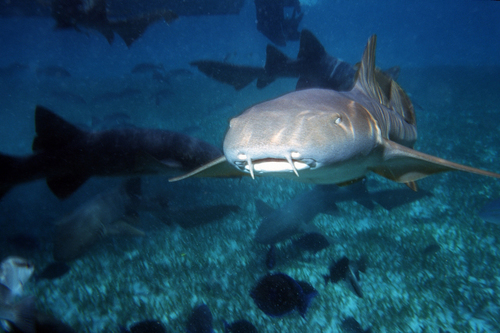
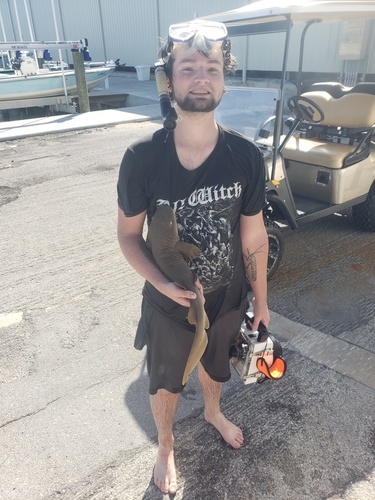
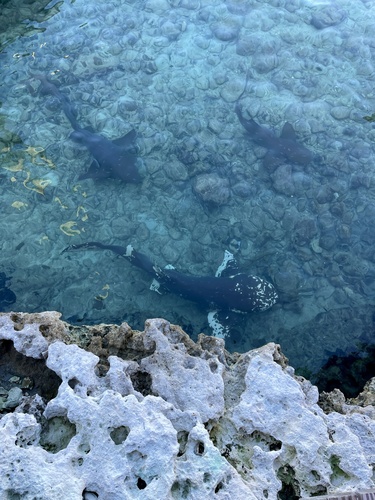
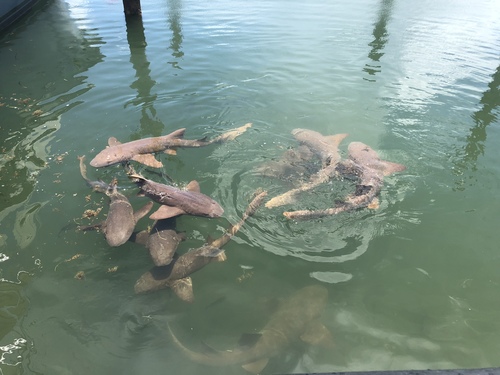
Seen lately
PierMonkey’s live map carries community shark sightings from iNaturalist, refreshed every three hours. Open the map to see where nurse sharks have turned up recently.
How big is that, really?
Maximum reliably recorded length. Rose marks the large or potentially dangerous species the map flags as notable.
Help protect it
- MarAlliance — Shark Ray Alley nurse shark monitoringThe team counting and photo-identifying the fed aggregation in Belize since 2014. Read what they have found before you book a swim-with trip anywhere, and use it to pick an operator that neither baits the sharks nor lets anyone touch them.
- New England Aquarium — three decades in the Dry TortugasThe plain-English account of the 30-year tagging study that found the returns and rewrote the life span. The full paper is open access and free — a good first real scientific paper for an older kid who wants one.
- Blue Star operators, Florida Keys National Marine SanctuaryNOAA’s list of Keys dive, snorkel and fishing operators that have committed to teaching responsible practice on the reef. If you are going to meet a nurse shark anywhere, this is the page to book from.
Report what you see
Photograph a shark, upload it, and once the community confirms the ID it becomes a research-grade record — which is where every sighting on our map comes from. Yours would appear here within three hours.
How to submit an observation →Organisations working on sharks like this one
- The Shark Trustgood for kidsReport eggcases and sightings, join campaigns, download free ID guides.
- Great Eggcase Huntgood for kidsWalk a beach, find a mermaid’s purse, log it. Over 630,000 eggcases recorded since 2003 — the easiest real science a family can do.
- Sharks4Kidsgood for kidsFree classroom lessons, virtual field trips and activity packs for teachers and parents.
- Save Our Seas FoundationFunds shark research and education worldwide; publishes what each project found.
- Shark StewardsCampaigns to end the shark fin trade and establish shark sanctuaries.
- OceanaPolicy campaigning on fisheries management and bycatch — the thing that actually kills sharks.
- IUCN Shark Specialist GroupThe scientists behind the Red List assessments. For older readers who want the primary source.
Conservation status: Vulnerable (IUCN Red List, assessed 2021). Uplisted from Data Deficient straight to Vulnerable in the 2021 assessment (Carlson et al.) under criterion A2bcd, population trend decreasing. A reduction of 30–49% is suspected over three generation lengths — 90 years — driven by fishing and by the loss of the shallow reef, seagrass and mangrove habitat the species lives in. Regionally it reads worse: a reduction of more than 80% is suspected in the south-west Atlantic. The change is recent enough that good reference pages, the Florida Museum’s included, still carry the old Data Deficient listing. Read the assessment →
Common questions
Why do nurse sharks bite people if they are so docile?▾
How does a nurse shark eat with such a small mouth?▾
Do nurse sharks have to keep swimming to breathe?▾
What are the two whiskers on a nurse shark’s nose?▾
Why is the nurse shark Vulnerable when you see them everywhere in the Florida Keys?▾
How old do nurse sharks get?▾
Keep exploring
- New Smyrna Beach, Florida — live surf conditions
- Cocoa Beach Pier, Florida — live surf conditions
- Sebastian Inlet, Florida — live surf conditions
- All 40 species →
Sightings © iNaturalist contributors (research-grade observations). Occurrence maps © GBIF.org contributors (CC BY). Community science, not a beach-safety service. Last updated 2026-09-20.
See where sharks are turning up — on the live map
The map and live conditions are open to everyone. A free account unlocks full 16-day forecasts and custom swell alerts.