
Leopard shark
A calm, saddle-marked houndshark that spends its summers in waist-deep California water — and the one shark most people here will ever swim with on purpose.
Vital statistics
Live-bearing, with the pups fed by yolk rather than a placenta. After a 10–12 month pregnancy a female has 7–36 pups — FishBase gives a narrower 4–29 — about 20 cm long, born between March and July and peaking in April and May.
The short version
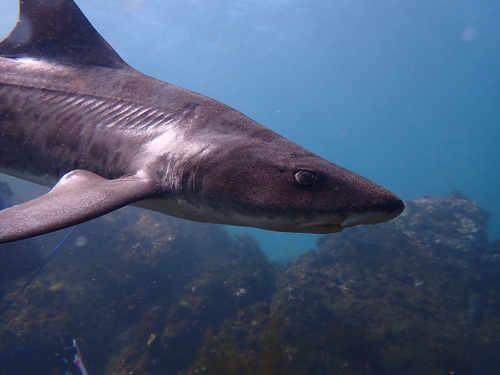
The leopard shark is a slender, harmless houndshark found only along the Pacific coast of North America, from Oregon south to Mazatlán in Mexico, including the Gulf of California. Most adults are 1.2–1.5 m long; the largest female ever measured was 2.1 m. You can identify it at a glance by the pattern that named it — dark rounded saddles down a silver-grey back, broken up with black spots — and by where it is, because it spends much of its life in water you could stand up in.
It feeds off the bottom on crabs, shrimp, fish eggs, fat innkeeper worms and the siphons it nips off buried clams, with larger adults taking more fish. It is slow at everything: males mature at seven to thirteen years and females at ten to fifteen, and after a 10–12 month pregnancy a female has 7–36 pups in spring. Most stay put in one bay or one stretch of coast for life.
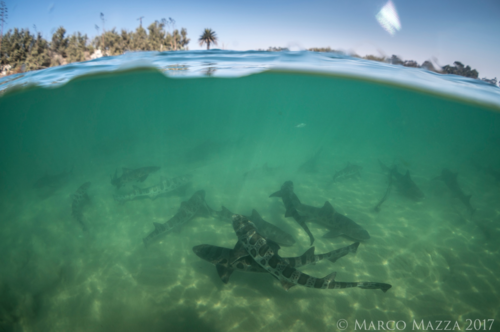
It is harmless, and it is one of the library’s good-news stories. The International Shark Attack File holds one record involving a leopard shark and a person, in which nobody was bitten. The IUCN assessed the species as Least Concern in 2015, largely because California closed the gap that was emptying its bays — a 36-inch minimum size, a three-fish bag limit and the removal of gillnets from nearshore waters. Every summer several hundred pregnant females gather in the warm shallows off La Jolla, San Diego, which makes that beach the easiest place in the United States to swim with a wild shark.
Where it lives
The leopard shark belongs to one coastline and no other. It runs from the Pacific Northwest — California’s Department of Fish and Wildlife puts the northern limit at Willapa Bay in Washington, the Aquarium of the Pacific at Coos Bay in Oregon — south to Mazatlán on the Mexican mainland, taking in the whole Gulf of California; FishBase bounds it between 45°N and 19°N. This is not a shark that crosses an ocean.
Inside that strip it is a shallow-water animal, and emphatically so. The Florida Museum and the Aquarium of the Pacific both put most sightings in 6 m of water or less, against a full depth range of 0–156 m. It likes muddy and sandy bays, estuaries and lagoons, the edges of kelp forest, rocky reef and open sandy beach, and it is usually in company — loose schools sorted by size and sex, often mixed in with bat rays, smoothhounds and sevengill sharks.
How it uses that range changes with latitude. In central and northern California it crowds into bays and estuaries seasonally and moves out to the open coast in winter — roughly half the state’s annual recreational catch comes from inside San Francisco Bay alone. South of central California it is on the open coast year-round. That shallowness is also why this page exists: the leopard shark is the second most-reported shark in PierMonkey’s own live sightings feed — 93 records in a recent 45-day window, almost every one Californian — not because it is rare, but because it lives in the same waist-deep water as the people holding the phones.


- La Jolla Shores, San Diego — The summer aggregation of pregnant females, and the classic swim-with-sharks experience in the United States. Sharks gather inshore of the surf line above the head of La Jolla Canyon, inside the no-take Matlahuayl State Marine Reserve.
- Del Mar, California — The male counterpart a few kilometres up the coast, and much less visited. Acoustic tagging found male numbers highest from late April to early October, rising and falling with sea temperature and day length.
- San Francisco Bay — The biggest estuarine population on the coast and the heart of the recreational fishery. Tagging here showed the sharks are largely residential, with only about one in ten leaving the bay seasonally.
- Elkhorn Slough & Monterey Bay — Warm, shallow, tidal, and the best place to watch the tidal commute — sharks ride the flood onto the mudflats to feed and drop back as it drains. Sharks tagged here have turned up in San Francisco Bay, and the reverse.
- Humboldt Bay, northern California — Near the northern end of the range and the most genetically isolated population known. Sharks here mature at a larger size and produce fewer pups than those further south.
Where it goes
For the most part, this shark does not migrate. It is a homebody with a small range, and the movement that matters day to day is tidal rather than seasonal: in the bays it rides the flood up onto shallow mudflats to feed and drops back into deeper channels as the water drains away. Tag-recapture work in San Francisco Bay found the sharks largely residential, with only about 10% of recaptured animals leaving for the open ocean in autumn and winter; one exception turned up in Santa Monica Bay ten years later. The genetics agree, finding northern and southern California sharks measurably different and as many as seven separate gene pools between Humboldt Bay and San Diego.
The exception, and the reason most people have heard of this shark at all, is La Jolla. Between 2007 and 2011 researchers caught 140 leopard sharks there: 97.1% were female, and every female examined closely turned out to be pregnant. Aerial photographs taken in August and September 2010 caught up to 120 sharks in a single frame, and the whole aggregation runs to hundreds. Acoustic tags then showed something startlingly tidy — the females’ arrival and departure were synchronised with the June and December solstices, almost to the week — and over three years 50% of tagged females and 60% of tagged males came back every year, the females to La Jolla and the males to their own site at Del Mar. Sea surface temperature explained 86% of the variation in how many females were present, which points at the simplest explanation: the sharks are pregnant, that corner of coast holds the warmest and calmest water around, and warm water speeds up the pups inside them.
Share of verified leopard shark records by month (GBIF, all years). Darker rose means a larger share of sightings fall in that month. This reflects when people record them, which mixes real seasonality with when divers and boats are out.
La Jolla, San Diego — the female aggregation: Females arrive around the June solstice and leave around the December one, and the hook-and-line surveys that caught 140 of them ran June to November. August and September are the peak — both the months the aerial counts were flown and the months San Diego divers and snorkellers report the biggest gatherings. Nothing to see between January and May.
What it eats
The leopard shark makes its living off the bottom, and what it eats shifts as it grows. Juveniles and smaller adults take crabs, ghost shrimp, fish eggs, clam siphons and the fat innkeeper worms that wash up on Californian beaches after storms. Larger adults eat more fish — anchovy, herring, topsmelt, sculpin, croaker, surfperch, rockfish, flatfish and the occasional small ray or shark. FishBase puts it at trophic level 3.7: a predator, but nowhere near a top one. Diet varies so much with place and season that two studies from different bays can read like two different animals.
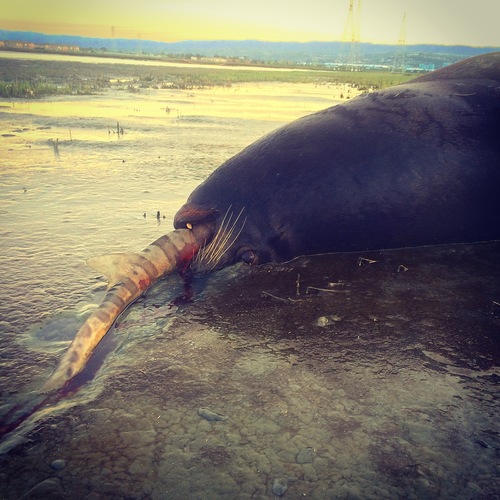
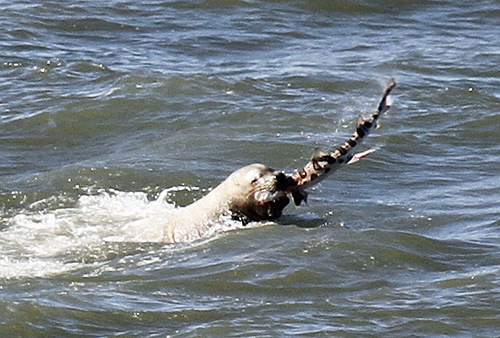
The method is suction rather than pursuit. The teeth are small — a central point with one or two smaller points either side, about 50 in the upper jaw and 38 in the lower — and they overlap into a gripping surface rather than a cutting edge. A leopard shark noses along the bottom and pulls prey in with a sharp expansion of its mouth, which is how it manages one of the odder feats in the diet lists: it nips the siphon off a clam buried in the mud without ever digging the clam up. The traffic runs the other way too — sevengill sharks and white sharks both eat leopard sharks, which is part of why they favour shallow water in the first place.
Is it dangerous?
This is one of the genuinely safe ones. The International Shark Attack File holds a single record involving a leopard shark and a person — a 1950s incident in which a shark repeatedly approached a diver who had a nosebleed. Nobody was bitten. FishBase lists the species flatly as harmless and the Florida Museum says it poses virtually no danger. The reason is plain anatomy: a small mouth, small gripping teeth built for crabs and clam siphons, and a preference for getting out of the way. If something stings you in those shallows it was a round stingray, not a shark — shuffle your feet on the way in.
The danger runs overwhelmingly the other way. Leopard sharks grow slowly, mature late and breed once a year, and a fishery can empty a bay before anyone notices; FishBase rates the species at very high fishing vulnerability, with a minimum population doubling time of more than 14 years. Between 1992 and 2004 investigators estimated that 20,000 to 25,000 pups were poached out of San Francisco Bay for the aquarium trade, and another 30,000 to 33,000 from southern California — often by killing pregnant females to get at the pups. So: look, photograph, log the sighting, leave them be, and if you fish for them know the minimum size before you go. One more honest note for anyone thinking about dinner — the Florida Museum flags high mercury levels in the flesh, so check your state’s advisory first.
Leopard shark facts
- The name comes from the markings: dark rounded "saddles" along the back, interspersed with spots. The pattern is individual and it changes with age — saddles are darker in juveniles and fade in adults, while adults carry more spots. Some sharks show streaks or nothing but small spots. The species name semifasciata means "half-banded". — San Diego Zoo Wildlife Alliance fact sheet
- Of 140 leopard sharks caught off La Jolla between June and November 2007–2011, 97.1% were female — and every female examined by ultrasound or dissection was pregnant. — Nosal et al. 2013, Environmental Biology of Fishes
- Aerial photographs flown over La Jolla in August and September 2010 captured up to 120 leopard sharks in a single frame. The full aggregation is thought to run to several hundred. — IUCN SSC Shark Specialist Group, La Jolla ISRA factsheet
- Female arrival at and departure from La Jolla is synchronised with the June and December solstices. Across a three-year acoustic study, 50% of tagged females and 60% of tagged males returned to their own site every year — the males to a separate aggregation at Del Mar. — Nosal et al. 2014, Marine Ecology Progress Series
- Sea surface temperature explained 86% of the variation in how many females were present at La Jolla. The leading explanation is that the pregnant sharks are using the warmest water available to speed up the development of their pups — the same logic as a bird sitting on eggs. — Nosal (Scripps / Univ. of San Diego); Hight & Lowe 2007
- It can bite the siphon off a clam buried in the mud without digging the clam out, which is why a leopard shark stomach can be full of clam necks and contain no shell at all. — Florida Museum; CDFW Status of the Fisheries Report
- California’s recovery measures worked. Average annual recreational landings fell from about 450,000 lb before the 1992 rules — a 36-inch minimum size and a three-fish bag limit — to about 148,000 lb after, and the same size limit was extended to commercial fishing in 1994. — CDFW Status of the Fisheries Report (2007)
- Investigators estimated that 20,000–25,000 pups were poached from San Francisco Bay between 1992 and 2004 for the aquarium trade, and 30,000–33,000 from the southern California coast between 1992 and 2003. A three-year multi-agency case ended in Lacey Act prosecutions in 2006. — CDFW Status of the Fisheries Report (2007)
Photos
Seen lately
PierMonkey’s live map carries community shark sightings from iNaturalist, refreshed every three hours. Open the map to see where leopard sharks have turned up recently.
How big is that, really?
Maximum reliably recorded length. Rose marks the large or potentially dangerous species the map flags as notable.
Help protect it
- Shark Stewards — Report a SharkSaw a leopard shark off a California pier, beach or boat? Log it. This Berkeley-based programme has been collecting Californian shark observations — live sharks, dead sharks and recreational catch — since 2015, and pushes them into iNaturalist and the California Shark Project, where scientists and managers can actually use them.
- CDFW ocean sport fishing rules for sharksIf you fish in California, read this before you go. Leopard sharks carry a 36-inch minimum size and a three-fish daily limit, and those two rules are most of the reason the species is Least Concern today. Measure, release anything short quickly and in the water, and keep only what you will eat.
- CalTIP — report poachingThe pup-poaching that stripped tens of thousands of juveniles out of San Francisco Bay was stopped by people who reported it. CalTIP takes anonymous reports 24 hours a day on 1-888-334-2258, or by texting "CALTIP" and your message to 847411. Undersized sharks in a bucket is exactly the kind of thing it is for.
Report what you see
Photograph a shark, upload it, and once the community confirms the ID it becomes a research-grade record — which is where every sighting on our map comes from. Yours would appear here within three hours.
How to submit an observation →Organisations working on sharks like this one
- The Shark Trustgood for kidsReport eggcases and sightings, join campaigns, download free ID guides.
- Great Eggcase Huntgood for kidsWalk a beach, find a mermaid’s purse, log it. Over 630,000 eggcases recorded since 2003 — the easiest real science a family can do.
- Sharks4Kidsgood for kidsFree classroom lessons, virtual field trips and activity packs for teachers and parents.
- Save Our Seas FoundationFunds shark research and education worldwide; publishes what each project found.
- Shark StewardsCampaigns to end the shark fin trade and establish shark sanctuaries.
- OceanaPolicy campaigning on fisheries management and bycatch — the thing that actually kills sharks.
- IUCN Shark Specialist GroupThe scientists behind the Red List assessments. For older readers who want the primary source.
Conservation status: Least Concern (IUCN Red List, assessed 2015). Assessed as Least Concern in 2015 (Carlisle, Smith, Launer & White; assessment dated 18 December 2014). The assessors credit US management — California’s minimum size limits and the withdrawal of gillnets from nearshore waters — together with the absence of a significant fishery in Mexican waters. The standing caution is that the species grows slowly and barely disperses, so a local population can be fished down one bay at a time without the global status ever moving. Read the assessment →
Common questions
Are leopard sharks dangerous to swim with?▾
When is leopard shark season at La Jolla?▾
Why are the La Jolla leopard sharks all pregnant females?▾
How big do leopard sharks get?▾
How do you tell a leopard shark from a smoothhound?▾
Are leopard sharks endangered?▾
Keep exploring
- Blacks Beach, California — live surf conditions
- Rincon, California — live surf conditions
- Steamer Lane, California — live surf conditions
- All 40 species →
Sightings © iNaturalist contributors (research-grade observations). Occurrence maps © GBIF.org contributors (CC BY). Community science, not a beach-safety service. Last updated 2026-09-20.
See where sharks are turning up — on the live map
The map and live conditions are open to everyone. A free account unlocks full 16-day forecasts and custom swell alerts.