
Lemon shark
A sand-coloured shark of mangrove creeks and shallow flats — and the most closely followed shark on earth, tracked individual by individual at one Bahamian lagoon since 1990.
Vital statistics
Live birth with a placenta after 10–12 months. Litters of 4–17 (Florida Museum) or 5–17 (FishBase), born at 50–65 cm. Females breed only every second year, and a single litter is usually fathered by several different males.
The short version
The lemon shark is a large, sand-coloured requiem shark of shallow warm coasts — mangrove creeks, seagrass, sand flats and reef edges. FishBase gives a maximum length of 3.4 m; the Florida Museum puts a common adult at 2.5–3 m, and the heaviest rod-caught individual on record weighed 183.7 kg. It lives in the western Atlantic from New Jersey to southern Brazil, along West Africa, and in the eastern Pacific from Baja California to Ecuador, almost always in less than 90 m of water.
It is also the best-studied shark in the world, and that is not a figure of speech. At Bimini in the Bahamas, the Biological Field Station has caught, measured, tagged and genetically fingerprinted the sharks born in one lagoon every year since 1990; a 2023 review of shark cognition calls it the only large, free-swimming shark whose behaviour has been examined in any real detail. Three things we now say about sharks generally came out of that one dataset: that females return to the place they were born to give birth, that young sharks hold stable social preferences for particular individuals, and that they learn by watching each other.
It is not a dangerous animal to share water with. The International Shark Attack File lists ten unprovoked lemon shark bites since 1580 and no fatalities. The pressure runs the other way: the IUCN assessed the species as Vulnerable in 2020, and at Bimini the threat was measured directly — by 2007 about 30% of the mangrove around the main nursery, some 120 hectares, had been cleared for a resort development, and juvenile mortality in that nursery rose while a control nursery six kilometres away did not change.
Where it lives
The lemon shark lives in three separate blocks of warm, shallow water. The big one is the western Atlantic, from New Jersey at the cold northern edge down through the Carolinas, Florida, the Gulf of Mexico, the Bahamas and the whole Caribbean to southern Brazil. A second, far less studied population runs along West Africa — Senegal and Côte d’Ivoire for certain, probably further. The third sits on the other side of the Americas, from southern Baja California and the Gulf of California to Ecuador. FishBase gives a depth range of 0–92 m and the Florida Museum 0–90 m, which for a shark this size is barely any depth at all.
Inside that outline it is an edge animal. Mangrove creeks, seagrass beds, sand flats, reef margins, enclosed bays, sounds and river mouths are all lemon shark habitat, and it will push into water fresh enough that most sharks turn back. Newborns spend their first years in a few hundred metres of mangrove fringe and hardly leave it. Adults keep home ranges rather than roam, gather in loose groups sorted by size and sex, and the Florida Museum notes a habit any pier angler will recognise: they collect around docks and piers after dark and drop back to deeper water at first light.
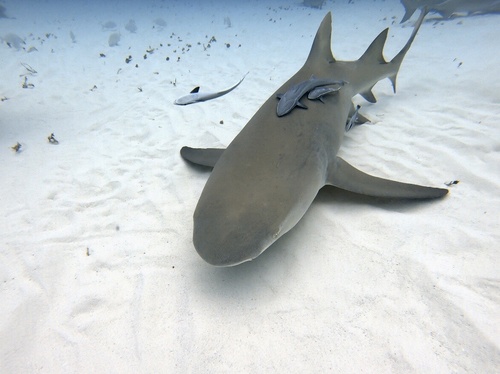
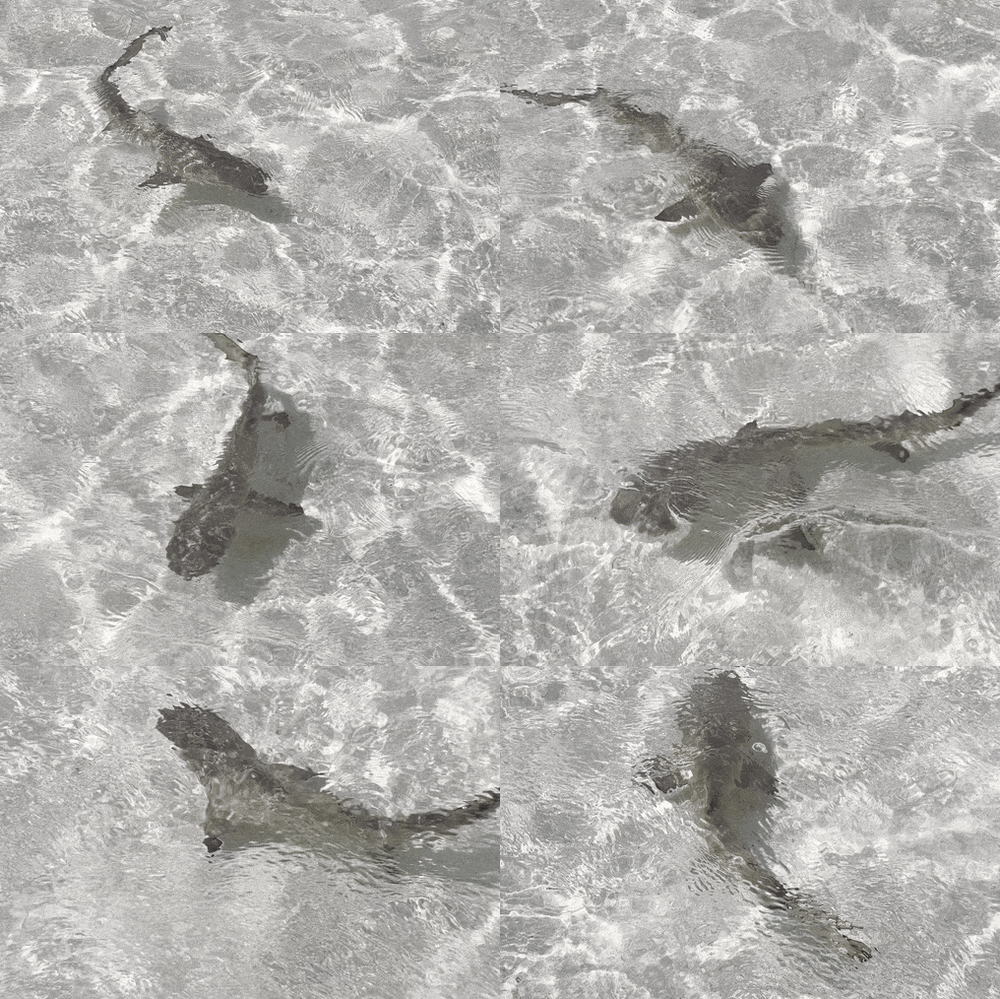
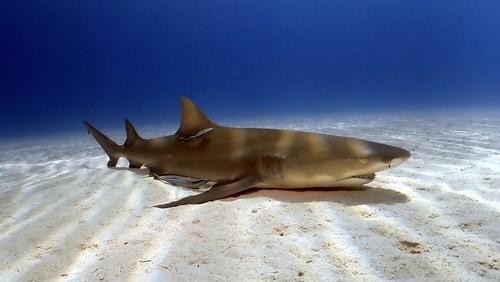
The colour is not decoration. A lemon shark is olive-grey to yellow-brown across the back and pale yellowish-white underneath — which is where the name comes from — and that is exactly the wrong colour for open blue water and exactly the right one for a sunlit sand flat. Seen from above against rippled sand, the back disappears; seen from below against the bright surface, the pale belly does the same job. Blue-water sharks are counter-shaded in blue and white for the same reason. This one is counter-shaded in sand.


- Bimini, Bahamas — A small chain of islands 85 km east of Miami, fringed with mangrove and holding two lemon shark nurseries. The Bimini Biological Field Station — the Shark Lab — has worked here since 1990, and its lemon shark records go back further: longline surveys from 1982, and genetic profiles of every cohort born in the North Sound from 1993 onwards. Nowhere else on earth is one shark population known in this much detail.
- Cape Canaveral, Florida — An exposed coastal nursery, unlike the sheltered lagoons the species usually chooses. Fifty-four juveniles tracked by acoustic array here held the area through December to February, then left north in late winter — and nineteen of them came back for a second or third consecutive winter.
- The southeast Florida coast — Between Cape Canaveral and Delray Beach, lemon shark presence tracks the thermometer: they are there when the water is below about 24 °C and gone when it is not. It is one of the most predictable seasonal shark aggregations anywhere in the United States.
- West Africa and the eastern Pacific — Two-thirds of the species’ range and a rounding error of the research. The Senegal-to-Côte d’Ivoire population and the Baja-to-Ecuador population are both poorly surveyed and lightly managed, which is why the Red List assessment leans on inference rather than counts for most of the map.
Where it goes
A lemon shark lives two lives in sequence, and the first one barely moves. Newborns stay inside a patch of mangrove shoreline measured in hundreds of metres, and they are good at finding it again: young sharks carried up to 16 km away and released came home. Leaving is gradual rather than sudden. Genetic work at Bimini that fingerprinted 1,776 nursery sharks between 1995 and 2007 found that more than half of the immature sharks caught around the island at up to 135 cm — roughly six years old — were still locally born animals. They drift outward from the nursery over years, not in one move at one size, which is the single most useful thing a manager can know about them: a small local protected area keeps working long after the pups have left the creek.
The second life is seasonal and, on the US coast, remarkably punctual. Fifty-four juveniles tracked along 300 km of east Florida held the Cape Canaveral region from December to February, then turned north between late February and April at speeds reaching 64 km a day; several were picked up by other research arrays in Georgia and South Carolina, up to 472 km from where they were released. Nineteen came back the following winter or the one after. Temperature is the switch — presence between Cape Canaveral and Delray Beach lines up with water below about 24 °C — and when an unusual cold snap hit, sharks ran as much as 190 km south in a matter of days and then came back.
Share of verified lemon shark records by month (GBIF, all years). Darker rose means a larger share of sightings fall in that month. This reflects when people record them, which mixes real seasonality with when divers and boats are out.
Cape Canaveral, east Florida: Built from three years of acoustic tracking of 54 juveniles: site fidelity to the Cape Canaveral region from December to February, then a northward departure from late February through April, with sharks detected as far as Georgia and South Carolina by summer (Reyier et al. 2014). The autumn build-up is the least precisely documented part of the cycle — the same animals return each winter, and presence along this coast tracks water below about 24 °C (Kessel et al. 2014), so the shoulder months move with how early the cold arrives.
What it eats
Lemon sharks are fish eaters, and the young ones are almost nothing else. Stomach work at Bimini and in the Florida Keys found nursery sharks with narrow, strongly fish-based diets, and a study of what juveniles actually select showed nearly half of it coming from prey living on the bottom rather than in open water. The menu widens with the shark. Larger juveniles and adults still take mostly bony fish — catfish, mullet, jacks, croakers — but add crabs, shrimp, octopus, sea snails and conch, stingrays, the occasional seabird, and smaller sharks, including, now and then, smaller lemon sharks. For a big predator the appetite is modest: young lemon sharks eat an estimated 1.5–2.1% of their body weight a day, and a meal is out of the stomach in 25 to 41 hours.
The hunting gear matches the habitat. The snout is short, flat and broadly rounded — brevirostris means exactly that — and it carries the shark’s electrical sensors, the ampullae of Lorenzini, low and close to the bottom, where a buried ray gives itself away. The teeth are the family’s standard arrangement in two jobs: narrow, smooth-edged, slightly hooked lower teeth to hold a fish, broader triangular upper teeth to cut. The genus name records the detail — Negaprion means "no saw", for the lack of the coarse serrations its relatives carry. Most feeding happens at dusk and through the night.
Is it dangerous?
For a requiem shark that can reach three metres and change, the lemon shark has a remarkably quiet record. The International Shark Attack File, which runs from 1580 to the present, attributes ten unprovoked bites to the species and no deaths at all. Divers in the Bahamas swim with them routinely; so do the researchers who catch, measure and release several hundred of them a year. The animal is simply not interested in people. What does raise the odds is food. Lemon sharks learn feeding schedules fast, remember them for months, and will crowd a place where they have been fed — which is a good reason to be careful about baited dives, and a very good reason not to clean fish off a dock with people in the water.
The traffic in the other direction is heavy. Commercial and recreational fisheries take lemon sharks across the Atlantic, the Caribbean and the eastern Pacific — the US bottom longline fishery targets them, and they turn up as bycatch in pelagic and gillnet gear — for meat in Central and South America, for fins exported to Asia, and for a hide that makes good leather. Being shallow, predictable and slow to mature at about 12 or 13 years makes them easy to overfish, which is how the IUCN arrived at Vulnerable in 2020. Two things have helped. The Bahamas banned commercial longlining in 1993 and in July 2011 declared all 630,000 km² of its waters a shark sanctuary, closing commercial shark fishing and the trade in shark products; Florida prohibits the harvest of lemon sharks in state waters entirely. If you hook one there, leave it in the water, cut the leader short and let it go.
Lemon shark facts
- Lemon sharks provided the first direct evidence that any shark returns to its own birthplace to breed. Genetic profiles of 20 consecutive cohorts born at Bimini between 1993 and 2012 showed at least six females, born there in the 1993–97 cohorts, coming back 14 to 17 years later to give birth on the same ground. — Feldheim, Gruber, DiBattista et al. 2014, Molecular Ecology
- The clock is two years long. Of 897 young sharks sampled at Bimini from 1995 to 2000, 119 could be matched to five individual mothers, and those females came back to the lagoon every second year to pup. Each litter was fathered by several different males, and the females mated with different males nearly every cycle. — Feldheim, Gruber & Ashley 2002, Proceedings of the Royal Society B
- Juvenile lemon sharks choose who they swim with. In the wild they form non-random associations with particular individuals, with body size the strongest influence on who groups with whom and some evidence of kin-biased company — among the first demonstrations of active social preference in any shark. — Guttridge et al. 2009, Animal Behaviour / Guttridge et al. 2011, Marine Ecology Progress Series
- They learn from each other. Wild lemon sharks held in pens at Bimini were set a food-finding task; naive sharks paired with a trained demonstrator solved it markedly faster than those paired with an untrained shark. Social learning had previously been shown in fish and birds, not in sharks. — Guttridge, van Dijk, Stamhuis, Krause, Gruber & Brown 2013, Animal Cognition
- And they learn schedules. When a Bimini lagoon was fed once a day for 27 days, six acoustically tagged lemon sharks began showing up in the hour before feeding after only 11 days — and were still doing it up to 90 days after the feeding stopped. — Heinrich et al. 2021, Animal Behaviour, via Brown & Schluessel 2023, Animal Cognition
- The published life span has roughly doubled. FishBase still gives a maximum reported age of 25 years and the Florida Museum about 27; reconstructing family trees from the Bimini genetic archive put the minimum at around 37, with pregnant females in their mid-thirties recorded at the island. — Brooks, Guttridge, Franks, Grubbs, Chapman & Gruber 2016, Journal of Fish Biology
- Habitat loss at Bimini was measured, not estimated. By August 2007, roughly 30% of the mangrove around the North Sound nursery — about 120 hectares — had been removed for a resort development, along with 18% of the seagrass and 750,000 m³ of sandfill. Juvenile mortality rose in that nursery; at a control nursery six kilometres away, over the same years, it did not. — DiBattista et al. 2011, Evolutionary Applications, on Jennings et al. 2008, Environmental Biology of Fishes
- The Bimini longline survey is one of the longest continuous catch series for any shark population: three survey periods between 1982 and 2014, 32 years in all. Catch per unit effort rose to a peak in 2000 and fell to its lowest average in the 2003–2014 period. — Kessel, Hansell, Gruber, Guttridge & Hussey 2016, Journal of Fish Biology
Photos
Seen lately
PierMonkey’s live map carries community shark sightings from iNaturalist, refreshed every three hours. Open the map to see where lemon sharks have turned up recently.
How big is that, really?
Maximum reliably recorded length. Rose marks the large or potentially dangerous species the map flags as notable.
Help protect it
- Bimini Biological Field Station — internshipsThe lab that produced most of what is on this page takes research interns for two to four months, over-18s, about $1,250 a month for room and board. You cut bait, haul gear and work sharks alongside the staff. It is the closest thing there is to joining the study that rewrote what we know about shark nurseries.
- Perry Institute for Marine Science — mangrove restorationMangrove loss is the concrete, local threat to this species, and this is the group replanting it across The Bahamas — 135,000 mangroves so far across 158 restoration sites. You can join a planting expedition, adopt a tree, or fund seedlings; they put the cost of planting and monitoring one at about $25.
- Florida FWC — shark fishing regulationsThe lemon shark is on Florida’s prohibited list: it may not be harvested in state waters at all, so a hooked one has to go back. The same page carries the release rules that decide whether it survives — keep it in the water, use non-stainless circle hooks, and carry cutters so you can free it fast.
Report what you see
Photograph a shark, upload it, and once the community confirms the ID it becomes a research-grade record — which is where every sighting on our map comes from. Yours would appear here within three hours.
How to submit an observation →Organisations working on sharks like this one
- The Shark Trustgood for kidsReport eggcases and sightings, join campaigns, download free ID guides.
- Great Eggcase Huntgood for kidsWalk a beach, find a mermaid’s purse, log it. Over 630,000 eggcases recorded since 2003 — the easiest real science a family can do.
- Sharks4Kidsgood for kidsFree classroom lessons, virtual field trips and activity packs for teachers and parents.
- Save Our Seas FoundationFunds shark research and education worldwide; publishes what each project found.
- Shark StewardsCampaigns to end the shark fin trade and establish shark sanctuaries.
- OceanaPolicy campaigning on fisheries management and bycatch — the thing that actually kills sharks.
- IUCN Shark Specialist GroupThe scientists behind the Red List assessments. For older readers who want the primary source.
Conservation status: Vulnerable (IUCN Red List, assessed 2020). Assessed on 9 September 2020 as Vulnerable under criterion A2bd — a suspected past population reduction driven by fishing across most of the range, with a decreasing trend. FishBase and GBIF’s copy of the Red List checklist carry the same category and the same Red List taxon number, 39380. The change is recent enough that several otherwise excellent reference pages, the Florida Museum’s included, still show the older listing of Near Threatened. Read the assessment →
Common questions
Why is it called a lemon shark?▾
Do lemon sharks really go back to where they were born?▾
Are lemon sharks social — do they have friends?▾
Are lemon sharks dangerous to swimmers and divers?▾
What happens to lemon sharks when mangroves are cut down?▾
Why is the lemon shark the best-studied shark in the world?▾
Keep exploring
- Cocoa Beach Pier, Florida — live surf conditions
- New Smyrna Beach, Florida — live surf conditions
- Sebastian Inlet, Florida — live surf conditions
- All 40 species →
Sightings © iNaturalist contributors (research-grade observations). Occurrence maps © GBIF.org contributors (CC BY). Community science, not a beach-safety service. Last updated 2026-09-20.
See where sharks are turning up — on the live map
The map and live conditions are open to everyone. A free account unlocks full 16-day forecasts and custom swell alerts.