
Horn shark
A blunt-nosed Californian reef shark that crawls more than it swims, cracks sea urchins with flat back teeth, and eats so many of them that its teeth and spines stain purple.
Vital statistics
Egg-laying. A female lays two eggs at a time every 11–14 days from February to April, as many as 24 in a season, each in a corkscrew case about 12 cm long that ends up wedged in a crevice. One pup hatches per case after six to ten months, at 15–17 cm.
The short version
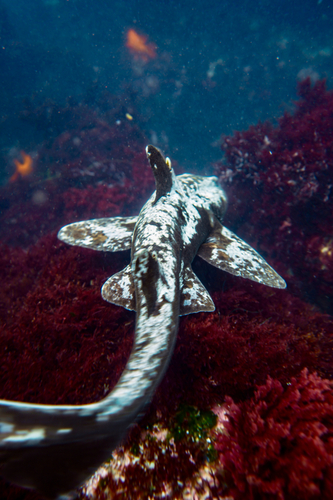
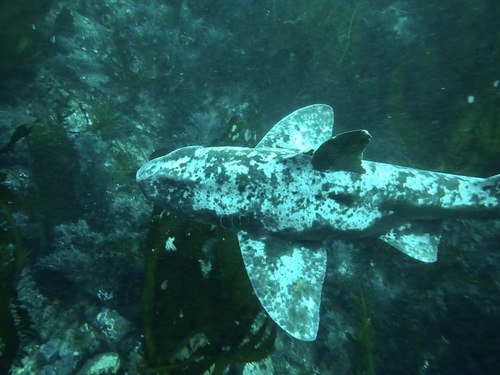
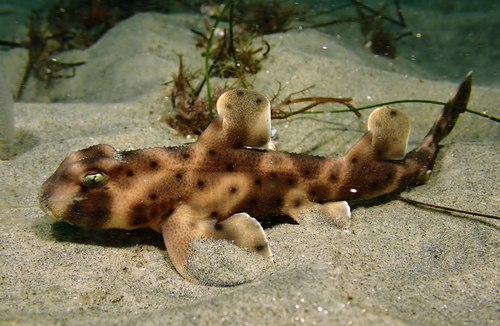
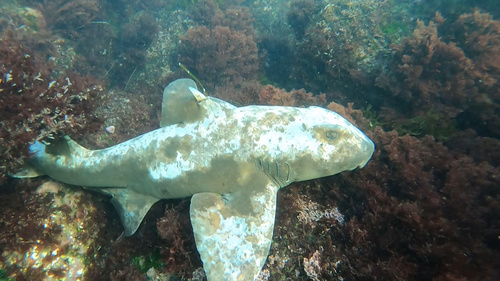
The horn shark is a small, stocky bullhead shark that lives on rocky reef and in kelp from central California south to Baja California and the Gulf of California. It reaches about 1.2 m; most adults are 0.6–0.97 m. It is easy to name on sight: a short, blunt, almost pig-like head with high ridges over the eyes, a grey to muddy-brown body speckled with small dark spots, and a stout spine in front of each of its two dorsal fins. Those spines are the horns.
It is nocturnal and profoundly unhurried. It spends the day jammed into a crack, cave or ledge — sharks tracked at Santa Catalina Island sheltered for roughly 90% of the daylight hours — then comes out after dark to work a small patch of neighbouring reef and sand, often crawling rather than swimming. Its food is armoured: sea urchins, crabs, snails, octopus and the odd small fish, gripped with pointed front teeth and crushed with flat molars at the back. Adults that specialise in purple sea urchins advertise it: the pigment stains their teeth and dorsal spines purple.
It is harmless to people, and it lays one of the strangest eggs in the sea: a brown case about 12 cm long wound into two and a half spiral turns, wedged into a crack in the reef, where a single pup develops for six to ten months. Horn sharks barely travel, return to the same daytime shelter night after night, and will not cross deep water. The IUCN moved the species from Data Deficient to Least Concern in 2024 and gives the population as stable — a change most published profiles have not caught up with.
Where it lives
The horn shark belongs to one coastline. The Florida Museum and the FAO catalogue run the range from central California to the Gulf of California; the Aquarium of the Pacific starts it at southern California and the Channel Islands, which is a fair description of where it is actually common. FishBase adds a cautious "and probably Ecuador and Peru", but those records have never been confirmed, and the two range-wide genetic surveys of the species sampled nothing south of the Gulf. There is a joke in the name: Girard described the shark in 1855 and called it francisci, apparently after San Francisco — but the type specimen came from Monterey Bay, and it does not live that far north.
Inside that strip it is a shallow, bottom-hugging reef animal. FishBase and the Florida Museum both give a depth range of 0–152 m and put the usual range at 2–11 m; the Aquarium of the Pacific adds that horn sharks rarely swim more than about two metres above the bottom. What it wants is structure — rocky reef with caves and deep crevices, kelp, and sand or eelgrass flats next door to hunt over after dark. It is a poor swimmer and an oddly good walker, hauling itself between rocks on thick paired fins that work more like legs than wings.
All of which makes this a shark you meet rather than one you go looking for — under ledges at Catalina, in the kelp off La Jolla and Palos Verdes, on the end of pier anglers’ lines. It also sits still while it is photographed, so it is well represented in the open sighting databases: GBIF holds more than a thousand records within 10 km of Blacks Beach alone.


- Santa Catalina Island, California — The best-studied population. Acoustic tracking here in 2016 and 2017 found tagged sharks sheltering for roughly 90% of the daylight hours and returning to the same rocky outcrops day after day.
- Northern Channel Islands, California — A genetically separate stock from Catalina despite being under 100 km away, because the deep, cold channel between them is a wall this shark will not cross.
- Palos Verdes peninsula & Redondo Beach, California — The mainland egg-laying ground people actually see: a 2025 study mapped horn shark sightings and egg-case locations here against beach and reef debris.
- La Jolla & San Diego kelp beds — Reliable night-dive habitat at the southern end of the US range, and where a rare leucistic — nearly white — horn shark lived for several years, apparently none the worse for it.
- Baja California & the Gulf of California — More than half the species’ range, and largely unwatched. The genetics find a population break at Punta Eugenia, the old dividing line between temperate and tropical faunas on that coast.
Where it goes
Almost none of the usual migration story applies here: the horn shark is a resident, on a startlingly small scale. Adults come out at dusk and forage over a patch of reef that the Florida Museum and the ReefQuest summary both put at about 1,000 m² — four tennis courts — while the Aquarium of the Pacific’s report card gives a wider home range of 8–10 hectares. Before dawn the shark goes back to the same daytime resting place, a habit recorded in Compagno’s FAO catalogue and in every field study since.
What movement there is runs up and down rather than along the coast; the Florida Museum reports a winter shift below 30 m. The age story is muddier. The older literature has juveniles of 35–48 cm out on sand flats in 40–150 m, moving shallower as they grow; the Catalina tracking found the reverse — immature sharks under 58 cm in small warm crevices shallower than 10 m, mature ones deeper in bigger caves. Both can be true in different habitats, and laboratory trials show juvenile horn sharks to be more sensitive to a change in temperature than the juvenile leopard sharks sharing their bays.
The hardest evidence is in their DNA. A survey of 318 animals found population structure at a scale almost unheard of in sharks: island and mainland populations differ across as little as 19 km, because those 19 km are deep open water. A follow-up genotyping 175 sharks at nearly 4,000 nuclear markers found at least five distinct populations. Most sharks show structure over hundreds or thousands of kilometres; this one does it over the width of a channel, which means that if a reef is fished or collected out, nothing swims in from down the coast to replace it.
Share of verified horn shark records by month (GBIF, all years). Darker rose means a larger share of sightings fall in that month. This reflects when people record them, which mixes real seasonality with when divers and boats are out.
What it eats
"Different teeth" is the whole design. Heterodontus means exactly that: small pointed teeth at the front to grip, broad flat molars at the back to crush, in one mouth. That makes it a durophage, an eater of armoured things — sea urchins, crabs and lobsters, snails and clams, octopus, worms and the occasional small fish. The crushing has been measured: a 2005 study calculated a maximum theoretical bite force of 128 N at the front teeth and 338 N at the molars, and recorded free-swimming horn sharks biting a force transducer of their own accord at an average of 95 N, up to 133 N. For its body mass that is one of the hardest bites ever measured in a cartilaginous fish — second among those studied at the time, though the Florida Museum calls it the highest known for a shark of its size.
A follow-up study explains why a young horn shark cannot simply do what its parents do. Purple sea urchins, the adults’ speciality, need 24 to 430 N to break, so a small shark is locked out of the biggest ones and grows into the diet as its jaw muscles outpace the rest of it. The method is suction as much as force — filmed feeding sequences show prey drawn into the mouth by a sharp expansion rather than snapped at — and it happens at night, with the shark able to pump water over its gills instead of swimming, so it can eat lying still.
Is it dangerous?
There is no record of a horn shark biting a swimmer. The Florida Museum’s profile states that the International Shark Attack File holds a single bite record for the entire bullhead family, and it involved a Port Jackson shark in Australia, not this animal. The mouth is small, the working teeth are grinding plates for shellfish, and a horn shark’s answer to a diver is to stay exactly where it is. The caveats are about handling, not swimming: Compagno’s catalogue notes that it may bite back when harassed, and the stout spine in front of each dorsal fin — the horns the name refers to — will go into a hand or a bare foot.
We are much harder on them. Horn sharks have long been taken by divers for sport and for their fin spines, which get made into jewellery, and the Monterey Bay Aquarium reports declines in parts of southern California where diver traffic is heaviest. They come up as bycatch in crab traps, gillnets and trawls, they are caught by artisanal gillnet fisheries in Mexico, and they are a staple of the aquarium trade because they survive captivity so well. Their eggs are the soft spot: a case sits in a shallow crevice for the better part of a year, in the same zone where beach and reef rubbish piles up, which is why a 2025 study mapped marine debris against horn shark sightings and egg cases at Redondo Beach and Palos Verdes. If you find one wedged in a crack, photograph it and leave it in the crack.
Horn shark facts
- Its egg case is a brown corkscrew 11.7–12.6 cm long and 2.9–4.0 cm wide, wound into two and a quarter to two and a half complete turns by a pair of spiral keels. Unlike some of its relatives’ cases it has no sticky tendrils — the shape alone is what holds it in the rock. — O’Neill, Tokunaga & White 2025, Journal of Fish Biology
- Give a captive female no crevice to wedge a case into and the system breaks down: she drops the cases on the tank floor, where other horn sharks may eat the contents. In the wild the cases are found jammed between and beneath rocks. — FishBase / Compagno 2001, FAO Sharks of the World
- Maximum theoretical bite force is 128 N at the front teeth and 338 N at the molars. Free-swimming horn sharks that chose to bite a force transducer averaged 95 N, with a maximum of 133 N — one of the hardest bites for body size measured in any cartilaginous fish. — Huber, Eason, Hueter & Motta 2005, Journal of Experimental Biology
- Purple sea urchins need between 24 and 430 N to crack, which means young horn sharks physically cannot eat the larger ones. Their bite force grows faster than their bodies do, so they grow into the urchin diet rather than being born to it. — Kolmann & Huber 2009, Zoology
- Adults that eat a lot of purple sea urchins are easy to pick out: the pigment from the urchins stains their teeth and their dorsal fin spines bright purple. — Florida Museum (after Ebert 2003); ReefQuest Centre for Shark Research
- It forages over a home patch of roughly 1,000 m² — about four tennis courts — and returns to the same daytime resting place before dawn, night after night. — Florida Museum (after Nelson & Johnson 1970); ReefQuest Centre for Shark Research
- Horn sharks will not cross deep open water, and it shows in their genes: island and mainland populations are distinct across as little as 19 km, and a genomic follow-up found at least five separate populations in a range most sharks would treat as one stock. — Canfield, Galván-Magaña & Bowen 2022 & 2026, Journal of Heredity
- It has only about 148 ampullae of Lorenzini — the pores that let a shark sense the faint electrical fields of living animals — far fewer than other sharks, so electroreception plays a smaller part in its hunting than in most. — Florida Museum (after Bullock et al. 2005)
Photos
Seen lately
PierMonkey’s live map carries community shark sightings from iNaturalist, refreshed every three hours. Open the map to see where horn sharks have turned up recently.
How big is that, really?
Maximum reliably recorded length. Rose marks the large or potentially dangerous species the map flags as notable.
Help protect it
- REEF Volunteer Fish Survey ProjectIf you dive in California, this is the one that counts. REEF trains recreational divers to run standardised surveys and log every species they see, horn sharks included, and the resulting dataset gets used by sanctuary and fishery managers. Because horn sharks sit still under ledges, they are one of the easiest species on the list to record accurately.
- Marine Debris TrackerHorn shark egg cases spend most of a year wedged in shallow crevices on exactly the reefs where rubbish collects — this is the app used in the 2025 Redondo Beach and Palos Verdes study. Log what you pick up on a beach or a dive and it joins an open dataset local groups use to target clean-ups. Ten minutes and a phone.
- CDFW ocean sport fishing regulations for sharksHorn sharks have no targeted fishery and no special size limit in California, so they fall under the general finfish rules — which means the decision is yours. If one comes up on a pier or boat line, mind the two dorsal spines, unhook it in the water where you can, and put it back: there is no market for the meat, and the population on that reef is not replaced from anywhere else.
Report what you see
Photograph a shark, upload it, and once the community confirms the ID it becomes a research-grade record — which is where every sighting on our map comes from. Yours would appear here within three hours.
How to submit an observation →Organisations working on sharks like this one
- The Shark Trustgood for kidsReport eggcases and sightings, join campaigns, download free ID guides.
- Great Eggcase Huntgood for kidsWalk a beach, find a mermaid’s purse, log it. Over 630,000 eggcases recorded since 2003 — the easiest real science a family can do.
- Sharks4Kidsgood for kidsFree classroom lessons, virtual field trips and activity packs for teachers and parents.
- Save Our Seas FoundationFunds shark research and education worldwide; publishes what each project found.
- Shark StewardsCampaigns to end the shark fin trade and establish shark sanctuaries.
- OceanaPolicy campaigning on fisheries management and bycatch — the thing that actually kills sharks.
- IUCN Shark Specialist GroupThe scientists behind the Red List assessments. For older readers who want the primary source.
Conservation status: Least Concern (IUCN Red List, assessed 2024). Assessed as Least Concern on 3 June 2024 (Rigby, García & Rohner). That is a change worth knowing about: the previous assessment listed the species as Data Deficient, and most profiles online — the Florida Museum’s and the Aquarium of the Pacific’s species page among them — still say so. Nothing targets horn sharks commercially. They come up as bycatch in California and are caught by artisanal gillnet fisheries in Mexico, and the Aquarium of the Pacific’s report card, citing the 2024 assessment, gives the population trend as stable across 25 years of South Coast observations. Read the assessment →
Common questions
Are horn sharks dangerous to humans?▾
What is the corkscrew-shaped thing I found on a California beach?▾
Why do some horn sharks have purple teeth?▾
How do you tell a horn shark from a leopard shark or a Port Jackson shark?▾
Where and when can you see horn sharks?▾
How long do horn sharks live, and are they endangered?▾
Keep exploring
- Blacks Beach, California — live surf conditions
- The Wedge, California — live surf conditions
- Swami’s, California — live surf conditions
- All 40 species →
Sightings © iNaturalist contributors (research-grade observations). Occurrence maps © GBIF.org contributors (CC BY). Community science, not a beach-safety service. Last updated 2026-09-20.
See where sharks are turning up — on the live map
The map and live conditions are open to everyone. A free account unlocks full 16-day forecasts and custom swell alerts.