
Grey reef shark
The shark that warns you first — arched back, dropped fins and a stiff, exaggerated swim that means “you are too close”.
Vital statistics
Live birth after about 12 months (some sources 12–14); 1–6 pups, each 45–60 cm long. Females breed roughly every other year and mature at around seven years old.
The short version
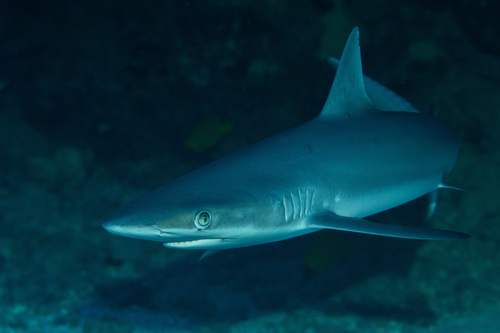
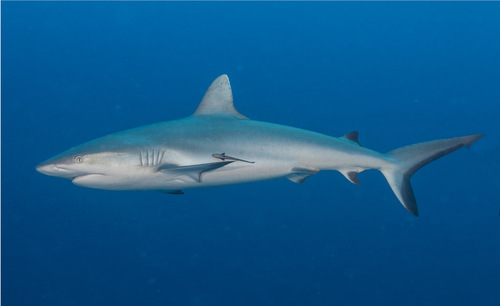
The grey reef shark is a medium-sized requiem shark of Indo-Pacific coral reefs. Most adults are 1.2–1.9 metres long, the largest on record is about 2.55 metres, and on a healthy reef it is usually the commonest large shark a diver meets. Its range runs from the Red Sea and East Africa east to French Polynesia, and it lives in no part of the Atlantic. The quickest way to name one is the tail: a broad black band along the whole rear edge of the caudal fin, on an otherwise plain bronze-grey shark with a short, rounded snout.
What makes it worth knowing is that it tells you when it is unhappy. Crowd a grey reef shark and it performs a threat display — snout raised, both pectoral fins dropped, back arched, body bent sideways, swimming in a stiff, rolling, exaggerated figure of eight. That display is a warning, not the start of an attack. It means the shark feels cornered and would like a way out. Stop, keep it in sight and give ground, and it almost always leaves. It is one of the clearest pieces of body language known in any fish, first described by divers in the Marshall Islands in 1971.
They are strongly site-attached, with a home range of about 12 square kilometres of reef, and they hunt small reef fish, octopus and crustaceans mostly at night. The IUCN assessed the species as Endangered in 2020, and since November 2023 all requiem sharks including this one are on CITES Appendix II. Because they disappear from fished reefs before almost anything else does, counting them is one of the quickest ways to tell whether a reef is being looked after.
Where it lives
Grey reef sharks are an Indo-Pacific animal and nothing else. FishBase maps them from Madagascar and the Mauritius–Seychelles region east to the Tuamotu Archipelago, north to southern China and south to northern Australia; the Florida Museum starts the same range at northern South Africa and takes in the Red Sea. Around Australia they run from Carnarvon in Western Australia to Bundaberg in Queensland, and out to Lord Howe, Norfolk and Christmas Islands. They are absent from the Atlantic altogether, where the Caribbean reef shark fills the same job.
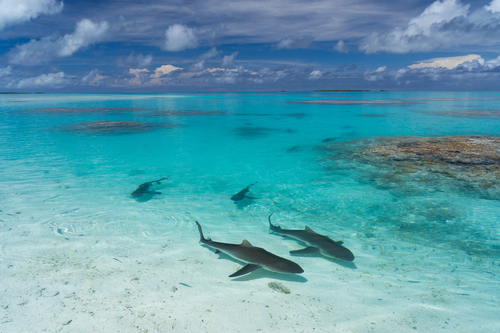
Inside that band they are reef specialists, common along coral drop-offs facing open water, in atoll passes, and in lagoons beside strong currents — exactly where divers find them. The working depth range is the surface to about 280 metres. Tagged sharks in Palau averaged 35 metres in winter and 60 in spring, in water of 23–29 °C, and were deepest around late morning; at Fakarava in French Polynesia they averaged 18.6 metres by day and 16.1 at night.
The range map and the reef-health map are now nearly the same document. Grey reef sharks are still thick in the places that stopped fishing them — Palau, the first national shark sanctuary, in 2009; the Maldives in 2010; French Polynesia, across its whole exclusive economic zone, in 2012; and the no-take reefs of the Chagos Archipelago. On reefs that are fished they thin out quickly, and on a great many they have gone entirely.


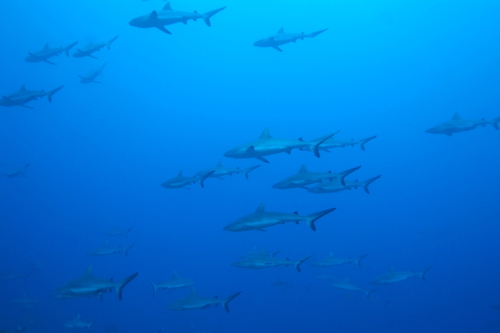
- Tumakohua (south) pass, Fakarava, French Polynesia — The densest gathering of this species known anywhere: an average of about 600 sharks, peaking near 700, in a channel roughly a kilometre long — two to three times the biomass per hectare recorded at any other reef shark aggregation.
- Blue Corner and the western barrier reef, Palau — The outer reef slope where 39 sharks were tracked for years, and the population behind the study that valued a single live reef shark at about US$179,000 a year in dive tourism.
- Chagos Archipelago, central Indian Ocean — A very large no-take reserve with no resident fishery. More than 120 grey reef sharks tracked here from 2013 to 2020 produced the clearest evidence yet that reef sharks leave reefs during marine heatwaves.
- Outer Great Barrier Reef and the Coral Sea, Australia — Where the comparison between fished and unfished reefs was first done properly. Densities on reefs open to fishing were 97 per cent below those inside no-entry zones.
- Pohnpei and Ant Atoll, Micronesia — Twenty tracked females contracted their range around the January-to-May grouper spawning, from an average of 38.8 km² in other months to 7.8 km² while the groupers were in.
Where it goes
This is a shark that stays put. Three and a half years of acoustic tracking in New Caledonia — 147 sharks tagged, 118 analysed across 70 receivers — put the average home range at about 12 square kilometres of reef, split sharply by sex and age: adult males 21 km², adult females 4.4 km², juvenile males 6.2 km², juvenile females 2.7 km². In Palau, 31 of 39 tagged sharks were detected in 70–100 per cent of the weeks monitored, and about two-thirds of the 2008–09 cohort were still using the same site years later. Long moves happen, but they are the exception: of nine sharks followed between the Great Barrier Reef and the Coral Sea, exactly one covered the 134 kilometres between them.
The movement that matters is daily rather than annual. Sharks in the Fakarava pass sit deepest around eleven in the morning, spread out and speed up after dark, use a larger area on an incoming current than an outgoing one, and are busiest around the full and new moons. Seasonal patterns are real but gentler — Palau’s aggregation sites are better attended from June to September — and the strongest seasonal pull is food, with Pohnpei’s sharks shrinking their range fivefold while the groupers spawn. The exception to all this loyalty is heat: eight years and 714,000 detections in the Chagos Archipelago show sharks leaving heat-stressed reefs for cooler, deeper water, with residency still depressed as much as sixteen months after the 2015–16 El Niño.
Share of verified grey reef shark records by month (GBIF, all years). Darker rose means a larger share of sightings fall in that month. This reflects when people record them, which mixes real seasonality with when divers and boats are out.
Palau, Micronesia: Resident all year — 37 of 39 tagged sharks were detected again, most of them in 70–100% of the weeks monitored — with noticeably higher attendance at the aggregation sites from June to September (Vianna et al. 2013).
What it eats
Grey reef sharks eat small reef fish first and foremost — the Florida Museum names surgeonfish, butterflyfish and cowfish among them — then octopus and squid, then crabs, lobsters and shrimp. FishBase places them at trophic level 4.1, high but not at the top of the reef. Most of the hunting happens after dark, which is why they look so idle on a daytime dive: the sharks hanging in the current have generally just finished work. The fullest picture of what one actually eats comes from Fakarava, where researchers filming the night hunt identified around fifty species of fish and molluscs being taken.
Fakarava also showed that they hunt as a crowd. Acoustic tags caught sharks pairing up in twos and threes for the evening hunt, roughly six o’clock to midnight, and holding those temporary teams together throughout, although each shark still swallows its own catch. They also rob their neighbours: the same project recorded the first known case of kleptoparasitism in sharks, grey reefs taking prey from whitetip reef sharks, whose slimmer bodies reach into coral heads a grey reef cannot. All that appetite has to be paid for. The pass supports roughly 90 tonnes of shark feeding a year against about 17 tonnes of local fish production, and the gap is closed by fish arriving to breed — some 17,000 groupers gathering in one channel.
Is it dangerous?
The record here is short. The International Shark Attack File, counting from 1580, attributes nine unprovoked bites to grey reef sharks, one of them fatal — against 351 for the white shark, 142 for the tiger and 119 for the bull. What sets this species apart is that it usually tells you first. Robert Johnson and Donald Nelson recorded 23 threat displays at Eniwetok Atoll in January 1971 and found the trigger was a fast, direct approach by a diver: the shark lifts its snout, drops both pectoral fins, arches its back, bends sideways and swims in a stiff, rolling, exaggerated figure of eight. In 57 later trials with a small submersible, Nelson’s team drew ten high-speed strikes, every one from a grey reef shark, and what predicted a strike was how far the shark was cornered against reef or seabed and whether the pursuer kept turning to follow it. A bite in that situation is a fast slash and an immediate retreat — a shove, not a meal.
That makes the advice unusually concrete. If a grey reef shark begins to display, stop swimming towards it, do not chase it or pin it against a wall, keep it in sight, and move away steadily so it gets the exit it is asking for. Then keep the comparison the right way round. Global FinPrint filmed 371 reefs in 58 nations and recorded no sharks at all on close to a fifth of them; a 2023 follow-up in Science estimated declines of 60 to 73 per cent across five common resident reef shark species. On the Great Barrier Reef, grey reef shark density on fished reefs was measured 97 per cent below that on no-entry reefs. A shark that warns before it bites, and has bitten nine people in four and a half centuries, is not the dangerous party here.
Grey reef shark facts
- The threat display has six parts: a raised snout, both pectoral fins dropped, an arched back and a sideways bend of the body, combined with exaggerated side-to-side swimming and rolling or spiral looping. It was documented 23 times at Eniwetok Atoll in January 1971, and a fast, direct approach by a diver was the trigger. — Johnson & Nelson 1973, Copeia
- A follow-up experiment ran 57 trials with a small wet submersible. It drew ten high-speed strikes, all from grey reef sharks, and the likelihood of a strike rose with how far the shark was cornered against reef or seabed and whether the vehicle kept turning to follow it. — Nelson, Johnson, McKibben & Pittenger 1986, Bulletin of Marine Science
- The south pass at Fakarava holds an average of about 600 grey reef sharks and up to 700 — two to three times the biomass per hectare of any other reef shark aggregation measured. The sharks need roughly 90 tonnes of fish a year; the pass itself produces about 17. The difference is made up by around 17,000 groupers arriving to spawn. — Mourier et al. 2016, Current Biology
- Grey reef sharks at Fakarava hunt in loose teams of two or three from about six in the evening until midnight, and were filmed stealing prey from whitetip reef sharks — the first record of kleptoparasitism in any shark. Around fifty prey species were identified from the footage. — Labourgade et al. 2020, Bulletin of the Ecological Society of America
- Tracking 118 sharks in New Caledonia over three and a half years put the average home range at about 12 km² of reef, but split sharply by sex and age: adult males 21 km², adult females 4.4 km², juvenile males 6.2 km² and juvenile females 2.7 km². — Bonnin et al. 2021, Scientific Reports
- Global FinPrint deployed more than 15,000 baited underwater cameras on 371 reefs across 58 nations and recorded no sharks at all on close to a fifth of them. Six nations produced essentially no sharks on any reef surveyed. — MacNeil et al. 2020, Nature
- Eight years of tracking in the Chagos Archipelago — over 714,000 detections from more than 120 sharks — showed grey reef sharks leaving heat-stressed reefs for cooler, deeper water, with residency still reduced up to sixteen months after the 2015–16 El Niño. — Williamson et al. 2024, Communications Biology
- A single live reef shark in Palau was valued at roughly US$179,000 a year in dive tourism, about $1.9 million over its lifetime, against $108 as a one-off catch. Palau became the world’s first national shark sanctuary in 2009. — Vianna et al. 2012, Biological Conservation
Photos
Seen lately
PierMonkey’s live map carries community shark sightings from iNaturalist, refreshed every three hours. Open the map to see where grey reef sharks have turned up recently.
How big is that, really?
Maximum reliably recorded length. Rose marks the large or potentially dangerous species the map flags as notable.
Help protect it
- Global FinPrintThe survey that filmed 371 reefs in 58 nations. Look up the country you are about to dive or surf in and see whether its reefs still have sharks, and which rules — gear limits, catch limits, national bans — made the difference where numbers held up.
- eOceans / eShark, with Shark GuardianLog the sharks you see on a dive in the eOceans app and they join eShark, a global count already used to test whether shark sanctuaries work. One logged dive feeds every project you have joined.
- Reef Check: tropical reef monitoringTrain as a volunteer EcoDiver and run standardised reef surveys — sharks included — on reefs across the Indo-Pacific. This is how the absence of a species gets recorded rather than merely noticed.
Report what you see
Photograph a shark, upload it, and once the community confirms the ID it becomes a research-grade record — which is where every sighting on our map comes from. Yours would appear here within three hours.
How to submit an observation →Organisations working on sharks like this one
- The Shark Trustgood for kidsReport eggcases and sightings, join campaigns, download free ID guides.
- Great Eggcase Huntgood for kidsWalk a beach, find a mermaid’s purse, log it. Over 630,000 eggcases recorded since 2003 — the easiest real science a family can do.
- Sharks4Kidsgood for kidsFree classroom lessons, virtual field trips and activity packs for teachers and parents.
- Save Our Seas FoundationFunds shark research and education worldwide; publishes what each project found.
- Shark StewardsCampaigns to end the shark fin trade and establish shark sanctuaries.
- OceanaPolicy campaigning on fisheries management and bycatch — the thing that actually kills sharks.
- IUCN Shark Specialist GroupThe scientists behind the Red List assessments. For older readers who want the primary source.
Conservation status: Endangered (IUCN Red List, assessed 2020). Assessed as Endangered on 3 July 2020 under criterion A2bcd — a past population reduction inferred from falling abundance, declining habitat quality and fishing pressure. Since 25 November 2023 every requiem shark, this one included, is on CITES Appendix II, so international trade in its fins and meat needs a permit. The listing sits awkwardly beside photographs of hundreds of them in one reef pass, and both are accurate: numbers hold up inside sanctuaries and collapse on reefs that are fished. Read the assessment →
Common questions
What does it mean when a grey reef shark arches its back and drops its fins?▾
Are grey reef sharks dangerous to people?▾
How big do grey reef sharks get?▾
How do you tell a grey reef shark from other reef sharks?▾
Why do hundreds of grey reef sharks gather in the Fakarava pass?▾
Why are grey reef sharks Endangered when divers still see them in numbers?▾
Keep exploring
- Teahupo’o, Tahiti — live surf conditions
- P-Pass, Pohnpei — live surf conditions
- Cloudbreak, Fiji — live surf conditions
- Pasta Point, Maldives — live surf conditions
- All 40 species →
Sightings © iNaturalist contributors (research-grade observations). Occurrence maps © GBIF.org contributors (CC BY). Community science, not a beach-safety service. Last updated 2026-09-20.
See where sharks are turning up — on the live map
The map and live conditions are open to everyone. A free account unlocks full 16-day forecasts and custom swell alerts.