
Greenland shark
The longest-lived vertebrate known — a cold, slow, deep Arctic shark that outlasts four human lifetimes.
Vital statistics
Live birth from eggs retained inside the mother. Exactly one pregnant female has ever been properly documented — landed in 1957 with ten near-term pups about 37 cm long — but a 2020 study of preserved ovaries found 400-649 ripening eggs and argued litters could run to a few hundred. Gestation length is unknown.
The short version
The Greenland shark is the longest-lived vertebrate known to science. In 2016 a team led by Julius Nielsen radiocarbon-dated the lens of the eye — tissue that forms before birth and is never replaced — in 28 female sharks between 0.81 and 5.02 metres long. The largest came out at 392 years old give or take 120, meaning her true age lay somewhere between about 272 and 512 years. That interval is the finding, and it is more interesting than the headline: even at the cautious end of it, she was swimming before the United States existed. The same study put the age at which females start breeding at 156 years, and treated even that as a floor.
It is a heavy, slow animal of cold deep water in the Arctic and the North Atlantic. Adults are usually 3–5 metres long; the largest on record was 6.4 m and about 1,022 kg. It grows roughly one centimetre a year and cruises at 0.34 metres per second — slower than you walk — which, corrected for body size, is the slowest sustained swimming speed ever measured in a fish. Most live 200–600 metres down, coming shallower in winter, and they eat fish, carrion and a surprising number of seals.
They are no danger to anyone: the International Shark Attack File holds one reported incident, from around 1859, which was never investigated — and the water they live in is close to freezing. The IUCN listed the species as Vulnerable in 2020, mainly because around 3,500 are still killed every year as accidental catch in Arctic bottom fisheries. Their flesh is poisonous when fresh, which is why Iceland ferments and dries it for months before anybody eats it.
Where it lives
The Greenland shark belongs to the Arctic and the North Atlantic, from the Gulf of St. Lawrence and Baffin Island across to Greenland, Iceland, Svalbard, the Barents Sea and the seas north of Siberia, with thinner records trailing south to Portugal and France on one side and the Gulf of Maine and North Carolina on the other. Most of the population sits between about 200 and 600 metres down. In winter and early spring they come up — Fisheries and Oceans Canada describes them near the surface at the edge of the ice — and in summer they drop back down. The far southern records are the deep ones: the shark filmed at the wreck of the SS Central America in 1995 was 2,200 metres down, off Georgia.
What holds the range together is temperature, not latitude. Fisheries and Oceans Canada puts them between about −2 and 7 °C, and the pop-up tags Steven Campana and colleagues recovered in 2015 agree: sharks tagged in the Canadian Arctic averaged 2.7 °C, sharks in the northwest Atlantic 7.9 °C. The same tags logged one excursion to 17.2 °C, which is FishBase’s upper limit for the species, so they tolerate warm water briefly. They just do not live in it. Where cold water is shallow a Greenland shark can be shallow; where it is warm, it goes down until it finds the temperature it wants.
The other thing to understand about the range is how little of it anyone has looked at. Add up every verified record in the world and GBIF holds roughly 1,080 occurrences; iNaturalist holds 45 observations. A whale shark collects that many photographs in a quiet week. Almost everything known about Greenland sharks comes from animals pulled up by accident in commercial fisheries, from a few tagging programmes in Baffin Bay, Svalbard and the St. Lawrence, and from museum specimens landed a century ago. A map of this species is not a map of where they are — it is a map of where people with boats and research permits have been.


- Baffin Bay & Cumberland Sound, Nunavut — The best-studied population anywhere. An acoustic array tracked 155 tagged sharks here for up to seven years and showed them moving in and out of the coastal fjords on a strict ice schedule.
- Disko Bay & the west Greenland halibut grounds — Where the sharks and the fishery overlap most. Greenland halibut longlines and trawls are both the main threat to the species here and the reason science has any specimens to work from.
- Svalbard fjords, Norway — Kongsfjorden and the surrounding fjords have supported Greenland shark research since the 1990s, including the stomach-contents study that first showed how much seal these sharks eat.
- St. Lawrence Estuary, Baie-Comeau, Québec — The one place in the world where divers have met Greenland sharks repeatedly and on purpose. The St. Lawrence Shark Observatory logged hundreds of encounters here between 2003 and 2012 — the first time this had ever been predictable.
- Westfjords & north Iceland — Sharks come up on halibut gear, and the hákarl tradition that turns toxic flesh into food is centred here. Bjarnarhöfn on Snæfellsnes runs a small museum about it.
Where it goes
Greenland sharks move much further than an animal cruising at walking pace ought to. When Steven Campana and colleagues put pop-up satellite tags on 15 sharks in the Canadian Arctic and the northwest Atlantic, every one covered at least 315 km before its tag released, and one covered 1,615 km, at depths reaching 1,816 m. The pattern in Cumberland Sound was the interesting part: the sharks there are young, and they all left the shallow coastal water long before maturity, apparently heading for the deep water of Davis Strait. If that is right, the fjords are a nursery and the adults are somewhere almost nobody looks.
The seasonal pattern is keyed to ice rather than to food or breeding. Seven years of acoustic tracking in Baffin Bay — 193 sharks tagged, 155 of them later detected — found presence in the coastal fjords restricted to the open-water months of July to November, and presence offshore along the continental margin from November through to July, while the ice was forming and in place. That is not migration in the basking-shark sense of crossing an ocean on a schedule. It is a slow annual shuffle between inshore and offshore, repeated for a very, very long time.
Share of verified greenland shark records by month (GBIF, all years). Darker rose means a larger share of sightings fall in that month. This reflects when people record them, which mixes real seasonality with when divers and boats are out.
Baffin Bay fjords, Nunavut: Coastal presence only, from the seven-year acoustic study: sharks were detected in the fjords exclusively during the ice-free period of July to November. A zero here does not mean the sharks are gone — it means they are offshore and under ice, where the receivers are not.
What it eats
Most of what a Greenland shark eats is fish: Greenland halibut, cod, capelin, Arctic char, herring, redfish, lumpfish and wolffish all turn up in stomachs. So do seals. When researchers went through the gut contents of 45 sharks caught off Svalbard, seal tissue was in 36.4% of the 33 that had eaten anything, and genetic testing identified most of it as ringed seal. Some was pups still in their birth coat, and some of the remains were fresh rather than rotten — the evidence that these sharks hunt seals and do not only find them dead. They scavenge too: whale carcasses draw them in, and stomachs have held reindeer and even polar bear remains — which says more about what ends up in an Arctic sea than about the shark.
So how does the slowest fish in the sea catch a seal, when a seal in a hurry is many times faster? The likeliest answer came out of the speed study itself. Arctic seals sleep in the water, because sleeping on the ice is how you get eaten by a polar bear. A shark that is cold, silent, dark-skinned and moving at one kilometre an hour is exactly the sort of predator that can close on a sleeping animal without waking it. The rest of the biology fits: the eyes are poor and often damaged, the nose is enormous, and the whole animal runs at a metabolic rate so low it needs remarkably little food. Nothing about a Greenland shark is built for a chase, and nothing about it needs to be.
Is it dangerous?
Greenland sharks are not dangerous to people. The International Shark Attack File carries one reported incident, from around 1859 near Pond Inlet in the Canadian Arctic, in which a shark was said to have contained a human leg; it was never investigated and is not treated as a confirmed record. There has been nothing since. Mostly that is because the two of us are never in the same water: these sharks live hundreds of metres down in temperatures near freezing. Where people have gone to meet them on purpose — divers off Baie-Comeau in the St. Lawrence, over hundreds of encounters between 2003 and 2012 — the sharks have been slow, incurious and easy to be around.
What we do to them is the real story, and it is an old one. Iceland, Norway and Greenland all hunted Greenland sharks for the oil in their huge livers: Icelandic exports peaked in 1867 at more than 13,000 barrels of shark oil, Greenland was taking something like 32,000 sharks a year in the 1910s, and the Norwegian fishery peaked in 1948 at close to 60,000 animals — nearly 2.8 million kilograms of liver oil in a single year. Synthetic oils killed the market and the fishery was over by the 1950s. What replaced it is accidental: roughly 3,500 Greenland sharks a year are still caught as bycatch in bottom trawls, longlines and gillnets across the northwest Atlantic, the Arctic and the Barents Sea, most of it by boats chasing Greenland halibut. The arithmetic is brutal for an animal like this: a shark that grows a centimetre a year and does not breed until it is about 150 cannot replace what a trawl fleet removes by mistake. That is why the Northwest Atlantic Fisheries Organization banned retaining them in September 2022, and why the IUCN moved the species to Vulnerable.
Greenland shark facts
- The oldest Greenland shark ever aged was 392 years old, plus or minus 120 — so somewhere between 272 and 512. The uncertainty shrinks with size: a shark aged at 50 years is accurate to within about five. — Nielsen et al. 2016, Science
- It is the slowest fish in the sea for its size. Accelerometers on six sharks recorded a mean cruising speed of 0.34 m/s and a tail beat every seven seconds — about nine beats a minute. — Watanabe et al. 2012, Journal of Experimental Marine Biology and Ecology
- They grow about one centimetre a year. A shark tagged in 1936 and recaptured 16 years later had gone from 262 to 270 cm — eight centimetres in sixteen years. — Fisheries and Oceans Canada; Hansen 1963
- Most of them have a parasite anchored to the eye. Of 1,505 Greenland sharks examined in east Greenland waters, 1,270 — about 84% — carried the copepod Ommatokoita elongata, usually one on each cornea. — Berland 1961, Nature
- Seal tissue was found in 36.4% of the Greenland shark stomachs that had any contents at all in a Svalbard study, mostly ringed seal, including pups still in their birth coat. — Leclerc et al. 2012, Polar Biology
- Fresh Greenland shark flesh is poisonous. Fermenting it for hákarl drops trimethylamine N-oxide below detection within five weeks and turns urea into ammonia, taking the meat from pH 6 to pH 9. — Heliyon 2023, hákarl fermentation study
- A six-metre Greenland shark was filmed by a submersible at the wreck of the SS Central America, 2,200 m down and 370 km east of Savannah, Georgia — a kilometre deeper and 440 km further south than any record before it. — Herdendorf & Berra 1995, Transactions of the American Fisheries Society
- Exactly one pregnant Greenland shark has ever been properly documented, in 1957, carrying ten pups about 37 cm long. A 2020 study of preserved ovaries counted 400–649 ripening eggs and argued the real litter may be far larger. — Nielsen et al. 2020, PLOS ONE
Photos
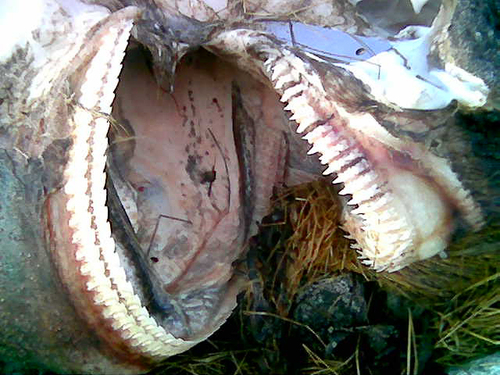
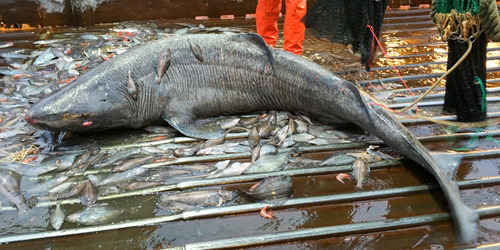
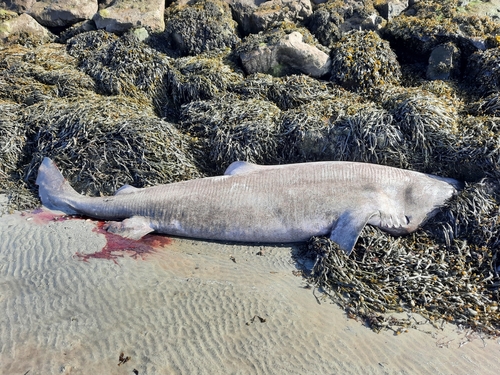
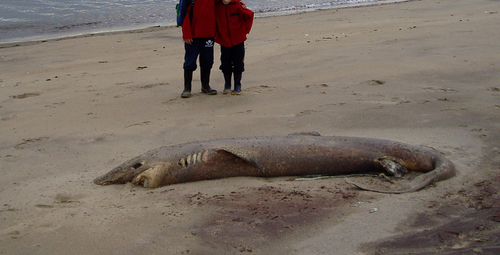
Seen lately
PierMonkey’s live map carries community shark sightings from iNaturalist, refreshed every three hours. Open the map to see where greenland sharks have turned up recently.
How big is that, really?
Maximum reliably recorded length. Rose marks the large or potentially dangerous species the map flags as notable.
Help protect it
- St. Lawrence Shark Observatory (ORS)If you see or accidentally catch a Greenland shark in the St. Lawrence or Atlantic Canada, report it to them. They are the group that made diver encounters with this species predictable in the first place, and their records are the Canadian baseline.
- Oceana Canada: Greenland sharkBycatch in the Greenland halibut fishery is what actually kills these sharks, and that is a gear and management problem. Sign up for their action alerts and you are pushing on the part of the problem that can be fixed.
- Oceans NorthThe Arctic conservation group that carried the Greenland shark proposal into the 2022 NAFO meeting that banned retaining them. Read how a protection measure is actually built — it is the clearest example on this page of campaigning that worked.
Report what you see
Photograph a shark, upload it, and once the community confirms the ID it becomes a research-grade record — which is where every sighting on our map comes from. Yours would appear here within three hours.
How to submit an observation →Organisations working on sharks like this one
- The Shark Trustgood for kidsReport eggcases and sightings, join campaigns, download free ID guides.
- Great Eggcase Huntgood for kidsWalk a beach, find a mermaid’s purse, log it. Over 630,000 eggcases recorded since 2003 — the easiest real science a family can do.
- Sharks4Kidsgood for kidsFree classroom lessons, virtual field trips and activity packs for teachers and parents.
- Save Our Seas FoundationFunds shark research and education worldwide; publishes what each project found.
- Shark StewardsCampaigns to end the shark fin trade and establish shark sanctuaries.
- OceanaPolicy campaigning on fisheries management and bycatch — the thing that actually kills sharks.
- IUCN Shark Specialist GroupThe scientists behind the Red List assessments. For older readers who want the primary source.
Conservation status: Vulnerable (IUCN Red List, assessed 2020). Assessed in June 2019 and published in 2020 by Kulka and colleagues as Vulnerable, an uplisting from the Near Threatened status it had carried since 2006. The Red List works in three-generation windows, and for an animal whose females may not breed until about 150 years old, three generations is several centuries — which is why the assessment rests on a suspected decline rather than a measured one. In September 2022 the Northwest Atlantic Fisheries Organization banned fishing for, retaining, transhipping and landing Greenland sharks across its area, the first international protection the species has ever had. Read the assessment →
Common questions
How old do Greenland sharks get?▾
How does a shark that slow catch a seal?▾
Why do Greenland sharks have things hanging off their eyes?▾
Can you eat Greenland shark?▾
Are Greenland sharks dangerous?▾
Why are there never any Greenland sharks on the map?▾
Keep exploring
Sightings © iNaturalist contributors (research-grade observations). Occurrence maps © GBIF.org contributors (CC BY). Community science, not a beach-safety service. Last updated 2026-09-20.
See where sharks are turning up — on the live map
The map and live conditions are open to everyone. A free account unlocks full 16-day forecasts and custom swell alerts.