
Great white shark
The largest predatory fish alive, warm-blooded, and far rarer than its reputation suggests.
Vital statistics
Live birth after roughly 12–18 months; 2–10 pups, each already about 1.2 m long.
The short version
The great white shark is the largest predatory fish in the ocean: reliably recorded to about 6 metres and roughly 1,100 kg, with mature females typically between 3.4 and 4.9 metres. It lives in temperate and subtropical coastal waters of every major ocean, and it is warm-bodied — able to hold its muscles, gut, eyes and brain above the temperature of the water around it.
Adults eat seals, sea lions, fish and whale carrion; juveniles eat fish and rays and only switch to marine mammals as they grow. Individuals migrate thousands of kilometres and return to the same coastline, and one female is documented crossing from South Africa to Australia and back.
The IUCN lists it as Vulnerable with a decreasing population. It is protected in several countries but still caught as bycatch, and it is the subject of far more fear than its record supports.
Where it lives
Great whites are a cool-water species in a warm-water family. They turn up in temperate and subtropical seas all around the world, and the map of where they concentrate is essentially a map of where seals and sea lions breed: central California, Guadalupe Island, the Western Cape of South Africa, South Australia, and the northeast coast of the United States from New Jersey to Cape Cod.
They are not confined to the coast, though. Satellite tags have followed individuals thousands of kilometres across open ocean and down past 1,000 metres, which means the coastal aggregations everyone photographs are the visible part of a much larger, mostly offshore life.
Their temperature range is wider than a fish their size has any right to have. Great whites are regionally endothermic: a heat-exchange network called the rete mirabile keeps their swimming muscles, stomach, eyes and brain well above the surrounding water. That is what lets one hunt in 12 °C water off California and the same animal cruise through the tropics.


- Gansbaai & False Bay, South Africa — For decades the most reliable place on earth to see one. Numbers have fallen sharply since 2017 — orca predation on white sharks is the leading explanation.
- Guadalupe Island, Mexico — Clear, deep water off Baja; a long-running photo-ID population study.
- Farallon Islands & Año Nuevo, California — Autumn aggregation timed to the elephant seal haul-out.
- Neptune Islands, South Australia — Australian sea lion and fur seal colonies; the country’s main aggregation site.
- Cape Cod, Massachusetts — A genuine conservation success story: grey seals recovered after protection, and the sharks followed them back.
Where it goes
Great whites are long-distance migrants, and tagging has turned what was guesswork thirty years ago into some of the best-documented animal movement in the ocean.
The northeastern Pacific population spends autumn and early winter near the California and Guadalupe seal colonies, then heads offshore to a region of open ocean midway to Hawaii that researchers named the White Shark Café. They loiter there for months, diving repeatedly, before returning to almost exactly the same stretch of coast they left.
The record holder is a female called Nicole, tracked from South Africa to Western Australia and back — roughly 20,000 km in nine months, and the first proof that individuals cross an entire ocean basin and return to the same site.
Share of verified great white shark records by month (GBIF, all years). Darker rose means a larger share of sightings fall in that month. This reflects when people record them, which mixes real seasonality with when divers and boats are out.
Central California coast: Peak presence at the California seal colonies runs late summer through autumn; most of the population is offshore by late winter.
What it eats
What a great white eats changes as it grows, and the switch is one of the most important facts about the species. Juveniles under about three metres eat fish, rays and smaller sharks; their jaws and teeth are not yet built for large prey. Only as adults do they move onto marine mammals.
Adults hunt seals and sea lions, often by ambushing from below at speed, and will feed for days on a floating whale carcass — a windfall large enough to be worth crossing open ocean for. They are not indiscriminate eaters: energy-rich blubber is the target, which is one reason a bite on a person is so often not followed by a second.
Is it dangerous?
This is a large predator and the honest answer is that it deserves respect. Worldwide there are roughly 60 unprovoked bites a year from all shark species combined, and fewer than ten are fatal. Great whites account for more of those records than any other species — and that is still a vanishingly small number against the hundreds of millions of people who enter the sea each year.
The reverse comparison is the one worth keeping hold of. Tens of millions of sharks are killed annually by fishing, mostly as bycatch. The great white is a Vulnerable species with a decreasing population; we are immeasurably more dangerous to them than they are to us. If you surf or swim where they live, the practical advice is unglamorous: avoid dawn and dusk near seal colonies, avoid murky water near river mouths, and follow local beach advice.
Great white shark facts
- Great whites are warm-blooded in the parts that matter. A counter-current heat exchanger keeps their swimming muscles, stomach, eyes and brain well above sea temperature, which is why one can hunt in 12 °C water. — Florida Museum ISAF
- Bomb-radiocarbon dating of vertebrae pushed their estimated lifespan to around 70 years — decades longer than anyone assumed, and the reason the species recovers so slowly from overfishing. — Hamady et al. 2014
- They are born ready: pups are already about 1.2 m long at birth and get no parental care whatsoever. — FishBase
- A female known as Nicole was tracked from South Africa to Western Australia and back — roughly 20,000 km in nine months. — Bonfil et al. 2005
- They can dive past 1,000 metres, so the coastal sharks people film are only the visible part of the population. — NOAA Fisheries
- Their teeth are serrated and replaced continuously throughout life, rolling forward from rows behind as older ones break off. — Florida Museum ISAF
- Off Cape Cod they came back because the seals did: grey seals recovered after legal protection, and the sharks followed the food. — NOAA Fisheries
- Since 2017 white sharks have largely vanished from parts of the Western Cape, and predation by a pair of orcas is the leading explanation. — Towner et al. 2022
Photos
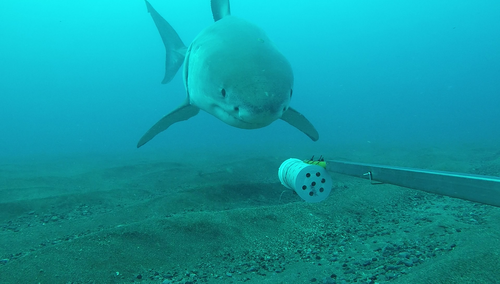
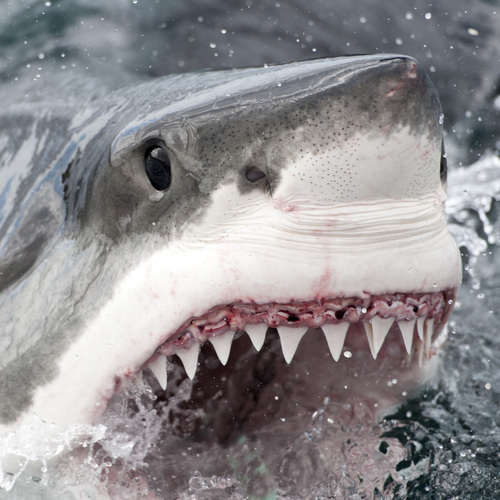
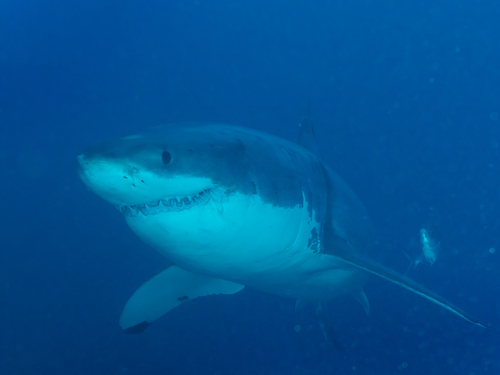
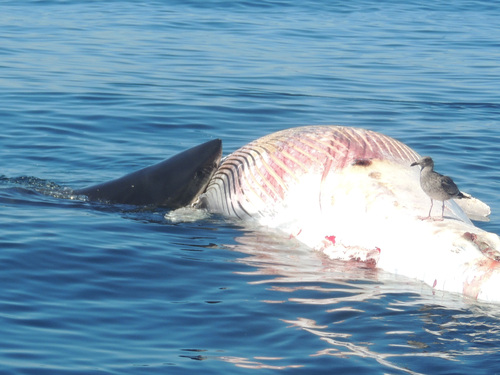
Seen lately
PierMonkey’s live map carries community shark sightings from iNaturalist, refreshed every three hours. Open the map to see where great white sharks have turned up recently.
How big is that, really?
Maximum reliably recorded length. Rose marks the large or potentially dangerous species the map flags as notable.
Help protect it
- Atlantic White Shark ConservancyResearch and public safety on the Cape Cod population. Their Sharktivity app lets beach users log and see confirmed sightings.
- OCEARCH Shark TrackerFollow individually named, satellite-tagged white sharks as they ping in. Free, and genuinely gripping for kids.
- Save Our Seas FoundationFunds white shark research projects and publishes what they find.
Report what you see
Photograph a shark, upload it, and once the community confirms the ID it becomes a research-grade record — which is where every sighting on our map comes from. Yours would appear here within three hours.
How to submit an observation →Organisations working on sharks like this one
- The Shark Trustgood for kidsReport eggcases and sightings, join campaigns, download free ID guides.
- Great Eggcase Huntgood for kidsWalk a beach, find a mermaid’s purse, log it. Over 630,000 eggcases recorded since 2003 — the easiest real science a family can do.
- Sharks4Kidsgood for kidsFree classroom lessons, virtual field trips and activity packs for teachers and parents.
- Save Our Seas FoundationFunds shark research and education worldwide; publishes what each project found.
- Shark StewardsCampaigns to end the shark fin trade and establish shark sanctuaries.
- OceanaPolicy campaigning on fisheries management and bycatch — the thing that actually kills sharks.
- IUCN Shark Specialist GroupThe scientists behind the Red List assessments. For older readers who want the primary source.
Conservation status: Vulnerable (IUCN Red List, assessed 2018). Assessed as Vulnerable with a decreasing population trend. Protected in South Africa, Australia, New Zealand, the United States and the Mediterranean, but still taken as bycatch across much of its range. Read the assessment →
Common questions
How big do great white sharks get?▾
How long do great white sharks live?▾
Where do great white sharks live?▾
Are great white sharks dangerous to people?▾
What do great white sharks eat?▾
Are great white sharks endangered?▾
Keep exploring
- Steamer Lane, California — live surf conditions
- Jeffreys Bay, South Africa — live surf conditions
- All 40 species →
Sightings © iNaturalist contributors (research-grade observations). Occurrence maps © GBIF.org contributors (CC BY). Community science, not a beach-safety service. Last updated 2026-09-20.
See where sharks are turning up — on the live map
The map and live conditions are open to everyone. A free account unlocks full 16-day forecasts and custom swell alerts.