Great hammerhead shark
The largest hammerhead, a stingray specialist that hunts with its head — and one of the most endangered big sharks in the sea.
Vital statistics
Live birth with a placenta after about 11 months; 6–42 pups at 50–70 cm, and only every second year.
The short version
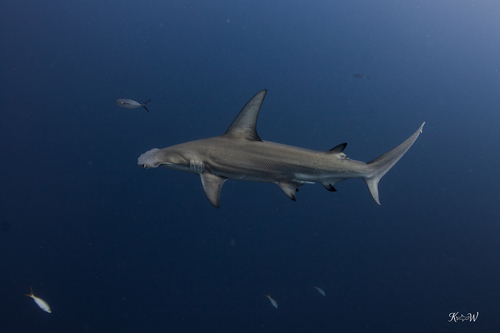
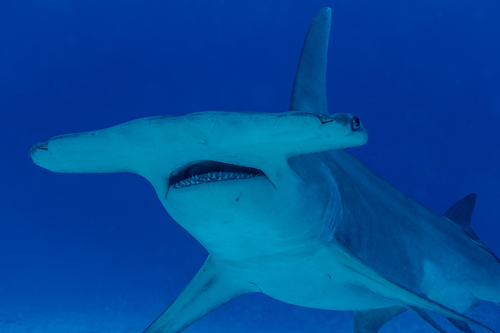
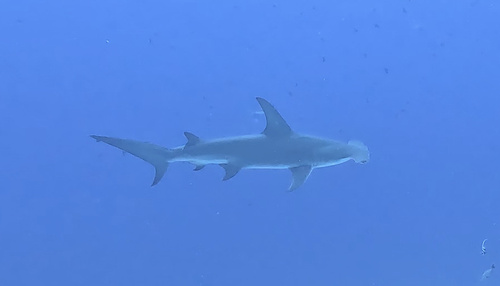
The great hammerhead is the largest of the hammerhead sharks: recorded to about 6.1 metres, with most mature adults between 3.5 and 4 metres, and a rod-and-line record of 580 kg. Two things separate it from the other hammerheads — the front edge of its head is almost straight with a notch in the middle, where a scalloped hammerhead’s is curved, and its first dorsal fin is enormous, tall and swept back like a scythe. It lives in warm coastal water all around the world, roughly between 40° N and 37° S.
The head is called a cephalofoil, and here it is 23–27% of the shark’s body length — a wide bar carrying the eyes, the nostrils and thousands of electrical sensors. Spread that far apart, the sensors sweep a much wider strip of seabed with every swing of the head, which is how a great hammerhead finds a stingray buried out of sight. It then uses the same head as a tool, pinning the ray down while it bites. Rays and smaller sharks are the bulk of its diet, barbs and all.
It is also one of the most threatened large sharks in the sea. The IUCN lists it as Critically Endangered on an estimated decline of more than 80% over three generations, about 70 years. The reason is not only that it gets caught but that it dies so easily when it does: more than 98% were already dead at the vessel in commercial longline observer data, and its post-release survival is among the worst measured in any shark.
Where it lives
Great hammerheads live in warm water all the way around the world. FishBase draws the band at roughly 40° N to 37° S: North Carolina to Uruguay in the western Atlantic, Morocco to Senegal in the east, through the Red Sea, the Indian Ocean and the Indo-Pacific, and from Baja California down to Peru on the American side. Inside that band they are coastal and semi-oceanic animals rather than open-ocean ones — reef drop-offs, continental shelves, lagoons, sandflats and the blue water just outside them.
By big-shark standards they do not go deep. FishBase and the Florida Museum both give 1–300 metres, with most of the time spent in the top hundred. Temperature is the sharper line: satellite tags in the western North Atlantic put 89% of records between 23 and 28 °C, and sharks tracked off Andros in the Bahamas spent most of the year in 25–26 °C water — some of them sitting out a warm season that pushed past 30 °C rather than moving away from it.
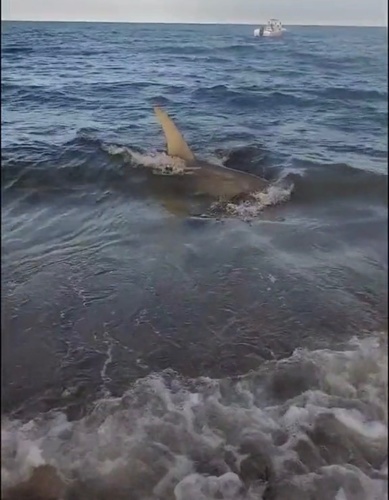
The shallow end of the range is the surprising one. On the Florida Keys flats, researchers documented great hammerheads hunting in under 1.5 metres of water, catching prey with a tight, hard-turning lunge they named grasp-turning, then resting head-first into the current, which appears to help them breathe and swallow. A four-metre shark in a metre of water looks like a mistake; for this species it is routine.


- Bimini, The Bahamas — A winter aggregation and one of the few places on earth where seeing one is likely. Acoustic residency peaks January to March, and all twelve sharks tagged in one study were female.
- Jupiter, Florida — The mainland half of the same population — tagged sharks move between here and Bimini. Florida has banned harvest in state waters since 2012, but state waters end three miles out.
- Andros Island, The Bahamas — Where the seasonal story breaks down: sharks tagged here stayed in Bahamian waters all year, on the same reef drop-off and flats.
- Rangiroa & Tikehau, French Polynesia — A December-to-April gathering in the Tuamotu atolls, monitored since 2023 with observations collected from divers and fishers.
- KwaZulu-Natal, South Africa — The cautionary one. 209 were taken in the bather protection nets between 1978 and 1993, and catch rates fell about 79% over 1978–2003.
Where it goes
For a long time nobody knew where great hammerheads went. Tagging on both sides of the Florida Straits has filled much of that in. Sharks marked at Bimini and at Jupiter turn up in each other’s water, and one female left Bimini and was tracked to a point roughly 500 km off the Virginia coast — about 1,505 km in a straight line, and close to a 3,000 km round trip. They come back, too. Three Bimini females were recorded in four consecutive winters and one male used the same small island across seven years, which is remarkable fidelity for an animal with an ocean to choose from.
Not all of them travel, and that turns out to matter. The sharks tracked off Andros stayed in Bahamian waters the whole year, and the Bahamas has banned commercial shark fishing throughout its waters since 2011 — so a great hammerhead that stays is inside a sanctuary roughly the size of France, and one that crosses to the US shelf is not. Rebuilding this population is a job several countries have to do at once.
Share of verified great hammerhead shark records by month (GBIF, all years). Darker rose means a larger share of sightings fall in that month. This reflects when people record them, which mixes real seasonality with when divers and boats are out.
Bimini, The Bahamas: Built from the seasonal residency indices in Guttridge et al. 2017 — winter 0.68, autumn 0.42, spring 0.28, summer 0.15. A 0 here means rarely detected rather than absent: the only month with no detections at all was September.
What it eats
Rays first, and by a distance. Of the 209 great hammerheads examined from the KwaZulu-Natal nets, elasmobranchs — stingrays, guitarfish and smaller sharks — were in 82% of the stomachs that had anything in them. On the other side of the world the answer came out the same way: stable-isotope work on nine sharks off Andros estimated southern stingray at 28–40% of the diet, with great barracuda and small sharks such as blacktips, silkies and Caribbean reef sharks making up most of the rest. Squid, crabs and ordinary bony fish fill the gaps.
Catching a stingray means solving two problems — the ray is buried, and it has a barb — and the great hammerhead has an answer to each. The electrical sensors spread across the cephalofoil find a ray under the sand without ever seeing it. Then the shark uses that same head as a tool, swinging it down to pin the ray to the seabed and holding it there while it bites a wing off; divers have watched this done to southern stingrays and to spotted eagle rays. The barbs seem not to trouble it. One large shark caught off Florida had 96 stingray spines embedded in its mouth, throat and tongue, and was in good health when landed.
Is it dangerous?
For an animal that can reach six metres, the record is remarkably quiet. The International Shark Attack File, which runs from 1580 to the present, attributes 18 unprovoked bites to hammerhead sharks of any species, and not one was fatal — against 351 for the white shark and 142 for the tiger. ISAF notes that a hammerhead is one of the easy sharks to identify afterwards, so that count is unlikely to be hiding much. A great hammerhead will normally ignore you; the sensible rules are the ordinary ones — give it room, do not chase or corner it on a dive, and keep speared fish and bait out of the water.
The danger runs the other way, and it runs hard. Great hammerheads are rarely the target of a fishery, but their large fins are valuable, and hammerheads are the second most abundant group in the international fin trade. What sets this species apart is how badly it copes with being caught at all. Observer data from commercial bottom longlines recorded total mortality above 98% — most great hammerheads are already dead when the line comes up. Of five shark species caught and released side by side, this one showed the highest lactate levels and the worst survival: 53.6% of satellite-tagged individuals were still reporting four weeks later, against close to 100% of the tiger sharks. Releasing one is not the same as saving it, which is why a shark almost nobody sets out to kill has ended up Critically Endangered.
Great hammerhead shark facts
- The cephalofoil is 23–27% of the shark’s body length, with a nearly straight front edge and a notch at the centre. Together with a very tall, scythe-shaped first dorsal fin, that is how you tell a great hammerhead from a scalloped or smooth one. — Florida Museum ISAF; Shark Research Institute
- Great hammerheads swim tipped over on their side, spending up to 90% of the time at roll angles of 50–75°. Their dorsal fin is longer than their pectorals — the reverse of every other shark — so rolling turns it into a wing and cuts the cost of swimming by about 10%. — Payne et al. 2016, Nature Communications
- They live to at least 44 years, one of the oldest ages reported for any shark. Bomb-radiocarbon dating confirmed the growth bands are laid down annually to at least age 42, and an independent specimen in the Mexican Pacific was aged near 45. — Piercy et al. 2010; Passerotti et al. 2010
- In 209 great hammerheads taken in the KwaZulu-Natal bather protection nets between 1978 and 1993, rays, guitarfish and smaller sharks were present in 82% of the non-empty stomachs. — Cliff 1995, South African Journal of Marine Science
- One large individual caught off Florida carried 96 stingray spines embedded in its mouth, throat and tongue, and appeared none the worse for it. — ReefQuest Centre for Shark Research
- A female tagged at Bimini was tracked to a point about 500 km off Virginia — 1,505 km from where she started. Three females returned to Bimini in four consecutive winters and one male used it across seven years. — Guttridge et al. 2017, Frontiers in Marine Science
- Commercial bottom-longline observer data recorded total mortality of more than 98% for this species, and in a five-species catch-and-release experiment only 53.6% of satellite-tagged great hammerheads were still reporting four weeks later, against nearly 100% of the tiger sharks. — Morgan et al. 2009; Gallagher et al. 2014
- Protections exist but are patchy: CITES Appendix II since September 2014, CMS Appendix II since 2014, no harvest in Florida state waters since 2012, and no commercial shark fishing anywhere in Bahamian waters since 2011. A US Endangered Species Act listing was petitioned and found not warranted in 2014. — CITES; FWC; Miller et al. 2014 (NOAA status review)
Photos
Seen lately
PierMonkey’s live map carries community shark sightings from iNaturalist, refreshed every three hours. Open the map to see where great hammerhead sharks have turned up recently.
How big is that, really?
Maximum reliably recorded length. Rose marks the large or potentially dangerous species the map flags as notable.
Help protect it
- Saving the BlueThe team that satellite-tagged the Andros hammerheads. You can adopt and name one of their tagged sharks, which funds the next tag and gets you that individual’s movements.
- Mokarran Protection SocietyRunning the Tamataroa project on the great hammerheads of Rangiroa and Tikehau. If you dive French Polynesia between December and April they want your observations; if you do not, they publish what the project finds.
- Bimini Shark LabThe field station behind the Bimini tagging work. They run internships, courses for teachers and bookable tours of the lab, so you can go and watch the data being collected.
Report what you see
Photograph a shark, upload it, and once the community confirms the ID it becomes a research-grade record — which is where every sighting on our map comes from. Yours would appear here within three hours.
How to submit an observation →Organisations working on sharks like this one
- The Shark Trustgood for kidsReport eggcases and sightings, join campaigns, download free ID guides.
- Great Eggcase Huntgood for kidsWalk a beach, find a mermaid’s purse, log it. Over 630,000 eggcases recorded since 2003 — the easiest real science a family can do.
- Sharks4Kidsgood for kidsFree classroom lessons, virtual field trips and activity packs for teachers and parents.
- Save Our Seas FoundationFunds shark research and education worldwide; publishes what each project found.
- Shark StewardsCampaigns to end the shark fin trade and establish shark sanctuaries.
- OceanaPolicy campaigning on fisheries management and bycatch — the thing that actually kills sharks.
- IUCN Shark Specialist GroupThe scientists behind the Red List assessments. For older readers who want the primary source.
Conservation status: Critically Endangered (IUCN Red List, assessed 2019). Assessed in 2018 and published in 2019 (Rigby et al.) as Critically Endangered, on an estimated population reduction of more than 80% over three generations — roughly 70 years. Listed on CITES Appendix II at CoP16 in 2013, in force from 14 September 2014, and on Appendix II of the Convention on Migratory Species in 2014. Read the assessment →
Common questions
Why do hammerhead sharks have hammer-shaped heads?▾
How big is a great hammerhead shark?▾
What do great hammerhead sharks eat?▾
Are great hammerhead sharks dangerous to swimmers?▾
Why are great hammerheads Critically Endangered?▾
Where can you see a great hammerhead?▾
Keep exploring
- Cocoa Beach, Florida — live surf conditions
- Sebastian Inlet, Florida — live surf conditions
- Cape Hatteras, North Carolina — live surf conditions
- All 40 species →
Sightings © iNaturalist contributors (research-grade observations). Occurrence maps © GBIF.org contributors (CC BY). Community science, not a beach-safety service. Last updated 2026-09-20.
See where sharks are turning up — on the live map
The map and live conditions are open to everyone. A free account unlocks full 16-day forecasts and custom swell alerts.