
Dusky smooth-hound
The fifth most-reported shark on our own map and the one almost nobody can name — a mild, metre-long crab specialist carrying paving slabs where other sharks carry blades.
Vital statistics
Live birth through a true yolk-sac placenta. Mating runs May to July, gestation 10–12 months, and 3–20 pups of 34–39 cm are born in shallow estuaries in late spring and early summer — the biggest females carrying the biggest litters.
The short version
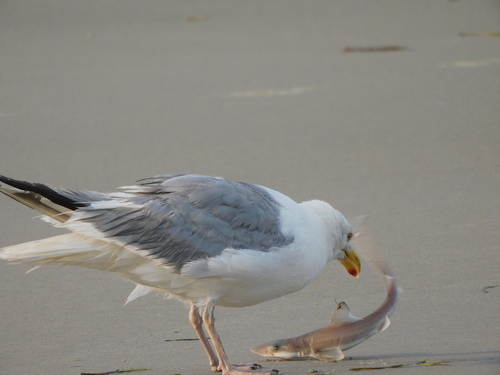
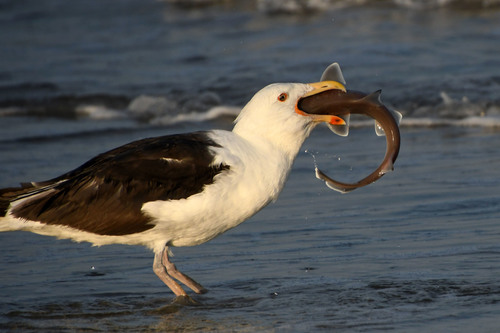
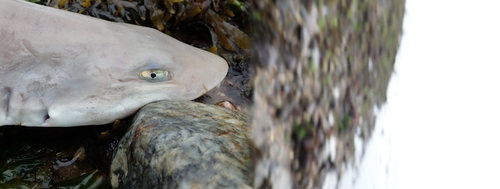
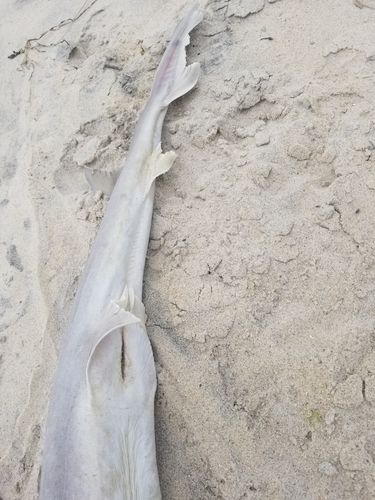
The dusky smooth-hound — almost everyone on the US east coast calls it the smooth dogfish — is a small, plain, harmless houndshark of the western Atlantic. Adults run about 0.9–1.2 m; the largest ever measured was 1.5 m and 12.2 kg. It is grey to brown above and pale below, with two spineless dorsal fins of nearly equal size, large oval catlike eyes and a blunt snout. It is also one of the most abundant sharks on the coast: in a recent 45-day window it was the fifth most-reported species in PierMonkey’s own live sightings feed.
It is not a dogfish in the strict sense. The spiny dogfish, Squalus acanthias, sits in another order entirely and carries a sharp spine in front of each dorsal fin; this shark has none, and in 1815 it was named into that genus by mistake before being moved. "Smooth" refers to its teeth, which are the other thing worth knowing about it: eight to ten rows of flat, blunt plates in each jaw that crush and grind rather than cut. It uses them on crabs, lobsters, shrimp, squid and clams, working the bottom at night.
It migrates with the temperature — north and inshore in spring, south and offshore in autumn, wintering on the edge of the continental shelf between New Jersey and North Carolina and pupping in estuaries from Virginia to Massachusetts. Litters are 3–20 pups, fed before birth through a true placenta, which only a minority of sharks have at all. The International Shark Attack File has never attributed a bite to it. The IUCN listed it as Near Threatened in 2021: abundant and capped by quota in US waters, but heavily and largely uncounted further south.
Where it lives
This shark belongs to one ocean and mostly to one side of it. FishBase and the Florida Museum run the main range from Massachusetts to Florida, taking in the northern Gulf of Mexico, the Caribbean and Bermuda, with a second arm from southern Brazil to northern Argentina; Fisheries and Oceans Canada adds the Bay of Fundy as the northern tip, where it is rare. Able and Fahay, the standard reference on the region’s estuarine fishes, note that it thins out north of Cape Cod and is absent along the Central American coast. The centre of gravity is the mid-Atlantic United States, and an island form, Mustelus canis insularis, is told apart mainly by counting vertebrae.
Inside that range it is a bottom shark of shallow water, and that is the key to it. The Florida Museum puts its preference below 18 m and its recorded limit at 200 m; it works estuaries, bays, sounds, inlets and the surf line, handles brackish water happily and turns up in fresh water now and then, though it cannot stay. It is largely nocturnal, which is why so many are caught from piers after dark.
That shallowness is why this page exists. In a recent 45-day window the smooth dogfish was the fifth most-reported shark in PierMonkey’s live sightings feed, with 56 records — ahead of species that get documentaries made about them. It is not rare and it is not shy of people; it is simply plain, grey, about a metre long, and nameless to most of the people whose feet it swims past.


- Delaware Bay — The mating and pupping ground at the heart of the range. Adults move in during spring, and the state’s long-running otter-trawl index — one of the time series behind the 2015 stock assessment — has trended upward since the 1990s.
- Great Bay and Little Egg Harbor, New Jersey — The best-studied nursery on the coast. Newborn pups dominate the catch from May to July and young-of-the-year stay until October, with marsh creeks mattering most to the smallest of them.
- Lower Chesapeake Bay — A common-to-abundant summer and autumn visitor, according to the Virginia Institute of Marine Science, whose longline survey has been catching them since 1973 — and has seen the catch fall in recent years.
- Narragansett Bay, Rhode Island — Where the temperature story was measured. Smooth dogfish are in the bay from June to November, with catches peaking at a bottom temperature of 21 °C — a temperature that visibly stresses the spiny dogfish sharing the same water.
- The shelf edge off New Jersey to Cape Hatteras — The winter address. When the inshore water cools the adults drop off the edge of the continental shelf and spend the cold months there, which is why a shark that is everywhere in July is nowhere in January.
Where it goes
This is one of the tidiest seasonal migrations in the western Atlantic, and it is run by a thermometer. In spring the sharks move north and inshore; in autumn they move south and offshore. Off South Carolina the northbound run starts in mid-April as inshore water climbs past about 18 °C, and the sharks come back in November as it falls back through the same figure. They reach Rhode Island in June and are still abundant off Cape Cod into October. The adults winter on the edge of the continental shelf between New Jersey and North Carolina, while others hold inshore from Chesapeake Bay down to South Carolina. Much of that picture comes from ordinary anglers — the mark-recapture record underpinning it was built by NOAA’s volunteer Cooperative Shark Tagging Program, running since 1962.
The sexes do not travel together all year. A Bayesian habitat model built on inshore survey data found males and females overlapping in spring between New Jersey and North Carolina, then splitting hard in autumn, with males pushing north above 40° N as far as Georges Bank while females stayed south — the authors’ favoured explanation being females avoiding the attentions of males rather than any difference in temperature preference. Pupping happens in estuaries from Virginia to Massachusetts, and the young of the year stay in the nursery until autumn before joining the adults offshore. One quiet surprise: over three decades of federal trawl surveys, and despite measurable warming on the north-east US shelf, the centre of this species’ distribution has not moved.
Share of verified dusky smooth-hound records by month (GBIF, all years). Darker rose means a larger share of sightings fall in that month. This reflects when people record them, which mixes real seasonality with when divers and boats are out.
New Jersey and Delaware Bay — inshore adults and pups: April is the leading edge, May to September the season, and November the stragglers: newborn pups dominate New Jersey estuary catches from May to July and young-of-the-year stay until October, while the South Carolina run north begins in mid-April and reverses in November. The winter zeroes mean inshore only — in January the adults are alive and well on the shelf edge a long way out.
What it eats
Decapod crustaceans are the core of it: crabs, lobsters and shrimp, taken along the bottom, mostly at night. Around that it adds squid, clams, snails, polychaete worms and small bony fish — menhaden and tautog are the two the Florida Museum names — and it will scavenge what it finds, up to and including rubbish. Pups start on small shrimp, worms and little crabs in the estuary where they were born. FishBase puts the species at trophic level 3.6: a predator, but one that eats a lot of things with shells on.
The tools match the job, and they are the reason for the name. Where most sharks carry blades, this one has eight to ten rows of small, flat, blunt teeth, near enough the same in both jaws, laid down like paving — the Florida Museum’s word is "pavement-like" — and in older sharks the crowns wear so low that the little cusps disappear altogether. That mouth crushes and grinds; it cannot cut. "Smooth" in smooth dogfish and smooth-hound means exactly this, as against the spiny dogfish with its sharp teeth and its dorsal spines. Being a crab-eater a metre long also means being eaten: dusky sharks, blacktips and great hammerheads all take them.
Is it dangerous?
There is no danger here, and the reasons are structural rather than lucky. The International Shark Attack File’s table of species implicated in bites does not list Mustelus canis, or any other houndshark of that genus; the Florida Museum says flatly that the species poses no threat to people because of its small size and blunt, pavement-like teeth; FishBase lists it as harmless. A shark with no cutting teeth, a mouth built for crabs and a maximum weight of 12 kg is not equipped for anything else. Handle one on a hook and it will twist hard and can graze you with its skin, which is the whole of the risk — so keep it in the water, get the hook out and let it go.
The traffic runs the other way, and the numbers are large. Landings of smooth dogfish were under 80,000 lb a year before the 1990s, spiked past 2.6 million lb in 1995 and settled a little over a million lb a year in the early 2000s, taken by gillnet, trawl and longline off the mid-Atlantic states for meat and hide. It is managed now by the Atlantic States Marine Fisheries Commission inshore and under the federal highly migratory species plan beyond, and the 2025 Atlantic smoothhound quota of 3,973,902 lb dressed weight ended the year only 14% filled, at 556,196 lb. Against that, FishBase puts the population doubling time at 4.5–14 years: the margin is real but not unlimited, and this is a shark that can be fished down quietly, as it has been in the parts of its range where nobody is counting.
Dusky smooth-hound facts
- Instead of blades it has eight to ten rows of small, flat, blunt teeth, almost identical in both jaws and asymmetrical with a rounded cusp. In old sharks the crowns wear so low the cusps vanish. They crush and grind shellfish rather than bite and tear, and they are what "smooth" in smooth dogfish means. — Florida Museum, Discover Fishes; Fisheries and Oceans Canada
- It is not a true dogfish. Mitchill described it in 1815 as Squalus canis — the genus of the spiny dogfish — and it was later moved to Mustelus, Latin for "weasel-like". The quickest field check is the fins: a spiny dogfish carries a spine in front of each dorsal fin and white spots on its back; this shark has neither. — Florida Museum, Discover Fishes; NOAA Fisheries (Atlantic spiny dogfish)
- It is one of the few sharks with a real placenta. Once the pup has used up its yolk, the empty yolk sac attaches to the wall of the uterus and feeds it directly for the rest of a 10–12 month pregnancy — a placental connection of the kind most people assume is a mammal invention. — Florida Museum, Discover Fishes; FishBase
- Females can store live sperm year-round. Whether they use it to fertilise eggs outside the May-to-July mating season is not known. — Florida Museum, Discover Fishes
- It can change colour. By contracting pigment cells called melanophores it shifts its grey-to-brown shade to match the bottom it is lying over — unusual in a shark, and easy to miss in an animal most people never look at twice. — Florida Museum, Discover Fishes
- In Narragansett Bay it shares the water with spiny dogfish from June to November, but the two are tuned differently: spiny dogfish catches peak at a bottom temperature of 10 °C and smooth dogfish at 21 °C. Warmed from 15 °C to 21 °C for three days, spiny dogfish produced nearly three times the heat-shock protein; smooth dogfish shrugged it off. — Bockus et al. 2020, Biological Bulletin 238(2)
- Of 894 sharks aged from the growth bands in their vertebrae, the oldest female was 16 and the oldest male 10. Males mature at two or three years and females between four and seven — fast for a shark, and the reason this one copes with fishing better than most. — Conrath, Gelsleichter & Musick 2002, Fishery Bulletin 100
- It is the single exception in US law to the rule that sharks must be landed with their fins naturally attached: a state-licensed commercial fisherman inside 50 nautical miles may land smooth dogfish fins separately, provided they weigh no more than 12% of the carcasses aboard. — Shark Conservation Act of 2010; NOAA Fisheries final rule, effective 29 July 2016
Photos
Seen lately
PierMonkey’s live map carries community shark sightings from iNaturalist, refreshed every three hours. Open the map to see where dusky smooth-hounds have turned up recently.
How big is that, really?
Maximum reliably recorded length. Rose marks the large or potentially dangerous species the map flags as notable.
Help protect it
- NOAA Cooperative Shark Tagging ProgramCatch a shark wearing a small plastic dart tag near the first dorsal fin? Report it — call (877) 826-2612, email sharkrecap@noaa.gov or use the online form, and both you and whoever tagged it get the shark’s story back. This programme has run on volunteers since 1962, and the smooth dogfish migration described on this page is built largely on its recaptures.
- ASMFC Coastal Sharks managementThe smoothhound quota and each state’s share of it are set here, every year, in public. Board meetings are open, draft addenda go out for public comment, and comments from ordinary people are read into the record. If you want a say in how many of these sharks come out of the mid-Atlantic, this is the room.
- NOAA Fisheries — careful catch and releaseMost people who meet a smooth dogfish meet it on a hook. NOAA’s free brochure covers the handling that decides whether a released fish actually survives — minimising time out of the water, supporting the body, getting the hook out or cutting the line close. Read it before your next pier session, not after.
Report what you see
Photograph a shark, upload it, and once the community confirms the ID it becomes a research-grade record — which is where every sighting on our map comes from. Yours would appear here within three hours.
How to submit an observation →Organisations working on sharks like this one
- The Shark Trustgood for kidsReport eggcases and sightings, join campaigns, download free ID guides.
- Great Eggcase Huntgood for kidsWalk a beach, find a mermaid’s purse, log it. Over 630,000 eggcases recorded since 2003 — the easiest real science a family can do.
- Sharks4Kidsgood for kidsFree classroom lessons, virtual field trips and activity packs for teachers and parents.
- Save Our Seas FoundationFunds shark research and education worldwide; publishes what each project found.
- Shark StewardsCampaigns to end the shark fin trade and establish shark sanctuaries.
- OceanaPolicy campaigning on fisheries management and bycatch — the thing that actually kills sharks.
- IUCN Shark Specialist GroupThe scientists behind the Red List assessments. For older readers who want the primary source.
Conservation status: Near Threatened (IUCN Red List, assessed 2021). Assessed Near Threatened in 2021 (Carlson and co-assessors, e.T39359A2908200). The split verdict is the interesting part: in the north-west Atlantic, where the United States counts and caps the catch, the assessors rate it regionally Least Concern, and the 2015 SEDAR 39 stock assessment found the Atlantic smooth dogfish stock neither overfished nor undergoing overfishing. Further south it is taken in quantity by mixed fisheries with no species-specific monitoring and no management, and Venezuelan fisheries report falling abundance. Near Threatened is what an abundant shark looks like when it is only really counted in one part of its range. Read the assessment →
Common questions
Is a smooth dogfish the same as a spiny dogfish?▾
Are smooth dogfish dangerous?▾
What is the small grey shark I caught off a mid-Atlantic pier in summer?▾
Where do smooth dogfish go in winter?▾
Do smooth dogfish really have a placenta?▾
Why is such a common shark listed as Near Threatened?▾
Keep exploring
- Ditch Plains, New York — live surf conditions
- Rockaway Beach, New York — live surf conditions
- Virginia Beach, Virginia — live surf conditions
- Cape Hatteras, North Carolina — live surf conditions
- All 40 species →
Sightings © iNaturalist contributors (research-grade observations). Occurrence maps © GBIF.org contributors (CC BY). Community science, not a beach-safety service. Last updated 2026-09-20.
See where sharks are turning up — on the live map
The map and live conditions are open to everyone. A free account unlocks full 16-day forecasts and custom swell alerts.