
Common thresher shark
It hunts with its tail — and the tail is as long as the rest of the shark.
Vital statistics
Live birth, with the embryos eating their mother’s unfertilised eggs inside the uterus. Litters are almost always 2–4 pups — occasionally up to seven — born at 1.2–1.6 m long after a gestation put at about nine months in the Pacific, though work in the north-west Atlantic suggests a roughly year-long pregnancy followed by a year off.
The short version
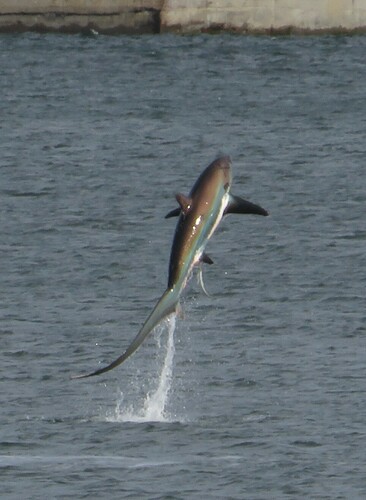
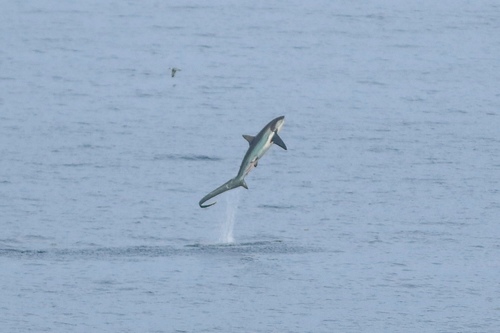
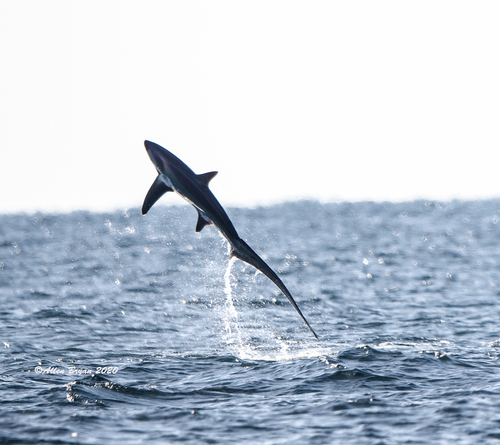
The common thresher shark hunts with its tail, and that is meant literally. The upper lobe of its tail fin is about as long as the entire rest of the animal, and the shark throws it forward over its own head to stun the small fish it eats. Divers in the Philippines filmed the manoeuvre in a close relative, the pelagic thresher: the tip of the tail crossed the shark’s body at an average of 14 metres per second and as much as 21.8, the whole strike took about four tenths of a second, and the water where the tail tip travelled fastest boiled into bubbles.
It is the largest of the three thresher sharks, reaching about 5.7 m and 348 kg, and the only one that is warm-bodied: it keeps its swimming muscles a couple of degrees above the sea, the way a mako or a white shark does. It lives in temperate and tropical seas worldwide, usually over continental shelves rather than far offshore, eating anchovies, sardines, mackerel, hake and squid. Bomb-radiocarbon dating has validated an individual at 38 years old, and litters are tiny — two to four pups, each already well over a metre long at birth.
The IUCN lists it as Vulnerable, and the reason is fishing rather than fear. Because a thresher strikes bait with its tail, it gets hooked by the tail, and a shark dragged backwards through the water cannot breathe — tail-hooked sharks die after release far more often than mouth-hooked ones. It is not dangerous to people: the International Shark Attack File’s list of species confirmed in unprovoked bites, which goes back to 1580, contains no thresher shark at all.
Where it lives
Common threshers live in every ocean, from about 74° N to 58° S, and they reach higher latitudes than either of their two relatives. What they do not do is spread evenly. Despite being classed as a pelagic shark, this is a shelf animal: catches in the central Pacific were virtually nil beyond about 40 miles from land, and north-east Atlantic longlines showed the same. Threshers go where small schooling fish are, and small schooling fish are where the water is shallow and productive.
Where in the water column they sit depends on the time of day and on how old they are. Tagged sharks off southern California spend the night in the top twenty metres and drop below the thermocline during the day, and one shark tracked off eastern Australia reached 640 m — the deepest dive published for the species. Young ones stay much shallower and much closer in. Of the first-year threshers caught across a large north-west Atlantic dataset, 98% came from water less than 50 m deep, and nearly half of all catches were in just 10–25 m. A thresher’s first year or two is spent in water you could paddle a board over.
Temperature is what draws the outline. In the north-east Pacific, tagged sharks sat in surface water of 16–21.7 °C and dipped into 9.1 °C on their daytime dives. In the north-west Atlantic and Gulf of Mexico they have been caught in anything from 4 to 31 °C, but most often between 12 and 18 °C. That tolerance for cool water is the species’ real distinguishing habit — it is why a shark most people picture in the tropics turns up off Cornwall, Nova Scotia and the North Sea.


- Southern California Bight — The best-known thresher ground on earth and the one with the longest paper trail. Pregnant females move up from Baja in spring, pups appear through spring and early summer, and the nursery is thought to run from Point Conception down to Punta Eugenia in Baja California.
- Delaware to Massachusetts, US mid-Atlantic shelf — Where north-west Atlantic threshers appear to pup, between May and June and sometimes into August. Almost every first-year shark in the regional catch record comes from shelf water north of 35° N, which points at the Carolinas and the Mid-Atlantic Bight as the nursery.
- Gulf of Cádiz & north-west Morocco — Spanish surveys found newborns and heavily pregnant females gathered within 40 nautical miles of the coast between May and August, sometimes a few metres off the beach. It is also where driftnets are set for swordfish 1–2 miles out, which is the problem.
- Northern Adriatic Sea — Juveniles turn up in midwater trawls often enough that researchers think the northern Adriatic is a pupping or nursery area. It sits inside the sea where thresher biomass is estimated to have fallen furthest — over 80% in parts of the Adriatic and Ionian.
- Northern New Zealand — Home of the heaviest thresher ever weighed on certified scales, a 348 kg fish taken off the Bay of Islands in 1983. Also the one place where threshers have been watched being hunted themselves: orcas there take sharks of 1.5–3 m.
Where it goes
The north-east Pacific run is the one people can set a calendar by. Adults move north out of Baja California in early spring into the Southern California Bight, where pupping is thought to happen. Sub-adults stay through the summer and work up the coast as far as San Francisco, while adults — mostly males — keep going, reaching Oregon, Washington and even Vancouver Island by late summer. In autumn the whole distribution pulls back south and winters off Mexico. The same seasonal shuffle happens in the north-west Atlantic, where catches are scarce south of 37° N in summer and scarce north of it in winter.
What is surprising is how short those journeys are by pelagic-shark standards. Of 203 common threshers tagged by the US Cooperative Shark Tagging Program, only about 2% were ever recaptured, and the furthest any of them had moved was 271 km — though one was at liberty for eight years. Satellite tags off California recorded 425 km and 446 km in about three months, and the longest journey on record anywhere is 1,556 km in the Indian Ocean. Compare that with a mako crossing an ocean basin. Genetic work backs the impression up: there appear to be at least six distinguishable populations worldwide, which is what you get when a shark stays home. It also means a stock wiped out in one sea will not simply be refilled from the next one.
Share of verified common thresher shark records by month (GBIF, all years). Darker rose means a larger share of sightings fall in that month. This reflects when people record them, which mixes real seasonality with when divers and boats are out.
Southern California Bight: Built from California’s own fishery record rather than from sightings. Pregnant females and pups show up from March, recreational catches peak May through August, and the population pulls south again through autumn to winter off Mexico. The state closes the drift gillnet fishery entirely from 1 February to 30 April, and keeps it more than 75 miles offshore from 1 May to 14 August, precisely because that is when the big females are inshore.
What it eats
A thresher eats small fish in large numbers. Stomachs from the California drift gillnet fishery held food from twenty different groups, but the pattern was simple: Pacific whiting north of Point Conception, anchovies south of it, plus sardines, Pacific mackerel, squid and pelagic red crabs. In the north-east Atlantic pelagic fish made up 97% of the diet by occurrence. In southern Australia, seventeen stomachs with anything in them held nothing but anchovies and sardines. The teeth fit the menu — small, smooth-edged, the same shape top and bottom, a mouth for gripping fish rather than cutting chunks out of anything large.
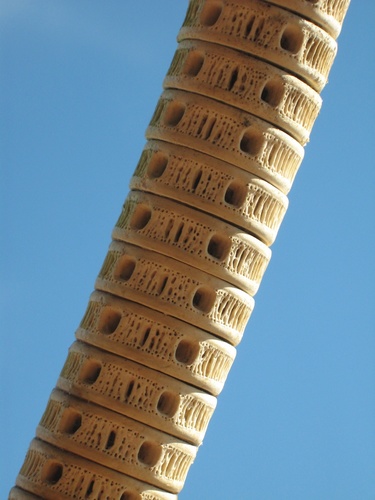
The tail is how the fish get caught. The upper lobe of the caudal fin is about as long as the rest of the shark, and instead of only pushing water it can be thrown forward over the shark’s own head, like cracking a whip the wrong way. The shark comes at a bait ball, brakes with its pectoral fins, pitches its body down and flings the tail over the top; the strike stuns or kills several fish at once and the shark turns round and collects them. It is not a figure of speech and it is not a swipe — it is a specific, repeatable, overhead movement, and the spine is built for it. A thresher has 339–364 vertebrae, and a 2024 micro-CT study found that the ones behind the body are shaped and mineralised differently from the ones in front, which is what you would expect in a backbone that has to bend up and down hard in an animal that otherwise swims side to side.
Is it dangerous?
A thresher carries the most conspicuous weapon of any shark and is, as far as anybody can show, harmless to people. The Florida Museum’s International Shark Attack File keeps a table of every species ever confirmed in an unprovoked bite, running back to 1580, and no thresher of any kind appears on it. The reasons are not mysterious. The tail is a tool for herding and stunning small schooling fish, aimed at a bait ball; the mouth behind it is small and its teeth are little, smooth and blunt-cusped. Threshers are shy of divers, they mostly work the outer shelf, and nothing about a swimmer resembles a sardine school. Give one room, as you would any large wild animal, and there the problem ends.
Everything dangerous about this relationship runs the other way, and the tail is the reason. Because a thresher hits bait with its tail before eating it, it hooks itself by the tail — commonly on longlines, and so routinely on rod and reel that some California anglers target a tail hook-up on purpose. A shark hauled backwards cannot breathe: threshers must swim forward to push water over their gills. When researchers tagged released sharks and watched what happened, all seven that had been hooked in the mouth were still alive ten days later, and only three of nine tail-hooked sharks were. California’s own fishery is the cautionary history: drift gillnetting took off in the late 1970s, peaked in 1981, and by the late 1980s whole size classes had stopped appearing in the landings. Closures followed, the fleet switched to swordfish, and the stock has been rebuilding since about 2006 — the 2018 assessment found it neither overfished nor subject to overfishing. That is a rare good ending, and it took forty years.
Common thresher shark facts
- The tail-slap has been filmed properly once. Divers recorded pelagic threshers — the common thresher’s close relative — hunting sardines at Pescador Island in the Philippines, and analysed 25 hunting events. Twenty-two were overhead tail-slaps. The tail tip crossed the shark’s body at 14.03 ± 1.01 m/s, peaking at 21.82 m/s, the strike lasted 0.39 seconds, and a successful shark ate 3.6 sardines on average and up to seven. Bubbles formed in the water where the tip moved fastest. — Oliver et al. 2013, PLOS ONE
- Common threshers do the same thing, and it was watched off southern California between March 2007 and June 2009. Across 27 sampling runs, of 33 sharks that came to a tethered bait, 14 hit it with their tails — 29 strikes in all. No instrument has ever measured the tail speed of a common thresher. — Aalbers, Bernal & Sepulveda 2010, Journal of Fish Biology
- Hooking a thresher by the tail is very likely to kill it. Researchers fitted archival tags to released sharks from the California recreational fishery: all seven that had been hooked in the mouth were alive at least ten days later, while only three of the nine hooked in the caudal fin survived. Threshers are obligate ram ventilators — dragged backwards, they cannot pass water over their gills. — Sepulveda et al. 2015, via the ICCAT species manual
- Of the three thresher species, only this one is warm-bodied. Its red swimming muscle sits next to the backbone instead of under the skin, fed by heat-exchanging blood vessels the other two threshers lack. Measured in live sharks, that muscle averaged 2.33 °C above sea-surface temperature and reached 5.4 °C above it. — Bernal & Sepulveda 2005; Patterson, Sepulveda & Bernal 2011
- A thresher’s backbone has 339–364 vertebrae. A 2024 micro-CT study of embryo, juvenile and adult sharks found the vertebrae behind the body differ in shape and mineral structure from those in front — the anatomical bill for a tail that has to be thrown up and over rather than only swept side to side. — Compagno via ICCAT; Knaub et al. 2024, Royal Society Open Science
- Nobody agreed how old these sharks get until the bombs helped. Counting growth bands in the vertebrae gave 22–24 years, but bomb-radiocarbon dating validated a 38-year-old and showed band counts start underestimating age above about 14 years. The 50 years still widely quoted is an extrapolation from a 1983 growth curve, not a shark anyone aged. — Natanson et al. 2015; Smith et al. 2008
- California’s thresher fishery is a full boom-and-bust in one lifetime. Drift gillnetting began in the late 1970s and peaked in 1981, when 113 boats landed nearly 600 short tons; all gears combined took more than 1,700 short tons in 1982. Entire size classes vanished from the landings by the late 1980s. After closures, annual landings have stayed under 200 short tons since 2004, and the 2024 West Coast commercial catch was 63,000 pounds. — CDFW Status of the Fisheries 2008; NOAA Fisheries
- Thresher pups are enormous and there are hardly any of them. A litter is almost always two to four — rarely as many as seven — and each pup is born between 1.2 and 1.6 m long, having eaten its mother’s unfertilised eggs to get that big. A newborn thresher is already longer than a small-spotted catshark ever gets. — ICCAT species manual; FishBase
Photos
Seen lately
PierMonkey’s live map carries community shark sightings from iNaturalist, refreshed every three hours. Open the map to see where common thresher sharks have turned up recently.
How big is that, really?
Maximum reliably recorded length. Rose marks the large or potentially dangerous species the map flags as notable.
Help protect it
- NOAA Fisheries — Pacific common thresher sharkThe US West Coast management page: current stock status, the 2018 assessment that found the stock neither overfished nor subject to overfishing, and the gear and area rules that apply. Check it before you fish, and read the bycatch section before you buy.
- California shark fishing regulations (CDFW)California’s current shark rules, including the two-fish bag limit on threshers. If you fish for them, the research on this page argues for one change of habit: fish for a mouth hook-up, not a tail hook-up, and get the shark to the boat fast — long fights kill big threshers after release.
- Sharkipedia — Alopias vulpinusEvery published growth, size and maturity figure for this species with the paper it came from. Good for checking our numbers, good for a school project, and open for researchers to add new records.
Report what you see
Photograph a shark, upload it, and once the community confirms the ID it becomes a research-grade record — which is where every sighting on our map comes from. Yours would appear here within three hours.
How to submit an observation →Organisations working on sharks like this one
- The Shark Trustgood for kidsReport eggcases and sightings, join campaigns, download free ID guides.
- Great Eggcase Huntgood for kidsWalk a beach, find a mermaid’s purse, log it. Over 630,000 eggcases recorded since 2003 — the easiest real science a family can do.
- Sharks4Kidsgood for kidsFree classroom lessons, virtual field trips and activity packs for teachers and parents.
- Save Our Seas FoundationFunds shark research and education worldwide; publishes what each project found.
- Shark StewardsCampaigns to end the shark fin trade and establish shark sanctuaries.
- OceanaPolicy campaigning on fisheries management and bycatch — the thing that actually kills sharks.
- IUCN Shark Specialist GroupThe scientists behind the Red List assessments. For older readers who want the primary source.
Conservation status: Vulnerable (IUCN Red List, assessed 2022). Vulnerable. The page linked here is the 2022 amended version of the global assessment by Rigby and colleagues, first published in 2019 from a November 2018 assessment; the listing itself has not changed. The concern is fishing pressure across a range that is almost entirely fished: one analysis of pelagic shark and ray abundance puts the global decline of this species near 60% since the 1970s, and Mediterranean biomass in some basins down more than 80%. Regional assessments call it Endangered in the Mediterranean and the north-east Atlantic and Near Threatened in Australia. All three thresher species went onto CITES Appendix II at the 2016 Conference of the Parties, with the listing taking effect on 4 October 2017, and onto Appendix II of the Convention on Migratory Species. Read the assessment →
Common questions
How does a thresher shark use its tail to hunt?▾
Why is the thresher shark’s tail so long?▾
Are common thresher sharks dangerous to people?▾
Why do thresher sharks get hooked in the tail?▾
Is the common thresher warm-blooded?▾
Is the common thresher recovering off California?▾
Keep exploring
- Huntington Beach, California — live surf conditions
- Blacks Beach, California — live surf conditions
- Cape Hatteras, North Carolina — live surf conditions
- Ditch Plains, Montauk — live surf conditions
- All 40 species →
Sightings © iNaturalist contributors (research-grade observations). Occurrence maps © GBIF.org contributors (CC BY). Community science, not a beach-safety service. Last updated 2026-09-20.
See where sharks are turning up — on the live map
The map and live conditions are open to everyone. A free account unlocks full 16-day forecasts and custom swell alerts.