
Bull shark
The one big shark that can swim up a river and stay there — because it can rewrite its own body chemistry.
Vital statistics
Live birth after 10–11 months; 1–13 pups (usually 6–8), each 56–81 cm long, dropped in estuaries and river mouths.
The short version
The bull shark is a thickset coastal requiem shark that reaches about 4 metres and 316 kg, with most adults between 2.1 and 3 metres. It lives in warm, shallow water all around the world, usually shallower than 30 metres, and it is the one large shark that moves freely between the sea and fresh water. Individuals have been recorded roughly 3,700 km up the Amazon, about 2,800 river kilometres up the Mississippi, far up the Zambezi, and in Lake Nicaragua.
It does that by changing its own body chemistry as the water changes. Sharks normally keep their blood about as salty as the sea by loading it with a chemical called urea. A bull shark heading up a river lets that urea go, makes enormous amounts of very watery urine — the Shark Trust puts it at more than twenty times what it produces at sea — and turns down its rectal gland, the small salt-dumping organ at the end of its gut. Heading back out to sea, it reverses all three. Measured in young sharks, the concentration of their blood falls from about 940 to about 595 mOsm on the way in, and climbs back on the way out.
Adults eat mostly bony fish, smaller sharks and rays. Females give birth in estuaries and river mouths after 10–11 months, and the pups stay in that brackish water for years, where bigger sharks cannot follow them. The IUCN assessed the species as Vulnerable in 2021, and since November 2023 all requiem sharks, this one included, are on CITES Appendix II.
Where it lives
Bull sharks turn up in warm coastal water in every ocean: Massachusetts down to southern Brazil in the western Atlantic, Morocco to Angola in the east, right through the Indian Ocean and the western Pacific, and from Baja California to Ecuador on the American Pacific coast. What unites that list is not an ocean basin but a habitat. They want warm, shallow, often murky water over sand and mud, usually inside the 30-metre contour, and very often at the mouth of a river. FishBase and the 2021 Red List assessment agree the deepest records reach 164 metres, but that is the exception rather than the rule.
The part of the range that no other large shark shares is the freshwater part. Bull sharks have been recorded roughly 3,700 km up the Amazon, as far inland as Iquitos in Peru; about 2,800 river kilometres up the Mississippi, where one was netted at Alton, Illinois in 1937; well up the Zambezi, which is why southern Africa calls them Zambezi sharks; and in Lake Nicaragua, 190 km from the sea at the top of a river with rapids in it. They also go the other way, tolerating hypersaline lagoons up to 53 parts per thousand — saltier than the open sea.
Temperature, not salinity, is what actually fences them in. Young bull sharks leave Florida’s Indian River Lagoon once the water drops below about 20 °C, and seven years of acoustic tracking in Sydney Harbour found them present between 20 and 26 °C with abundance peaking at 24 °C. That boundary is a moving one: the same Sydney dataset, extended to 2024, shows big migratory bull sharks leaving their summer estuary about a day later with every passing year.


- Indian River Lagoon & Mosquito Lagoon, Florida — The most important bull shark nursery on the US Atlantic coast. A 30-year synthesis logged 449 sharks here, overwhelmingly pups and juveniles that stay until roughly nine years old.
- Sydney Harbour & the New South Wales coast — A temperate estuary used as a summer ground. Tagged sharks arrive with the warm water, peak in January and February, and are gone by July.
- Lake Nicaragua & the Río San Juan — The population that gave the species its Nicaraguan name. Tagging in the 1960s and 70s proved the lake sharks are not trapped — they run the river’s rapids in both directions.
- Breede Estuary, South Africa — A 4.0-metre female caught and acoustically tracked here in 2009 is the largest bull shark ever measured, and pushed the known range 366 km further south than anyone expected.
- Beqa Lagoon, Fiji — A long-running aggregation at the Shark Reef Marine Reserve where researchers have identified and followed 184 individual bull sharks.
Where it goes
Bull sharks are not ocean-crossers in the way great whites are. They shuttle along coastlines, following warm water up and down the shelf, and the best-documented example is Sydney Harbour. Forty sub-adult and adult sharks tracked over seven years used the harbour through the austral summer and autumn, peaked in January and February, and were completely absent between July and October — spending those months at lower latitudes, with some detected on the Great Barrier Reef. Seventy per cent came back to the same harbour in at least one later year, and more than a quarter returned every single year they could have.
Juveniles do something different and, for a shark, quite unusual: they barely migrate at all. Pups born in an estuary stay in and around it for years — in the Indian River Lagoon until about age nine — making only short seasonal moves, such as retreating to warm-water outflows when the lagoon cools. Only once they are big enough to be safe do they move out into adult coastal habitat and start the long north–south commute.
Share of verified bull shark records by month (GBIF, all years). Darker rose means a larger share of sightings fall in that month. This reflects when people record them, which mixes real seasonality with when divers and boats are out.
Sydney Harbour, New South Wales: Seven years of acoustic monitoring: present through the austral summer and autumn, peaking in January and February, and completely absent from July to October (Smoothey et al. 2019).
What it eats
Bull sharks are generalists, and the list of what has been found inside them is long: mullet, catfish, tarpon, jacks and other bony fish first and foremost, then smaller sharks and stingrays, sea turtles, crabs and mantis shrimps, squid, sea snails, sea urchins, the occasional dolphin, and carrion when it turns up. A shark that hunts in water you cannot see through does better by eating whatever it bumps into than by specialising.
The hardware matches the menu. For its size, the bull shark bites harder than any other cartilaginous fish yet measured — harder, pound for pound, than a white shark or a great hammerhead — with a 2.85-metre individual modelled at 5,914 newtons at the back teeth. Broad, triangular, serrated upper teeth do the cutting while narrower lower teeth hold on, which is what lets a mid-sized shark deal with armoured prey like turtles and rays. What it is not is fast: no burst speed has ever been properly measured, and the figure FishBase actually documents is endurance rather than sprint — around 180 km covered in 24 hours.
Is it dangerous?
Bull sharks are often called the most dangerous shark in the sea. The record behind that claim is real; the reasoning behind it usually runs backwards. The International Shark Attack File, counting from 1580 to now, attributes 119 unprovoked bites to bull sharks, 26 of them fatal — third behind white sharks (351) and tiger sharks (142). Set that against the scale: worldwide there were 65 confirmed unprovoked bites in 2025 against a five-year average of 61, with nine unprovoked fatalities and a five-year average of about eight. The reason bull sharks feature at all is overlap, not temperament. They are large, they are common, and they live in warm, shallow, murky water and in rivers — which is a precise description of where people swim. ISAF adds a caveat worth keeping: requiem sharks are hard to identify in murky water, so this species is both over-blamed in some reports and missed entirely in others.
The practical advice is unglamorous and it is mostly about conditions. Along the New South Wales coast, bull sharks were detected at beaches more often when the water was above 20 °C, after more than 45 mm of rain, and when the swell ran between 1.8 and 2.8 metres — so the brown, freshly flushed river-mouth session a couple of days after a big downpour is the one to think twice about. Stay out of discoloured runoff, avoid dawn, dusk and night, keep clear of people fishing and of baitfish working the surface, and surf with other people. Then keep hold of the reverse comparison: tens of millions of sharks are killed every year by fishing, mostly as bycatch, this species is assessed as Vulnerable, and the estuaries its pups cannot do without are being dredged, drained and polluted. We are far more dangerous to bull sharks than they are to us.
Bull shark facts
- A bull shark rebuilds its own chemistry to enter fresh water: it sheds urea, its kidneys pump out over twenty times more urine than at sea, and its rectal gland — the organ that dumps excess salt — is turned down. Blood concentration in juveniles falls from around 940 mOsm in seawater to around 595 mOsm in fresh. — Pillans et al. 2005; The Shark Trust
- One was caught in the Mississippi at Alton, Illinois in 1937, about 2,800 river kilometres from the Gulf of Mexico — still the farthest inland record on that river, and re-examined and confirmed in 2021. — Thomerson et al. 1977; Shell & Gardner 2021
- The Florida Museum puts the Amazon record at 3,700 km upstream, near Iquitos in Peru; other accounts round the same journey up to 4,000 km. Either way it is the deepest freshwater penetration known for any shark. — Florida Museum ISAF
- Lake Nicaragua’s sharks are not a landlocked freshwater species, as was believed for a century. Tagging between 1966 and 1972 recorded sharks running the full length of the Río San Juan in both directions, rapids and all. — Thorson 1971
- Pound for pound the bull shark has the strongest bite of any cartilaginous fish measured — ahead of the white shark and the great hammerhead. A 2.85 m individual was modelled at 5,914 N at the rearmost teeth. — Habegger et al. 2012
- The largest bull shark ever measured was a 4.0 m female caught in the Breede Estuary, South Africa in January 2009. Tracked for 43 hours, she ran 20 km up the river and briefly out to sea, and extended the known range 366 km southward. — Dicken 2009, African Journal of Marine Science
- Florida’s Indian River Lagoon is the most significant bull shark nursery on the US Atlantic coast. Thirty years of records covering 449 sharks show juveniles using it until roughly age nine before moving offshore. — Curtis, Adams & Burgess 2011
- Along New South Wales beaches, bull sharks were detected more often when the water was warmer than 20 °C, after more than 45 mm of rain, and when swell ran 1.8–2.8 m — conditions a surfer can check before paddling out. — Smoothey et al. 2023
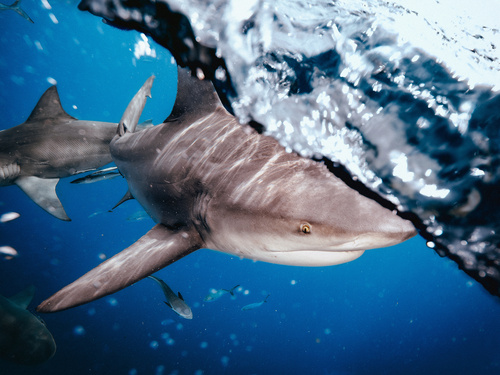
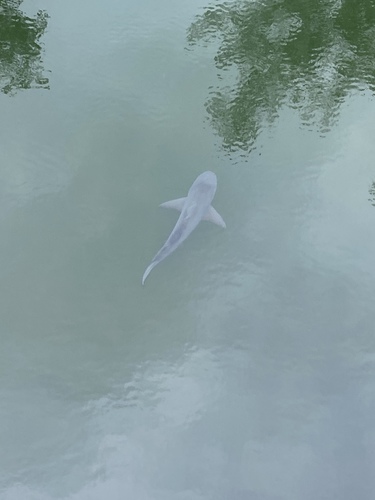
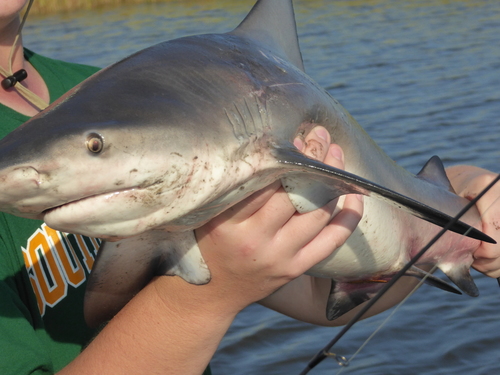
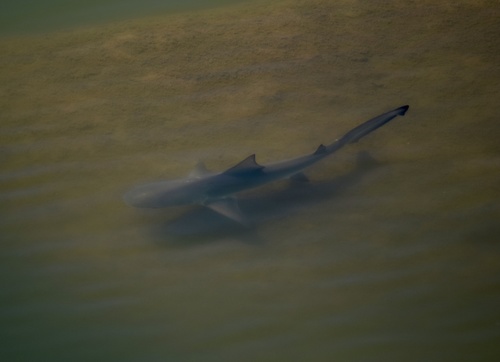
Photos
Seen lately
PierMonkey’s live map carries community shark sightings from iNaturalist, refreshed every three hours. Open the map to see where bull sharks have turned up recently.
How big is that, really?
Maximum reliably recorded length. Rose marks the large or potentially dangerous species the map flags as notable.
Help protect it
- NOAA Cooperative Shark Tagging ProgramAnglers can request free dart tags, tag and release the sharks they catch, and report any tagged shark they land. Recaptures are what the age and growth numbers on this page are built from.
- FWC: shark fishing rules, FloridaThe free shore-based permit and course, the non-offset circle-hook rule and the keep-it-in-the-water release rules — aimed squarely at the inlets and river mouths where bull sharks actually are.
- Save Our Seas Foundation: Zambezi sharksThe Breede River bull shark project, written up post by post. Its findings fed directly into the 2013 fishing ban on that estuary.
Report what you see
Photograph a shark, upload it, and once the community confirms the ID it becomes a research-grade record — which is where every sighting on our map comes from. Yours would appear here within three hours.
How to submit an observation →Organisations working on sharks like this one
- The Shark Trustgood for kidsReport eggcases and sightings, join campaigns, download free ID guides.
- Great Eggcase Huntgood for kidsWalk a beach, find a mermaid’s purse, log it. Over 630,000 eggcases recorded since 2003 — the easiest real science a family can do.
- Sharks4Kidsgood for kidsFree classroom lessons, virtual field trips and activity packs for teachers and parents.
- Save Our Seas FoundationFunds shark research and education worldwide; publishes what each project found.
- Shark StewardsCampaigns to end the shark fin trade and establish shark sanctuaries.
- OceanaPolicy campaigning on fisheries management and bycatch — the thing that actually kills sharks.
- IUCN Shark Specialist GroupThe scientists behind the Red List assessments. For older readers who want the primary source.
Conservation status: Vulnerable (IUCN Red List, assessed 2021). Assessed as Vulnerable (Rigby et al. 2021). The picture is regional: the assessment describes the Northwest Atlantic population as increasing under US management and the South African population as decreasing, largely through habitat degradation. Since 25 November 2023 every requiem shark, this one included, is listed on CITES Appendix II, so international trade in its fins and meat now requires permits. Read the assessment →
Common questions
Can bull sharks live in fresh water?▾
How far up a river has a bull shark been found?▾
How big do bull sharks get?▾
Why do baby bull sharks live in rivers and estuaries?▾
Are bull sharks dangerous to people?▾
Are bull sharks endangered?▾
Keep exploring
- New Smyrna Beach, Florida — live surf conditions
- Sebastian Inlet, Florida — live surf conditions
- The Pass, Byron Bay — live surf conditions
- All 40 species →
Sightings © iNaturalist contributors (research-grade observations). Occurrence maps © GBIF.org contributors (CC BY). Community science, not a beach-safety service. Last updated 2026-09-20.
See where sharks are turning up — on the live map
The map and live conditions are open to everyone. A free account unlocks full 16-day forecasts and custom swell alerts.