
Brown-banded bamboo shark
The shark most people have already met — a metre of patient brown bottom-dweller that hatches out of an egg case in half the world’s aquariums and can sit out a low tide on almost no oxygen.
Vital statistics
Egg-laying, and prolifically. Eggs are laid in pairs on the bottom in flattened, elongated capsules — the Florida Museum measures them at roughly 11 x 15 cm. Embryos live entirely on yolk and take about 118 days to hatch at 25 °C, close to the Florida Museum’s "up to four months", emerging at 13-17 cm long and wearing their bands. In aquariums females lay all year round: six females at one Australian facility produced 692 eggs in a single year, of which about one fifth were viable.
The short version
The brown-banded bamboo shark is a small, slow, bottom-living carpet shark of the shallow Indo-West Pacific — India and the Andamans east to the Philippines, north to Japan and south to northern Australia, from the intertidal zone down to 85 m. The Florida Museum gives a maximum length of 104 cm; FishBase and the Australian Shark and Ray Report Card both put it at at least 132 cm. Juveniles are boldly barred in dark brown, which is where the name comes from, and the bands fade as the shark grows until an adult is plain light brown — the same growing-up trick that gets the zebra shark called a leopard shark, and the reason people are forever told they have identified the wrong animal.
It is almost certainly the shark you have already seen. Public aquariums keep it everywhere because it is small, calm and extraordinarily hardy, and because it lays eggs all year without any encouragement: six females at one Australian facility laid 692 eggs in a single year. Those eggs turned the species into a laboratory animal as well as an exhibit. A Japanese aquarium supplied the tissue for the first brown-banded bamboo shark genome in 2018, and the same year a 38-stage table of its embryonic development was published, built on embryos that hatch in about 118 days at 25 °C. If you have ever seen a shark embryo wriggling inside a backlit egg case, it was probably one of these.
It is also tough in a way almost no other shark is. It lives in tide pools, survives up to 12 hours out of water by Compagno’s account, and tolerates water with essentially no oxygen in it for long enough to be studied alongside the epaulette shark, the textbook anoxia specialist. And it is still Near Threatened, assessed in 2023, because none of that helps against a gillnet: inshore fisheries across Southeast Asia catch and keep it in numbers nobody counts. Australia, where it is bycatch released alive, rates the same shark Least Concern. Being easy to buy in a shop and being fine in the wild are two entirely different questions.
Where it lives
The brown-banded bamboo shark lives around the warm edges of the Indo-West Pacific and nowhere else. FishBase draws the box as 34°N to 26°S and 78°E to 155°E: India and the Andaman Islands east through Thailand, Malaysia, Singapore, Indonesia and Viet Nam to the Philippines, north past Taiwan and China to southern Japan, and south across southern New Guinea to northern Australia. Everything about that range is coastal. It is a bottom shark of nearshore reefs, tidal flats, seagrass, sand and mud, recorded from the intertidal zone down to 85 m and spending most of its life far shallower than that — in crevices by day, out over the sediment at night, and often in tide pools that other sharks would not survive.
Australia holds the best-documented end of it. The species runs from the Sandon River in New South Wales around the tropical north to Shark Bay in Western Australia, and it is not targeted by any Australian fishery: it turns up as bycatch in prawn and fish trawls and inshore nets, and is generally thrown back alive. That shows up in the occurrence records too. Of the 1,475 georeferenced records in GBIF, 736 are Australian, with Malaysia, Indonesia and Papua New Guinea next. That is a map of who keeps records, not of where the sharks are — the countries that catch the most of them are the ones reporting fewest.
It is also possible that the range is not one shark. A DNA survey of sharks and rays published in 2012 found evidence that the Australian form is a cryptic sister-species to the Southeast Asian one, identical to look at and separate underneath, and the question is still open. Work on Malaysian waters published in 2021 found high genetic diversity and real differentiation between sampling areas within a single country. Both point the same way: a shark this sedentary builds up local populations that do not mix much, which is fine until one of them is fished out and nothing arrives to refill it.


- Inshore Queensland and the Great Barrier Reef lagoon, Australia — Shallow reef flats, seagrass and estuary mouths along the Queensland coast, where the species is common and almost entirely left alone. It is caught as bycatch in the East Coast trawl and inshore net fisheries and released, which is the main reason the Australian assessment comes out Least Concern.
- The Andaman Sea and the Gulf of Thailand — The other side of the same species. Here it is a retained catch, sold for meat in the inshore fisheries of Thailand and India, and the reef habitat it depends on is also being damaged by blast and cyanide fishing. Two of the tapeworms described from this shark were collected from an animal on a Thai fish-market slab.
- Sabah, Sarawak and the Malaysian coast — The best-sampled genetics in the species’ core range. A 2021 study of Malaysian waters found high genetic diversity but clear differentiation between areas — evidence that these are separate local populations rather than one pool of sharks moving freely along the coast.
- The Gulf of Papua, Arafura Sea and Java Sea — Heavily trawled shelf seas either side of the Indonesian archipelago, and the place the global assessment is really about. The species is taken in moderate numbers as trawl bycatch off southern Papua New Guinea, and extensive trawling in the Arafura and Java Seas is expected to be hitting it hard.
Where it goes
This is a shark that goes nowhere, and saying so is the honest answer. No satellite or acoustic tracking study has been published for the species, there is no known migration, no aggregation site and no seasonal run. What evidence exists is genetic, and it points firmly at animals that stay put: strong differentiation between sampling areas inside Malaysian waters, and an unresolved suggestion that the Australian population is a separate species altogether. Sharks that swim between places do not accumulate differences like that.
The movement that matters here is measured in metres and hours rather than kilometres. When a reef flat drains on a spring low, a brown-banded bamboo shark does not follow the water out — it stays in the pool, or under a rock, and waits the tide out as the oxygen falls away, sometimes out of the water entirely. That is a strategy, not an accident: it keeps the shark in a larder everything else has had to abandon. The only long-distance travel this species does is in a box. Eggs and sharks move between aquariums and laboratories on three continents, which is how a Japanese aquarium came to supply the tissue for the first bamboo shark genome and a San Francisco aquarium came to document the longest sperm storage recorded in any shark.
Share of verified brown-banded bamboo shark records by month (GBIF, all years). Darker rose means a larger share of sightings fall in that month. This reflects when people record them, which mixes real seasonality with when divers and boats are out.
What it eats
Nothing about this shark is built for a chase. The mouth is small and set well forward under a rounded snout, with a pair of short barbels hanging in front of it, and the eyes sit high with large spiracles behind them so the shark can pump water over its gills while its face is buried. It feeds at night, working over sand and mud, excavating the sediment and using the barbels to feel for whatever is under it. A study of Australian animals found the diet to be crabs, polychaete worms, shrimps and small fishes; FishBase sums it up as bottom invertebrates and small fish, which is the same list with less detail.
Eating slow, buried prey pairs neatly with the rest of the animal. A shark that does not chase anything does not need much oxygen, and a shark that does not need much oxygen can feed on a reef flat at night, when the corals and seagrass stop producing oxygen and start consuming it and the water in a cut-off pool goes stale. Most fish have to leave. This one keeps turning over crabs in water that has become uninhabitable for its competitors — about the best deal a slow metre-long shark could hope for.
Is it dangerous?
Brown-banded bamboo sharks are harmless to people. FishBase files the species under "harmless", the Florida Museum calls it harmless with the sensible caveat that it may nip a diver who provokes it, and it does not appear at all in the International Shark Attack File’s table of species implicated in confirmed unprovoked bites. In practice the risk runs the other way round: this is the shark in the touch pool, and the one being handled is the shark. If an aquarium invites you to touch one, two fingers along the back, never near the head, gills or tail, and never lift it. In the wild, a bamboo shark wedged under a rock is doing exactly what it should be, so leave it there.
The pressure on the species is a fishing story, and it splits along a line on the map. Across India, Thailand, Malaysia, Singapore, Indonesia and the Philippines it is caught and kept for meat, mostly by demersal gillnets, longlines and trawls working exactly the shallow inshore ground it lives on, while destructive fishing on reefs removes the habitat as well. In Australia it is nobody’s target, comes up as trawl and net bycatch, and mostly goes back over the side alive. That is the whole reason one shark is Near Threatened globally and Least Concern in Australian waters. The aquarium trade — the part most readers have actually touched — is rated a minor threat, not because collectors are careful but because the species breeds so readily in captivity that taking wild ones is barely worth the trouble.
Brown-banded bamboo shark facts
- The name belongs to the babies. Young sharks carry dark transverse bands and a scattering of dark spots; adults are plain light brown with, at most, a ghost of the pattern left. The species name punctatum is Latin for "spotted" and refers to those spots on young specimens, so both halves of the name describe a shark that has since grown out of them. — Florida Museum species profile / FishBase (short description, etymology)
- It can survive up to 12 hours out of water. The figure comes from Compagno’s 1984 FAO shark catalogue and is carried by FishBase; the Florida Museum puts it more cautiously as "several hours" and adds that the species is regularly found in tide pools and tolerates low oxygen for extended periods. — FishBase (Compagno 1984, FAO Species Catalogue) / Florida Museum species profile
- Its anoxia tolerance is real but not quite epaulette-shark class. In a direct comparison at three seasonal temperatures, the two species lasted about equally long in water with no oxygen at 23 °C, but the bamboo shark did significantly worse at 25 and 27 °C — and unlike the epaulette shark it never slowed its breathing to save energy, instead over-breathing once the oxygen came back. — Chapman, Harahush & Renshaw 2011, Fish Physiology and Biochemistry
- A female at the Steinhart Aquarium in San Francisco produced a pup from sperm she had been storing for 45 months — the longest documented case of sperm storage in any shark. Genetic analysis confirmed a stored-sperm fertilisation rather than a virgin birth. — Bernal et al. 2015, Journal of Fish Biology
- It was one of the first sharks to have its genome sequenced. The 2018 study that produced de novo assemblies for the brown-banded bamboo shark and the cloudy catshark, plus an improved whale shark genome, recovered Hox C genes that elasmobranchs had been thought to have lost entirely. The bamboo shark genome runs to roughly 4.7 billion base pairs. — Hara et al. 2018, Nature Ecology & Evolution
- Its embryos can tell a predator is nearby and hold still. Inside the egg case, embryos exposed to an electric field mimicking a predator stopped their respiratory gill movements — an innate freeze response in an animal that has not hatched yet, and one being studied as a basis for shark repellents. — Kempster, Hart & Collin 2013, PLoS ONE
- It lays eggs all year in captivity, in quantity. Six females at one Australian facility produced 692 eggs in a single year, of which about one fifth were viable — the reason aquariums can supply both their own exhibits and a steady stream of embryos to laboratories. — Harahush, Fischer & Collin 2007, Journal of Fish Biology, via the Australian Shark and Ray Report Card 2023
- The Australian sharks may not be the same species. A DNA-based survey of sharks and rays found evidence that the Australian form is a cryptic sister-species of the Southeast Asian one — which would mean the sustainable Australian population and the heavily fished Asian population are not two ends of one stock at all. — Naylor et al. 2012, Bulletin of the AMNH, via the Australian Shark and Ray Report Card 2023
Photos
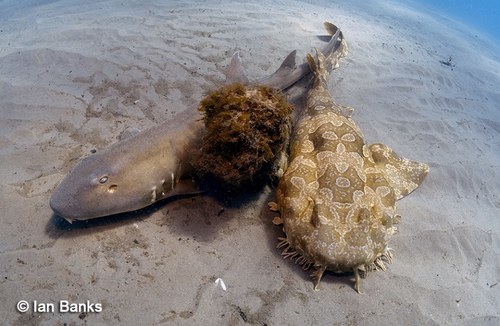
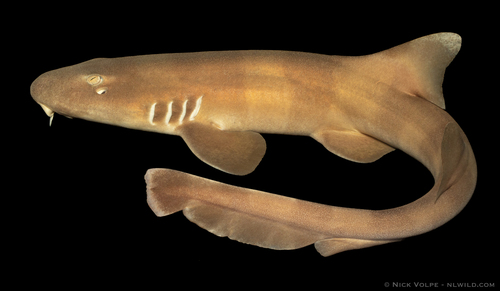
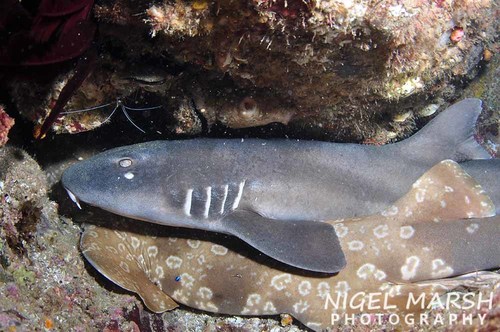
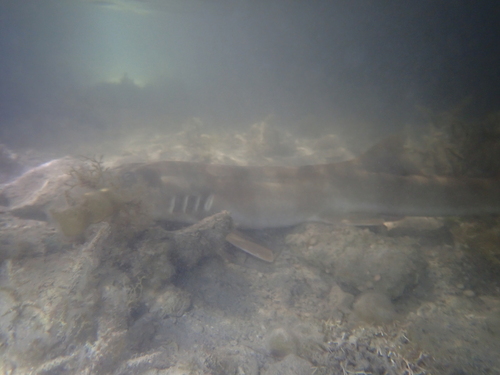
Seen lately
PierMonkey’s live map carries community shark sightings from iNaturalist, refreshed every three hours. Open the map to see where brown-banded bamboo sharks have turned up recently.
How big is that, really?
Maximum reliably recorded length. Rose marks the large or potentially dangerous species the map flags as notable.
Help protect it
- Australian Shark and Ray Report CardLook up "Brownbanded Bambooshark" and you get the two-page card this entry leans on: Sustainable in Australia, Least Concern in Australian waters, Near Threatened globally, with the catch and biology behind each call. Every Australian shark and ray has one, which makes it the fastest way to check a claim — your own, a fisher’s or a headline’s — before you repeat it.
- Shark GuardianA UK-registered charity that runs shark education in schools and dive centres — over 20,000 students a year — with much of its work in the Southeast Asian waters where this species is actually under pressure. If you are diving in the region, their eOcean citizen science turns your logged dives into sighting data, and their campaigns are where the fin-trade side of this gets fought.
- ReSharkThe coalition putting aquarium-bred sharks back into Indo-Pacific reefs, with more than a hundred partner institutions. It is the best argument that a breeding tank can be worth something to a wild population — and a good question to ask at the desk of whichever aquarium you next see a bamboo shark in: what happens to the eggs?
Report what you see
Photograph a shark, upload it, and once the community confirms the ID it becomes a research-grade record — which is where every sighting on our map comes from. Yours would appear here within three hours.
How to submit an observation →Organisations working on sharks like this one
- The Shark Trustgood for kidsReport eggcases and sightings, join campaigns, download free ID guides.
- Great Eggcase Huntgood for kidsWalk a beach, find a mermaid’s purse, log it. Over 630,000 eggcases recorded since 2003 — the easiest real science a family can do.
- Sharks4Kidsgood for kidsFree classroom lessons, virtual field trips and activity packs for teachers and parents.
- Save Our Seas FoundationFunds shark research and education worldwide; publishes what each project found.
- Shark StewardsCampaigns to end the shark fin trade and establish shark sanctuaries.
- OceanaPolicy campaigning on fisheries management and bycatch — the thing that actually kills sharks.
- IUCN Shark Specialist GroupThe scientists behind the Red List assessments. For older readers who want the primary source.
Conservation status: Near Threatened (IUCN Red List, assessed 2023). Near Threatened under criterion A2d — a suspected past population decline driven by fishing. The assessment is dated 19 September 2023 and was published in Red List version 2024-1, which is why it is cited as Rigby et al. 2024; it is still the current listing in version 2025-2. Near Threatened means it came close to qualifying as Vulnerable and did not quite get there, mostly because nobody has the population data to prove the decline. Australia is assessed separately and comes out Least Concern, with the national Shark and Ray Report Card rating the Australian stock Sustainable: there it is discarded bycatch with high survival rather than a catch anyone keeps. Read the assessment →
Common questions
Why is it called a brown-banded bamboo shark if adults are plain brown?▾
Can a bamboo shark really survive out of water?▾
How long does a bamboo shark egg take to hatch?▾
Should I buy a bamboo shark for a home aquarium?▾
Are bamboo sharks safe to touch?▾
What is the difference between a bamboo shark and an epaulette shark?▾
Keep exploring
- Cloud 9, Siargao — live surf conditions
- Keramas, Bali — live surf conditions
- G-Land, Java — live surf conditions
- Noosa, Queensland — live surf conditions
- All 40 species →
Sightings © iNaturalist contributors (research-grade observations). Occurrence maps © GBIF.org contributors (CC BY). Community science, not a beach-safety service. Last updated 2026-09-20.
See where sharks are turning up — on the live map
The map and live conditions are open to everyone. A free account unlocks full 16-day forecasts and custom swell alerts.