
Bonnethead shark
The little shovel-headed hammerhead of American grass flats — and the only shark known to digest plants and live off them.
Vital statistics
Live birth with a placenta after only 4.5–5 months — among the shortest gestations of any shark; 4–14 pups born at roughly 25–33 cm.
The short version
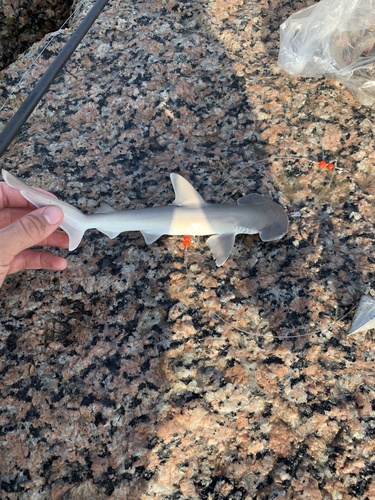
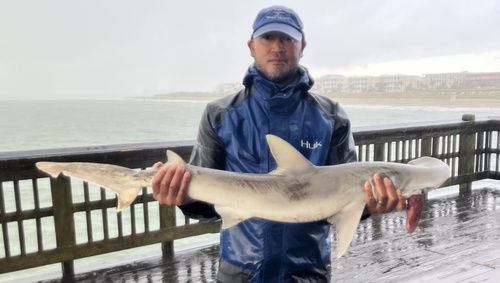
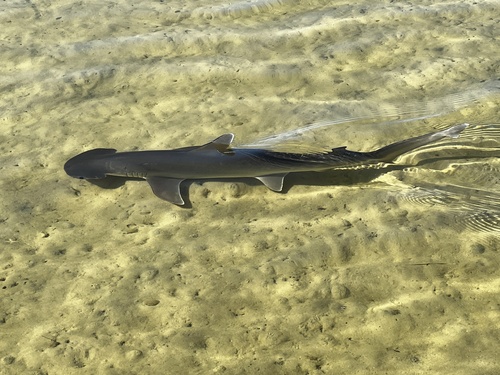
The bonnethead is a small hammerhead of warm, shallow American coasts — usually 0.9–1.2 metres long, 1.5 metres at the very largest and rarely over 10.8 kg. Instead of the wide bar a great hammerhead carries, its head is a smooth rounded blade, more like a garden spade or a bonnet than a hammer, which is where all its names come from. It lives in bays, mangrove channels and seagrass flats from the Carolinas round the Gulf of Mexico and south, and it is the hammerhead ordinary people actually meet: off a pier, from a kayak, or crossing a flat in water barely deep enough to cover it.
It is also the first shark ever shown to be an omnivore. Bonnetheads had long been found with seagrass filling their stomachs — up to 62% of gut contents by mass — and everyone assumed it went in by accident with the crabs. A 2018 experiment fed captive bonnetheads 90% seagrass and 10% squid for three weeks, using seagrass grown with a traceable heavy form of carbon. The sharks digested about half of it, gained weight, and that carbon turned up built into their own tissue. They were not swallowing plants; they were living on them.
Two other things set it apart. Males and females have differently shaped heads — males grow a bulge along the front edge at maturity — the first sexually dimorphic head shape found in any cartilaginous fish. And a female that had never been near a male gave birth in a Nebraska zoo, a case that in 2007 became the first genetic proof of virgin birth in any shark or ray. Despite being one of the most abundant sharks on the American coast, it was listed as Endangered in the IUCN’s 2021 assessment.
Where it lives
Bonnetheads belong to the Americas and to the shallow edge of them. The classic range runs down the western Atlantic from the Carolinas — rarely as far north as Rhode Island — through the Gulf of Mexico and the Caribbean to southern Brazil, with a second arm in the eastern Pacific from southern California to Ecuador. Inside that band they are animals of bays, tidal creeks, mangrove channels and, above all, seagrass meadows. The IUCN gives a depth range of 0–90 metres and FishBase 10–80, but most bonnethead life happens in water you could stand up in, and the Florida Museum puts their preference above 21 °C — the fact that explains most of their year.
That map has just been redrawn. In 2024 a team led by Cindy Gonzalez compared bonnetheads from Belize with bonnetheads from the United States and found they were not the same animal: 80–83 vertebrae in front of the tail against 71–74, mitochondrial and nuclear DNA that separates cleanly, and a more pointed front edge to the head giving it a properly shovel-like outline. The southern sharks are now a species of their own, Sphyrna alleni, and the eastern Pacific form is likewise usually treated now as Sphyrna vespertina, though the same authors say more work is needed there. Sphyrna tiburo in the strict sense is the US, Mexican and Bahamian shark, and FishBase has already narrowed its distribution line to "North Carolina to Belize".
The everyday picture is simpler than the taxonomy. A bonnethead hunts invertebrates over shallow grass flats at night and on the falling tide, pushing up into creeks too small for it at any other state of the tide, and travels in groups of up to about fifteen.


- Florida Bay & the Keys flats — Shallow, clear and carpeted in turtle grass — the seagrass at the centre of the whole story. The sharks used in the digestion experiment were caught here, off Layton in the Keys and off Key Biscayne.
- Tampa Bay, Florida — The research home ground. The University of South Florida in Tampa produced both the study of how a bonnethead crushes a crab and the bite-force measurements showing how little force that crush actually takes.
- The Big Bend, eastern Gulf of Mexico — Florida’s quiet north-west coast is one long shallow grass shelf, and the eastern Gulf of Mexico is where the diet study that first put seagrass at 62% of gut contents was done.
- North Edisto River, South Carolina — The best-documented seasonal population. Forty-four sharks were tagged here and tracked for years; they live in the estuary from April to November and go south for the winter.
- Belize — The edge of the species, in a new sense. Bonnetheads from Belize southwards were described in 2024 as a separate shark, Sphyrna alleni, so this coast is now the boundary rather than the middle of the range.
Where it goes
For a shark barely a metre long, the bonnethead keeps a remarkably tidy calendar. Forty-four of them tagged in the North Edisto River in South Carolina were followed by acoustic receivers along roughly 1,070 km of the US Atlantic coast, some for as long as 2,804 days — over seven years. Most showed strong site fidelity: they held the same estuary from April to November, left as the water cooled, wintered in nearshore water between Georgia and central Florida, and came back to the same river next spring. The Florida Museum describes the same pattern at continental scale — inshore off the Carolinas and Georgia in summer, Florida and the Gulf from spring to autumn, a retreat towards the equator in winter.
The winter address is not fixed, though. Because the same individuals were followed year after year, the researchers could ask whether a warm winter changed a shark’s behaviour, and it did: winter sea-surface temperature affected how far female bonnetheads travelled and the date they arrived. They are going not to a place so much as to a temperature, and that temperature keeps moving.
Share of verified bonnethead shark records by month (GBIF, all years). Darker rose means a larger share of sightings fall in that month. This reflects when people record them, which mixes real seasonality with when divers and boats are out.
North Edisto River, South Carolina: Built from the acoustic-telemetry residency window in Keller et al. 2024 — sharks resident in the estuary April to November — with April and November marked down as the arriving and departing months. A 0 means gone from this estuary, not gone altogether: in January those same sharks are in nearshore water somewhere between Georgia and central Florida.
What it eats
Start with crabs, because the bonnethead’s whole head is built around them. In South Florida its diet is almost entirely blue crabs; elsewhere it adds shrimp, snails, clams, octopus and small fish. Sharp little teeth at the front grab; broad flat molars at the back crush. It runs a crab down, breaks it with an extra jaw-closing phase no ordinary shark bite has, then sucks the pieces back to swallow. What it lacks is power. Bite force runs from about 25.7 newtons at the front of the jaw to 107.9 at the back — for its body mass, the second weakest of any fish yet tested — while blue crab shells need 30 to 490 newtons to break. Plenty of the crabs on a grass flat are simply too strong for it.
Then there is the grass. Bonnetheads had been turning up with stomachs full of seagrass for decades — one eastern Gulf of Mexico diet study put it at up to 62% of gut contents by mass — and the explanation was always that they swallowed it by accident while grabbing crabs out of it. As the 2018 paper that settled the question put it, science had "largely dismissed seagrass ingestion by this shark as incidental intake". The test was direct: captive bonnetheads fed 90% seagrass and 10% squid for three weeks, the seagrass grown with a heavy, traceable form of carbon so it could be followed. The sharks digested 50 ± 2% of its organic matter, gained weight rather than losing it, and — the part that clinches it — that carbon turned up built into the amino acids of their own tissue. They were not passing the grass through. They were making themselves out of it.
The machinery matched: unusually high amylase activity for a meat-eater, and in the hindgut a fibre-splitting enzyme at levels on a par with plant-eating fish. That makes this the first shark shown to have an omnivorous digestive strategy — not a carnivore with salad in its stomach, but an animal that partly lives on plants. It matters beyond the novelty: a shark grazing one meadow and leaving its waste in another moves nutrients around what the same paper calls a fragile seagrass ecosystem.
Is it dangerous?
Nothing about this shark is dangerous, and it is worth being precise about why. The International Shark Attack File’s table of species implicated in unprovoked bites does not list the bonnethead, and the Florida Museum calls it harmless and shy. The reasons are physical: a full-grown bonnethead is about a metre long and 10 kg, with a small mouth under a rounded head, crushing molars rather than blades at the back of it, and a bite weaker for its size than almost any fish tested. If you wade a Florida grass flat in summer and a small grey shark swings away from your shins, this is very likely what it was. Care is needed in one place only — on the end of a line: keep a hooked shark in the water, work fast, cut the hook.
The traffic runs the other way, and the picture is odd. A shark anyone can catch off a Florida pier is assessed by the IUCN as Endangered, on an estimated decline of at least half the population over about 36 years, with a Green Status of Largely Depleted at 44%. It is taken as bycatch in shrimp trawls and gillnets, retained for food across Latin America, and in US waters managed inside a mixed "small coastal shark" quota — NOAA lists both the Atlantic and Gulf stocks as unknown. The regulatory contrast is stark: in Florida state waters great, scalloped and smooth hammerheads are all prohibited, while the bonnethead sits on the harvestable list with no minimum size. Being small and common has kept it out of the headlines, and out of the protections.
Bonnethead shark facts
- It is the first shark shown to digest plants. Captive bonnetheads fed 90% seagrass and 10% squid for three weeks digested 50 ± 2% of the seagrass’s organic matter, gained an average of 6.65% of their body mass, and assimilated the seagrass carbon into their own amino acids. Their hindguts showed fibre-splitting enzyme activity on a par with plant-eating fish. — Leigh, Papastamatiou & German 2018, Proceedings of the Royal Society B
- Seagrass can make up as much as 62.1% of a bonnethead’s gut contents by mass — a figure from an eastern Gulf of Mexico diet study that stood for a decade as evidence of nothing, because the grass was assumed to be swallowed by accident. — Bethea et al. 2007, Marine Biology, as reported in Leigh et al. 2018
- Its bite is one of the weakest ever measured in a fish. Maximum theoretical bite force runs from 25.7 N at the front of the jaw to 107.9 N at the back — second lowest for body mass of any fish tested — while the blue crabs it specialises in need 30–490 N to crack. Some of its own prey is stronger than its jaws. — Mara, Motta & Huber 2010, Journal of Experimental Zoology
- Males and females have different-shaped heads. At sexual maturity a male grows a bulge along the front edge of the cephalofoil, produced by elongation of the rod-like rostral cartilages at exactly the time his clasper cartilages lengthen. This was the first cephalic sexual dimorphism documented in any cartilaginous fish, and we can find no other shark known to show it. — Kajiura, Tyminski, Forni & Summers 2005, The Biological Bulletin
- A bonnethead produced the first genetically confirmed virgin birth in any cartilaginous fish. A female at the Henry Doorly Zoo in Omaha, Nebraska, gave birth with no male present; microsatellite DNA profiling found no paternal alleles in the pup at all, identifying automictic parthenogenesis rather than stored sperm. — Chapman, Shivji, Louis, Sommer, Fletcher & Prodöhl 2007, Biology Letters
- Forty-four bonnetheads tagged in the North Edisto River, South Carolina, were tracked along about 1,070 km of coast, some for up to 2,804 days. They held the same estuary from April to November each year and wintered between Georgia and central Florida — and winter sea-surface temperature changed how far the females went and when they arrived. — Keller, Frazier & Grubbs 2024, Environmental Biology of Fishes
- Its hammer is too narrow to buy the usual hammerhead advantage. Measured binocular overlap in front of the head is just 13° — no better than the lemon shark’s 10° or the blacknose’s 11°, and far behind the winghead shark’s 48°. It compensates by swinging its head further while swimming, at 15.6° of yaw. — McComb, Tricas & Kajiura 2009, Journal of Experimental Biology
- In 2024 the bonnethead was split in two. Sharks from Belize southwards were described as a new species, Sphyrna alleni, on 80–83 precaudal vertebrae against 71–74, clean genetic separation and a more pointed, shovel-shaped head. Sphyrna tiburo in the strict sense is now the US, Mexican and Bahamian shark. — Gonzalez, Postaire, Driggers, Caballero & Chapman 2024, Zootaxa
Photos
Seen lately
PierMonkey’s live map carries community shark sightings from iNaturalist, refreshed every three hours. Open the map to see where bonnethead sharks have turned up recently.
How big is that, really?
Maximum reliably recorded length. Rose marks the large or potentially dangerous species the map flags as notable.
Help protect it
- Eyes on Seagrass (Florida Sea Grant)Snorkel a survey site and record how the seagrass is doing. Florida Sea Grant trains volunteers and lends the kit across eleven counties, from Escambia to Palm Beach. Meadow health is bonnethead health, and this is the one place a swimmer can measure it.
- Florida FWC — shore-based shark fishingIf you fish for sharks from a Florida beach, bridge or pier and you are 16 or over, a free online course and a free annual permit are required. The same page has the release rules that matter most: keep the gills in the water, use non-stainless circle hooks with natural bait, and carry cutters so you can free a shark fast.
- NOAA Fisheries — bonnethead sharkThe official US management page: current limits, the mixed small coastal shark quota this species is landed under, and the line worth reading twice — the population status of both the Atlantic and Gulf stocks is listed as unknown. Check it before you keep one.
Report what you see
Photograph a shark, upload it, and once the community confirms the ID it becomes a research-grade record — which is where every sighting on our map comes from. Yours would appear here within three hours.
How to submit an observation →Organisations working on sharks like this one
- The Shark Trustgood for kidsReport eggcases and sightings, join campaigns, download free ID guides.
- Great Eggcase Huntgood for kidsWalk a beach, find a mermaid’s purse, log it. Over 630,000 eggcases recorded since 2003 — the easiest real science a family can do.
- Sharks4Kidsgood for kidsFree classroom lessons, virtual field trips and activity packs for teachers and parents.
- Save Our Seas FoundationFunds shark research and education worldwide; publishes what each project found.
- Shark StewardsCampaigns to end the shark fin trade and establish shark sanctuaries.
- OceanaPolicy campaigning on fisheries management and bycatch — the thing that actually kills sharks.
- IUCN Shark Specialist GroupThe scientists behind the Red List assessments. For older readers who want the primary source.
Conservation status: Endangered (IUCN Red List, assessed 2021). Assessed on 2 July 2019 and published in 2021 (Pollom et al., an amended version of the 2020 assessment) as Endangered under criterion A2bcd: a past population reduction of at least 50% over three generations, which is about 36 years given the 12-year generation length the IUCN uses for this species. The separate IUCN Green Status assessment, dated 31 October 2021, rates it Largely Depleted with a recovery score of 44%. Older species profiles, including the Florida Museum’s, still carry the previous listing of Least Concern. Read the assessment →
Common questions
Do bonnethead sharks really eat seagrass?▾
Can a shark give birth without a male?▾
How can you tell a male bonnethead from a female?▾
Are bonnethead sharks dangerous to people?▾
Why is a shark this common listed as Endangered?▾
Where and when are you likely to see a bonnethead?▾
Keep exploring
- New Smyrna Beach, Florida — live surf conditions
- Cocoa Beach, Florida — live surf conditions
- Sebastian Inlet, Florida — live surf conditions
- Cape Hatteras, North Carolina — live surf conditions
- All 40 species →
Sightings © iNaturalist contributors (research-grade observations). Occurrence maps © GBIF.org contributors (CC BY). Community science, not a beach-safety service. Last updated 2026-09-20.
See where sharks are turning up — on the live map
The map and live conditions are open to everyone. A free account unlocks full 16-day forecasts and custom swell alerts.