
Blue shark
The ocean’s great traveller — a slender, indigo shark that can circle an entire ocean basin and come back.
Vital statistics
Live birth with a true placenta after 9–12 months; 4–135 pups (usually 25–50) at 35–50 cm — the biggest litters of any requiem shark.
The short version
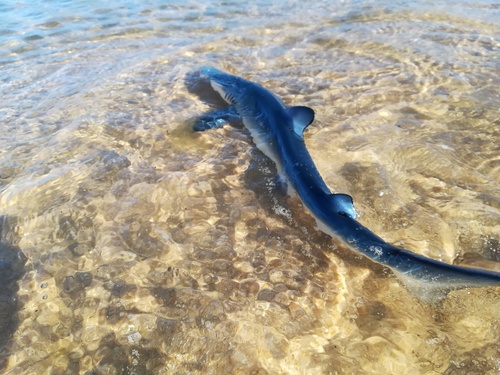
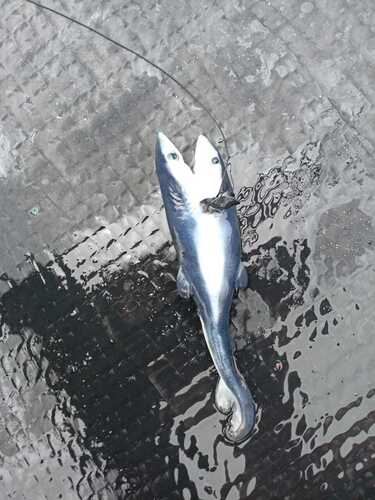
The blue shark is the most widely distributed shark in the world and almost certainly the most abundant large one, found in open water from sub-Arctic seas to the tropics in every ocean and in the Mediterranean. It looks like nothing else: a long pointed snout, very large eyes, and pectoral fins so long and narrow they work like glider wings, on a body slim enough that a three-metre blue weighs a fraction of what a three-metre bull shark does. The back is a deep indigo no other shark has, and it drains to grey within minutes of death. They reach about 3.8 m; the heaviest on rod and line weighed 239.5 kg.
It is the champion traveller of the shark world. NOAA’s Cooperative Shark Tagging Program has marked roughly 118,000 blue sharks — more than half of every shark in its database — and one of them holds the programme’s distance record: tagged off Long Island, recaptured off Africa in the South Atlantic, 3,997 nautical miles or about 7,400 km away, more than eight years later. A satellite-tagged individual reported for 952 days and covered an estimated 28,139 km. The classic picture is a clockwise lap of the North Atlantic gyre, riding the Gulf Stream east and the Canary Current south, though tag data from the European side has never shown that loop as neatly.
It is also the most heavily fished shark on the planet — estimates of the annual global catch run from about ten million to about twenty million sharks, nearly all taken on longlines set for tuna and swordfish. The IUCN still lists it only as Near Threatened, because it grows quickly, matures at four to seven years and produces the largest litters of any requiem shark, up to 135 pups. To swimmers and surfers it is close to irrelevant: 13 unprovoked bites in a global record that begins in 1580.
Where it lives
No shark is spread more widely. FishBase puts the blue shark between 70° N and 55° S at every longitude on earth — the Atlantic, Pacific and Indian Oceans and the Mediterranean as well — and it is probably the most numerous large shark alive. So the obvious question is why almost nobody has seen one. The answer is that this is an oceanic animal in the strict sense: it lives out past the edge of the continental shelf, over water kilometres deep, and it has no reason to come to a beach. Where it does come close is where deep water comes close — oceanic islands like the Azores, and coasts with a narrow shelf such as southern California, the Basque country and southwest Ireland. Even there it tends to move inshore at night and back out by day.
Temperature draws the real boundary, and the blue shark is the cool customer of the requiem family. The Florida Museum gives a preference of 12–20 °C and FishBase an envelope of 7–21 °C — water a bull or tiger shark would never tolerate. But that describes northern adults better than it describes the species. Azores satellite tags found small juveniles favouring roughly 17–25 °C, large juvenile males 16–30 °C and adult females across 15–30 °C, because females shift towards the tropics as they mature — one species living several quite different thermal lives.
Depth is the other axis, and they use far more of it than their surface reputation suggests. Day to day they work the top 350 m, but FishBase compiles records to 1,082 m and Gulf Stream tags caught a dive of 1,008 m. The pattern inside those numbers is the good bit: the same tags had sharks at a mean depth of 74 m by night and 412 m by day, riding the daily commute of the squid and small fish they hunt.


- The Azores & the central North Atlantic — A nursery. Satellite-tagged small juveniles stayed inside a box between 25–45° N and 22–56° W, while large juvenile females ranged north as far as 59° N in summer — the same species using two different oceans.
- Southern New England shelf, USA — The summer ground where the classic reproductive work was done: 160 subadult females sampled here, half of them already carrying stored sperm. It is also the home water of NOAA’s Cooperative Shark Tagging Program.
- Celtic Sea & southwest Ireland — Present roughly June to October. Irish anglers tagged and released 19,309 blue sharks between 1970 and 2013 — 45% of every fish the national programme has ever tagged, of any species.
- Southern Bay of Biscay — Courtship was filmed here for the first time in July 2023, in the Bermeo canyon 8 km off the Basque coast, and 17 bitten females were logged over four seasons. Probably a breeding area.
- Southern California Bight — Squid country, and close enough inshore to dive. Stomach work in the California Current found jumbo squid and Gonatus squid the most important prey of all.
Where it goes
This is the best migration story in the shark world. The textbook version is a clockwise circuit of the whole North Atlantic gyre: pups born off Iberia and northwest Africa drift north and west with the Gulf Stream, summer off New England and Newfoundland, ride the North Atlantic Current back east to Europe, then drop south on the Canary Current to the tropics and start again. John Casey assembled that loop from ordinary numbered tags returned by fishermen, and it has been in the books ever since. One honest caveat: tagging programmes based in Europe and the central Atlantic have not reproduced a clean clockwise pattern, so the loop may lean too hard on where the tagging was done. What nobody disputes is the distance.
The numbers are extraordinary even by open-ocean standards. NOAA’s Cooperative Shark Tagging Program has tagged about 118,000 blue sharks since 1962 — 51% of every shark in the database, more than any other species — and roughly 7% come back. One of them holds the programme’s all-species distance record: tagged off Long Island, New York and recaptured in the South Atlantic off Africa, 3,997 nautical miles (about 7,400 km) away, after more than eight years. The longest any blue shark has stayed out with a tag in it is 15.9 years. An Irish-tagged fish turned up about 6,840 km away in West African water in 274 days; of 168 tagged off Portugal, one crossed the Atlantic to be caught 3,187 km away. And one satellite-tagged shark reported for 952 days, covering an estimated 28,139 km — two-thirds of the way round the planet. Threaded through all of it is sexual segregation on a scale seen in almost no other fish: males and females hold different parts of an ocean for most of the year, so a longline set in the wrong place catches one sex and almost nothing of the other. A South Pacific sample ran 425 mature males to 64 mature females.
Share of verified blue shark records by month (GBIF, all years). Darker rose means a larger share of sightings fall in that month. This reflects when people record them, which mixes real seasonality with when divers and boats are out.
Ireland & the Celtic Sea: Inland Fisheries Ireland puts blue sharks in Irish water from about June to October, with the aggregations anglers fish over peaking June–August. They are offshore animals, so this is availability to a boat several miles out rather than anything you would see from the strand.
What it eats
Squid first, everything else second. A California Current study opened 158 blue sharks, found food in 114 of them and identified 38 prey types, with jumbo squid and the deepwater genus Gonatus top of the list. Add schooling fish — herring, sardine, anchovy — plus cuttlefish and pelagic octopus, and you have most of the diet. The teeth match the job: uppers broad, curved and finely serrated for slicing, lowers narrow and spike-like for gripping something soft and slippery. They feed round the clock but especially at night, when the squid rise towards the surface.
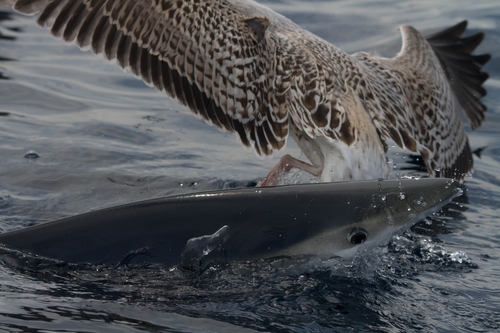
The edges of the menu are where it gets strange. Blue sharks have comb-like gill rakers that stop small prey escaping through the gill slits, and off southern California they have been filmed swimming open-mouthed through balls of krill, straining them out like a very slim baleen whale. They take seabirds off the surface and smaller sharks when they can. And they are the great scavengers of the open ocean: a dead whale draws them from a long way off, and naturalists watching the American sperm-whale fishery in 1916 described “hundreds, even thousands” around the ships. That willingness to investigate anything edible is exactly why they end up on longline hooks.
Is it dangerous?
Blue sharks are about as close to harmless as a three-metre shark gets. The International Shark Attack File, which runs from 1580 to the present, holds 13 unprovoked blue shark cases, four of them fatal — against 142 for tiger sharks and 351 for white sharks. Some of those records involve people already adrift in the open ocean after a disaster at sea, which is the other half of the explanation: blue sharks are not in the surf zone, and surfers and swimmers are not out where blue sharks live. Divers who deliberately get in with them describe an inquisitive animal that circles, comes in for a look and has to be gently pushed off a camera dome. The rules there are the operators’ own: no spearfishing, no bait in your hands, and let the shark decide how close it comes.
The imbalance here is the starkest in the library. Recorded global landings in 2019 came to 189,783 tonnes — over seven million individual sharks — and adding the 81,156 tonnes estimated to be thrown back dead takes it past ten million, while the Florida Museum puts the figure nearer 20 million a year. Nobody can pin the number down, and every version of it makes the blue shark the most heavily fished shark on earth. It is usually called bycatch on longlines set for tuna and swordfish, but in the southwest Atlantic around five tonnes of blue shark are landed for every tonne of tuna, which makes it the catch. It joined CITES Appendix II on 25 November 2023, so international trade now needs a permit. Thirteen bites since 1580, against roughly ten million sharks a year: it is not a close call.
Blue shark facts
- Blue sharks make up 51% of every shark ever tagged by NOAA’s Cooperative Shark Tagging Program — about 118,000 fish since 1962, with roughly 7% recaptured. One tagged off Long Island was caught again in the South Atlantic off Africa, 3,997 nautical miles (about 7,400 km) away, after more than eight years. — NOAA Fisheries / Kohler & Turner 2019
- The longest any blue shark has been at liberty with a tag in it is 15.9 years. Across the whole programme only the sandbar shark has beaten it, at 27.8 years. — NOAA Fisheries
- One satellite-tagged blue shark reported for 952 days and travelled an estimated 28,139 km in that time — roughly two-thirds of the way around the world. — Vandeperre et al. 2014, PLOS ONE
- The skin over most of a mature female’s body is more than twice as thick as a male’s — thicker than his teeth are long — because males bite females during courtship. Females carry the scars; males almost never do, so a blue shark can be sexed from above. — Pratt 1979, Fishery Bulletin
- Females mate before their eggs are ready and store the sperm. Of 160 subadult females examined off New England, 79 already held sperm in the oviducal gland; fertilisation waits until the following spring. — Pratt 1979, Fishery Bulletin
- In the Gulf Stream, tagged blue sharks rose to a mean depth of 74 m at night and dropped to a mean of 412 m by day, with a deepest recorded dive of 1,008 m — commuting with the squid they eat. — Campana et al. 2011, PLOS ONE
- Males and females use different parts of an ocean. A South Pacific longline sample returned 425 mature males to just 64 mature females, a ratio of 1 : 0.34 — so a fleet can hammer one sex and barely touch the other. — Mucientes et al. 2009, Biology Letters
- Recorded global landings in 2019 came to 189,783 tonnes — over seven million sharks — plus an estimated 81,156 tonnes discarded, taking the total past ten million. The Florida Museum puts the annual catch nearer 20 million. — Oceana 2022 (FAO + tuna RFMO data); Florida Museum
Photos
Seen lately
PierMonkey’s live map carries community shark sightings from iNaturalist, refreshed every three hours. Open the map to see where blue sharks have turned up recently.
How big is that, really?
Maximum reliably recorded length. Rose marks the large or potentially dangerous species the map flags as notable.
Help protect it
- Shark Trust — Blue Shark ID GuideA free download, plus a pocket version. Learn the indigo back, the long scythe-shaped pectorals and the pointed snout, and you can tell a blue from a porbeagle or a mako at the side of a boat — which is what makes your sighting report usable.
- Inland Fisheries Ireland — Marine Sportfish Tagging ProgrammeIf you fish for blue sharks off Ireland, book a skipper who tags and releases, and return the card if you catch a tagged one. Nineteen thousand blue shark tags from this programme are a large part of what we know about Atlantic crossings.
- Shark Trust — Big Shark PledgeSign it. The pledge feeds the Trust’s Oceanic Programme, which lobbies the bodies that set high-seas fishing rules for actual catch limits — the single change that would move the blue shark’s numbers.
Report what you see
Photograph a shark, upload it, and once the community confirms the ID it becomes a research-grade record — which is where every sighting on our map comes from. Yours would appear here within three hours.
How to submit an observation →Organisations working on sharks like this one
- The Shark Trustgood for kidsReport eggcases and sightings, join campaigns, download free ID guides.
- Great Eggcase Huntgood for kidsWalk a beach, find a mermaid’s purse, log it. Over 630,000 eggcases recorded since 2003 — the easiest real science a family can do.
- Sharks4Kidsgood for kidsFree classroom lessons, virtual field trips and activity packs for teachers and parents.
- Save Our Seas FoundationFunds shark research and education worldwide; publishes what each project found.
- Shark StewardsCampaigns to end the shark fin trade and establish shark sanctuaries.
- OceanaPolicy campaigning on fisheries management and bycatch — the thing that actually kills sharks.
- IUCN Shark Specialist GroupThe scientists behind the Red List assessments. For older readers who want the primary source.
Conservation status: Near Threatened (IUCN Red List, assessed 2019). Assessed Near Threatened under criterion A2bd, on a global decline of roughly 20–29% over three generations — about 30 years in the Atlantic, 31.5 in the Pacific and Indian Oceans. It is caught in larger numbers than any other shark, but it also matures at four to seven years and carries the biggest litters of any requiem shark, and Pacific trends have been flat rather than falling, which is what keeps it a rung below Vulnerable. The Mediterranean population is assessed separately and is Critically Endangered. Added to CITES Appendix II on 25 November 2023. Read the assessment →
Common questions
Why is a blue shark blue?▾
How far do blue sharks travel?▾
Do blue sharks attack people?▾
How many pups does a blue shark have?▾
If it is the most fished shark in the world, why is it only Near Threatened?▾
Can you see blue sharks from the shore?▾
Keep exploring
- Ditch Plains, Montauk — live surf conditions
- Lahinch, Ireland — live surf conditions
- Mundaka, Basque Country — live surf conditions
- All 40 species →
Sightings © iNaturalist contributors (research-grade observations). Occurrence maps © GBIF.org contributors (CC BY). Community science, not a beach-safety service. Last updated 2026-09-20.
See where sharks are turning up — on the live map
The map and live conditions are open to everyone. A free account unlocks full 16-day forecasts and custom swell alerts.