
Blind shark
A small, harmless Australian carpet shark that is not blind at all — it shuts its eyes when you lift it out of the water, and it can stay out there for most of a day.
Vital statistics
Live-bearing without a placenta — the pups grow on their yolk supply inside the mother. Litters are small, 7 or 8 pups, born in late spring and summer at about 15–18 cm long.
The short version
The blind shark is not blind. It has perfectly serviceable eyes, and the name comes from a habit: lift one out of the water and it pulls its eyeballs back into their sockets and closes its thick lower eyelids. Anglers took that for blindness, the name stuck, and it has been misleading people ever since. It is a carpet shark, one of only two species in the family Brachaeluridae, and it lives on the east coast of Australia and nowhere else on earth.
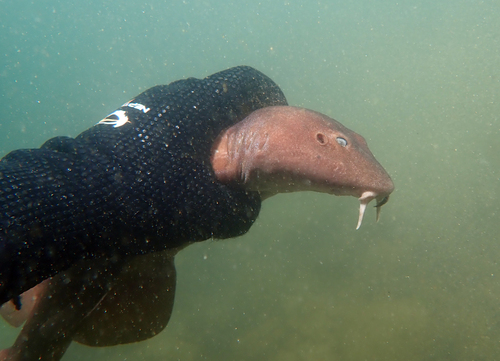
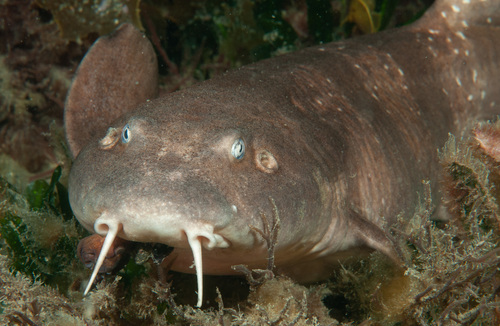
It is small, growing to about 1.2 m at the absolute maximum with most adults between 0.5 and 0.7 m, brown with pale spots and faint darker saddles, with a blunt flattened head and a barbel trailing from each nostril. It spends the day jammed into a cave or under a ledge on a rocky reef and comes out at night to suck crabs, prawns, squid, sea anemones and small fish out of the rock. The trick that makes it worth knowing about is what happens when the tide goes out: stranded in a rock pool, a blind shark can survive as long as 18 hours out of the water and simply wait for the sea to come back.
It is harmless — no bite on a swimmer or diver has ever been recorded — and the IUCN lists it as Least Concern, because nobody wants to eat it and its rocky home is difficult to trawl. Females give birth to 7 or 8 pups at around 15–18 cm long in late spring and summer. Almost everything else about it, including how long it lives and how much it weighs, rests on one or two studies or on nothing at all.
Where it lives
The blind shark lives on one coastline and nowhere else: the east coast of Australia, in warm temperate and subtropical water. Exactly where it stops at each end is still argued over. Last and Stevens’ Sharks and Rays of Australia and the IUCN assessment both run the range from Mooloolaba in southern Queensland down to Jervis Bay in New South Wales; Fishes of Australia stretches it further at both ends, from Noosa down to Lilli Pilli just south of Batemans Bay. The 750-odd verified photo records in iNaturalist back the longer version, running from 26.4° S — Noosa almost exactly — to 35.9° S on the far south coast. Old records from Western Australia and the Northern Territory are treated as misidentified brownbanded bamboo sharks.
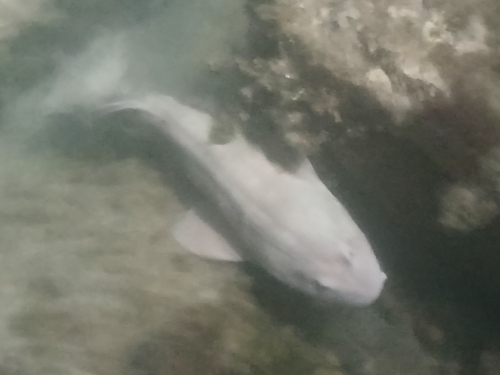
Inside that strip it is a rocky-reef animal. By day it wedges itself into caves, gutters and the space under a ledge; at night it works the reef and the seagrass beds next to it. Records run from the intertidal zone — including tide pools barely deep enough to cover the shark — down to 140 m, but the great majority are shallow: the median depth on occurrence records with a depth attached is 25 m, and the standard accounts put nearly all sightings above about 70 m. Juveniles and adults split the habitat between them, with young sharks in the high-energy surge zone right up against the rocks and adults deeper under the ledges.
That shallowness is the point of this page. Most sharks are something you read about; this one you can find on a shore dive, a snorkel or a poke around a New South Wales rock platform at low tide. Which is why an animal almost nobody outside Australia has heard of has hundreds of verified photographs behind it, nearly all taken by people who were not scientists.


- Port Stephens & Nelson Bay, New South Wales — The single densest concentration of blind shark records anywhere — more than a third of all verified photo records of the species come from this one bay, most of them from the Fly Point and Halifax Park shore dives.
- Cabbage Tree Bay & North Head, Sydney — Over a hundred verified records within five kilometres of Manly. A protected bay you can snorkel from the beach, and one of the easiest places on earth to meet this shark.
- Botany Bay — Bare Island & Kurnell, Sydney — Around a hundred records. A classic Sydney night dive, which is when this shark is out of its cave and moving over the sand and sponge beds.
- Jervis Bay to Batemans Bay, New South Wales — The southern end of the range in most published accounts, though photo records continue another hundred kilometres or so down the coast.
- Noosa & the southern Queensland coast — The northern edge. Records thin out quickly north of Moreton Bay, and the northernmost verified photograph sits at Noosa itself.
Where it goes
It does not appear to migrate, and the honest version of that sentence is that nobody has checked properly. There is no published acoustic tagging or satellite study of the blind shark — no receiver array, no tracks, nothing like the decade of telemetry behind the Port Jackson shark that shares its reefs and commutes several hundred kilometres every year. What the sighting records show is a shark that turns up in the same gutters in the same bays in every month of the year, which is what you would expect of a resident, but consider that a working assumption rather than a finding.
The movements it definitely makes are small ones. There is a nightly commute: out of the cave after dark to hunt across the reef and the seagrass, back under the ledge before morning. There is a tidal one, where a falling tide leaves a shark in a rock pool and it simply waits the tide out — which is exactly where its ability to tolerate hours out of the water earns its keep. And there is a slow one over a lifetime, from the surge zone where the juveniles live into the deeper ledges where the adults do. That small world is part of why the species is doing fine: rocky shorelines are awkward to trawl, so most of its habitat is effectively unfished.
Share of verified blind shark records by month (GBIF, all years). Darker rose means a larger share of sightings fall in that month. This reflects when people record them, which mixes real seasonality with when divers and boats are out.
What it eats
The blind shark eats the small things that live in and around a rocky reef: crabs, shrimps and prawns, cuttlefish and squid, small bony fishes, and — the odd one on the list — sea anemones, stinging tentacles and all. It is nocturnal, and it feeds by suction. The mouth is small and sits underneath a slightly flattened head, and rather than chasing anything down the shark puts its snout to a crevice and pulls the contents out with a sharp inward gulp. FishBase’s modelled trophic level of 3.85 is a useful corrective to the word "sluggish": this is a predator, just a patient one working at walking pace.
Two barbels hang from its nostrils like short whiskers, and they are the giveaway to how it actually finds food. A shark that hunts at night, nose-first, inside holes in the rock is not relying much on its eyes — it is feeling and smelling its way along, which is a quiet joke at the expense of the common name. Its jaws, for the record, are strong out of all proportion to that small mouth, a detail anglers discover the hard way.
Is it dangerous?
None. There is no record of a blind shark biting a swimmer, a surfer or a diver, and the species appears nowhere in the Florida Museum’s International Shark Attack File tallies. The reasons are boring and reassuring: it tops out at 1.2 m and most adults are half that, the mouth is small, and its whole strategy when something large turns up is to stay exactly where it is. Divers photograph them from arm’s length off Sydney and Port Stephens most nights.
The one caveat is about handling, not swimming. Anglers who accidentally hook one find that the small mouth and strong jaws make a hook very hard to get back out, and a shark being held will bite and then hang on rather than let go. Cutting the line close to the hook is the kind thing and the sensible thing. The same goes for the rock-pool version: a blind shark stranded by the tide can survive being picked up and passed around, which is not the same as it being a good idea. The traffic here runs overwhelmingly one way — this shark is caught as bycatch in prawn trawls and New South Wales trap fisheries, and collected at unmeasured levels for home aquariums, and it has never done anything to anybody.
Blind shark facts
- It is not blind. The name came from anglers: a blind shark lifted out of the water retracts its eyeballs and closes its thick lower eyelids, and its vision has been described as perfectly adequate. — Compagno, FAO Sharks of the World; Australian Museum
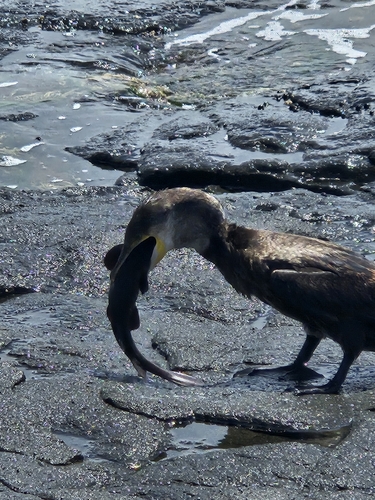
- A blind shark can survive up to 18 hours out of the water. That is what lets it be stranded in a rock pool by a falling tide, sit it out, and swim off when the sea returns. — Michael 1993, cited in the national SAFS report card
- Its family contains two species and both live only on the east coast of Australia. The other one, Colclough’s shark, has not been so lucky — the IUCN lists it as Vulnerable. — IUCN Red List / GBIF
- Fisheries do not want it: its flesh is reported to taste strongly of ammonia. Sharks caught in prawn trawls and traps are thrown back, and a shark that tolerates hours in air probably survives that better than most species would. — FRDC / SAFS Report Card, citing Grant 1978
- Sources disagree about where it lives. Sharks and Rays of Australia and the IUCN say Mooloolaba to Jervis Bay; Fishes of Australia says Noosa to Lilli Pilli, south of Batemans Bay. Verified photo records run from 26.4° S to 35.9° S, which favours the longer version. — Last & Stevens 2009; Fishes of Australia; iNaturalist
- The only study of its age and breeding is an unpublished 2013 master’s thesis from the University of Newcastle. It estimated a maximum age of about 19 years, and maturity at 50 cm in females and 58 cm in males. — Norén 2013, via the FRDC / SAFS Report Card
- Litters are tiny by shark standards — 7 or 8 pups, born at 15–18 cm in late spring and summer, fed inside the mother on yolk alone with no placenta. — Compagno, FAO Sharks of the World; Fishes of Australia
- Sea anemones are on its menu, stinging cells and all, alongside the crabs, prawns, squid and small fish it sucks out of crevices at night. — FishBase; Australian Museum
Photos
Seen lately
PierMonkey’s live map carries community shark sightings from iNaturalist, refreshed every three hours. Open the map to see where blind sharks have turned up recently.
How big is that, really?
Maximum reliably recorded length. Rose marks the large or potentially dangerous species the map flags as notable.
Help protect it
- Redmap AustraliaLog a photo of any marine species you see outside its usual range. This is the rare case where that genuinely matters: the published northern and southern limits for the blind shark disagree by hundreds of kilometres, and a dated, located photo from either end is real evidence in that argument.
- Reef Life Survey — blind shark pageThe Australian programme that trains ordinary divers to swim standardised transects and count what is on them. Their blind shark page shows where surveys actually find it — and they take recreational divers, not just scientists.
- iNaturalistPhotograph the shark in the rock pool, upload it, and let the community confirm the identification. The map on this page is built from exactly those records — several hundred of them, nearly all taken by people who were not scientists and were not looking for a shark that morning.
Report what you see
Photograph a shark, upload it, and once the community confirms the ID it becomes a research-grade record — which is where every sighting on our map comes from. Yours would appear here within three hours.
How to submit an observation →Organisations working on sharks like this one
- The Shark Trustgood for kidsReport eggcases and sightings, join campaigns, download free ID guides.
- Great Eggcase Huntgood for kidsWalk a beach, find a mermaid’s purse, log it. Over 630,000 eggcases recorded since 2003 — the easiest real science a family can do.
- Sharks4Kidsgood for kidsFree classroom lessons, virtual field trips and activity packs for teachers and parents.
- Save Our Seas FoundationFunds shark research and education worldwide; publishes what each project found.
- Shark StewardsCampaigns to end the shark fin trade and establish shark sanctuaries.
- OceanaPolicy campaigning on fisheries management and bycatch — the thing that actually kills sharks.
- IUCN Shark Specialist GroupThe scientists behind the Red List assessments. For older readers who want the primary source.
Conservation status: Least Concern (IUCN Red List, assessed 2015). Assessed as Least Concern by Kyne & Bennett in 2015, and rated Sustainable by Australia’s national fish stock status reports. It is not targeted by anyone: the flesh is reported to taste of ammonia, so trawl and trap boats that catch one throw it back, and a shark that can spend hours out of water probably survives that better than most. FishBase now shows the listing re-dated to April 2025, still Least Concern. Read the assessment →
Common questions
Is the blind shark actually blind?▾
How long can a blind shark survive out of the water?▾
I found a small shark in a rock pool in New South Wales — what is it?▾
Are blind sharks dangerous?▾
How big do blind sharks get, and how long do they live?▾
Why is so little known about a shark this common?▾
Keep exploring
- Manly Beach, New South Wales — live surf conditions
- North Narrabeen, New South Wales — live surf conditions
- Merewether Beach, Newcastle — live surf conditions
- Noosa, Queensland — the northern edge of its range — live surf conditions
- All 40 species →
Sightings © iNaturalist contributors (research-grade observations). Occurrence maps © GBIF.org contributors (CC BY). Community science, not a beach-safety service. Last updated 2026-09-20.
See where sharks are turning up — on the live map
The map and live conditions are open to everyone. A free account unlocks full 16-day forecasts and custom swell alerts.