
Blacktip shark
The shark behind most of Florida’s shark-bite statistics: a fast, silvery baitfish hunter that leaps and spins clear of the surf — and is nothing like as dangerous as that sentence sounds.
Vital statistics
Live birth with a yolk-sac placenta. Litters run from 1 to 10 pups (FishBase), averaging about three in the Atlantic and four to five in the Gulf (NOAA), while the Florida Museum gives 4–11; gestation is 10 to 12 months. Pups are born 53–65 cm long in shallow estuarine nurseries in late spring and early summer and stay in them for months. Females can also manage without a male: parthenogenesis — a pup developing from an unfertilised egg — was genetically confirmed in this species in 2007.
The short version
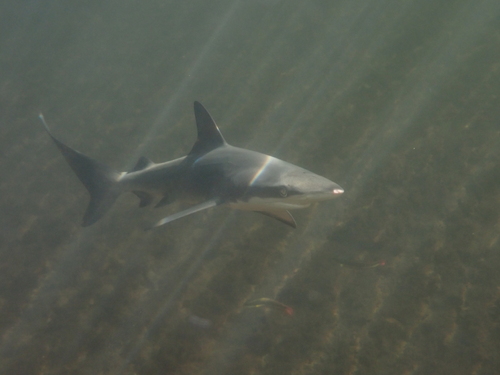
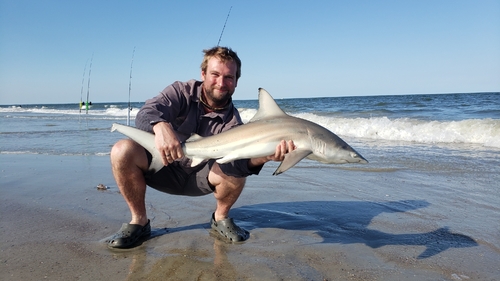
The blacktip shark is a fast, medium-sized shark of warm coasts worldwide, and in the United States it is the one behind most of the shark-bite headlines. Adults usually run 1.4–1.8 m; the largest reliably reported are about 2.55 m. It is not the blacktip reef shark, which is a smaller Indo-Pacific animal that lives on shallow lagoon flats and carries a bright white band under the black tip of its dorsal fin. This one is an open-coast shark of the Americas, West Africa and the Indo-Pacific, and its black fin tips sit on plain grey and fade as it ages.
Its year is a migration. Blacktips summer off the Carolinas and winter in southeast Florida, and where the continental shelf narrows at Palm Beach County the whole procession is funnelled close to the beach. Aerial surveys counted 12,128 sharks in one February pass over a 75.6 km stretch of shoreline, and 104,255 over four years of flights. Tracking has since shown some males run all the way to Long Island in summer, while others never leave Florida at all.
It is rarely dangerous. The International Shark Attack File lists 35 unprovoked blacktip bites and no deaths, and suspects the species accounts for most of Florida’s unidentified requiem-shark bites — the Florida Museum puts it at about 20% of the state’s total. Volusia County, the most bitten stretch of coast on earth, logged 94 bites from 2012 to 2021 without a single fatality. An abundant small shark hunting baitfish in murky surf, plus a crowded beach, produces a statistic rather than a danger. The IUCN assessed the species as Vulnerable in 2020, mainly on fishing pressure outside US waters.
Where it lives
The blacktip shark lives along warm coasts almost everywhere. FishBase runs the range from about 45° N to 38° S: in the western Atlantic from Nova Scotia south to Brazil, in the eastern Atlantic from Senegal to the Congo, right across the Indo-Pacific, and in the eastern Pacific from Baja California to Peru. NOAA gives the everyday US range as Virginia through Florida with summer movements to Cape Cod; the Florida Museum runs it from Massachusetts to Brazil and puts the centre of abundance in the Gulf of Mexico and the Caribbean. Those separate oceans are not one population: a worldwide study of mitochondrial DNA found the western Atlantic animals isolated from the rest of the species.
Within that huge range it is a shark of the edge of the sea. It works the continental shelf — surf zones, bays, estuaries, river mouths, the water over reefs — and although FishBase gives a depth range of 0–140 m, the Florida Museum notes it usually stays in the upper 30 m. Pregnant females go further in still, dropping their pups in shallow estuarine nurseries: in Terra Ceia Bay on Florida’s Gulf coast, a bay roughly 5 km by 1.5 km and no more than about 4 m deep, immature sharks flood in during April and females arrive to give birth in May and June.
One stretch of coast matters more than any other, and it is a matter of geography. The continental shelf that runs broad and shallow down the US east coast pinches almost shut in Palm Beach County, Florida, which squeezes the whole southbound winter migration into a narrow band of clear water close inshore. Aerial surveys there fly a belt just 200 m wide from the beach and still see thousands of sharks at a time. Everything we know about the size of this migration comes from that accident of bathymetry — and the thing it tracks, water temperature, is on every buoy page on this site.


- Palm Beach County, Florida — The winter bottleneck, where the shelf narrows and the migration passes within a couple of hundred metres of the beach. Fifty-eight survey flights between 2011 and 2014 counted 104,255 blacktips inside a 75.6 km belt transect from Boca Raton to Jupiter, peaking at 12,128 sharks in one February pass. Sampling later showed the aggregation is 95% adult males of almost identical size.
- New Smyrna Beach & Volusia County, Florida — Where the species meets the most people. An inlet pumping bait and murky water into a beach break full of surfers produces more shark bites than anywhere else on earth — 94 in Volusia County between 2012 and 2021, not one of them fatal. Blacktips pass Daytona, just up the coast, heading south in September to November and north again in March and April.
- Bulls Bay & the Carolina coast — The summer half of the year. Blacktips spend it off North Carolina, South Carolina and Georgia, and start south from Bulls Bay in October when the water drops below 21 °C. Their comings and goings at South Carolina fishing piers have been studied in their own right, to work out which environmental cues drive them.
- Terra Ceia Bay & Tampa Bay, Florida Gulf coast — A nursery, which is a different habitat from everything above: shallow, warm, cloudy, and largely out of reach of the bigger sharks that eat newborns. Immature blacktips arrive in April, females pup in May and June, and the young stay through the warm months. Water in these inshore survey grounds can reach the low thirties.
- Ilha Grande Bay, Rio de Janeiro, Brazil — Six years of visual surveys, drone footage and baited video in a warm-temperate bay found blacktips and spinner sharks aggregating together — up to 113 animals — through the southern autumn and winter, and recorded the first breaching by either species in the southwest Atlantic. Proof the behaviour is not a Florida quirk.
Where it goes
This is one of the great visible migrations in North American waters, and it runs on temperature. Blacktips summer off the Carolinas and Georgia, turn south in September and October, and pile into southeast Florida for the winter; they go back north in spring. Aerial surveys over Palm Beach County between 2011 and 2014 put numbers to it: abundance peaked every January to March, averaging 9,925 sharks in the survey belt and topping out at 12,128 in one February 2011 flight — a density of 803 sharks per square kilometre. By April and May the count had fallen to about 1.1% of that. Large numbers appeared only when the water was below 25 °C, and abundance tracked temperature inversely all the way through.
Two later findings complicate that picture. The winter aggregation is not the whole population — sharks sampled out of it were 95.2% adult males averaging 170.8 cm, so this is a segregated group, not a cross-section. And acoustic tracking of males along the east coast found partial migration: some individuals run from Palm Beach County all the way to Long Island, New York, farther than the older literature described, while a smaller share never leaves southeast Florida at all. That same work found autumn departures keyed to day length rather than to temperature, which worries the researchers who did it: day length will not change as the ocean warms, so a shark using it as a calendar may arrive to the wrong water. The team behind the aerial surveys put it more bluntly — if blacktips avoid water above 25 °C, a warming ocean may stop southeast Florida being the southern end of the journey.
Share of verified blacktip shark records by month (GBIF, all years). Darker rose means a larger share of sightings fall in that month. This reflects when people record them, which mixes real seasonality with when divers and boats are out.
Southeast Florida (Palm Beach County): Aerial surveys found abundance highest every January–March and roughly 1.1% of that from May to December. A zero here means the winter aggregation has gone, not that the species has: blacktips are present off southeast Florida year-round in small numbers. Further north the rhythm is passage rather than residence — they pass Daytona Beach southbound in September–November and northbound in March–April.
What it eats
Blacktips are baitfish specialists. The Florida Museum lists herring, sardines, menhaden, mullet and anchovies first, then other bony fishes, small sharks and rays, squid and crustaceans; NOAA’s list is the same. The teeth match the job — narrow, upright, finely serrated cusps that grip a slippery fish rather than shear through anything big. FishBase puts the species at trophic level 4.4 — high for its size, because what it eats are themselves hunters rather than grazers.
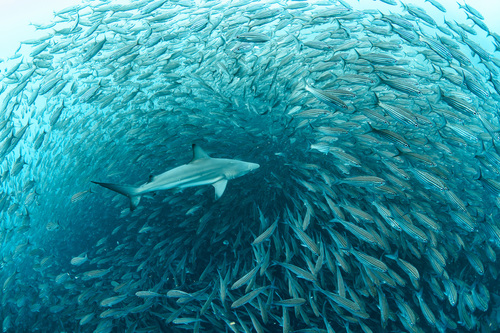
The hunting is what people actually see. A blacktip drives up through a bait school from below at speed and often keeps going, coming clear of the surface and, as the Florida Museum puts it, "sometimes spinning up three or four times around their axis before falling back in the water". Spinner sharks do the same thing, which is where a great deal of confusion between the two species comes from; the behaviour was only formally recorded in the southwest Atlantic in 2025, in a Brazilian bay where both species aggregate together. The setting matters as much as the move: a blacktip does this where the bait is, which in Florida means the churned, sandy water at an inlet mouth or along a bar — exactly where people swim.
Is it dangerous?
This is the species behind most of Florida’s shark-bite statistics, and it is worth being precise about what that means. The International Shark Attack File’s species table, which covers 1580 to the present, credits blacktips with 35 unprovoked bites and no fatalities; the Florida Museum’s older species profile lists 29 with one death, and says blacktips account for roughly 20% of bites in Florida waters. ISAF itself goes further, noting that because requiem sharks are so hard to identify from a wound, it suspects blacktips are responsible for the majority of the state’s unidentified requiem bites — while saying plainly that those cases lack the evidence to be conclusive. So the honest version is: probably the commonest biter in Florida, and still no confirmed death anywhere in the world.
The mechanism explains both halves of that. A blacktip is a metre-and-a-half predator hunting small fish in churned, sandy water you cannot see through; a hand or a foot moving in that water looks and sounds like a fish, and the shark takes one grab and lets go. That is why Volusia County — New Smyrna Beach and its neighbours, surfers in the water beside an inlet all year — recorded 94 bites between 2012 and 2021 with zero fatalities, and why ISAF’s 2025 report counted 11 bites in all of Florida, none of them fatal. Measured the other way the ledger is one-sided: blacktips are among the sharks most often caught in coastal fisheries, every requiem shark has needed a CITES Appendix II permit to cross a border since November 2023, and the IUCN listed the species Vulnerable in 2020 — even as the managed US stocks come back not overfished.
Blacktip shark facts
- The scale of the winter gathering is hard to take in. Fifty-eight aerial survey flights off Palm Beach County between 2011 and 2014 tallied 104,255 sharks, with a single February 2011 pass counting 12,128 inside a 75.6 km belt transect — a density of 803.2 sharks per square kilometre. — Kajiura & Tellman 2016, PLOS ONE
- Those winter aggregations are not a random crowd. Sharks sampled from them off southeast Florida were 95.2% adult males, and strikingly uniform in size at 170.8 ± 8.07 cm — evidence that the species segregates by both size and sex while overwintering. — Arvin & Kajiura 2025, Journal of Fish Biology
- A blacktip shark can reproduce without a male. A female at the Virginia Aquarium & Marine Science Center produced a pup in 2007 that was found during a necropsy; five microsatellite markers showed no paternal DNA at all. It was the first parthenogenesis confirmed in a large live-bearing requiem shark, and the pup, like the bonnethead case before it, did not survive. — Chapman, Firchau & Shivji 2008, Journal of Fish Biology
- Drone footage off southeast Florida caught adult blacktips fleeing into the shallow water right against the beach when a great hammerhead chased them — the first evidence that adults of this species use the shallows as a refuge. Some of the fins closest to swimmers are sharks hiding from something bigger. — Doan & Kajiura 2020, Journal of Fish Biology
- The leap is real and it is a hunting move. Blacktips drive up through bait schools and come clear of the surface, "sometimes spinning up three or four times around their axis before falling back in the water". Spinner sharks do it too, which is why the two species are so often mistaken for each other. — Florida Museum species profile; Rolim et al. 2025, Aquatic Conservation
- Tracked male blacktips migrate farther than the textbooks said. Acoustic telemetry followed individuals from Palm Beach County, Florida to Long Island, New York, while a smaller share of the population stayed off southeast Florida year-round — partial migration, with autumn departures keyed to day length rather than to temperature. — Bowers & Kajiura 2025, Marine Ecology Progress Series
- How long a blacktip lives depends on which ocean you ask about. Vertebral ageing of 475 sharks in central eastern Australia reached 22 years for females and 24 for males, with both sexes maturing at 8.3 years and 200 cm. Western Atlantic figures are about half that: NOAA gives 15.5 years as the oldest observed and maturity at 4–7 years. — Harry et al. 2019, Marine & Freshwater Research; NOAA Fisheries
- Volusia County, Florida — New Smyrna Beach and its neighbours — recorded 94 unprovoked shark bites between 2012 and 2021 and not one fatality. The Florida Museum calls it the shark bite capital of the world; ISAF suspects blacktips account for the majority of the state’s requiem-shark bites, though it stresses those cases cannot be confirmed. — Florida Museum, International Shark Attack File
Photos
Seen lately
PierMonkey’s live map carries community shark sightings from iNaturalist, refreshed every three hours. Open the map to see where blacktip sharks have turned up recently.
How big is that, really?
Maximum reliably recorded length. Rose marks the large or potentially dangerous species the map flags as notable.
Help protect it
- FWC — shore-based shark fishing in FloridaIf you fish a Florida beach or pier you will hook blacktips, and the rules are not optional: anyone 16 or over targeting sharks from shore must take a free online course and carry the no-cost shore-based permit. The same page gives the handling rules that decide whether a released shark lives — non-offset circle hooks with natural bait, a tool that cuts the leader fast, gills kept in the water, no photo delays.
- ISAF — how to avoid a shark biteThe Florida Museum’s own checklist, and most of it is aimed squarely at the situation this shark creates: stay out of murky water and away from anglers and bait, skip dawn and dusk, leave the shiny jewellery on the beach, swim with someone. Ten minutes here takes care of most of what this page is about.
- Volusia County Beach Safety Ocean RescueThe lifeguard service for New Smyrna Beach and Daytona publishes a daily beach report, live beach cams and the meaning of each warning flag. Check the report before you paddle out and swim within sight of a tower — the single most useful habit at the beach that records more shark bites than any other.
Report what you see
Photograph a shark, upload it, and once the community confirms the ID it becomes a research-grade record — which is where every sighting on our map comes from. Yours would appear here within three hours.
How to submit an observation →Organisations working on sharks like this one
- The Shark Trustgood for kidsReport eggcases and sightings, join campaigns, download free ID guides.
- Great Eggcase Huntgood for kidsWalk a beach, find a mermaid’s purse, log it. Over 630,000 eggcases recorded since 2003 — the easiest real science a family can do.
- Sharks4Kidsgood for kidsFree classroom lessons, virtual field trips and activity packs for teachers and parents.
- Save Our Seas FoundationFunds shark research and education worldwide; publishes what each project found.
- Shark StewardsCampaigns to end the shark fin trade and establish shark sanctuaries.
- OceanaPolicy campaigning on fisheries management and bycatch — the thing that actually kills sharks.
- IUCN Shark Specialist GroupThe scientists behind the Red List assessments. For older readers who want the primary source.
Conservation status: Vulnerable (IUCN Red List, assessed 2020). Assessed Vulnerable in 2020 under criterion A2bd, population trend decreasing — FishBase records the assessment date as 18 November 2020. The listing is global. NOAA assesses the two US stocks separately — the Atlantic in 2021, the Gulf in 2018 — and finds both not overfished and not subject to overfishing, so the decline the Red List describes is happening largely elsewhere in the range. The change of status is recent enough that good reference pages — the Florida Museum’s own species profile among them — still show the older Near Threatened listing. Read the assessment →
Common questions
Is the blacktip shark responsible for most shark bites in Florida?▾
Why is New Smyrna Beach called the shark bite capital of the world?▾
How do you tell a blacktip shark from a spinner shark?▾
Is a blacktip shark the same as a blacktip reef shark?▾
Why do blacktip sharks jump out of the water and spin?▾
Can a blacktip shark have a pup without mating?▾
Keep exploring
- New Smyrna Beach, Florida — live surf conditions
- Cocoa Beach Pier, Florida — live surf conditions
- Sebastian Inlet, Florida — live surf conditions
- Cape Hatteras, North Carolina — live surf conditions
- All 40 species →
Sightings © iNaturalist contributors (research-grade observations). Occurrence maps © GBIF.org contributors (CC BY). Community science, not a beach-safety service. Last updated 2026-09-20.
See where sharks are turning up — on the live map
The map and live conditions are open to everyone. A free account unlocks full 16-day forecasts and custom swell alerts.