
Blacktip reef shark
The shark most people meet first: a small, wary reef shark that works lagoon flats in water too shallow to cover it, fin tips dipped in black.
Vital statistics
Live birth with a placenta, like most requiem sharks. Litters of two to four pups (FishBase, Florida Museum), with genetic work in Mo’orea’s nurseries putting the average nearer three to five; gestation is usually given as 8–9 months, but 10–11 and even 16 months are reported from different places. Pups are born about 33–52 cm long and go straight into knee-deep water.
The short version
The blacktip reef shark is a small, shallow-water shark of the tropical Indo-Pacific, and for most people it is the first shark they ever see. Adults are usually 1.0–1.6 m long and the largest reliably reported are about 1.8 m. It lives from the Red Sea, the Persian Gulf and East Africa east to Hawaii and the Tuamotus, north to Japan and south to Australia, and it hardly ever leaves the shallows: the depth range on paper is 0–75 m, but the everyday life of the species happens in the first couple of metres.
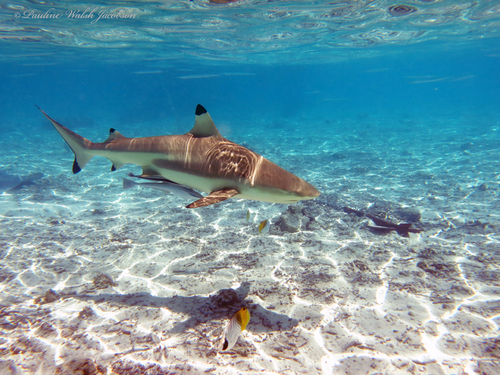
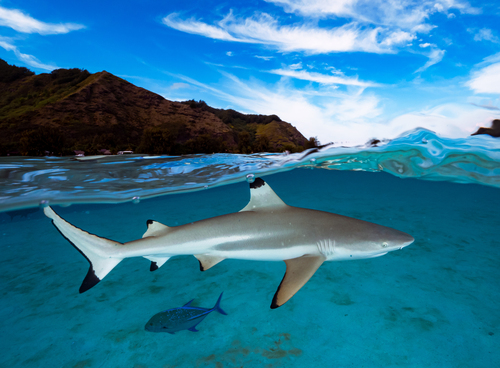
Two things make it easy to know. The fins look dipped in ink, and the first dorsal fin carries a bold black tip with a bright white band beneath it. And it is the shark you see with that fin out of the water, crossing a lagoon flat in water that would not cover your knees. That is not a stranded or confused animal: shallow water is where its food is and where bigger sharks struggle to follow. It stays in a very small patch of it, too — sharks tracked at Palmyra Atoll held home ranges averaging about 0.55 km² and were still using the same sand-flat ledges three years later.
It is rarely a danger to people. The International Shark Attack File’s species table lists 14 unprovoked bites and no deaths, and the Florida Museum’s profile puts it at 11 since 1959; a review of ten cases found nine in water less than waist-deep, with all but one victim wading. The IUCN assessed the species as Vulnerable in 2020, suspecting that fishing and the loss of shallow coral, seagrass and mangrove habitat have cut the world population by 30–49% over three generations, or about 44 years.
Where it lives
The blacktip reef shark belongs to the tropical Indo-Pacific and almost nowhere else. FishBase runs the range from the Persian Gulf, the Red Sea and East Africa east across the Indian Ocean and the tropical Pacific to Hawaii and the Tuamotu Archipelago, north to Japan and south to Australia — roughly 35° N to 25° S. In Australia it reaches from Moreton Bay round to Shark Bay. The one real outlier is the eastern Mediterranean, which it got to by swimming up the Suez Canal out of the Red Sea; both FishBase and Australia’s national shark report card list those records.
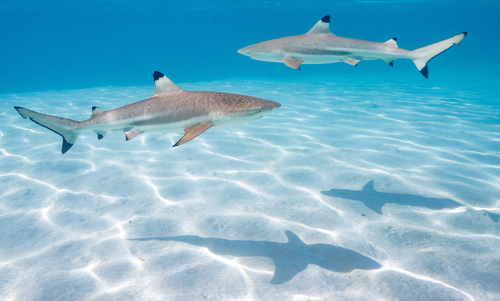
Inside that outline it is an animal of the edge. The depth range on paper is 0–75 m, but nearly everything the species does happens in the top few metres: coral reef flats, sand flats, lagoons, the lip of a drop-off, and the mangrove and seagrass margins where the pups are born. A 2025 study of newborns at Mo’orea measured their reef-flat nursery at a median depth of 0.74 m — less than knee-deep. Adults work the same flats on the tide: at St Joseph Atoll in the Seychelles they were up on the flats once the water reached about 0.5 m, while the larger sicklefin lemon sharks sharing the atoll had to wait for 1.4 m.
That shallowness is why this page exists. The blacktip reef shark is the fourth most-reported shark in PierMonkey’s own live sightings feed — 75 records in a recent 45-day window — not because it is the commonest shark in the sea, but because it lives in the exact strip of water where people wade, snorkel and hold up phones. Worth keeping straight, though: a shark you can photograph ten times in a morning is not the same as ten sharks. Tiny home ranges and strong site fidelity mean the fins off one beach are very often the same few animals, over and over.


- Mo’orea, French Polynesia — The best-studied population of the species anywhere — tagged, photo-identified and genetically sampled since 2007, with nursery work still running. French Polynesia banned shark fishing across its whole territory in 2006 and tightened it in 2012, so these sharks are watched against a background of no fishing at all. It is also where the awkward questions about feeding sharks for tourists are being answered.
- Palmyra Atoll, central Pacific — A US national wildlife refuge with no fishery and almost no people. Acoustic tracking in its lagoons produced the numbers everyone quotes for this species: home ranges of about half a square kilometre, and the same individuals on the same sand-flat ledges three years later.
- St Joseph Atoll, Seychelles — Thirty-one blacktips tracked for an average of more than a year each, in an atoll whose flats nearly dry at low tide and whose lagoon is only 3–9 m deep. It is the clearest picture anywhere of how the species uses the tide, and of how it shares a reef with a bigger shark by getting somewhere first.
- Great Barrier Reef & northern Australia — The part of the range where the population is judged stable. Reef catch trends held steady from 1989 to 2006, and Australia assesses its own blacktip reef sharks as Least Concern while the global listing stays Vulnerable — largely because marine parks cover so much of the habitat.
Where it goes
This shark does not migrate, and the numbers behind that are unusually firm. Acoustic tracking at Palmyra Atoll gave home ranges of 0.55 ± 0.24 km² over days to weeks — an area you could swim across — with strong fidelity to particular sand-flat ledges right through a three-year study. The Save Our Seas Foundation summarises the species’ home range as usually under half a square kilometre. What a blacktip reef shark does instead of travelling is move up and down with the tide, on and off the same flat, twice a day, for years.
A few do more. The Palmyra sharks made occasional longer excursions out of the lagoons, and genetic parentage work at Mo’orea found that while most females give birth at their home island, some cross about 50 km of open ocean to a particular nursery — and go back to that same nursery for every litter. Sampling 230 pups across ten Mo’orea nurseries later showed the habit is flexible rather than absolute. Either way the practical consequence is the one that matters for a fished species: a lagoon emptied of blacktip reef sharks does not refill from the lagoon next door.
Share of verified blacktip reef shark records by month (GBIF, all years). Darker rose means a larger share of sightings fall in that month. This reflects when people record them, which mixes real seasonality with when divers and boats are out.
What it eats
A blacktip reef shark eats small things. Reef fishes make up most of it — mullet, wrasses, groupers, surgeonfishes, goatfishes — along with octopus, squid, shrimps, crabs and the occasional sea snake, which Australian stomach-content work in the 1980s found often enough to count. FishBase puts the species at trophic level 3.9, about where a large cod sits and well below the big sharks it shares a reef with. The mouth is small and the teeth are narrow and finely serrated: gripping teeth for slippery fish, not the shearing blades of a tiger shark.
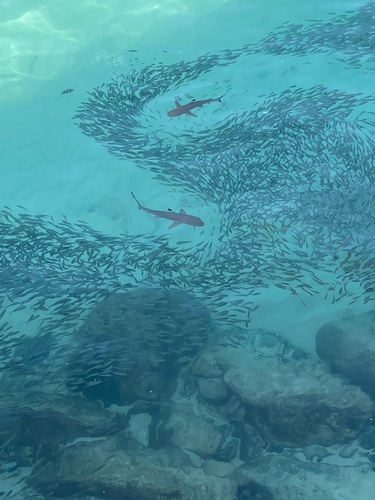
The hunting is the interesting part, and it is often a group effort. Blacktips have been watched since the 1950s driving schools of mullet ahead of them into the shallows and pinning them against a sandbar or a beach, thrashing half out of the water after fish trapped in a few centimetres. That only works if you are small enough to swim where the prey is hiding — the same advantage the newborns are using when they sit in 70 cm of water. A 2025 experiment at Mo’orea put physics behind it: in water that shallow a larger shark loses a great deal of its thrust to drag, while a 50 cm newborn barely notices.
Is it dangerous?
Blacktip reef sharks are not a serious danger to people, and the few bites there are follow one clear pattern. The International Shark Attack File’s species table lists 14 unprovoked bites and no fatalities; the Florida Museum’s own species profile gives 11 since 1959. When Randall and Helfman worked through ten documented cases in 1973, nine had happened in water less than waist-deep, every victim but one was wading, and the wounds were mostly to feet and ankles. The mechanism is not mysterious: a shark hunting small fish in ankle-deep water, in a family that investigates unfamiliar things with its mouth, will now and then close on a foot in murky shallows and let go again. Divers usually complain about the opposite problem — the species is famously nervous, hard to get near, and inclined to leave the moment a regulator hisses.
Measured the other way round the ledger is one-sided. Blacktip reef sharks are taken across the Indo-Pacific for meat, fins and liver oil, mostly in small coastal fisheries where nobody is counting, while the reef itself goes under to bleaching, coastal building and blast fishing. The 2020 Red List assessment suspects a 30–49% fall over three generations, about 44 years, and the Global FinPrint survey — 15,000 baited video drops on 371 reefs in 58 nations — found no sharks at all on roughly one reef in five. Protection is patchy but real: French Polynesia has banned shark fishing since 2006, and the whole requiem shark family went onto CITES Appendix II in November 2023. The one thing a visitor controls is whether they pay to have these sharks fed — and blood sampled from 117 adults at Mo’orea in 2025 found females at the tourist feeding sites running lower on glucose and, in the breeding season, lower on oestradiol than females elsewhere.
Blacktip reef shark facts
- Blacktip reef sharks hold some of the smallest home ranges measured in any shark. Acoustic tracking at Palmyra Atoll gave 0.55 ± 0.24 km² over days to weeks, with the same individuals returning to the same sand-flat ledges across a three-year study. — Papastamatiou et al. 2009, Marine Ecology Progress Series
- The reef-flat nursery newborns use at Mo’orea has a median depth of 0.74 m. That shallowness is the point: once the bottom is close relative to body depth, a larger shark loses much of its thrust to drag, so a newborn in knee-deep water is genuinely quicker than the thing chasing it. — Trujillo et al. 2025, Conservation Physiology
- Warm water makes those newborns harder to catch again. Across treatments from 25 to 31 °C, acceleration in an escape response rose by about 29%, turning rate by about 9%, and reaction time fell by nearly 48%. — Trujillo et al. 2025, Conservation Physiology
- At St Joseph Atoll in the Seychelles, 31 tracked blacktips could get onto the reef flats once the tide reached about 0.5 m, while the sicklefin lemon sharks sharing the atoll needed about 1.4 m. The two species overlapped only around 26% of the time. — Lea et al. 2020, Frontiers in Marine Science
- The oldest wild blacktip reef shark ever aged was 15, from vertebral band pairs validated by chemical marking in north-eastern Australia. The same study warns the method probably underestimates the biggest animals, and captive sharks have lived past 25. — Chin et al. 2013, Marine & Freshwater Research
- A 1973 review of ten attacks by this species found nine had happened in water less than waist-deep, all but one victim was wading, and eight of the ten occurred in the afternoon. The International Shark Attack File lists no fatal unprovoked bite by a blacktip reef shark. — Randall & Helfman 1973, Pacific Science / Florida Museum ISAF
- Blood sampled from 117 adult blacktip reef sharks around Mo’orea showed females at tourist feeding sites carrying lower glucose than females elsewhere, and lower 17β-oestradiol during the breeding season — evidence that hand-feeding is poorer nutrition than the reef. — Mills, Planes & Mourier 2025, Animal Conservation
- The name is a straight description: melanopterus is Greek for "black fin". The field mark is the first dorsal fin, whose black tip sits on a bright white band — the detail that separates it from the Atlantic blacktip shark, a bigger open-coast species it is constantly confused with. — ETYFish / FishBase and Florida Museum species profiles
Photos
Seen lately
PierMonkey’s live map carries community shark sightings from iNaturalist, refreshed every three hours. Open the map to see where blacktip reef sharks have turned up recently.
How big is that, really?
Maximum reliably recorded length. Rose marks the large or potentially dangerous species the map flags as notable.
Help protect it
- Global FinPrint — reef shark survey findingsThe largest reef shark survey ever run: 371 reefs in 58 nations, all filmed the same way. The interactive map lets you look up the country you are about to dive or surf in and see whether its reefs still have sharks — and which rules actually produced them.
- Reef Check — tropical coral reef monitoringTrains ordinary divers as volunteer reef surveyors and runs counts in more than 40 countries. The reef is what this shark actually needs, and a week of your next dive trip can add a real survey to the global record instead of just photographs.
- Shark Stewards — how to choose a shark tripA short checklist for picking an operator: no chum or excess bait, no touching, let the shark come to you. Given what the Mo’orea blood work found, this is the single most useful page here for anyone about to book a lagoon shark tour.
Report what you see
Photograph a shark, upload it, and once the community confirms the ID it becomes a research-grade record — which is where every sighting on our map comes from. Yours would appear here within three hours.
How to submit an observation →Organisations working on sharks like this one
- The Shark Trustgood for kidsReport eggcases and sightings, join campaigns, download free ID guides.
- Great Eggcase Huntgood for kidsWalk a beach, find a mermaid’s purse, log it. Over 630,000 eggcases recorded since 2003 — the easiest real science a family can do.
- Sharks4Kidsgood for kidsFree classroom lessons, virtual field trips and activity packs for teachers and parents.
- Save Our Seas FoundationFunds shark research and education worldwide; publishes what each project found.
- Shark StewardsCampaigns to end the shark fin trade and establish shark sanctuaries.
- OceanaPolicy campaigning on fisheries management and bycatch — the thing that actually kills sharks.
- IUCN Shark Specialist GroupThe scientists behind the Red List assessments. For older readers who want the primary source.
Conservation status: Vulnerable (IUCN Red List, assessed 2020). Assessed Vulnerable on 15 July 2020 under criterion A2bcd, population trend decreasing. A reduction of 30–49% is suspected over three generation lengths — about 44 years — driven by coastal and reef fisheries and by the loss of the shallow coral, seagrass and mangrove habitat the species never leaves. Australia assesses its own population separately as Least Concern, because marine parks cover so much of the habitat there. The change is recent enough that good reference pages — the Florida Museum’s species profile among them — still carry the older Near Threatened listing. Read the assessment →
Common questions
How big do blacktip reef sharks get?▾
Why do blacktip reef sharks swim in water too shallow to cover them?▾
Why do the few blacktip reef shark bites nearly all happen to waders?▾
How do you tell a blacktip reef shark from a blacktip shark?▾
Should I go on a trip that feeds blacktip reef sharks?▾
If you see them everywhere, why are blacktip reef sharks Vulnerable?▾
Keep exploring
- Teahupo’o, Tahiti — live surf conditions
- Pasta Point, Maldives — live surf conditions
- Cloudbreak, Fiji — live surf conditions
- Uluwatu, Bali — live surf conditions
- All 40 species →
Sightings © iNaturalist contributors (research-grade observations). Occurrence maps © GBIF.org contributors (CC BY). Community science, not a beach-safety service. Last updated 2026-09-20.
See where sharks are turning up — on the live map
The map and live conditions are open to everyone. A free account unlocks full 16-day forecasts and custom swell alerts.