
Basking shark
The second-largest fish alive, and it lives entirely on plankton strained out of the sea.
Vital statistics
Live birth after an estimated 2–3 years, the longest gestation suspected in any shark. The only pregnant female ever examined carried six pups, each about 1.5–2 m long.
The short version
The basking shark is the second-largest fish alive, after the whale shark. Most adults are 6–9 metres long and weigh a few tonnes; the largest ever measured was 12.27 m, caught in a herring net in the Bay of Fundy in 1851, and big modern animals reach about 7 tonnes. Despite the size it is a filter feeder: it swims with its mouth open and strains zooplankton out of the water with bristle-like gill rakers, processing somewhere between 1.5 and 2 million litres an hour.
It lives in cool temperate seas in both hemispheres, feeding at the surface within sight of land from roughly April to October — which is why Cornwall, the west of Ireland and the Hebrides are where people actually see them — and spending the rest of the year deep and offshore. Satellite and archival tags have tracked individuals across the Atlantic, across the equator and down past 1,200 metres. They do not hibernate on the seabed, whatever older books say.
The IUCN lists the basking shark as Endangered, on a suspected global decline of 50–79% over three generations. Hunted for liver oil for centuries and now protected across much of its range, it is recovering slowly if at all, because a shark with a gestation of two to three years and a generation length of about thirty years cannot replace itself quickly. It is completely harmless to people.
Where it lives
Basking sharks live in cool temperate water worldwide, and FishBase puts the outer limits of the range at about 75° N to 58° S. They are animals of continental shelves and shelf edges, and they prefer water somewhere around 8–16 °C, which is why they are a familiar sight off Scotland and almost unknown in the tropics at the surface. What people see is only the summer half of the year: from roughly April to October they feed at the surface within sight of land, and for the rest of the year they are deeper, further out, and effectively invisible.
The northeast Atlantic is both the stronghold and the best-watched part of the range. Southwest England, the west and north coasts of Ireland, the Isle of Man, the Hebrides and the Norwegian coast all get them, and the sightings roll northward through the summer as the plankton bloom does. The northwest Atlantic has its own population off New England and Atlantic Canada, where Fisheries and Oceans Canada records them inshore from about May to September.
The Pacific tells a bleaker story. Schools of hundreds were ordinary off California and British Columbia in the middle of the twentieth century; after decades of fishing and deliberate culling the eastern Pacific population is estimated to have fallen by as much as 90%, and a sighting now is news. Smaller numbers turn up in the Mediterranean, around New Zealand and southern Australia, off South Africa, and off Brazil and Argentina, but the southern hemisphere records are thin.


- Sea of the Hebrides, Scotland — Coll, Tiree and the west coasts of Mull and Skye. Designated in December 2020 as the world’s first Marine Protected Area for basking sharks, and the largest protected area for any shark in the northeast Atlantic.
- Malin Head & the west coast of Ireland — One of the most dependable summer aggregations in Europe, and where the breaching study was filmed. Ireland gave the species full legal protection in 2022.
- Cornwall & the Isles of Scilly — England’s main sightings hotspot, busiest in late spring and early summer. Most of the UK public sighting records come from this coast.
- Cape Cod & the Gulf of Maine — The western Atlantic summer feeding ground. Sharks tagged here turned out to be the ones crossing the equator in winter.
- Monterey Bay & southern California — Historic, not current. Surface schools of hundreds were routine before the 1950s; today a single animal is a rare record.
Where it goes
For fifty years the textbook answer to “where do they go in winter?” was that they hibernate. Parker and Boeseman noticed in 1954 that basking sharks shed their gill rakers in autumn — losing the only apparatus they have for feeding — and reasoned that the animal must spend the cold months lying dormant on the seabed while new rakers grow. It was a sensible idea and it was wrong. When David Sims and colleagues put archival tags on them and read the data back in 2003, the sharks had stayed active all winter, moving long distances and diving repeatedly to between 750 and 1,000 metres. They had not stopped. They had gone deep and offshore, where nobody was looking.
Once tags could follow them, the distances turned out to be enormous. A female tagged off the Isle of Man had her tag surface off Newfoundland, having covered 9,589 km and dived to 1,264 m on the way — the first hard evidence linking European and North American basking sharks. Sharks tagged off southern New England went the other way, south past the Bahamas and the Caribbean to the coast of South America and across the equator, sitting for weeks or months at mesopelagic depths in water far too warm for them at the surface. That matters for more than curiosity: if the sharks off Cornwall, Norway and Cape Cod are one connected population, protecting them in one country’s waters is only ever part of the job.
Share of verified basking shark records by month (GBIF, all years). Darker rose means a larger share of sightings fall in that month. This reflects when people record them, which mixes real seasonality with when divers and boats are out.
British Isles & Ireland: The Shark Trust’s recording season runs April to October, with most sightings between May and October. Surface sightings in winter are rare anywhere in the British Isles.
What it eats
A basking shark eats nothing larger than a grain of rice. Its food is zooplankton — mostly small copepods, plus fish eggs and larvae and the drifting larval stages of crabs and barnacles — and the method is to swim slowly with a mouth over a metre wide held open. Water goes in at the front and out through five gill slits so long they almost meet around the throat, and on the way past it crosses rows of bristle-like gill rakers that comb the plankton out. The Florida Museum puts the throughput at up to 2,000 tons of water an hour; the New England Basking Shark and Ocean Sunfish Project gives about 1.5 million litres an hour. Either way it is a swimming pool every few minutes. The shark does have teeth — hundreds of them, each a few millimetres long — but they play no part in feeding at all.
None of this is lazy grazing. Plankton is patchy and thin, and a shark this size only breaks even in water rich enough to pay for the swimming, so foraging research describes it as living on an energetic knife-edge. Basking sharks work thermal and tidal fronts, the seams where currents meet and plankton piles up, and they leave as soon as the density drops below what is worth filtering. That is the real reason they show up off the same headlands in the same few weeks every year — those are the places the food reliably collects.
Is it dangerous?
A basking shark is harmless. It has no interest in anything bigger than a copepod, its teeth are too small to matter, and the International Shark Attack File holds no record of an unprovoked attack by one. The Florida Museum describes them as tolerant of divers and boats. The only real cautions run the other way and are about not causing harm: their skin is covered in coarse denticles that can graze a swimmer who touches them, a startled several-tonne animal is a hazard to a small boat that crowded it, and deliberately disturbing one is a criminal offence in UK waters.
The risk we pose to them is the whole story. For centuries basking sharks were hunted for the oil in their vast liver, first for lamps and then for machinery, and later for their fins. The Achill Island fishery in County Mayo took around 9,000 sharks between 1950 and 1964 and then collapsed because there were no sharks left to take; Norway landed over 4,000 in a good year into the 1980s. In British Columbia they were treated as a nuisance and deliberately eradicated: from 1955 to 1969 a fisheries patrol vessel with a blade fitted to its bow killed 413 in Barkley Sound alone. Directed fishing has now largely stopped — they are protected in UK waters under the Wildlife and Countryside Act, in Ireland under the Wildlife Act since 2022, and EU vessels may not target, retain or land them — but they are still drowned in nets, struck by ships while feeding at the surface, and pushed off their food by boat and drone traffic. With a gestation measured in years and a generation length of roughly three decades, a population that was fished out in fifteen years takes far longer than that to come back.
Basking shark facts
- A feeding basking shark strains up to 2,000 tons of water an hour through its gill rakers — around 1.5 million litres — to collect plankton it could not otherwise catch. — Florida Museum ISAF
- It has hundreds of tiny teeth and uses none of them to eat. The teeth are a few millimetres long; all the feeding is done by bristle-like gill rakers behind the mouth. — Florida Museum ISAF
- They breach. An 8 m, 2.7-tonne shark was recorded accelerating from 28 m down and leaving the water at about 5 m/s — the same vertical speed as a breaching great white. — Johnston et al. 2018, Biology Letters
- The old idea that they hibernate on the seabed all winter came from their habit of shedding their gill rakers in autumn. Archival tags later showed them still swimming through winter and diving to 750–1,000 m. — Sims et al. 2003, Marine Ecology Progress Series
- A female tagged off the Isle of Man was tracked 9,589 km to Newfoundland, diving to 1,264 m on the way — the first proof that European and North American basking sharks meet. — Gore et al. 2008, Biology Letters
- Sharks tagged off New England crossed the equator to South America, spending weeks to months at mesopelagic depths where the surface water is far too warm for them. — Skomal et al. 2009, Current Biology
- Only one pregnant basking shark has ever been examined — landed in Norway in 1943, carrying six pups. Gestation is still only estimated, at two to three years. — The Shark Trust
- The Achill Island fishery in County Mayo landed around 9,000 basking sharks between 1950 and 1964 for their liver oil, and the local population has never returned to what it was. — Irish Basking Shark Group
Photos
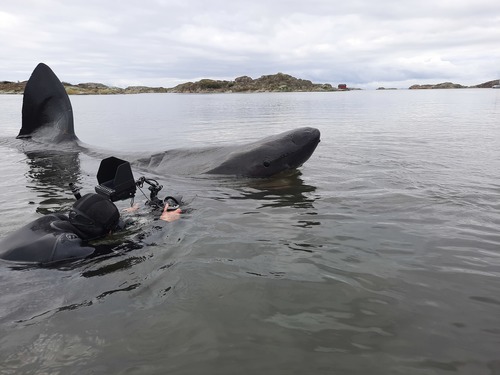
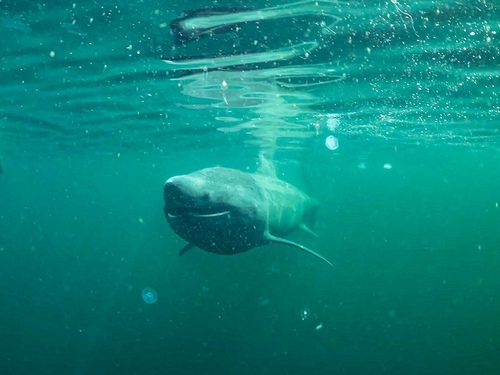
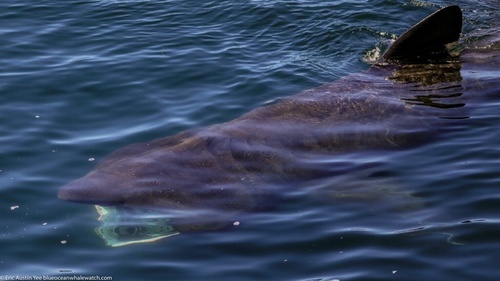
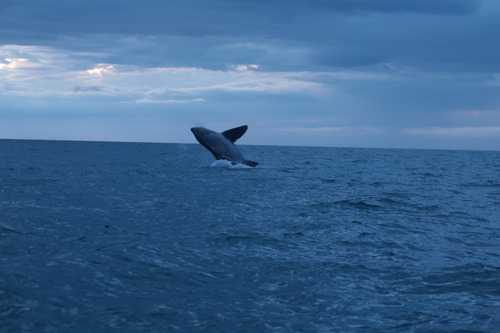
Seen lately
PierMonkey’s live map carries community shark sightings from iNaturalist, refreshed every three hours. Open the map to see where basking sharks have turned up recently.
How big is that, really?
Maximum reliably recorded length. Rose marks the large or potentially dangerous species the map flags as notable.
Help protect it
- Shark Trust Basking Shark ProjectLog any sighting on the recording hub or the free Shark Trust app. A sharp photo of the dorsal fin is the valuable bit — the nicks and markings identify individuals, which is how researchers count them.
- Irish Basking Shark GroupReport Irish sightings straight to the group that runs the national database. Their evidence is what won the species full protection under Ireland’s Wildlife Act in 2022.
- Basking Shark Code of ConductRead this before you go looking. It sets out how to approach one from a boat, kayak or board without driving it off its food — and deliberate disturbance is a criminal offence in UK waters.
Report what you see
Photograph a shark, upload it, and once the community confirms the ID it becomes a research-grade record — which is where every sighting on our map comes from. Yours would appear here within three hours.
How to submit an observation →Organisations working on sharks like this one
- The Shark Trustgood for kidsReport eggcases and sightings, join campaigns, download free ID guides.
- Great Eggcase Huntgood for kidsWalk a beach, find a mermaid’s purse, log it. Over 630,000 eggcases recorded since 2003 — the easiest real science a family can do.
- Sharks4Kidsgood for kidsFree classroom lessons, virtual field trips and activity packs for teachers and parents.
- Save Our Seas FoundationFunds shark research and education worldwide; publishes what each project found.
- Shark StewardsCampaigns to end the shark fin trade and establish shark sanctuaries.
- OceanaPolicy campaigning on fisheries management and bycatch — the thing that actually kills sharks.
- IUCN Shark Specialist GroupThe scientists behind the Red List assessments. For older readers who want the primary source.
Conservation status: Endangered (IUCN Red List, assessed 2018). Reassessed in 2018 and published as Endangered, on a suspected global population reduction of 50–79% over three generations — about 102 years. Listed on CITES Appendix II and on Appendices I and II of the Convention on Migratory Species, and fully protected in UK and Irish waters. Read the assessment →
Common questions
How big do basking sharks get?▾
Are basking sharks dangerous to humans?▾
What do basking sharks eat?▾
Why are they called basking sharks?▾
When and where can I see a basking shark in the UK or Ireland?▾
Why have basking sharks not recovered?▾
Keep exploring
- Fistral Beach, Cornwall — live surf conditions
- Mullaghmore Head, Ireland — live surf conditions
- Thurso East, Scotland — live surf conditions
- All 40 species →
Sightings © iNaturalist contributors (research-grade observations). Occurrence maps © GBIF.org contributors (CC BY). Community science, not a beach-safety service. Last updated 2026-09-20.
See where sharks are turning up — on the live map
The map and live conditions are open to everyone. A free account unlocks full 16-day forecasts and custom swell alerts.