
Atlantic sharpnose shark
The shark most American beach and pier anglers have already caught without ever learning its name — a metre-long requiem shark with a pointed nose, and one of the very few whose numbers are going up.
Vital statistics
Live birth through a true placenta after 10–11 months, then straight back into pregnancy: females breed every year. Broods average about 4.5 embryos, range 1–9, and pups are born at roughly 29–37 cm, with peak pupping in late May and early June.
The short version
The Atlantic sharpnose shark is a small requiem shark of the southeastern United States and the Gulf of Mexico. Adults run 80–100 cm and a big one is about 110 cm and 7 kg — small enough to lift in one hand. It lives in the surf zone, in bays, harbours and estuaries, usually in under 10 m of water, and it is extremely common: five years of longline sampling off Cape Canaveral caught 2,595 sharks, and 1,436 of them, 55%, were this one species. If you have ever pulled a small grey shark off a Florida pier or a Carolina beach, this is the likeliest animal on the line — and it is harmless. No sharpnose shark appears in the International Shark Attack File’s list of species confirmed in unprovoked bites.
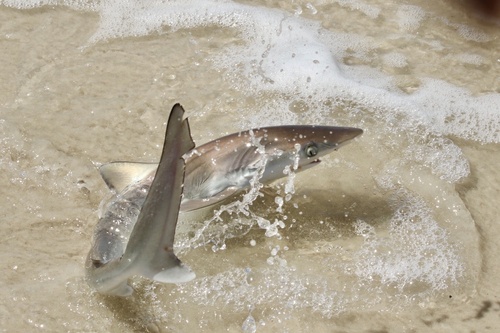
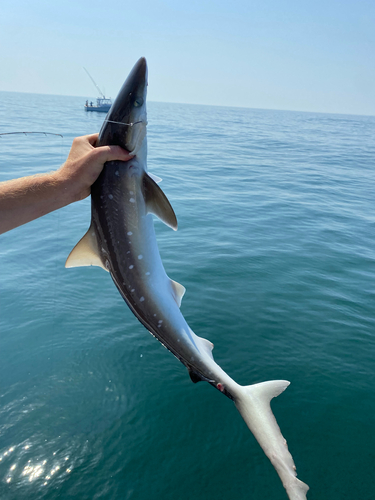
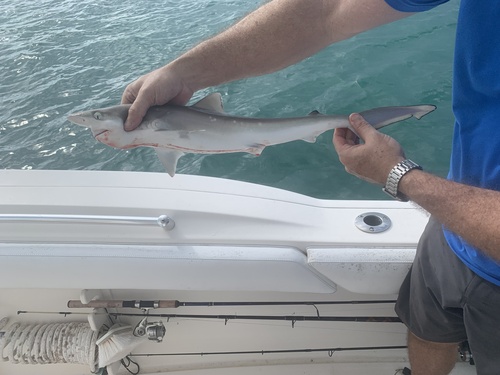
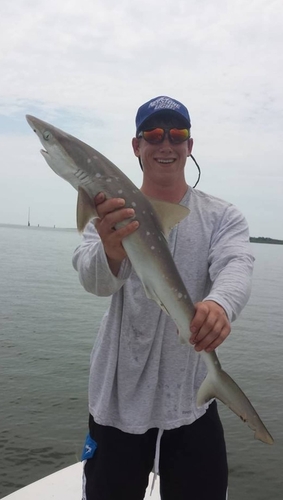
The name is the field mark. The snout is long and sharply pointed, longer than the mouth is wide, and long grooves called labial furrows run back from the corners of the mouth — no blacktip or spinner shark has those. Adults carry scattered white spots, and the second dorsal fin begins over or behind the middle of the anal fin rather than in front of it. The confusion comes from young ones, whose dorsal and tail fins are edged in black, and which get called baby blacktips on every beach they are caught on.
It is also the best news in this library. Most sharks live slowly — late to breed, small litters, long lives — so fishing empties a population faster than it can refill. The sharpnose does the opposite: mature at two to three years old, a litter of four or five pups every single year, and a life of roughly 18 years. The IUCN listed it Least Concern in 2021 with the population estimated to be rising about 1.1% a year, and both US stocks have been assessed as not overfished. The speed a shark lives at is most of the difference between one that recovers and one that does not.
Where it lives
The Atlantic sharpnose is a shark of the warm western Atlantic and of shallow water. Its range runs from New Brunswick in Canada down the United States seaboard, around the whole Gulf of Mexico to the Yucatán, and NOAA Fisheries says it is commonly caught from Virginia to Texas. The northern half of that line is thin: the 2021 Red List assessment notes it rarely occurs north of North Carolina, which makes the scientific name a quiet joke. Terraenovae means "of Newfoundland", after the specimen John Richardson described in 1836 — the outer edge of anywhere this shark has been seen.
Vertically it lives in a narrow band. FishBase gives 0–280 m but adds "usually 0–10 m", and NOAA says the same in feet: normally less than 32 ft of water, occasionally as deep as 920. In practice that means surf zones, sand shoals, harbours, bays and tidal estuaries — the water a pier reaches into. It handles brackish water happily, but unlike the bull shark it does not push up rivers into fresh water. FishBase and shark-references both add a southwest Atlantic arm along Brazil, but the Red List range stops at the Yucatán and sharks caught that far south are usually referred to the Caribbean and Brazilian sharpnose instead.
What earns it a page is how many there are. Off Cape Canaveral, five years of longline sampling on the sand shoals caught 2,595 sharks of 16 species, and 1,436 of them — 55% — were Atlantic sharpnose. In the north-central Gulf of Mexico the research literature simply calls it the most common small coastal requiem shark there is. No large shark on this coast comes close, which is exactly why so many people have caught one without ever learning what it was.


- Mississippi Sound & the Alabama coast — The species’ research heartland. The monthly sampling that mapped its seasonal movements ran between St Louis Bay, Mississippi and Perdido Bay, Alabama and handled 1,344 sharpnose in three years, and the north-central Gulf is where the reproductive and tooth work has been done too.
- Canaveral Shoals, east Florida — A shallow shoal complex where sharpnose made up 55% of every shark caught across five years of longlining — mean length 85 cm, 84% of them adults, and males outnumbering females three to one.
- Onslow Bay, North Carolina — The clearest picture of how seasonal this shark is. Five years of trawls caught 828 sharpnose: 660 in summer and none at all in the winter quarter. Newborns down to 188 mm fork length say pupping happens nearby.
- Chesapeake Bay & the Virginia coast — The northern working edge of the range. The Virginia Institute of Marine Science describes the pattern in five words — inshore in summer, offshore in winter — and in winter this coast simply has none.
- Campeche Bank, southern Gulf of Mexico — The far end of the range, and the one place the species is a directed food fishery rather than bycatch. The Mexican fishery on this shelf is where the first demographic work outside US waters was done.
Where it goes
The Atlantic sharpnose does not make one long journey; it shuttles. The Virginia Institute of Marine Science puts it in five words — inshore in summer, offshore in winter — and survey data show how absolute that can be. Of 828 sharpnose caught in five years of nearshore trawling off North Carolina, 660 came in summer and not one in the winter quarter, at water temperatures of 15.2 to 29.3 °C. Further south at Cape Canaveral it is again a warm-season fish on the shoals, and most sharpnose fitted with acoustic tags there ran north in spring and came back in autumn. What reads like migration is really a small shark holding station on a temperature while the temperature moves up and down the coast.
The sexes often do not travel together. In the north-central Gulf of Mexico, adult males crowd the inshore water behind the barrier islands in spring and autumn while females are offshore, and the researchers who documented that suspected the males leave for deeper water in summer to mate. The female calendar is set by pregnancy: gestation runs 10–11 months, so a female carries a litter almost all the time. She moves into shallow water to give birth, peaking in late May and early June, and is pregnant again within weeks. Newborns turn up in nearshore trawls at under 19 cm, which is how a summer beach in the Carolinas can be a shark nursery without anybody noticing.
Share of verified atlantic sharpnose shark records by month (GBIF, all years). Darker rose means a larger share of sightings fall in that month. This reflects when people record them, which mixes real seasonality with when divers and boats are out.
Onslow Bay, North Carolina: Built from the seasonal catch in five years of nearshore trawls off North Carolina — 0 sharpnose in winter (January–March), 133 in spring (April–June), 660 in summer (July–September) and 35 in autumn (October–December). The survey reported whole seasons rather than months, so months inside each one are graded by how the water warms and cools: spring weighted to its end, autumn to its start. A 0 means gone from this stretch of coast, not gone from the world — in January those sharks are in warmer, deeper water offshore and further south.
What it eats
It eats whatever small thing the shallows are full of: menhaden, eels, silversides, wrasses, jacks, toadfish and filefish, plus shrimp, crabs, marine worms and molluscs. FishBase puts it at trophic level 4.4, which is genuinely high — this is a predator, not a picker of scraps — but a predator of things a few centimetres long. The diet shifts as it grows: in the northern Gulf of Mexico, young-of-the-year feed mostly on shrimp, other crustaceans and squid, and reliance on fish, mainly drums and herrings, climbs with size. Males switch earlier. At 50–60 cm long, fish made up 35.2% of what males had eaten against 14.3% for females the same size, which fits the two sexes using different water.
The teeth follow the food, and serrations appear on them as the shark starts taking larger fish. What is not ordinary is what mature males do in the breeding season. A 2023 study of 126 jaw sets from the northern Gulf found that males over about 82 cm grow narrow, needle-like teeth at the front of the lower jaw from roughly April to September, then replace them with normal cutting teeth. Those teeth grip rather than cut: they are for holding a female during mating, and the authors suspect they make a male slightly worse at eating big fish while he has them. Two earlier authorities had stated flatly that this species did not do this at all.
Is it dangerous?
There is no danger here worth the name. The Florida Museum’s International Shark Attack File keeps a table of species confirmed in unprovoked bites, and no sharpnose shark of any kind appears on it. The animal is a metre long at the outside, its mouth is small, and a wading swimmer is of no interest to it. The one place it meets people is on the end of a line, and it meets a great many there, because from the Carolinas round to Texas it is the shark anglers catch most. A hooked one twists hard, so keep fingers clear of the mouth, keep the shark and its gills in the water, and carry cutters for a deeply hooked fish.
Now the part that makes this page different from most of the library. The sharks here are mostly in trouble; this one is not. The IUCN assessed it Least Concern in 2021 with an estimated 1.1% annual increase over three generations, and NOAA’s 2013 assessments found neither the Atlantic nor the Gulf of Mexico stock overfished — despite being landed under the mixed small coastal shark quota, eaten, used as bait and caught in enormous numbers as bycatch by shrimp trawls and gillnets. The reason is arithmetic. It matures at two to three years old, has a litter every year, and is old at 18, where a sandbar shark breeds at best every second year and a Greenland shark measures its life in centuries. A fast, short life rebuilds a population about as quickly as fishing knocks it down. That is not a licence: a 1995 demographic analysis of the Gulf population put the rate of population change between −0.029 and +0.044 a year depending on how many pups survive their first year, and concluded the federal shark plan of the day rested on unrealistic biology. Productive by shark standards is still slow by fish standards — and the bonnethead, also small and abundant and familiar, is assessed as Endangered.
Atlantic sharpnose shark facts
- It is the shark you are most likely to catch on the US southeast coast. Five years of longline sampling on the Canaveral Shoals in Florida recorded 2,595 sharks from 16 species; Atlantic sharpnose alone accounted for 1,436 of them, or 55%, at a mean length of 85 cm and with 84% of the catch adult. — Reyier et al. 2023, PLOS ONE
- It vanishes in winter. In five years of nearshore trawling off North Carolina, 828 Atlantic sharpnose were caught — 660 in summer, 133 in spring, 35 in autumn and zero between January and March — at water temperatures of 15.2 to 29.3 °C. The smallest were 188 mm fork length, so those beaches are a nursery as well as a feeding ground. — Roskar, Morley et al. 2024, PLOS ONE
- Its known lifespan has nearly doubled. Vertebral band counts gave maximum ages of 10–11 years, and FishBase still carries 10. Then five sharpnose tagged off South Carolina were recaptured after 7.7 to 14.0 years at liberty, giving ages up to 19.8 years, with one vertebral section read at 18.5. NOAA Fisheries now says up to 18 years. — Frazier, Driggers & Ulrich 2015, F1000Research; Loefer & Sedberry 2003, Fishery Bulletin 101
- It breeds every single year, which very few sharks do. Gestation runs 10–11 months, broods average 4.5 ± 0.1 embryos (range 1–9), pups are about 329 mm at birth, and peak pupping is late May and early June. Ovulating females were found from March to October, so the season is longer than was once thought. — Hoffmayer et al. 2013, Marine and Coastal Fisheries 5
- Mature males grow breeding teeth. In 126 jaw sets from the northern Gulf of Mexico, 15 of the 16 males over 815 mm carried narrow, needle-like teeth in the lower front jaw between about April and September — a gripping tooth for holding a female during mating, replaced by ordinary cutting teeth out of season. Two earlier authorities had said this species lacked the trait entirely. — Ebersole, Kelosky, Huerta-Beltrán, Cicimurri & Drymon 2023, PeerJ
- It can change its own life history. Atlantic sharpnose sampled in the Gulf of Mexico from 1998 to 2001 were maturing at smaller sizes and younger ages than sharks measured there 20 years earlier — evidence of density-dependent growth and maturity, the flexibility that lets a heavily fished population answer back. — Carlson & Baremore 2003, Marine and Freshwater Research 54
- The 2021 Red List assessment found the population rising. Combining the available survey time series in a global model gave an estimated annual increase of 1.1% across three generation lengths, taken as 30 years, which is why it is listed Least Concern. NOAA’s 2013 assessments likewise found neither US stock overfished nor subject to overfishing. — IUCN Red List 2021 (e.T39382A124408927); NOAA Fisheries species directory
- It is named after a place it almost never reaches. Richardson described it in 1836 from a Newfoundland specimen as Squalus terraenovae — "of Newfoundland" — and the common name Newfoundland shark followed. The Red List assessment notes the species rarely occurs north of North Carolina. — Eschmeyer’s Catalog of Fishes (type locality); Florida Museum; IUCN Red List 2021
Photos
Seen lately
PierMonkey’s live map carries community shark sightings from iNaturalist, refreshed every three hours. Open the map to see where atlantic sharpnose sharks have turned up recently.
How big is that, really?
Maximum reliably recorded length. Rose marks the large or potentially dangerous species the map flags as notable.
Help protect it
- NOAA Cooperative Shark Tagging ProgramAsk NOAA for tags, tag the sharks you catch and release, and report the ones you recapture. Volunteer anglers have tagged more than 295,000 sharks since 1962, and it is recaptures like those — a sharpnose back on a line 14 years after it was tagged — that rewrote how long this species is known to live.
- NOAA Fisheries — Atlantic sharpnose sharkThe official US management page: current recreational and commercial limits, the small coastal shark complex this species is landed under, and the 2013 stock assessments that found the Atlantic and Gulf stocks healthy. Worth checking before you keep one, because the rules change more often than the shark does.
- Florida FWC — shark fishing rules and shore-based permitAtlantic sharpnose is one of the few sharks Florida lets you keep — one per person per day, two per vessel, no minimum size — and it is the species most often taken under that rule. The same page carries the free online course and annual permit required for shore-based shark fishing, and the gear rules that decide whether a released shark swims away.
Report what you see
Photograph a shark, upload it, and once the community confirms the ID it becomes a research-grade record — which is where every sighting on our map comes from. Yours would appear here within three hours.
How to submit an observation →Organisations working on sharks like this one
- The Shark Trustgood for kidsReport eggcases and sightings, join campaigns, download free ID guides.
- Great Eggcase Huntgood for kidsWalk a beach, find a mermaid’s purse, log it. Over 630,000 eggcases recorded since 2003 — the easiest real science a family can do.
- Sharks4Kidsgood for kidsFree classroom lessons, virtual field trips and activity packs for teachers and parents.
- Save Our Seas FoundationFunds shark research and education worldwide; publishes what each project found.
- Shark StewardsCampaigns to end the shark fin trade and establish shark sanctuaries.
- OceanaPolicy campaigning on fisheries management and bycatch — the thing that actually kills sharks.
- IUCN Shark Specialist GroupThe scientists behind the Red List assessments. For older readers who want the primary source.
Conservation status: Least Concern (IUCN Red List, assessed 2021). Least Concern in the 2021 Red List (e.T39382A124408927, DOI 10.2305/IUCN.UK.2021-1.RLTS.T39382A124408927.en); FishBase records the assessment date as 20 June 2019. The assessment found no evidence of decline: combining the available survey time series in a global model gave an estimated annual increase of 1.1% and a rising population over the past three generation lengths, which it takes as 30 years. That is an unusual sentence to be able to write about a requiem shark, and the reason it can be written is life-history speed rather than protection. Read the assessment →
Common questions
How do I tell an Atlantic sharpnose from a young blacktip or spinner shark?▾
Is an Atlantic sharpnose shark dangerous to swimmers or surfers?▾
When are Atlantic sharpnose sharks around, and where do they go in winter?▾
How long does an Atlantic sharpnose shark live?▾
Why is this shark doing well when so many other sharks are not?▾
Can I keep an Atlantic sharpnose shark I catch?▾
Keep exploring
- New Smyrna Beach, Florida — live surf conditions
- Cocoa Beach, Florida — live surf conditions
- Sebastian Inlet, Florida — live surf conditions
- Cape Hatteras, North Carolina — live surf conditions
- Virginia Beach, Virginia — live surf conditions
- All 40 species →
Sightings © iNaturalist contributors (research-grade observations). Occurrence maps © GBIF.org contributors (CC BY). Community science, not a beach-safety service. Last updated 2026-09-20.
See where sharks are turning up — on the live map
The map and live conditions are open to everyone. A free account unlocks full 16-day forecasts and custom swell alerts.